10 Unmissable Films Based On Non-Fiction

Who needs fiction when you have stories like these?

Horror films (they're the biggest offenders) and film studios by association are giving the 'based on a true story' moniker a very, very bad public perception. Whenever an audience sees that title flash up on a cinema or television screen, the response is one of either mild eye-rolling or total snorts of disbelief. The first thing many movie-goers will do after seeing such a film will be to immediately whip out their phone, look up the story that supposedly 'inspired' the film and quickly discover that it's so loosely based on what it claims to be its source material that it would be akin to saying Star Wars is based on the true story of the moon landings. Thankfully, accurate representation of source material still exists in film, you just have to look harder to find out that which ones are. The following list is truly proof that the real lives of certain individuals can be infinitely more interesting that anything fictional, and while certain events can be exaggerated even for films such as these, the stories they tell are by and large, very real events. From war and tragedy to crime and heart-warming tales of the human spirit, there's really no shortage of factual stories to tell in feature film form. Documentaries may be all about objective discussion and informative displays, but the following manage all of that and more. Read on to discover (or re-discover) some of cinemas greatest non-fiction stories.

10. Goodfellas

Based on: Nicholas Pileggi's Wiseguy (1986) When a film revolves around the Italian American mob and its daily flaunting of societal laws, one would think that the person such a film is based on would be rather reluctant to have their entire criminal life played out on-screen for all to see. Henry Hill though, never seemed to be too bothered about letting people know how deplorable he was as a young man in the '60s, '70s and '80s, even giving Martin Scorsese and Nicholas Pileggi an encouraging thumbs up after seeing the film, stating that they got as close to the truth as was possible. The law eventually caught up with Hill, and, after one incident post being placed into a witness protection program, the mob associate renounced his life of crime entirely, opting instead to write his own series of cookbooks. Hill passed away in 2012.

9. Casino

Based on: Nicholas Pileggi's Casino (1995) In much the same way as Goodfellas before it, Casino is another film collaboration between Scorsese and Pileggi, and one that also details the life of a career criminal: Frank Rosenthal (renamed as Sam "Ace" Rothstein in the film). Unlike Scorsese's earlier gangster film though, Casino was a much more glamorous and indulgent affair, detailing the life of Rosenthal (De Niro) as he rose up to a position of prominence as the manager of a mob-run casino. If Scorsese's gangster films ever teach you anything, it's that the 'crime never pays' motto has a lot more truth to it than one might think. Casino never did receive the same amount of critical success as Goodfellas (largely due to critics believing the film had a bloated running time), but there's no denying that it is another fantastic insight into the world of organised crime.

8. The Theory Of Everything

Based on: Jane Wilde Hawking's Travelling To Infinity: My Life With Stephen (2008) Stephen Hawking is known for two things above all else: for being one of the most intelligent, living people in human history and for being a sufferer of the crippling affliction that is motor neurone disease. Due to the early onset of the disease for Hawking and his not becoming world renowned until he was already in the later stages of the illness, there's only a small group of people that remember the man before he became wheelchair-bound. The Theory Of Everything exists thanks to the accounts of Hawking's ex-wife Jane and how she coped with mothering three children while also caring for her disabled husband. Not only does the film give audiences a rare glimpse of Hawking's life before being diagnosed with MND, it also serves to show just how extraordinary Hawking's life has been and how he was able to overcome his body's continued deterioration through mental strength and the support of loved ones.

7. Bully

Based on: Jim Shutze's Bully: A True Story Of High School Revenge (2002) Bully is a rare example of an American film where nobody comes out as a winner, there's no happy ending, and nothing is really resolved. Based directly on the 1993 murder of Bobby Kent, Bully tells the story of a murder plot conceived by a group of friends to kill Kent, the best friend of one of the killers and a serial abuser of several of the conspirators, and the subsequent admittance and sentencing of all those involved in the murder. While the film received mixed reviews from critics upon its release, it was praised for its uncompromising portrayal of those involved in the murder, it's sombre tone and refusal to sugar-coat any of the events. Above all else, Bully is both a tragic tale of a group of young adults who threw away their lives and a justice system that (rightly) had no choice but to prosecute young adults for taking the law into their own hands and taking the life of someone who committed terrible crimes against them.

6. Black Hawk Down

Based on: Mark Bowden's Black Hawk Down: A Story Of Modern War(1999) Frequently cited as being both an anti- and pro-war film in equal measure, Ridley Scott's war film is one that is known for its uncompromising look at war and its refusal to rely on established motifs found in the genre. Its realistic depiction of certain concepts in relation to war no doubt have its inspiration partly to thank. Based on the events chronicled by Mark Bowden of the 1993 U.S. military's attempt to capture Mohamed Farrah Aidid in a raid on Mogadishu, Black Hawk Down takes a candid look at an American military operation that ultimately ended in failure and resulted in embarrassment for senior military officials due to the loss of life. Received with more positivity in its native country, Black Hawk Down was subject to a large amount of criticism by foreign critics for glorifying war through its sensational display of certain scenes within it.

5. Full Metal Jacket

Based on: Gustav Hasford's The Short-Timers (1979) Another war film, this time set around the time of the Vietnam War, details the life of James T. "Joker" Davis and his experiences in the marine corps, eventually becoming a military correspondent and documenting the horrifying result of war. Stanley Kubrick's critically acclaimed film is based on the semi-autobiographical book written by Gustav Hasford about his own experiences in the U.S. army during the Vietnam war, and it details the tragedies of such conflicts in various scenarios. The film is probably most fondly remembered by many for the stellar performance from R. Lee Ermy as Gunnery Sergeant Hartman and his extensive list of quotable dialogue large enough to rival James Cameron's Aliens. Aside from that though, Full Metal Jacket is an unflinching feature film that explores the intense amount of pressure that marines were put under in the 60s and 70s both on and off the battlefield.

4. Evil

Based on: Jan Guillou's Ondskan (1981) If you haven't heard of or seen Evil then don't be surprised, the film is Swedish, and with no English language remake in sight, it's probably going to remain a niche piece of cinema that many haven't seen. There's no reason why you can't find yourself a copy and watch it now though, and you should, because Evil is an excellent story of corruption, violence and perseverance. Based on the autobiographical book of the same name, Evil details the life of Erik Ponti (the alter ego of Guillou himself), a young man habitually beaten by his stepfather on a daily basis who is sent to a boarding school by his mother in an effort to give him a fresh start away from violence. Resolved to do away with the violent nature 'inherited' from his stepfather upon starting his new school, Erik finds himself enrolled in an institution that's physically and psychologically tormented by its senior students. With little choice than to fight fire with fire, Erik has to resort to his former tendencies to free his classmates from the scandalous nature of how the school is run.

3. Moneyball

Based On: Michael Lewis' Moneyball: The Art of Winning An Unfair Game (2003) A film about the intricacies of baseball should, by the game's very nature, should never have been very interesting (sorry, baseball fans), but stellar performances from Brad Pitt and Jonah Hill ensured from the very beginning that Moneyball would be a hit with critics, with the pair injecting a funny and humorous personality into the film. Based on Michael Lewis' book of the same name, Moneyball charts the rise of sabermetric analysis and its far greater accuracy in scouting for suitable players to make up a baseball team. While that may sound unbearably dull as a concept for a film, Moneyball does a great job of appealing to a wider audiences by setting the central story against the backdrop of Oakland Athletics - a baseball team that is in dire straights due to many of its star players leaving and the club's poor financial situation. Even if you're not a baseball fan, Moneyball is definitely worth the watch.

2. Apollo 13

Based on: Jim Lovell and Jeffrey Kluger's Lost Moon: The Perilous Voyage Of Apollo 13 (1994) Considered by many to still be Ron Howard's greatest directorial achievement, Apollo 13 is the ultimate story of surviving against the odds. Based on the non-fiction book and the accounts of the real Apollo 13 astronauts Jim Lovell and Jeffrey Kluger, Howard's film is a technically and historically accurate portrayal of the events that surrounded Apollo 13's expedition to Luna. For those too young to have been alive when the actual Apollo 13 mission began (it was over forty years ago, so it's pretty likely), the original mission was for the crew to land on on the Moon itself and follow in the footsteps of the Apollo 11 mission. The landing was never to be though, as an oxygen tank fitted to the crew's shuttle burst shortly after take-off, prompting NASA to abort the mission and get the astronauts back to Earth alive.

1. The Elephant Man

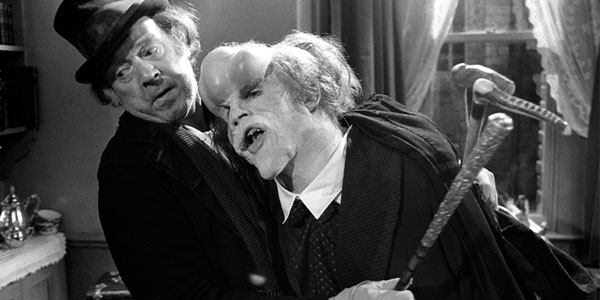
Based on: Frederick Treves€™s The Elephant Man And Other Reminiscences (1923) and Ashley Montagu€™s The Elephant Man: A Study In Human Dignity (1971) A tragic and eye-opening story so extraordinary that it's sometimes hard to take as fact, The Elephant Man details the life of Joseph Merrick (referred to as John in the film), a severely deformed man that is discovered being treated as a virtual slave by a travelling Victorian freak show. London surgeon Frederick Treve's comes across Merrick and, after realising his own mistreatment, eventually offers him shelter and a better, more respectable life. Other than the unflattering name and the hilariously absurd rumours you may know the man for (Michael Jackson didn't buy his bones), David Lynch's film tells the very true story of a man who, through no fault of his own, was treated as sub-human purely because of his appearance. A brilliant film by any means, David Lynch's work is bolstered considerably by a career-defining performance from John Hurt as Merrick, and you owe it to yourself to watch it if you haven't already. What other feature film adaptations of non-fiction do you adore that aren't listed here? Let us know in the comments below!

Contributor
Contributor

Joe is a freelance games journalist who, while not spending every waking minute selling himself to websites around the world, spends his free time writing. Most of it makes no sense, but when it does, he treats each article as if it were his Magnum Opus - with varying results.