10 Utterly Bleak Science Fiction Movies To Ruin Your Day

solaris

As a genre, science fiction is one of the most fertile grounds for making bleak movies: they tend to be set in universes where things can go wrong, or where things have already gone wrong, and the fallout informs the trajectory of the narrative. Whether that's through major intergalactic tragedies, or more introspective portraits that look at grander human issues against backdrops that magnify them and make them grotesque and terrible. Seriously, when was the last time you saw a sci-fi movie where things went right? If you can remember one, share it so other people will avoid it, because it is probably terrible. The genre offers bountiful opportunity for stories with dramatic, far-reaching consequences and spectacular implications if something goes wrong. There is also a strong sub-genre of movies that are themselves devoted to bleak Dystopian worlds, where darker stories play out, and both hope and happy endings are far removed concepts. In order to qualify for this particular type of film, it isn't just a matter of death and destruction, there has to be some craft in the story-telling: after all it isn't enough to destroy the world €“ you need to destroy the soul of humanity. When bleak science fiction stories are told with emotion and craft, one death can be more devastating than the death of an entire galaxy. It takes a true artist to really make a great movie that is bleak in such an inherently dark genre. In a genre full of death and destruction, we've pulled 10 movies, which are exceptionally bleak, and which will probably drawn you into an endless wormhole of misery if you watch...

10. Beyond The Black Rainbow (2010)

Beyond The Black Rainbow

Beyond the Black rainbow is a Canadian film that is a throw back to science fiction movies of the late 70's and early 80's, and more specifically, the colours, music and the feel are heavily influenced by Stanley Kubrick. In other words, it deserves your attention. The film takes place some time in the 1980s where Dr. Barry Nyle (Michael Rogers) is running a New Age institute that wants to combine spirituality and science, at the same time as holding a girl named Elena (Eva Braun) captive. While Elena is under heavy sedition, she tries to escape while Dr. Nyle will do anything to keep her imprisoned. The pace is moody and drawn out, despite it essentially being a cat-and-mouse story, and the resulting feeling is so somber and cold that the film is incredibly creepy. We are invited in as voyeurs, and it feels perverse to watch Dr. Nyle, as he watches Anna, which in itself is incredibly unsettling. The film is surreal and unsettling; making this one of the most colourful bleak movies you will ever see.

9. The Mist (2007)

ending of the mist

There is going to be some debate on this one because some would classify The Mist as a horror movie, but since this has creatures from another dimension, this can easily be classified as science fiction. Either way, it's incredibly depressing. After a large storm, a group of people in Bridgton, Maine are in a grocery store when a mysterious mist descends on the city, inside which are vicious creatures ready to kill anyone who strays within. The townspeople try to fight off the monsters for as long as they can, and the film trades openly on the traditionalist expectations that lots of expendable people will be killed off, before a select group are able to overcome the odds and escape. Sadly, it's a little bleaker than that. While this sounds like standard monster survival movie fare, what separates the Mist is the desperation that the heroes feel: they fight as much as they can, but how do you fight something you can't see? It is as if the characters seemed resigned to their fate once the mist sets in, and while the ending is too good and affecting to be expressly spoiled, it is one of the bleakest of any film endings ever.

8. THX 1138 (1971)

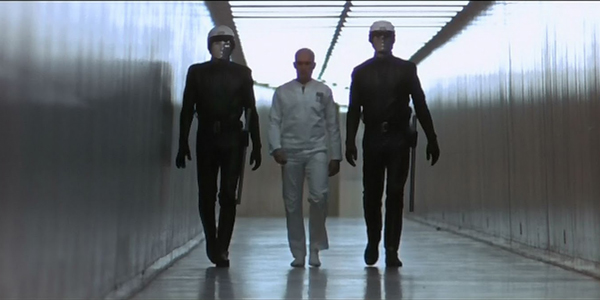
THX 1138 IMAGE George Lucas's first feature film, THX 1138, has a different take on bleakness: instead of things having a dark, moody feel, Lucas uses white liberally, with all characters dressed in white, and the rest of the palette daubed in white or grey only. Taking place in the 25th century, human life is muted using drugs: sex is not allowed and people have to work long hours under constant surveillance. Against that backdrop LUH (Maggie McOmie), stops taking her drugs and swaps THX's (Robert Duvall) drugs with ones that don't work, and as both of the drugs begin to wear off, illegal love begins to spark between the pair, and they attempt to escape. THX 1138 is a much more adult affair than the rest of Lucas's filmography - it has a cold and sterile feeling, which is extremely effective in building a clinical feel for the universe. Regardless of how the events of the film play out, the canvas is what creates the bleak feel, and Lucas can be praised for such a simple, but hugely affecting creative choice.

7. Soylent Green (1973)

green-soylent

Released in 1973, this is an example of a filmmakers view on a social problem that we may very well see €“ overpopulation. The movie is about the devaluation of human life as the population grows and resources start to become exhausted, like an Al Gore disaster porn flick. In 2022, the oceans are dying and global warming has hit a new high; Earth is becoming almost unbearable to live in, especially the film's dirty, over-crowded version of New York City, where the population has swollen to 40 million people. The only food people can get is Soylent Green, which is a wafer apparently made from high-energy plankton. Robert Thorn (Charleton Heston) is a detective investigating the murder of a wealthy businessman who knows the horrific answer to the movie's tagline "what is Soylent Green?" So what's so bleak? Well, that answer is that Soylent Green is made from delicious human meat. Earth in Soylent Green is so bleak that the government even sets up assisted suicide clinics called Home, since dead is preferable to being alive.

6. Solaris (1972)

solaris

Solaris is one of the most famous and successful Russian films of all time, which was blandly remade in 2002 starring George Clooney and directed by Steven Soderbergh, but it's not nearly as depressing as the original. The movie is a sad examination of how powerful grief and memory are. Kris Kelvin (Donatas Banionis) is a psychiatrist who has recently lost his wife when she committed suicide, and who is tasked with evaluating the crew on a space station that's circulating around a newly found planet called Solaris. When arriving at the station, he finds that some of the crew have killed themselves, including one of his friends who was aboard, and after a short time, apparitions of Kris's dead wife start to appear. Hari (Natalya Bondarchuk) is self-aware, fully formed and created entirely from Kris's memory. Kris now has to decide if he wants to stay on the space station with the apparition who may be doomed to repeat her own history over and over or return to Earth where he has lost everything. Cheerful, no? Solaris' bleakness is based entirely in the idea that you can never go home again, hammering home that some things remain in the past and can never be re-attained or relived. All those moments we cherished with loved ones are only memories €“ you can never relive them and if you've lost that loved one, you'll never get a second chance with them, and you can either move on or be haunt by ghosts of the past.

5. Dark City (1998)

After waking up in a bathtub, John Murdoch (Rufus Sewell) realizes he has no memory and has been accused of killing his wife. Murdoch traverses the city, which is constantly bathed in night, hoping to unlock clues from his memory and solve his wife's murder, all the while being chased by the police and a mysterious group called The Strangers. The Strangers are able to stop time, rearrange the city and can give people new identities and memories. You could go to bed as a smart, dignified person and wake up as disheveled mess; without the aid of alcohol. The film uses incredibly dark cinematography, building a deeply affecting atmosphere for the bleak overall message that no matter how happy you are, it could all be taken away in a moment, or that your life could have started mere minutes earlier. If a movie makes you question the authenticity of your life, you know it's bleak.


4. A Clockwork Orange (1971)

clockwork orange At times a Clockwork Orange can be downright uncomfortable to watch - although it was made over 30-years ago it is shocking and unsettling to this day; directed by Stanley Kubrick, he actually had the movie banned in England until after his death. Alex (Malcolm McDowell) is a charming but violent sociopathic young man: after a brutal home invasion (where he beats a woman to death with a giant penis), he is arrested and sent to prison for rape and murder, where he volunteers for aversion therapy in order to cure him of his violent and hedonistic tendencies. A Clockwork Orange shows how much a problem violence is but also that there is nothing anyone can do about it. Even worse, random acts of violence are like lightning €“ they can strike anyone at any time and there is nothing that can save you. It's just not the violent youth, but what is terrifying is almost anyone is capable of horrible violence with the right motivation. A Clockwork Orange shows that even in the future, the barbarity of man is what we should fear. Kubrick shows that someone could break into your house and butcher your whole family and that the solution doesn't fit the crime. If they even catch them.

3. A.I. Artificial Intelligence (2001)

ai-artificialintelligence40

Unlike other movies on this list, this one does not have a dark setting or grim cinematography, and that's part of what makes it so unsettling. While it looks very much like a typical Spielberg movie, there is an unrelenting sadness that runs through the whole film: it's set in the future where androids are common, and the android manufactures decide to create a new model that looks and acts like a little boy. After a tragic accident puts their son in a coma, a married couple adopt the boy android named David (Haley Joel Osment,) but problems arise when the son wakes up. Despite clear instructions to have David brought back to the android lab, his mother sets him free, so he can miss and love her for millenniums. This movie has so many sad and dark themes that it's hard to know where to start. David is unsettling to begin with: he looks like a young boy, but there is something off about him €“ you know he isn't a real boy, although he desperately wants to be. If he was real, then his mother would love him, but she ultimately rejects him and sends him away and onto a perpetual search for the Blue Fairy. that leads him to horrific scenes and miserable discoveries. And then there's the ending, which is so depressing that it makes the rest of the movie retrospectively even more bleak.

2. Nineteen Eighty-Four (1984)

Nineteen Eighty Four1

Faithfully adapted from George Orwell's novel, the story is the defining bleak science-fiction scenario. Actually made in 1984, the film follows Winston Smith (John Hurt) who works at the Ministry of Truth as a re-writer of history. Eventually, Smith begins a relationship with a woman named Julia (Suzanna Hamilton), which leads to Winston trying to fight against the Party and Big Brother with tragic consequences. Apparently, the future is going to suck. While the movie wasn't ground-breaking, the story Nineteen Eighty-Four is the reason so many of these other movies exist. It brought to the forefront the notion the government could watch you at all times, like Big Brother. Plus, the crushing of culture for the sake of safety has been used many times throughout science fiction. Michael Radford's Nineteen Eighty-Four brings all of Orwell's elements together in a masterful adaptation of the legendary source material, and it channels the bleak message perfectly. The world is in shambles and everything is grey, it is as if the world is washed up and used up. This bleakness stretches into the plot €“ we watch as Winston Smith fights against Big Brother, but there's always a sense of futility about it all that just won't be shaken.

1. Blade Runner (1982)

Blade Runner Blade Runner is completely drenched in bleakness: from the way its dark and raining all the time to the concrete pillars that cover the city, it's melancholic and inescapable, and the setting and the cinematography match the story in its bleakness. Richard Deckard (Harrison Ford) is a Blade Runner, who track down organic android replicants on Earth. The replicants are not supposed to be used on-planet and are mostly deployed for dangerous, off-world work (although they probably would be better suited to customer service). Deckard is burnt out and reluctantly takes the case to track down four more androids who've bucked this trend, which leads to haunting realizations and deadly consequences for everyone involved. The themes in Blade Runner are innately unsettling - for example, Rachael (Sean Young) is a replicant who's almost identical to humans, and when she discovers that she isn't one, it's particularly heartbreaking. She's forever damaged, and Deckard chooses that exact moment to engage in one of the most ambiguously rape-y scenes ever committed to celluloid. When it comes to the villains, it's a similar picture €“ while they are really violent, they have an understandable goal in wanting to be on Earth and live a long, human-style life, which of course, this is denied them by Deckar. Where does one draw the line? The film's central ideas are incredibly bleak: through an exploration of what makes humanity human, the film poses questions that reverberate well after the credits roll. How would you feel if you found out everything about you was fake? Could you even move on from there? What would be the point? Think there is something bleaker out there? Share you own bleak sci-fi movies in the comments thread.

Contributor
Contributor

Robert is a Canadian entertainment, true crime and crime fiction writer. You can visit his website at http://robertgrimminck.wix.com/writer