12 Spectacular Cons Directors Pulled Off Shooting A Movie
 If there's one thing actors are good at, it's acting. Pardon me for stating the obvious, but the men and women of Tinseltown and beyond don't just take up this craft because they want something to do on a Saturday. They've dedicated their lives to their art, taken small speaking jobs they didn't necessarily want, done nude shots they perhaps weren't comfortable with and traveled to far-flung corners of the globe just to get their next paycheck. So, as a rule, they tend to be pretty good at what they do. Don't think I'm glorifying actors, because I'm not. All I'm saying is that they've got a job, and through time, practice and taking in new experiences they're more suited to that job than the rest of us. However, the same could equally be said about nurses, carpenters or even dustbin men. If you have a job, you tend to have more expertise in it than your average person might. However, unlike most professions, actors have to deal with directors the people whose job it is to actually make the film. Directors are multiple and varied in their approaches, with most choosing to stay on hand to offer helpful pointers, facilitating the actors into giving the best possible performances. However, there are other directors who believe actors are idiots, incapable of actually acting to the exact standards they want. They believe acting must be as realistic as possible, and go to terrible, devious lengths to put their exact vision onscreen, even if it means fooling their cast. This article is dedicated to those obsessives the ones who would shoot an actor for a realistic death scene, if only there wasn't a union to stop that sort of thing happening. These are the directors who believe that the best performances happen when the actors are deceived, shocked or worse, often resulting in nigh-on torture for those on set. This article will go through some of their cons, chronicling the most infamous instances where directors have willingly pulled the wool over their actors eyes for the sake of a good scene.
12. David Fincher Makes Helena Bonham Carter Unwittingly Evoke Paedophilia Fight Club
 If you know anything about Fight Club, you know that Marla Singer is a pretty terrible human being, capable of uttering all sorts of awfulness. After all, its only a nutcase who can say that she goes to cancer support groups because its cheaper than a movie and theres free coffee. Helena Bonham Carter was more than game to go along with this cavalcade of terrible scuzziness in the film, partly because she wanted to break away from any notions of typecasting she may have received through starring in Merchant and Ivory films. However, there was one scene which may have taken it too far, even for Marla Singer. When Tyler and Marla are in bed together, she was supposed to say I want to have your abortion. Obviously, even in a hard R/18-rated film this might be considered controversial, so they pulled it. However, what David Fincher chose to replace it with was hardly much better My god, I havent been f**ked like that since grade school. Again, Bonham Carter was game to say this, but nobody bothered to explain to her that grade school in America is the equivalent of primary school in her native Britain she thought it was similar to our secondary schools (for ages 11-16). So she knew she was saying something bad, yet she didnt know exactly how deep that rabbit hole went. Needless to say, when she found out everyone had been fooling her, she wasnt impressed.
11. Mel Brooks Cons A Legend Into Singing A Spoof Song Blazing Saddles
 If youre going to create a spoof, you have to make it as realistic as possible, yet ever so slightly off. The closer you can get to the real thing before pulling the comedy rug from under the audiences feet, the better spoofs should be pretty close to the bone, so authenticity is crucial. Nobody knows this like spoof master Mel Brooks. Like the Zucker-Abraham-Zucker trio and Edgar Wright after him, he knew realistic subject matter would make the lampoonery even better, so when the time came to shoot a cowboy movie, he knew he needed a convincing yet absurd theme song. Who Brooks had in mind for this was Frankie Laine the singer of classic Western theme Rawhide or at least somebody who sounded like the man. So he put his feelers out, and was charmed when he found Laine himself saying that Blazing Saddles was a cool name for a Western, and hed be happy to record a theme tune. Of course, Frankie thought this was just a regular Western, so played the whole damn thing perfectly straight. Brooks neglected to tell him about the comedy so Laine would do something realistic, rather than phone it in for a spoof. This made for the perfect spoof theme song if only for its complete earnestness.
10. Sam Raimi Tortures Alison Lohman With Fake Vomit Drag Me To Hell
 Sam Raimi is unique in the horror film genre thanks to his stylistic flair. Namely, the bloke loves himself some kitsch, and isnt exactly backward about showing you this. His early Evil Dead films didnt draw from the psychological horror well which would eventually become so popular it drew its inspiration from the sort of shocks you might get at a haunted house theme park ride. Namely, you knew you were going to be scared, but you had humour as a catharsis afterward. This sort of holy-balls-that-was-ridiculous reaction to scares was once again ready-and-apparent in Drag Me To Hell, Raimis 2009 effort and first stab at horror after 20 years on more mainstream projects. Drag Me To Hell was all about a regular woman being terrified haunted-house-at-a-carnival style by a gypsy sorceress who foists a demon on her for shaming her over her finances. It required lead actress Alison Lohman to look shocked, surprised and sickened as a variety of things not for the squeamish happened to her character, and she had to make this come across well. In order to 'help' her, Raimi borrowed from his Evil Dead directing playbook. Namely, he terrified her for real, taking her through her own carnival ride and filming the result. With little more scene-setting than bad stuffs going to happen to you, Raimi threw the metaphorical kitchen sink at Lohman, giving her food with fake maggots in (actually pasta), throwing bucketloads of fake blood at her and making her fight in a muddy grave, with mudpacks Lohman was allergic to. She was also rocketed into a ceiling at some point, and got so run down that she actually caught the shingles. Yet Raimis crowning glory came when Lohman had to wrestle an animated corpse at a funeral setting(!). Though this was a comic scene after all, shes wrestling a corpse he wanted the actress to be actually disgusted by the animatron, so resolved to fill its mouth with fake sick and not tell her about it until it threw up all over her. The look of sickened shock you see on her face when this happens? Thats Lohmans real reaction, miffed that Raimi had conned her again.
9. Francis Ford Coppola Mentally Breaks A Drunk Martin Sheen Apocalypse Now
 If you watch the beginning of Apocalypse Now, youll see the iconic scene of Martin Sheens Benjamin Willard going cuckoo-bananas in a dingy hotel room. Hes suitably drunk, dishevelled and insane, and you think it must be a great bit of acting. Well I suppose youre right, but what you dont know is that Martin Sheen is literally drunk throughout this whole scene in an attempt to make it more realistic. Of course, inebriation does not a good performance make, or every high street on a Friday night would be filled with budding Brandos. To really make this into something good, Coppola took advantage of a drunk Sheen, refusing to tell him that the scene where he would pretend to be emotionally tormented would actually involve some real emotional torment. But who was tormenting Sheen in this scene? Why, Coppola of course! As soon as the inebriated actor got on set, the director took advantage of his condition by calling him worthless all the way through, saying he was a terrible actor, and a terrible father to boot. Sheen wasnt expecting this, and in his delicate emotional state suffered something of a breakdown one of many on this set. So really, all the pain you see in that scene is totally unfaked, entirely because Coppola neglected to tell Sheen that he was going to put him through a brutal emotional wringer.
8. Bryan Singer Explodes A Train Carriage To Scare Hugh Jackman X-Men
 It can be hard to shock an actor in a superhero movie. If youre portraying somebody who commits impossible deeds with the same customary rigour that you or I apply to breathing, then most situations are going to be completely insane anyway, if only to establish a sense of actual risk when dealing with what is for all intents and purposes a demigod. And in the pantheon of unflappable superhero actors, Hugh Jackman must be right up there on a pedestal. Hes playing an ageless superhuman who shrugs off fatal injuries with little more than a shrug while possessing his own knife-kit on either hand and has an unbreakable skeleton to boot. Even if Jackman technically isnt any of these things, he mustve felt pretty badass while playing Wolverine, if for the mutton chops alone. To his credit, X-Men director Bryan Singer knew this, so resolved to make him soil his pants anyhow. The scene itself comes when Wolverine and Rogue are on a train which is ambushed by Magneto. Jackman knew that Ian McKellen was going to tear into the carriage, but thought this would just involve ripping the door off something Singer chose not to correct, because he wanted to elicit genuine shock from his actor. So when the director yelled action and the whole damn carriage tore itself apart, Jackman thought something had gone wrong, resulting in a very real shocked and afraid face before Ian McKellen came swooping in for a display of flying camp villainy. Singer, through the medium of trauma, got the shot he wanted. Yet there was a happy ending here Jackman used the footage for future reference to train himself how to react with shock better, proving once and for all that all traumas have a silver lining.
7. Stanley Kubrick Breaks Shelley Duvalls Mind With Torture The Shining
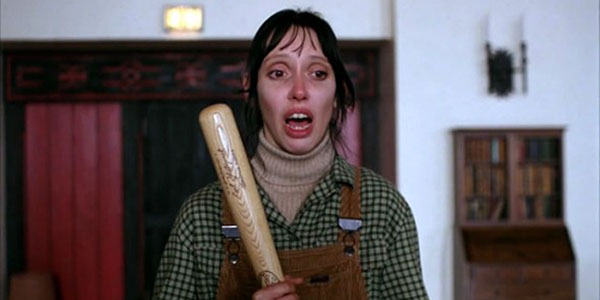 Remember what I just said about all traumas having a silver lining? Well technically thats a lie, especially when Stanley Kubrick is involved. The man was pretty obsessive on most films he once made an actor in Eyes Wide Shut walk across a room and close a door hundreds of times, just for an inconsequential shot but when it came time to don his horror hat in The Shining, you can bet that things got nutty, and quickly. Though the film is primarily concerned with the gradual decline of Jack Nicholsons Jack Torrance into axe-swinging madness, this descent is nothing without reaction namely from Torrances wife Wendy, played by Shelley Duvall. Unbeknownst to her, Kubrick was enacting a psychological horror behind the scenes of a psychological horror. He would attempt to mentally break his cast in order to better infuse the film with the madness he so desperately wanted. Obviously, as the films straight man (or woman), Duvall bore the brunt of this, with Kubrick changing the scripts, the shooting times and just flat out arguing with his actress for the hell of it before applying the coup de grace, which involved shooting the scene of a hysterical Wendy waving a bat at Torrance while going slowly up a staircase hundreds and hundreds of times. The whole affair actually caused Duvall serious mental trauma she stopped eating, became mentally ill and her hair began to fall out, a price Kubrick was willing to pay to capture real, unhinged fear on film. Unsurprisingly, she never worked with him again. Spectacularly, this perhaps isnt the biggest con Kubrick pulled throughout the filming of The Shining, he never once told Danny Lloyd, the child actor of Danny Torrance, that he was shooting a horror film, meaning that Lloyd could keep a childlike obliviousness to all the weirdness going on around him. Considering how weird his scenes get, its a wonder that Kubrick kept this charade going.
6. Stanley Kubrick Deceives Slim Pickens and George C. Scott Into Completely Bonkers Performances Dr. Strangelove
 You just cant keep a good nutcase down, so heres Stanley Kubrick again, this time in his earlier satire Dr. Strangelove. Though he was a comparative greenhorn at this stage, he still knew his way around deceiving actors and proceeded to do so with aplomb over filming. The thing with a satire is that needs to teeter on the line between normal and ridiculous. The actors are usually playing it straight-faced, maybe with a knowing wink to the camera but without the intentional clowning around which would make the whole thing a spoof. As a master of his craft, Kubrick was aware of this, and knew hed have a hard time getting satirical performances out of most actors if he went ahead and told them they were supposed to be acting out a satire. Its a weird paradox, but if you think about it, it does actually make sense. So with this in mind, Kubrick misled two of his actors Slim Pickens and George C. Scott. You may recognise Pickens as the man who rides the nuke down to the ground like a rodeo bull, yet the strange thing is that he didnt know he was giving a humorous performance. The auteur wanted a well-known cowboy actor to fit the satirical bill, so passed the script on to Pickens with only his pats, assuring him that it wasnt a comedy and he was playing the hero. Say what you like about Kubrick (and people have, many times and often) but youve got to admire his sheer audacity. Convincing a man that hes a hero when hes riding an apocalyptic nuke must take some doing. His deception of George C. Scott the actor behind General Turgidson seems almost mundane by comparison. Scott thought he was playing a cerebral character and intended to give an understated, measured performance. Kubrick agreed with this, telling him it was a great idea and that he should expend all his excess emotion in a hammy, over-the-top first take. What the director didnt mention was that these were the takes he wanted and that he discarded Scotts intentional efforts. Scott was pretty livid, although it mustve been funny to watch him at the premiere.
5. Tobe Hooper Drives Everyone Insane In The Heat The Texas Chainsaw Massacre
 Tobe Hoopers Texas Chainsaw Massacre was filmed in the Texas summer of 1973, and this wasnt just any summer either it was the kind of heatwave summer where you could fry an egg on a road. Temperatures pushed as high as 43 degrees, and due to budgetary concerns the cast often had to film in 16-hour shifts, seven days a week. Theres a reason why everyone looks insane in this film theyve quite literally been driven out of their minds by heat, lending the whole shebang a unique, crazed quality. However, while the outdoor scenes were hard, they had nothing on the indoor scenes. A 1900s abode doubled for the Sawyers that is, the crazed cannibal familys residence, a small, poky place with barely any ventilation, and stuffed with film equipment. There was also perishable food knocking about too which rotted in the heat, creating an unbearable stench. So when you came to the scene where the entire family sits down to dinner with their female captive, you knew something had to give. And boy howdy, did it. Hooper, looking to get just the right shot, chose to use the heat to his advantage he shot the scene again, again, again and again during a 24 hours shoot, eventually mentally breaking everyone in the room through a combination of rotting food and soaring heat. The worst part was that he did this on purpose, to make the family seem crazier and Marilyn Burns Sally Hardesty more deliriously frightened. In fact, many actors including Leatherfaces Gunnar Hansen snapped and began believing they actually were their characters. I think that when youve got a chainsaw-wielding man to believe he is in fact a bloodthirsty murderer, the con mightve gone too far.
4. John Ford Trolls A Hungover Vince McLagen To Oscar Glory The Informer
 Unsurprisingly for the man who once made Shirley Temple cry more effectively on camera by telling her that her someone had ran over her dog, John Ford could be a bit bonkers with how he wrung the last bit of talent out of his actors. Yet strangely, this was always a good thing Temple never performed better than when she teamed up with Ford for Wee Willie Winkie and the later Fort Apache. Though this brand of lunacy didnt win an award for Temple, Ford had already struck Oscar gold for an earlier effort from her Apache co-star, Victor McLaglen. Effectively, all the way through filming this 1935 Northern Ireland-set drama, Ford acting like a massive tool to McLaglen in order to enhance the mans surly demeanour. In fact, if this happened in modern times, the only explanation you could give was that Ford was effectively trolling him. Honestly, Im not kidding hed change the shoot schedule at the last minute, often when McLaglen was already on the lot, and inform the actor mid-take that his effort-filled performance didnt matter because they werent filming. Yet the most colossal dick move Ford managed was to tell McLaglen when he had days off, only to rescind those breaks the morning they started. Now much like everybody at the time McLaglen was a mans man, and loved himself a drink and a party. So obviously the mans going to be nursing a hangover in his mornings off, while sleeping under a blanket of naked women as befitting his status as a war veteran, hard man and movie star. Yet Ford would still drag his sullen corpse out of bed and make him act, even when he was filled with nausea. But McLaglen cant really complain the performance did net him the Best Actor Oscar.
3. Terence Young Ambushes Sean Connery With Sharks Thunderball
 Now, nobodys really fond of sharks except sharkologists and this goes doubly true when youre in the water with one. Usually, theyll leave you alone and go about their business, but theres always a chance theyll tear you apart with a mouth and digestive tract lined with the equivalent of steely knives. So when Sean Connery Sean bloody Connery says he doesnt like sharks, you believe him. But unfortunately for Connery he had a rather lucrative day job as James Bond, meaning that occasionally he had to swallow his phobias and look damn suave while doing it. Case in point, Thunderball a film replete with a shark pool owned by the villainous Emilio Largo. Of course, you cant have a shark pool and not have someone end up in it, so 007 was required to take a dip with actual sharks. Now, even though Connery was terrified, he was still game for it, having been informed by director Terence Young that he would be protected from a tooth-related death by a large plexiglass tunnel. What the actor didnt know was that Young was lying to him the director knew he didnt have enough plexiglass to create a safe passage but elected not to tell Connery because hed say hell no to actually swimming with the beasts. When did Connery eventually find out Youngs ruse? While he was in the water, being filmed. Theres a reason 007 looks panicked and jumps out of that water like a salmon on film hes actually bloody terrified. Id loved to have been there in the aftermath of this scene, when the director has to explain to a former Mr. Universe that he didnt tell him about his impending doom for the films sake. Im willing to bet it was a short conversation, beginning and ending with Connerys fists.
2. Jaume Balagueró and Paco Plaza Terrify Their Cast With A Falling Corpse REC
 To my mind, what makes REC such an effective horror film is that it takes a long time to get going. Youre following round actress Manuela Velasco as she presents something called While You Were Sleeping, which effectively revolves around her flouncing around a fire station documentary-style, and its a good twenty-odd minutes until you actually see a zombie. Even then, none of the actors are quite sure what she is, even if you that is, the viewer do. The excrement only truly hits the turbine (to go all Victorian English on it) when the firefighter sent to look after the woman who is on a high floor is sent tumbling into the lobby, where the residents of a block of flats are arguing about why theyve been sealed into the establishment. Its a hell of a shock for the viewer, but what you might not know is that it was also pretty damn traumatising for the actors too. Yes, nobody knew that a realistic mannequin was being dropped on them from several floors up, which makes directors Jaume Balagueró and Paco Plaza both evil geniuses and shockingly blasé about their casts safety. That reaction you see as a fireman makes a large noise on his way to becoming a pancake contains all the real shock of if you had actually seen a man plummet onto the tiles before your very eyes. To my mind, this is the sort of gambit which requires a lot of bravery and punch-able faces on the directors parts it happens so early in the film that theyve completely broken any sort of trust they had with an ensemble (which featured a little girl, by the way) that would surely be pissed off and suspicious all the way through the remainder of the shoot. Mind you, I guess thats kind of the point if you know your directors capable of pulling that sort of stunt, the rest of your performance will be tinged with a very real sense of fear.
1. Neil Blomkamp Incites Anti-Nigeria Feeling Then Records It District 9
 If youve seen District 9, you know how good it is its an original concept, shot innovatively and on a relatively shoe-string budget, yet it blows most sci-fi flicks out of the water. However, there was an odd undercurrent of xenophobia in the film, which made it clear from the outset that it really didnt like Nigerians. It seemed, well, maybe not superfluous, but perhaps a little gratuitous. Having Nigerians play dishonest merchants, exploiters and savage witchcraft practitioners was perhaps a little too on the nose, and is probably some of the most controversially racist stuff Ive seen committed to mainstream films, certainly in this century. Yet you have to admire the lengths Neil Blomkamp went to in establishing the hatred of Nigerians in this film yes, the actors sold it, it's their job after all, but the real genius came when certain real individuals were just asked how they felt about Nigerians. Im serious at one point Blomkamps team just went out onto the streets of South Africa with a camera, stopped people and asked them how they felt about people from that country. More often than not they mined racist gold, as passers-by just exploded into invective about their far-away neighbours. Blomkamp merely edited out the more mild-mannered stuff and added his results to the film, making for the most glorious instances of real, flippant racism covertly captured since Borat asked people to throw a Jew down the well. So thats my choices for the most spectacular directing cons. Can you think of any more? Feel free to comment!