15 Greatest Hard Science Fiction Movies Of All Time
Sci-fi classics like Ex Machina that really make you think...

Most science fiction movies aren't concerned with scientific accuracy. No one on the set of Star Wars questioned the viability of the lightsaber (although the less said about General Leia's Mary Poppins moment in The Last Jedi, the better), and audiences were quite happy to suspend disbelief when the Transformers - arriving from earth from a distant planet - spoke with a variety of stereotypical American accents.
But sometimes it's nice to switch your brain on rather than off when watching a movie, and when the mood calls for it there are some excellent hard science fiction films out there which take the genre far more seriously than the average blockbuster. Sometimes this accuracy relates to the technology depicted, taking the familiar science fiction world of spaceships and robots and grounding it in real world feasibility.
Other hard sci-fi movies opt for a different approach, preferring instead to focus on more complex philosophical and metaphysical questions which the future might bring, and how new technological developments could affect society, culture and our conception of consciousness.
Strap on your thinking caps and get ready to explore the complex yet riveting world of hard science fiction cinema.
15. Robot And Frank

Director Jake Schreier and writer Christopher Ford crafted one of the most understated - and underrated - science fiction movies in recent memory with Robot And Frank. Frank Langella stars as a retired thief Frank Weld, who is given a robot care assistant and decides to put his newfound companion to good use and revive his career as a cat burglar.
Set in a very near future which is thoroughly recognizable, it's a film which is slight and whimsical on the surface but carries with it a melancholic undercurrent, reflecting on the nature of ageing in a world where technology threatens to dehumanize how we care for the elderly.
Robot And Frank isn't concerned with unpacking the morality of artificial intelligence and how robots might pose a threat to the existence of humanity. But its exploration of Frank's slow slide into dementia and how this challenges the robot's programming is a far more unique approach to the material than is generally produced in Hollywood.
14. Sunshine

It's hard not to notice the influence of Tarkovsky and Kubrick in Danny Boyle's 2007 film Sunshine. Based on a screenplay by Alex Garland (more on him later), it's an ambitious film which attempts to bridge the gap between straight up hard science fiction and psychological horror, and largely succeeds in doing so.
An international team (made up on an international cast) are put together for a mission to fly to the dying sun in order to reignite it. As they near the sun they encounter physical - and metaphysical - obstacles they must overcome if they hope to return to earth with their sanity and their lives. There are shades of Event Horizon thrown in with the references to Solaris and 2001, and Garland builds a scientific framework which adds to the world-building.
Beyond the political-ecological message about the dangers of global warming, Sunshine was inspired by the concept of the heat death of the Universe, and professional scientists were called upon as consultants. This didn't stop some dispute emerging after its release, who debated the effectiveness of a single nuclear stellar bomb, saying that billions would be required to bring the sun back to life.
13. Gattaca

With its theories of genetic superiority and a population controlled by eugenics, Gattaca has more than a few things in common with the writings of Aldous Huxley. His novel Brave New World includes many of the concepts featured in Andrew Niccol's film which capture the essence of a dystopian future structured around chemically induced compliance.
As with many other dystopian works of fiction, Gattaca's central concern is the idea of free will in a system in which everyone's function in society is controlled by their genetic inheritance. Here, the character of Vincent Freeman (Ethan Hawke) moves up the social hierarchy from in-valid to valid by using someone else's genetic code, and is soon embroiled in a murder plot as he desperately tries to keep his true identity a secret.
Gattaca's plot might slip into the familiar in the final act, but it's held together by good performance from Hawke and Uma Thurman, and more significantly it has influenced real-world geneticists to exercise caution in their field of work, concerned how the brave new world we're entering could become Brave New World.
12. The Martian

With a title like The Martian, it's not surprising to hear that some audiences were perplexed when watching Ridley Scott's science fiction drama - there isn't an alien to be found. Instead, Scott's adaptation of Andrew Weir's surprise hit novel focuses on a scientist's struggle to survive after being presumed dead on the red planet.
Matt Damon's performance is central to The Martian, and his efforts to stave off a seemingly inevitable death form the dramatic core of the film. His exploits are exactly the kind of thing science geeks love: he mixes his feces with Martian soil in an attempt to create fertilizer, modifying left over rocket parts and doing whatever it takes to keep his life support systems functioning until he can figure out a way off the planet.
The Martian is surprisingly restrained on the visual front as far as Ridley Scott goes, opting for realism over extravagant production design. The producers also had a little help from NASA, keen to promote their own endeavours to explore Mars, and catch up with Elon Musk, who has the bold ambition of his own to see settlers on Mars in the near future.
11. Contact
647807Back in the 1980s the name Carl Sagan held as much respect for science documentaries as David Attenborough's does today for documentaries about the natural world. Sagan did more than anyone else to popularize mainstream interest in cosmology, astronomy and the universe around us. More recently, Neil deGrasse Tyson brought Sagan's flagship series, Cosmos, into the 21st century.
His 1985 novel, Contact, explores the possibility of humanity discovering a wormhole, opening up the chance of contact with extra-terrestrials. Jodie Foster stars as Dr. Arroway in Robert Zemeckis's screen adaptation, taking on the role of a scientist working for the SETI (Search for Extra-Terrestrial Intelligence) organization who discovers a repeating signal of prime numbers.
Contact's preoccupation with the compatibility of science and religion might lack sufficient depth to make it completely compelling, but the finale - in which Arroway is inserted into a pod and sent through a series of wormholes - is a wonderfully crafted cinematic experience which places a perspective on extra-terrestrial life in a similar way to Close Encounters Of The Third Kind.
10. Children Of Men

Whereas Gattaca explored the idea of mankind created in the image of a genetically engineering superior class, Children Of Men sees the population of the world reeling from a genetic defect in which mass infertility has left the species on the brink of extinction, with the discovery of a pregnant refugee perhaps the only hope for the future.
If Gattaca was a cinematic nod to Aldous Huxley, Children Of Men's world of terrorism, surveillance and an authoritarian police state is much closer to that of George Orwell's 1984. Director Alfonso Cuarón constructs a science fiction world a million miles away from his later film Gravity, full of run-down city streets and apartment blocks damaged by civil conflict, all shot in desaturated hues by cinematographer legend Emmanuel Lubwezki.
On top of the dystopian framework of species-wide degeneration sits subtle layers of additional complexity - the tension between faith and hope; the descent into nihilism following on from the dissolution of the Christian faith - which makes Children Of Men a modern science fiction masterpiece.
9. Solaris

Andrei Tarkowsky's 1972 adaptation of Stanislaw Lem's novel of the same name is perhaps one of the most meditative, slow paced hard science fiction movies out there, preoccupied less with the technical aspects of mankind's forays into the outer limits of space and more on the psychological ramifications of space exploration.
Research on the space station orbiting the fictional planet Solaris has stalled, as each of the crew begins to succumb to a psychological malaise which seems to be manifesting in very real forms. New arrival Psychologist Kris Kelvin (Donatas Banionis) has been sent to get to the root of the problem, but the appearance of his deceased wife soon distracts him from his mission, as he's drawn into a world of hallucinations and unusual dopplegangers.
Solaris is about alien life forms operating beyond the comprehension of human understanding, and how our yearning for a better understanding of worlds beyond the stars says just as much about the yearnings which live inside us, unanswered and threatening to undermine our psyche.
8. Moon

Doppelgangers return again as a motif throughout Moon, although this time their nature is of a different kind to the extra-terrestrial inspired creations of Solaris. At the same time, Moon is very much concerned with the nature of a life in solitary conditions beyond the earth's atmosphere, and its roots in scientific accuracy run deeper.
Sam Rockwell plays Sam Bell, the only person on the moon nearing the end of a three year contract mining helium-3, with nothing more than a disembodied robot voice (Kevin Spacey) for company. A great example of a thoroughly effective low budget contemporary science fiction film, Moon is perhaps Rockwell's most solid performance to date, full of emotional depth not often seen from an actor better known for his larger than life figures.
After a screening at NASA, Moon received a big thumbs up from the scientific community for its accuracy, who praised the production design of the settlement Bell occupies. Cognitive scientists agreed, citing Moon as one of the most accurate, relevant and highest quality film in the journal Trends in Cognitive Sciences.
7. Interstellar

Christopher Nolan's hard science fiction magnum opus Interstellar builds on the familiar premise of mankind's necessity to seek life on other planets due to the environmental destruction of earth. Matthew McConaughey and Anne Hathaway star as two scientists sent on a mission through a wormhole to find a new home for the human race.
Nolan's visually striking movie might have fallen short on the emotional front, but while his attempts to tug at our heartstrings might not have paid off, his attention to scientific detail is certainly commendable. Nobel prize winning theoretical physicist Kip Thorne was on hand as a consultant, and the result is a movie space mission entirely in keeping with the possibilities of interaction with wormholes.
Celebrity scientists Neil deGrasse Tyson and Michio Kaku also weighed in on the movie, dishing out high praise for Nolan's adherence to the restrictions of hard physics, with Kaku stating that Interstellar sets the gold standard for science fiction movies to come.
6. Her

Anyone who's spend a length of time on Tinder will probably have some sympathy for the desire to have an artificial intelligence partner - why go through all the trouble of dating when you can just get a dismembered robot voice to tell you what you want to hear?
It's this idea of AI developing to the point where it can convincingly emulate real people which inspired writer-director Spike Jonze to make Her, a film about a man called Theodore Twombly (Joaquim Phoenix) who falls in love with his computer operating system (voiced by Scarlett Johansson). As their relationship develops, Twombly finds himself struggling to engage with the real people in his life.
As well being a sharply observed commentary on relationships in the modern world, Her is also a fascinating look at computer learning and the ability of artificial intelligence to effectively simulate human emotions, proving that hard science fiction doesn't have to feature shiny tech in order to say something relevant about how technology can impact us on a psychological level.
5. Primer

If Spike Jonze's Her offered an insight into the effects of technology on the human libido, Primer takes an altogether different approach to the science of the mind, offering a head-scratching cerebral view of time travel through the lens of cold, hard mathematics.
Shane Carruth's ultra low budget film is the movie equivalent of a one man band: Carruth wrote, directed, produced, starred in, composed the music and edited the film, proving that filmmaking doesn't have to be a huge feat requiring hundreds of cast and crew members in order to be effective.
Primer is a pared down chamber piece focusing on two scientists working out of a garage who accidentally discover a time loop, devoid of fancy special effects and not afraid to take the science of the premise with complete sincerity and assume a high level of intelligence on the part of the audience.
Watching Primer and it's clear that such a film would never be made without the total control of someone like Carruth, who refused to dumb down the heavy mathematical concepts, building on intricate concepts of time as established by physicist Richard Feyman. This is definitely one of those science fiction films which requires a well-secured thinking cap.
4. Arrival

Only a handful of mainstream directors working in Hollywood today have the ability to produce films which manage to transcend their commercial ambitions and yet somehow retain popular appeal. Denis Villeneuve is one such director, bringing a degree of class and thoughtfulness to blockbuster scale productions rare for the industry.
Arrival, released in 2016 and seen as something of a warm up for his later sequel to Blade Runner, is one such film, tackling relatively complex scientific and philosophical themes within the framework of a multiplex movie and succeeding immensely.
It's an alien invasion movie along the lines of Close Encounters Of The Third Kind, in which linguistics plays a central role - both in how humans strive to communicate with their visitors and how language and memory shape the human experience.
Villeneuve consulted linguistics experts from McGill University to craft the alien language, while Amy Adams constitutes the emotional core of the film, her sophisticated character of a language expert trying to decode the alien language before the military take control anchoring Arrival to the world of feelings familiar to the audience.
3. Ex Machina

Several years after writing the screenplay for Danny Boyle's Sunshine, Alex Garland finally took to the director's helm himself for Ex Machina, a low budget British science fiction film starring Domhall Gleeson, Oscar Issac and Alicia Vikander.
Taking place almost entirely in the remote home/research facility of tech company CEO Nathan Bateman (Issacs), Ex Machina unwraps the conundrum of artificial intelligence as programmer Caleb Smith (Glesson) tries to assess whether or not a newly developed robot named Ava (Vikander) is capable of human emotion and independent thought. As the tests continue and Caleb becomes increasingly attached to the robot, he begins to question the nature of his own identity.
There's a classiness to the visuals in Ex Machina which belies its low budget, but the ideas behind the film are what makes it so effective and compelling. The nature of human consciousness remains a hazy concept to scientists to this day, and Ex Machina's exploration of AI in this context is handled with a suitable degree of complexity which leaves the viewer with as many questions as answers, as all good speculative hard science fiction should.
2. Blade Runner

Long before Alex Garland delved into the world of androids and artificial intelligence came Blade Runner, Ridley Scott's timeless classic adaptation of legendary mind-f**k sci-fi writer Philip K. Dick's 1960s novel, Do Androids Dream Of Electric Sheep? Blade Runner set the bar for dystopian science fiction, and few films have matched it.
Harrison Ford stars as Rick Deckard, the titular Blade Runner on assignment to take down a group of replicants who have arrived on earth and are creating havoc as they try to track down the head of the Tyrell Corporation in order to extend their lifespan. A visual treat which holds up in comparison to the best science fiction films being produced today, Blade Runner might have been a flop on its theatrical release but stands today as a masterpiece of the genre.
Fusing neo-noir elements with themes such as the nature of identity and mankind's fate at the hands of mega-corporations, Blade Runner asks questions about what it is to be human without sliding into heavy-handed polemics, with Rutger Hauer's replicant Roy Batty displaying more emotional depth and compassion (at least towards his fellow replicants) than most of the human characters who seek his destruction.
1. 2001: A Space Odyssey
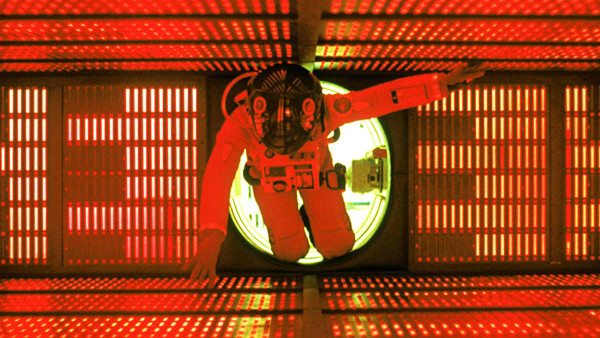
2018 saw yet another re-release of Stanley Kubrick's sci-fi masterpiece 2001: A Space Odyssey, this time in a stunning 4K digital transfer, as well as screenings around the country in its original 70mm format. It's a testament to the film's enduring legacy that it has continued to be screened in theatres since its release in 1968.
Encompassing many aeons of existence, from tool using primates to mankind's exploration of outer space, 2001: A Space Odyssey has the kind of grand sweeping cinematic gesture that few other films even try to achieve.
Kubrick's perfectionism has become the stuff of legends in movie history and 2001 is no exception: the production team went to great lengths in order to ensure the scientific accuracy of everything you see on screen, from the effects of zero gravity through to the motion of the spacecraft in the vacuum of space.
As with other Kubrick movies such as Barry Lyndon and The Shining, 2001: A Space Odyssey received a polarised reaction from the critics at the time of its release, with noted critic Pauline Kael describing it as a "monumentally unimaginative movie". Time has been considerably kinder, and proving that Kubrick was an iconoclastic filmmaker, ahead of the curve by some margin.