20 Most Important Film Deaths This Decade

Read it and weep.
TV as a medium has made substantial leaps over the last decade in terms of catching up with cinema, though it's still hard to contend with the feeling of witnessing an epic, big-screen death for the first time. Plenty of movies have tried to push our buttons and forge an all-time, historic death sequence, though few films have actually succeeded. Creating a memorable, artistic or downright emotional movie death requires a perfect convergence of writing, direction and acting, though it would be a mistake to assume that just because a death scene is memorable or important, that this means that it's also actually good. There are, in fact, a number of rather lame or unsavoury deaths in this list, ones which serve as a reminder of how anti-climaxes can irk audiences, and poor creative decisions can severely dent a franchise forever more. Also, remember that MAJOR SPOILERS WILL FOLLOW for many major, popular films from the last 10 years. In the case of one very recent movie, we have included an additional spoiler warning ahead of that page.

20. Bill - Kill Bill Volume 2 (2004)
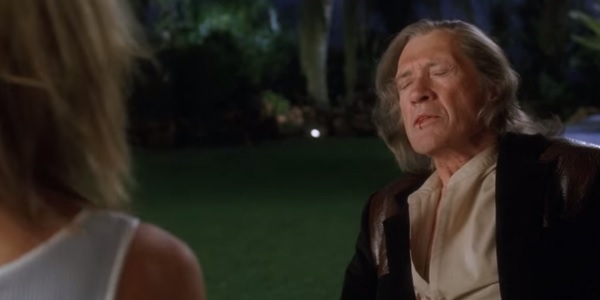
Quentin Tarantino's Kill Bill remains one of his most purely entertaining movies, a riotous work of pastiche that's action-packed, hilarious, and left us eagerly anticipating the concluding chapter, in which Uma Thurman's Bride would presumably put her murderous adversary Bill down once and for all. Kill Bill Volume 2 is a very different beast to its predecessor: with a slower pace and more dialogue-driven narrative, it felt far more like a typical Tarantino film, though still delivered brief spurts of violence and action here and there. Then came the moment everyone had been waiting for, the final showdown between The Bride (now known by her real name, Beatrix Kiddo) and Bill. They sit at a table talking for a few minutes, before the fight finally begins, and Beatrix promptly loses her sword. However, she reacts quickly, and delivers the infamous Five Point Palm Exploding Heart Technique to Bill's chest, the legendary finishing move that had apparently been secretly taught to her by the Pai Mei. After a brief chat, the two make an uneasy peace, and Bill takes five steps to his doom, as his heart explodes within his chest and he collapses. The death proved to be wildly divisive among fans: marketing materials had made it seem as though the two would have an epic swordfight by showing brief clips from the start of their fight, when in fact, this accounts for just a few seconds of the movie. On the other hand, would watching Uma take on a guy several decades older than her really be all that fun anyway? It's a very Tarantino move, and on greater reflection, an awesome and unforgettable death for Bill.

19. Padmé Amidala - Star Wars Episode III: Revenge Of The Sith (2005)
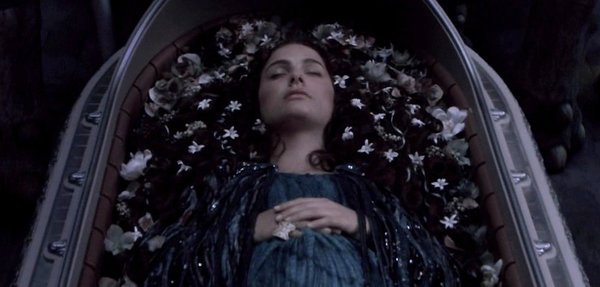
The romance between Anakin Skywalker and Padme was easily one of the lamest aspects of George Lucas' controversial Star Wars prequel trilogy, but Lucas one-upped himself by giving her an even more ridiculous death. After she tearfully tries to convince Anakin to return to the light side of the Force ("Anakin, you're breaking my heart!"), he notices that Obi-Wan has stowed away on Padme's ship, and believes that she set him up to be killed. As a result, Anakin force chokes a heavily pregnant Padme. Later on, attempts are made to save Padme's life, though it appears that she's dying of a "broken heart". She gives birth to Luke and Leia Skywalker in her final moments, and they are sent away to live separately for their own safety, while the autopsy would officially state that the child died along with Padme. Given how important this moment should be in Star Wars history, it's an incredibly lazy and boring way for a major character to die.

18. Ra's Al Ghul - Batman Begins (2005)

One of the major plot revelations in Christopher Nolan's outstanding Batman Begins reboot is that the man we believed to be Ra's al Ghul (Ken Watanabe) is in fact a decoy, and the man we've known as Henri Ducard (Liam Neeson) is in fact the real deal as well as the leader of the League of Shadows. Ra's explains that the League are planning to tear Gotham apart from the inside by spreading the Scarecrow's fear toxin with the use of a microwave emitter, which would result in mass insanity and murder. The climactic sequence has Ra's taking the emitter on a monorail train towards the main water distribution facility in Gotham, but with the help of Jim Gordon, who uses the Batmobile to explode the tracks, the train carriage carrying Ra's and the emitter ends up plummeting to its doom. The scene is an important part of Batman's cinematic heritage and is frequently discussed by fans, because of Batman's line, "I won't kill you...but I don't have to save you." Some argue that Batman leaving Ra's to die is essentially tantamount to murder (and therefore the breaking of his no-kill rule), while others attest that it keeps his integrity in tact. What do you think?

17. Hoban "Wash" Washburne - Serenity (2005)

Through his work in TV and film, Joss Whedon has made an art out of writing characters we can't help but love, and then swiftly killing them off in an emotionally excruciating way. This is exactly what happened in Whedon's fantastic movie follow-up to his acclaimed TV series Firefly, after pilot Wash managed to steer clear of a Reaper assault and crash land Serenity. After catching his breath, he utters his iconic line, "I am a leaf on the wind; watch how I...", but is cut off by a tree trunk hurled through the cockpit by the Reavers, impaling him and killing him instantly, to the shock of everyone. For fans of Firefly, it was a highly emotional moment, and after seeing Shepherd Book killed earlier in the movie, made it clear that Whedon wasn't playing around. Even once fans had been able to recover from the shock of Wash's death, it was hard not to feel a sting in your eye at the end of the movie when we saw Wash's toy dinosaurs still residing on the pilot's station as a tribute.

16. Billy Costigan - The Departed (2006)

The Best Picture-winning crime thriller The Departed finally won Martin Scorsese that Best Director Oscar he'd been deserving for so long, and the movie is a superb blend of outstanding acting, writing, direction and cinematography. As a remake of classic Hong Kong thriller Infernal Affairs, many viewers certainly knew what was coming, though may have expected that Hollywood's executive meddling might have resulted in something a little less brutal and downbeat. Though the very end of the movie deviates from the original conclusion (here, Matt Damon's corrupt cop Colin Sullivan ends up on the wrong end of Mark Wahlberg's gun), but the most shocking moment remains in tact, as Leonardo DiCaprio's undercover cop Billy Costigan takes Sullivan hostage and drags him into an elevator. After a short discussion, the elevator door opens, and as Costigan goes to step out, he's promptly shot in the head by a cop waiting on the other side, as the gory remains of his head splat onto the wall behind him. A shocking moment if you didn't know it was coming and a nerve-wracking one if you did, Scorsese delivered one of the biggest "Holy s***!" moments of the last decade with this perfectly-pitched kill.

15. Le Chiffre - Casino Royale (2006)

Martin Campbell's outstanding James Bond reboot Casino Royale completely changed the complexion of the series: it boasted more grounded, realistic action and a gritty, visceral tone, as well as a villain who was less-cartoonish and more believable in the real world. Though he ended up paling in comparison to Javier Bardem's Raoul Silva in Skyfall, Mads Mikkelsen gave a splendidly sinister performance as Le Chiffre, a terrorist financier who sets up a high-stakes cards tournament to try and win back some of his failed investments after Bond foiled his last terrorist attack (Chiffre would attack major companies and short-sell their stock to make massive profit). What's really compelling and unique here is that Le Chiffre himself doesn't just have to worry about Bond, but at this point he's also massively in debt to his terrorist clients, and the card game is really his last chance. When things don't go his way, Le Chiffre has Bond poisoned and kidnaps Vesper Lynd, but just as he's rather brutally torturing Bond, the mysterious Mr. White interrupts and shoots Le Chiffre dead. Unexpected and completely different from how we expect a Bond villain to bow out, this was just another way that Casino Royale reinvented and subverted all that came before.

14. King Leonidas - 300 (2007)

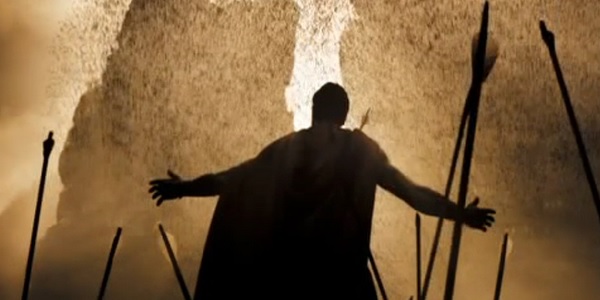
Zack Snyder's 300 became an instant cult hit upon release, in part due to its awesome visuals, but also because of its dialogue, which mostly consisted of absurdly macho one-liners being howled by Gerard Butler's King Leonidas before engaging in battle. Though Leonidas led his 300 men bravely, the sheer numbers game of trying to bring down Xerxes' 300,000-strong army eventually got the better of the Spartans, and at the end of the movie they are defeated, albeit at huge cost to the Persians. Leonidas is the last man standing as he stares down Persian archers atop a mountain. Tyler Bates' epic score rises as the King lets out his final words, "My Queen! My wife. My love...", before the arrows are simultaneously fired at him, blacking out the screen. We catch one final glimpse of Leonidas at the end of the movie, filled with arrows, before we learn that his death was not in vain, and the 300's efforts allowed Dilios to lead the combined 40,000 Spartans and Greeks to mop up what was left of the Persians.

13. Llewellyn Moss - No Country For Old Men (2007)

Count on the Coen Brothers to defy convention and give us one of the more unexpected, frustrating and divisive protagonist deaths in any recent movie, especially one that went on to win Best Picture at the Oscars. Llewellyn Moss (Josh Brolin) is preparing to meet his wife Carla Jean (Kelly Macdonald) in order to pass off the money to her, but she instead co-operates with Sheriff Ed Tom Bell (Tommy Lee Jones) in order to try and keep Llewellyn safe. However, Bell goes to the motel Carla Jean was supposed to meet him at, only to find his dead body, having been shot by Mexican drug dealers just moments earlier, who are then seen speeding away. So, the protagonist of the movie dies off screen? Why? This as well as the movie's enigmatic closing moments infuriated many viewers with the seeming lack of a resolution, as though the Coens were mocking their audience for expecting a conventional narrative. However, Llewellyn dying off-screen wasn't so much an effort to toy with audiences as much as it shifted the scope of the story from then on: it reminded us that, really, Bell is the protagonist of the story, an old man (as the title notes) who is struggling to maintain order. Sure, we would have liked to see Moss actually get blown away, but the Coens' choice served an artistic purpose rather than merely to screw with us.

12. Eli Sunday - There Will Be Blood (2007)
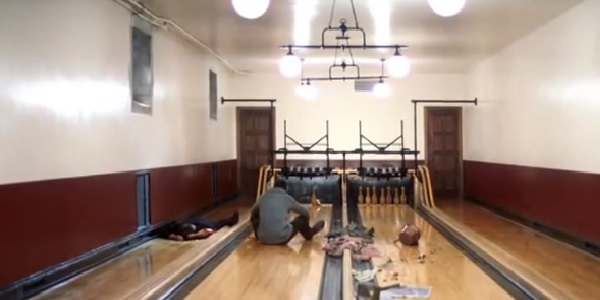
Paul Thomas Anderson's towering epic is commanded almost completely by Daniel Day-Lewis, whose performance as cantankerous, misanthropic oil baron Daniel Plainview stands as one of the greatest ever committed to film. Somewhat ironically, despite the movie's title promising a bloodbath, there's very little of the red stuff throughout the movie, at least up until the concluding section set in 1927, in which an aged Plainview is a filthy rich but lonesome alcoholic. After shooing away his own adopted son, he's visited by Paul Dano's loathsome preacher Eli Sunday, who wants to broker a deal. Plainview toys with Sunday, getting him to declare "I am a false prophet; God is a superstition" numerous times before rubbishing his deal and shouting various phrases at him (most famously, "I...drink...your...milkshake. I drink it up!"). Eventually, Plainview smashes Eli's head in with a bowling pin, and this wakes up his live-in butler, who comes down to check on Daniel to find him sitting in the bowling alley, next to Eli's corpse, before declaring, "I'm finished" as the movie ends. Eli's death serves as a final, brutal exclamation point on Plainview's journey throughout the movie.

11. Harvey Dent - The Dark Knight (2008)

Originally, it was believed that Harvey Dent's character arc throughout The Dark Knight would lead to him becoming the main villain, Two-Face, in the third film in Christopher Nolan's Batman trilogy. However, Nolan decided to rush Dent's arc through in The Dark Knight, introducing him as the District Attorney of Gotham, later having him become horribly disfigured and adopt the Two-Face persona, and end up dying at the end of the movie by Batman's hand. Dent kidnaps Jim Gordon's family and takes them to the burned-out warehouse where Rachel died, and uses his famous coin flip to decide who will live and die. He shoots Batman, survives his own coin flip, and just as he flips the coin for Gordon's son, Batman tackles Dent off the edge of the building, causing him to fall to his death, while Batman's suit takes the brunt of the impact, and he manages to save Gordon's boy. Much like Ra's al Ghul's death in Batman Begins, it was controversial because of how it appeared to interfere with Batman's code: granted, Bats had absolutely no choice but to tackle Dent unless he wanted to let a child just die, but strictly speaking, he broke his rule. However, Two-Face dying after so little screen time caused many to speculate that he would return in The Dark Knight Rises as the main villain, though of course, this wasn't to be.

10. Adolf Hitler - Inglourious Basterds (2009)
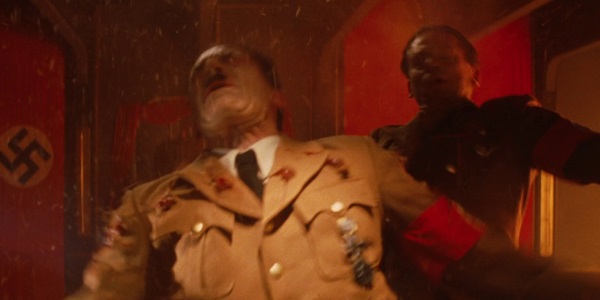
Quentin Tarantino's masterful WWII movie proved (unsurprisingly) controversial for its stylised depiction of a war-time scenario, and most famously how QT decided to alter history. The plot revolves around an attempt to assassinate Hitler and many members of his high-command by sealing them inside a cinema during the screening of a new Nazi propaganda film and blowing the thing up. It would be a mistake to say the plot goes off without a hitch, but the cinema ends up burning down, and the money shot comes when soldiers Ulmer and Donowitz burst into the cinema totting machine guns, which they use to riddle Hitler and Joseph Goebbels with bullets, to the shock and (depending on your sense of humour) possible amusement of everyone watching. Tarantino is well-known for his audacity, but killing Hitler simply took this to another level: in a sense, this act was a rather clever work of collective wish fulfillment, a cathartic cinematic "if only" moment, done entirely with its tongue poking through its cheek. Only the most uptight viewer wouldn't amid feeling a glimmer of satisfaction as Hitler's body was pumped full of machine gun rounds.

9. Albus Dumbledore - Harry Potter & The Half-Blood Prince (2009)

One of the most pivotal and iconic moments in the Harry Potter franchise came when Draco arrived to kill Dumbledore, as was chosen by Voldemort. However, when Draco finds he cannot bring himself to commit such an act, Snape instead casts the Killing Curse, causing Dumbledore to fall from the Astronomy Tower, to Harry's absolute horror. This moment made Snape easy to despise, though it crucially is given additional context in the final movie, The Deathly Hallows Part 2, when it's revealed that Dumbledore's final words, "Severus, please...", were a request to die at Snape's hand rather than Malfoy's so as not to taint Malfoy's soul with murder. Coming as a request from Dumbledore at Snape's knowing hand, however (who was aware that Dumbledore was dying anyway), it would not tarnish Snape's soul and give him a quick death. These later revelations may have softened the blow, but at the time, seeing such a beloved character perish was absolutely devastating to any hardcore Potter fan, if completely in line with the series' increasingly dark and mature tone.

8. Ellie - Up (2009)

Pixar are true masters of the animated medium, with their greatest works challenging the narrative bounds of cartoons, ensuring they can be held up as high as any live-action drama, touching on deeply humanist themes in an arresting, unforgettable manner. Just as they've done with the Toy Story movies and WALL-E in particular, Up manages to be both a gorgeous, exciting movie but also one with depth and intelligence uncommon in the genre. The movie begins with a heartbreaking montage sequence, depicting the life and love of protagonist Carl and his childhood playmate Ellie. We see them plan to travel but constantly have their dreams dashed by the inevitabilities of life, and sadly, Ellie either miscarries or finds out she cannot have a baby, as depicted here with supreme artistry and clever subtlety. However, the most upsetting moment comes when, just as they're finally planning their trip, Ellie falls ill and dies. The moment might not garner much of a reaction from children, though for any grown adult, it's an absolutely heart-wrenching story, and one that's completely relatable. With its ambitious, adult storytelling, it's no surprise that Up went on to become just the second animated film to ever be nominated for the Best Picture Oscar.

7. Mal - Inception (2010)

Mal (Marion Cotillard) is a phantom-like character who appears throughout Christopher Nolan's mind-meltingly brilliant sci-fi Inception. As protagonist Dom Cobb (Leonardo DiCaprio) enters people's dreams, she frequently shows up in the form of a projected memory, usually acting in a malevolent manner which threatens to sabotage whatever Dom's trying to do, in this case his attempt to perform Inception and earn his freedom back. And why does he need freedom? It's explained in a flashback that Dom and Mal spent the equivalent of 50 years in the dangerous dreamscape of "limbo", dream space which the pair filled with their own memories to create a Utopian existence. After finally waking, the two found only a few hours had passed, but Mal was convinced that she was still asleep, to the extent that she climbs out on a ledge and prepares to kill herself. She encourages Dom to do the same, even writing a letter which incriminates him in her death, and with that, she takes a leap, much to Dom's horror. This set in motion the events of the movie, as Cobb fled the US and sought a way to fix his legal issues. Without Mal's death, the rest of Inception's events would simply not be necessary.

6. Severus Snape - Harry Potter & The Deathly Hallows Pt. 2 (2011)

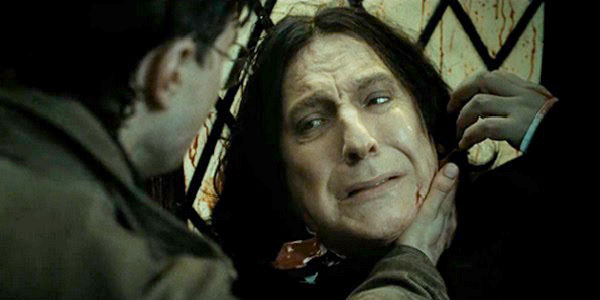
The Deathly Hallows Part 2 was everything the concluding movie in the Harry Potter saga needed to be: it was epic, emotional and delivered plenty of surprises along the way. One of the more crucial moments was the death of Alan Rickman's superb baddie Snape, after Voldemort informs him that he cannot tame the Elder Wand until Snape is dead. At that point, he orders his snake Nagini to kill Snape, biting him several times in rather disturbing fashion (though cleverly obscured from view to keep that precious 12A rating). Harry, Hermione and Ron hear this assault, and after Voldemort leaves, they check on Snape, who in his last words tells Harry to take his memories to the Pensieve. Snape expires, and it's only after his death that he is vindicated, as the truth about his ruse with Dumbledore is revealed. In the movie's epilogue, Harry says to his young son, "Albus Severus Potter, you were named after two headmasters of Hogwarts. One of them was a Slytherin and he was the bravest man I ever knew." A fitting tribute to one of the franchise's best and most beloved characters.

5. Agent Phil Coulson - The Avengers (2012)

Joss Whedon up to his old tricks again here, with the shocking death of Agent Coulson (Clark Gregg) mid-way through The Avengers. Loki attempts to flee the S.H.I.E.L.D. Helicarrier, and because Coulson gets in his way, he ends up being stabbed through the chest, dying not long thereafter. Nick Fury then uses his death to help unite The Avengers and make them co-operate with one another, even showing them some blood-stained Captain America trading cards that Coulson apparently had on him when he died. Maria Hill later goes on to note, however, that Fury doctored the bloody cards himself in order to give the team the "push" they so desperately needed. What's particularly important about Coulson's death is that it wasn't permanent. He was controversially resurrected for the TV show Agents of S.H.I.E.L.D., and easily the most compelling part of the show has been having the nature of his revival drip-fed over the course of the first season. It's eventually revealed that Coulson was eventually brought back to life after a number of complicated surgeries, but his memories of this were altered to avoid a psychotic episode that could arise from the trauma of this knowledge. Smartly, Coulson has been kept out of any post-Avengers Marvel Cinematic Universe movies so far, and it's probably best to keep it that way, as movie-only MCU fans can simply pretend the show doesn't exist, and that way it doesn't cheapen what was a pretty huge moment in The Avengers.

4. M - Skyfall (2012)

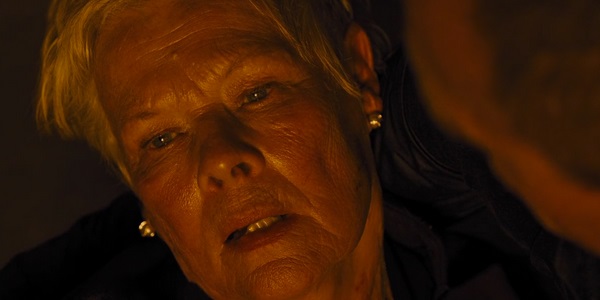
Sam Mendes' Skyfall is easily one of the best James Bond films of all time, a stylish, slick action adventure with a classically old school Bond villain, and of course, the series' own institution, Judi Dench's M. In the months prior to the movie's release, rumours began to surface online that Dench would be retired or possibly killed off from the series due to her deteriorating eyesight, which resulted in her needing to have movie scripts read to her. With this knowledge, Skyfall is infused with even more tension, considering the plot in part revolves around Raoul Silva (Javier Bardem) trying to kill M for giving him up in the past. In the tremendous final set-piece taking place in Scotland, M is wounded during the gunfire, and after Bond kills Silva, she succumbs to her wound, dying in an emotional Bond's arms. It was a watershed moment for the Bond franchise, and though in many ways M was an anachronistic relic left over from the pre-reboot Pierce Brosnan days, she will unquestionably be sorely missed in Bond's next outing, even with an actor of Ralph Fiennes' caliber filling her shoes.

3. Luke Glanton - The Place Beyond The Pines (2013)

The Place Beyond the Pines is a movie that completely defies regular categorisation. Derek Cianfrance's follow-up to his superb Blue Valentine is an epic, sprawling crime drama packed with excellent performances, though one that ended up being shockingly curtailed was Ryan Gosling's turn as the seeming protagonist, motorcycle stuntman-turned-bank robber Luke Glanton. Luke tries to rob another bank, but this time things don't go as planned, and he ends up being pursued by the cops. After falling off his bike, he desperately runs inside a nearby house, where police officer Avery Cross (Bradley Cooper) gives chase. Luke is stuck in an upstairs room when Avery enters, shooting him and causing him to fall out of the window, hitting the concrete below before quickly turning into a bloody mess. That's right, folks, the guy who was clearly marketed as the star to see the movie for dies at the end of the first act, and the rest of the movie follows the years that pass and how Luke's death affects everyone involved, from his family to Cross himself. It's an extremely ballsy move, and one that was concealed cleverly by sly marketing. Thankfully taking Gosling out of the frame wasn't a mere shock tactic, and resting on the shoulders of actors as talented as Cooper and Dane DeHaan (as Gosling's son), the movie certainly didn't suffer from his absence.

2. Zod - Man of Steel (2013)

Comic book movies are always going to be controversial: when you're dealing with source material this iconic and widely-read, everyone has their own perfect vision of how the character is supposed to be depicted on screen, and you're never going to please everyone. Zack Snyder took the ballsy (some might say stupid) risk of having Superman kill his Kryptonian nemesis Zod at the end of Man of Steel, in a suicide by cop-esque scenario, after Zod attempted to use his heat vision to kill some nearby civilians. Superman did what he's rarely seen doing: he kills Zod, violently breaking his neck. It's a hugely important cinematic moment for the character, and much like the earlier entry about Batman's altercation with Two-Face, it's a way of showing how silly these arbitrary no-kill policies are, by taking superheroes and thrusting them into a relatively believable, contemporary setting, where black-and-white moralities simply do not appear logical. Superman had to kill, and Snyder clearly didn't take the decision lightly, as Supes is shown to be deeply distraught at having to kill off the only other Kryptonian resident. What's more, he and David S. Goyer opted for the moment against the wishes of producer Christopher Nolan, who strongly advised against it. WARNING: MAJOR SPOILERS FOR THE AMAZING SPIDER-MAN 2 FOLLOW. If you haven't seen the movie yet, you might want to turn back now.

1. Gwen Stacy - The Amazing Spider-Man 2 (2014)
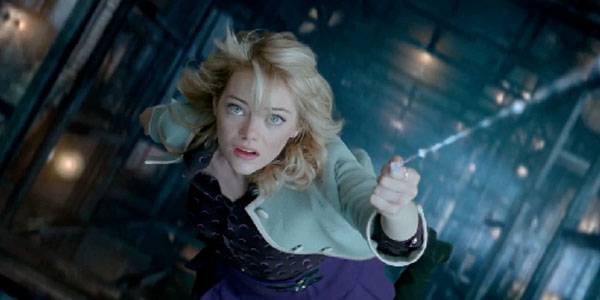
The Amazing Spider-Man 2 may have been a pretty mixed bag overall, but there's one moment it got indisputably right, and that's the death of Gwen Stacy in the climactic showdown between Spidey and Dane DeHaan's Green Goblin. The fight itself may not be up to much, but the drama revolves around Spidey trying to save Gwen from the grasp of the Goblin, who drops her through a clocktower. While subduing the Green Goblin, Spidey catches Gwen with his web shooter, though he proves to be a little slow to the draw, and she ends up violently hitting her head and back on the concrete floor, killing her instantly. This widely-expected moment is drawn straight out of the comics, right down to the clothing Emma Stone is wearing in the scene, and for all of the things the movie got wrong, director Marc Webb totally nailed this extremely dark, emotional moment in an otherwise pretty silly movie. Andrew Garfield deserves particular praise for his performance during the scene: we see a man who has lost pretty much everything, broken and defeated. Did we miss any of your favourite movie deaths from the last 10 years? Let us know in the comments!

Contributor
Contributor

Stay at home dad who spends as much time teaching his kids the merits of Martin Scorsese as possible (against the missus' wishes). General video game, TV and film nut. Occasional sports fan. Full time loon.