20 Things You Didn't Know About Scott Pilgrim Vs The World
More Scott Pilgrim trivia than a speech about the origin of Pac Man.

A certified box office bob-omb on release a decade ago, Scott Pilgrim Vs The World has since become the cult classic that all the geeky kids are in lesbians with.
Condensing a six volume comic book series into a single film, Edgar Wright's genre-bending videogame tribute, a musical action fantasy romantic comedy coming-of-age story, is absolutely packed with energy, incident and colourful characters. Not to mention it's every bit as full of creative references and Easter eggs as Wright's Cornetto trilogy.
There's so much to see in Scott Pilgrim that you really need to go back and rewatch it again and again to spot everything. (Which, judging by its paltry $48 million box office, very few people did at the time).
Never fear, though, because we've gone back through the movie which humbly describes itself as "an epic of epic epicness" to pick out all of the references, in jokes and background details that you may have missed. Feel free to bring any of these up the next time you want to impress a high school girl while playing a ninja-themed dance platform game.
20. It Was Inspired By Bryan Lee O'Malley's Wife's Exes All Having The Same Name

Talking to your new partner about their exes isn't typically a rewarding experience, but in the case of Scott Pilgrim creator Bryan Lee O'Malley it was what provided him with the germ for his most successful idea.
It was on hearing that his wife, comic book artist Hope Larson, had previously dated three guys named Matthew that O'Malley conceived of having to battle a League Of Matthews to win her. This is what developed into the Scott Pilgrim comics' League Of Evil Exes.
The name of Ramona's first evil ex, Matthew Patel, is a tribute to this earlier all-Matthew concept (the surname Patel is borrowed from graphic designer Harsh Patel, who designed the comic's title font).
O'Malley and Larson cameo together in the movie. They can be seen at the bar at Lee's Palace where The Clash At Demonhead play (and apparently the cleaning lady doesn't come in until Monday).
Sadly, O'Malley himself is now another of Larson's exes as the couple divorced in 2014.
19. The Character Names Are Tributes To Canadian Music

It's important to pay attention to the characters' T-shirts in the movie as they tell you a lot about what's going on.
Scott not only consistently changes the colour of his shirt to match Ramona's changing hair colour, but the logos on his shirts are full of references (the "SP" shirt isn't just Scott's initials but also a logo for The Smashing Pumpkins whose Mellon Collie And The Infinite Sadness album inspired the Scott Pilgrim And The Infinite Sadness volume of the comic).
For the fight with first evil ex Matthew, Scott is wearing a shirt with the logo of all-girl 90s indie band Plumtree. This is a reference to the Canadian power pop act's 1998 single Scott Pilgrim, from which O'Malley took the character's name.
The song itself was originally about a guy named Scott Ingram, hence Scott's rival and the third evil ex being named Todd Ingram. (O'Malley has explained that Todd is the "bigger, better, dumber" version of Scott, which is why they have similar sounding names).
Scott's not the only character whose name references Canadian music. His band's hanger on Young Neil has a name that's an inversion of Canadian rock legend Neil Young, while Sex Bob-omb frontman Stephen Stills shares a name with Young's American former bandmate from Crosby, Stills, Nash & Young.
Ramona Flowers, meanwhile, isn't named after a band, but there is a band named after her: Bristolian indie five-piece The Ramona Flowers.
18. Lucas Lee's Movies Are Also Named After Plumtree Songs

Scott's own name isn't the only Plumtree reference in the world of Scott Pilgrim, though.
When Scott goes to confront Ramona's second evil ex, skater-turned-movie star Lucas Lee, Lucas is on the set of his new movie. The film is titled You Just Don't Exist (Tagline: "Cole Hazard has just got a call saying he has 89 minutes to live... from himself!").
Like Scott Pilgrim, You Just Don't Exist is the name of a single from Plumtree's 1998 album Predicts The Future.
In fact, Wright and his production team went to a great effort to design a whole Lucas Lee filmography complete with posters and promotional magazine articles. The vast majority of these films too are named after Plumtree songs.
Predicts The Future also featured the album track This Game's Over, while Lucas has even made a sequel, This Game Is Over 2 ("One good cop is finished fooling around... again!"). Lucas's film Thrilled To Be Here shares its name with a song on Plumtree's final album This Day Won't Last At All. Meanwhile, Let's Hope There's A Heaven (which, according to its poster, was a winner at Sundance and looks like Lucas's step into making weepies instead of action fare) was also a song on the band's debut EP Flutterboard.
Disappointingly, Plumtree never recorded a song called Action Doctor ("The good news is you are going to live. The bad news is he's going to kill you!")
17. The Bands Are All Named After Classic Nintendo Games

If it's not Canadian indie pop that's the source for names in Scott Pilgrim then you can be sure that it's old school console games instead.
Scott's band Sex Bob-omb of course takes its name from the cute little anthropomorphic wind-up bombs in various Mario games. But the other bands in the story have also borrowed some, slightly more obscure, Nintendo nomenclature.
Envy and Todd's next big thing act The Clash At Demonhead have a namesake in Dengeki Big Bang!, a 1989 demon-blasting platformer for the NES that was retitled Clash At Demonhead for its American release. Envy actress Brie Larson, herself a former pop singer, revealed that O'Malley had told her that Clash At Demonhead was the first game he ever owned.
Purveyors of the shortest tunes in rock, Crash And The Boys, are also named after a NES game. In their case it's 1992 multiplayer street sports title Crash 'n' The Boys: Street Challenge.
The final showdown with Gideon happening in the Chaos Theater is also a Nintendo reference as that's the name of a location in cult favourite SNES role playing game EarthBound.
The comics, meanwhile, further flash back to Scott's high school bands Sonic & Knuckles and Kid Chameleon, which mix up the Nintendo references by being named after games on the Sega Genesis.
16. Edgar Wright's Brother Designed The 8-Bit Universal Logo At The Start

Scott Pilgrim is a movie that lays its cards on the pixellated table pretty immediately. If you're the kind of audience that enjoys the classic Universal ident rendered in 8-bit graphics with the accompanying fanfare in suitably tinny, digital form then this is definitely the movie for you.
The 8-bit logo (not even the only joke in Scott Pilgrim to use the Universal fanfare) was something of a family project as the animation was designed and produced by Edgar Wright's big brother Oscar.
An animator and artist, Oscar worked on the storyboards and title designs for both his brother's previous films, Shaun Of The Dead and Hot Fuzz. Fans of Edgar will recognise his brother's work in the "plot holes" extra feature on those movies' DVDs.
For the 8-bit ident, Oscar actually came at it by taking some existing animation (a 3D spinning globe) and simplifying it, stripping it back to two colours, pixellating the curves and then massively reducing the frame rate so that it spun in a jerkier fashion to resemble a Full Motion Video animation from an early 90s game.
Oscar also was a concept designer and storyboard artist for Scott Pilgrim and was responsible for replicating O'Malley's art style in the movie's animated sequences.
15. Everybody In The Movie Is Under 30 (Except The Vegan Police)

Perhaps it shouldn't surprise people that Scott Pilgrim didn't reach audiences across all age groups, given that the movie has an aversion to over-30s that is positively Logan's Run-esque.
Literally every character who gets a name and a credited actor is aged somewhere between the youngest cast member, Brie Larson (who turned 20 between production and the film's release), and the oldest, Brandon Routh (who turned 30 at the same time). So why should anyone born before 1980 really get it?
Amongst a hot young cast of twenty-somethings, Michael Cera was actually younger than the 22 year-old character that he played (as well as younger than Ellen Wong, playing his still-in-high-school girlfriend).
The one exception to Scott existing in a world of perpetual arrested development, seemingly hermetically sealed from either kids or proper adults, is the uncredited cameo from Clifton Collins Jr. and erstwhile Punisher Thomas Jane.
A good decade older than all their castmates, Collins and Jane show up as the Vegan Police arresting illicit dairy consumer Todd, so perhaps it's their refusal of meat products that's given them the superpower to still exist in a world without over-30s.
14. Bill Hader Does All The Videogame Voiceovers

One further exception to Scott Pilgrim's "no over-30s" rule, although only just barely (he was 31), was Saturday Night Live's Bill Hader.
Don't remember seeing the future IT star anywhere in the film? Don't worry, you didn't miss him. He doesn't actually appear on screen nor does he play a named character. Instead, Hader, who at the time was known for a lot of voicework in the likes of Cloudy With A Chance Of Meatballs, is simply credited as "The Voice."
Basically any voiceover anywhere in the film, that's Hader. Hader's voice is actually the first thing in the film after the 8-bit Universal fanfare, introducing the story with: "Not so long ago, in the mysterious land of Toronto, Canada..."
Hader also does all the videogame voiceovers whether they are diegetic sounds within the film itself (such as the "Here we go!" and "Combo!" voice for the Ninja Ninja Revolution arcade game played by Scott and Knives) or game-style commentary on the characters' own behaviour ("Scott earned the power of self-respect!").
13. The Sound Cues Are A Link To The Past

One way in which the Scott Pilgrim movie can tap directly into its millennial audience's nostalgia for videogame classics that a book could never achieve is through creative sound design.
So, of course it comes as no surprise that Scott Pilgrim is packed with videogame sounds like the triumphant "K.O!" when Scott defeats Gideon, which is taken from Street Fighter Alpha 3.
More than any other gaming classic, though, it is The Legend Of Zelda that most influences Scott Pilgrim's soundscape. As soon as Hader's voiceover introduces our hero, the movie transitions into further setting up the characters with a whole heap of Zelda sounds. Scott and Wallace's home appears to the intro music from the SNES Zelda game A Link To The Past, while the whistle from the N64 Ocarina Of Time sounds as a caption pops up with Scott's stats.
Later in the movie, there is an extended Zelda musical interlude when Scott's hallway fantasy with Ramona is accompanied by the iconic Great Fairy's Fountain theme, which also first appeared in A Link To The Past.
Wright even wrote a letter to Nintendo calling this music "the nursery rhyme of this generation" in order to convince them to allow its usage.
Away from sound effects, there's also a visual Zelda reference in how Gideon's triple G record label logo is just an upside-down Triforce symbol.
12. In A Reversal Of Its Own Plot, It Was Almost Shot In New York Instead Of Toronto

In the scenes on location for Lucas Lee's movie there is an Empire State Building backdrop, a joke about how Toronto is in constant use as a film set but only to play more iconic American cities, never itself.
It's a trend which makes Scott Pilgrim a bit of a rarity in actually making a film not just in Toronto, but also about Toronto. If the executives at Universal had had their way, however, then things could have gone in the opposite direction and seen this Toronto-based comic getting shot instead in New York itself.
Scott Pilgrim only ended up using the real Toronto as a location because Wright insisted on it. He felt that the particular chilled (and chilled, as in cold) atmosphere of Canada's biggest city was integral to the feel of O'Malley's world.
Not only did Wright make use of locations in Toronto landmarks like Lee's Palace, Casa Loma and the Pizza Pizza chain, he also shot on the same unremarkable, everyday streets that had inspired O'Malley's original art in the comics. This way, even when the movie is at its most imaginatively fantastical, it is always grounded in the regular mundanities of the real Toronto.
11. The Art Direction Is Full Of X Symbols

Just as in his Cornetto trilogy, Wright loves filling the visuals of his movies with references, call backs and sight gags. So, in this movie all about evil exes, the letter X can be found pretty much wherever you look.
When Ramona gives Scott her number, for example, she writes seven kisses beneath, which of course is also seven Xes for the members of the League Of Exes. It's a symbol that represents both the large amount of love that Ramona has to give and the amount of baggage that she comes with from her past relationships.
(Incidentally, Ramona's number - 212-664-7665 - belongs to Universal to use it instead of the classic 555 code which traditionally appears in movies. This means that the number also shows up the studio's other projects. Ramona shares a number with characters in deadly serious Spielberg true-life assassin movie Munich).
Xes frequently feature on characters' costumes, such as the X-Men patch on the sleeve of Scott's jacket and the twin Xes on Lucas Lee's belt buckle.
Even the backgrounds are full of Xes. Early in the movie Scott and Knives are shown walking through the snow where the cleared tracks make an X shape, street signs often show Xes for crossings, and when on the bus Ramona first tells Scott that he will have to defeat her evil exes, all the lights outside her window look like little Xes, while outside Scott's they look like hearts.
10. The Evil Exes All Have Their Numbers Attached

On top of all the Xes that can be spotted throughout the movie, each of Ramona's Evil Exes comes with an enormous amount of references to their number in the story.
This is at its most obvious when Scott faces off against Evil Ex Number 3, Todd, who comes wearing a shirt with an Adidas-style three-striped sleeve and a giant number "3" on the front, but can be seen in the costumes of all of the others.
Matthew Patel has a red chevron on his sleeve which looks like a 1, Lucas Lee has a tattoo of a symbol for 2 on his neck (as well as the previously mentioned 2 Xes belt buckle), Roxy Richter has four rips in her stockings, and the Katayanagi Twins have figures representing 5 and 6 on their cuffs.
The numbers are used in other ways as well. Defeating each ex gives Scott a thousand more points (so, he scores 1000 for Matthew, 2000 for Lucas and so on). The Exes' numbers appear around the fight locations. Todd is fought in an alleyway with 3s spray painted on the walls and trash cans and Roxy at a club called 4.
For seventh, and final, ex Gideon, the numerology really goes into overdrive. The Chaos Theater is on Level 7. Scott is attacked by seven guards and earns 700 points every hit he lands. Gideon's katana increases all his stats (including "hair" and "cockiness") seven times. Scott gets $7,000,000,000 when he wins. Gideon even swallows his gum and cites the urban myth that it will take seven years to digest.
9. Scott Is Associated With The Number Zero (Except At One Point)

While the movie's numerology associates all of Ramona's exes with a different digit, Scott gets a number of his own: zero.
On the one hand, this represents that he isn't an evil ex and doesn't get a number within their ranking. On the other, however, it fits with his self-doubt and insecurity, picked on when Gideon puts him down by saying: "You're not cool enough for Ramona. You're zero, you're nothing."
Scott is associated with zero through his drink of choice, Coke Zero, as well as his clothing. On going to see The Clash At Demonhead and later fighting Todd, who is wearing the "3" shirt, Scott dons a black T-shirt with "zero" written across it (a style popular with Billy Corgan and therefore another reference linking Scott Pilgrim and Smashing Pumpkins).
There is, however, another number shirt that Scott wears later in the movie. After the battle with fourth ex Roxy Richter, and a quarrel in which he and Ramona break up, Scott can be seen in a shirt with the Fantastic Four logo, only with ½ added in next to the "4".
This is a direct lift from the same outfit that Scott wears at that point in the comic and represents the idea that at this moment he's half way to becoming an evil ex himself.
8. Ramona's Costume Pays Tribute To Her Dead Brother

In order to help the cast to better understand their characters before production began, Wright's co-writer Michael Bacall used O'Malley's notes to write little crib sheets of "10 Secret Things" about each character.
Many of these have remained secret and some that have been revealed have proved controversial. Aubrey Plaza, for example, has said that her insight into her character's backstory meant that she played Julie as having a secret crush on Scott which she is angry at not being returned. O'Malley, though, has strenuously denied that this was in any way his intention when writing Julie.
One detail that has been revealed from the "Secret Things" told to the cast, however, is an element of Ramona's costume that has some added emotional weight for her.
Ramona's actress Mary Elizabeth Winstead revealed that part of the emotional damage which had made her character into who she was today had come as a result of her brother dying young. In the movie, Ramona wears one of her brother's shoelaces around her neck so that she can always remember him.
7. Beck Wrote The Songs For Sex Bob-omb

As a film structured around a Battle Of The Bands, Scott Pilgrim is full of music. All of the cast had to learn to play their instruments and to perform together. On top of this, the production brought in a load of talented musicians to write the actual songs that appear in the film, most prominently alt-rock icon Beck.
The seven-time Grammy winner reached for his Rhyming Becktionary to pen such garage rock numbers as Garbage Truck, Threshold and Launchpad McQuack (that's not the actual title of the song) for Sex Bob-omb to perform in the film.
In tribute to Beck's involvement in the movie, his acclaimed 1996 album Odelay can be seen when Scott and Knives are in the Sonic Boom record store. Scott takes the Clash At Demonhead album that Knives is considering buying and puts it back on the shelf in front of the Beck CD.
The Clash At Demonhead's own music was also provided by a real act, in their case Canadian indie rockers Metric.
Metric frontwoman Emily Haines is also part of the sprawling Toronto-based musical collective Broken Social Scene, the band whose Anthems For A Seventeen Year-Old Girl is used as a soundtrack for Scott's relationship with Knives. Broken Social Scene also penned the few seconds of thrash punk that makes up Crash And The Boys's on screen oeuvre, including I'm So Sad, So Very, Very Sad and We Hate You, Please Die.
6. Shots From The Film Made It Into The Comic

O'Malley's Scott Pilgrim comics were picked up for a film adaptation almost as soon as they appeared. This meant that only the first two volumes were actually publicly available when Wright and Bacall began working on the script for their adaptation. Even by the time the film was shooting, the sixth and final volume, Scott Pilgrim's Finest Hour, hadn't even been fully written.
This meant that, while Scott Pilgrim the movie has its fair share of the traditional comic book movie trope of recreating scenes from the page directly onto the screen, it also provides a much rarer example of things going the other way.
With O'Malley consulting and feeding back on the script even as he finished the comic version, Wright has admitted that there are both lines that O'Malley came up with that were in the movie, but never actually made it into the comic, and lines that Wright and Bacall wrote for the movie and O'Malley then lifted for his version.
This is even the case with some of the visuals. For example, the shot in which Scott is defeated in his first fight with Gideon and there is a caption with an arrow pointing to him simply saying "dead" is a shot conceived by Wright for the movie, but O'Malley liked it so much that an identical panel shows up in the comic as well.
5. Hardly Anyone Blinks

You'd really have to keep your eyes peeled to spot it, but one of the stranger details about Scott Pilgrim is that there is barely any blinking in the movie at all.
Taking a cue from O'Malley's wide-eyed manga-style art, the movie sought to capture a kind of anime feel in live action. While not going for full-on Alita-esque digital big eyes, Wright did, in his own words, fill the cast with "people with very expressive faces and eyes you could get lost in", describing the movie as "ocular porn". Basically, as a Tarantino movie is to feet, so Scott Pilgrim is to eyes.
Wright wasn't content simply to cast big eyed actors, though. To really nail that anime look he also insisted that the cast not blink. In fact, the director would order a whole new take on otherwise satisfying scenes just because an actor had blinked, prompting the on set nickname "the Blink Nazi".
The champion of keeping their eyes open? Alison Pill who played Kim and keeps a steely stare throughout, only blinking once in the entire movie.
Scott Pilgrim's unblinking world may be something that very few audiences pick up on, but it nevertheless subconsciously adds to the feel of watching a live action cartoon or videogame and is just further evidence of Wright's obsessive attention to detail.
4. Lucas Lee's Stunt Doubles Are Chris Evans's Real Doubles

Relying on them to fight Scott in his place, Lucas Lee tells our hero that he's "nothing without my stunt team". The same could be said for any real life action star including the one that plays Lucas right here.
With the former Human Torch and future Captain America, Wright was able to make use of having his in-movie action star played by a genuine action star from the real world. As a result, he didn't need to look far to cast Lucas's on screen stunt team.
The joke in the film may be that, while some of the Lucaslikes genuinely resemble the actor they are doubling for, increasingly as they fan out they look less and less convincingly like the preening skateboarder or the real actor who plays him. But in reality they were all genuinely Evans's real world stunt team.
It was another Marvel star, however, who inspired Lucas's practice of letting a double fill on for the wide shots when he feels like getting blazed in his winnie. This is a not so subtle dig at Wesley Snipes during the filming of Blade: Trinity in Canada.
Just like Lucas, Snipes would reputedly spend most of his time getting high in his trailer while a double filled in for anything that didn't require close ups or dialogue.
3. The Proposed Ending Was Ditched Because It Felt Like A Transformers Parody

With O'Malley not having finished writing the books, Wright and Bacall had to come up with their own climactic showdown with abusive, controlling uber-ex Gideon. Given the anime and videogame stylings of the rest of the movie, they settled on an obvious boss battle: Scott versus Mecha-Gideon.
Scenes were scripted and there were even storyboards and concept art for a sequence in which, after Scott beat Gideon, the latter's glasses would regenerate into a giant robotic Jason Schwartzman.
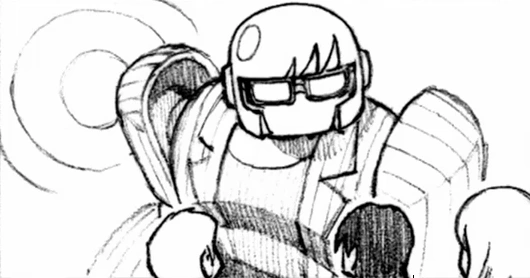
There have been various explanations put forward for why this grand finale didn't make it into the final draft of the screenplay, its place in the story replaced by the appearance of Nega-Scott.
For one thing Mecha-Gideon didn't quite fit with how O'Malley envisioned the climax of his story playing out (the comics writer describing the concept as "a bit too big and dumb"). It also would have been enormously expensive to film on a production that was already stretching its budget to breaking point.
The last word on Mecha-Gideon from Wright, though, was that "we thought it would look like a Transformers spoof, so we ditched it".
2. In The Original Ending, Scott Gets Together With Knives

Mecha-Gideon wasn't the only thing about the film's ending that changed as O'Malley wrapped up his own ending in the comic. In fact, a very different conclusion got as far as being shot and shown to test audiences.
Not being clear on which of the girls Scott would actually end up with, Wright originally shot an ending in which Scott and Ramona apologise to each other (for being "nonchalant and aloof" and "stupid and asinine" respectively) and go their separate ways, Scott realising that Knives was the right girl for him all along.
In the final moments of the original ending, Scott and Knives return to the arcade, playing Ninja Ninja Revolution in perfect synchronised harmony.
Test audiences did not respond well to this version, however, feeling let down by Scott fighting so much for Ramona only to let her go. Seeking something less divisive, Wright reshot the ending with the version we now know, which conveniently tallied with how O'Malley would decide to end the comics.
Wright now says that the Ramona ending is the one which he finds much more satifsying, calling it his preferred ending. The Knives ending is available to watch on the DVD and Blu-ray, however, and is a sweet conclusion in its own right. It would have been a different movie with that end, but not necessarily a worse one.
1. In A Planned Alternate Ending, Scott Was A Serial Killer Fantasist

Not content with being unsure about how to end the Scott-Ramona-Knives triangle, Wright also came very close to shooting one more ending for the film and it would have been a hell of a dark curveball.
In this version, the veil of the colourful videogame fantasy would have dropped and revealed that this was just the sociopathic Scott's method of processing the brutal murders of his crush's seven exes.
Wright has revealed that he planned to use the movie's reshoots to film a news report on a Toronto serial killer and his horrific murders across the local music scene, which could then serve as a bleakly downbeat alternative coda to the otherwise bright movie. It was only the tight timeframe for reshoots that prevented Wright from filming the scene.
To be fair, the "Canadian Psycho" ending was almost certainly never intended to be one that would give a nasty sting to the theatrically released version of Scott Pilgrim. More likely it was intended for the DVD and Blu-ray, with home releases of Wright's movies tending to be packed with extras, Easter eggs, and additional meta jokes on the film.
Either way, though, serial killer Scott Pilgrim is something we're sorry to miss out on even as an alternate extra feature.