20 Things You Somehow Missed In Jackie Brown
Breaking down Tarantino's criminally underappreciated masterpiece.

For some reason, Jackie Brown is a bit of an odd duck in Quentin Tarantino's illustrious filmography - the one that even a lot of Tarantino's supposedly die-hard fans haven't ever seen.
And yet, it's a terrifically crafted, superbly acted homage to 1970s blaxploitation films that ranks among his finest work, even if it understandably doesn't reach the iconic highs of Pulp Fiction.
Jackie Brown's default status as Tarantino's least-watched major release means that there's probably a lot you haven't picked up on, because this movie is as richly, densely detail-packed as anything the legendary filmmaker has ever produced.
Jackie Brown is absolutely a movie that rewards those who pay attention, and yet even its biggest fans might've missed some of these details, Easter eggs, and references.
It is a film positively awash in wink-wink gags for fans of exploitation cinema and of its incredible leading lady, Pam Grier, not to forget Tarantino's own wider filmography.
Like so many great movies, it's one that reveals more and more with each new viewing, but we'll save you the time by breaking down the 20 neatest details you absolutely need to see...
20. The Casting Director Is Named "Jaki Brown"

Unless you've paid close attention to the film's opening credits, here's something you can miss incredibly easily. During the titles, one of the movie's two casting directors is revealed to be named "Jaki Brown."
Now, we certainly wouldn't put it past Quentin Tarantino to make a gag out of this, either by inventing a fictional casting director or having one of them go uncredited for the sake of the joke.
But alas, IMDB indeed reveals Jaki Brown to be a real Hollywood casting director with 60 credits to her name on movies such as Boyz n the Hood, Cool Runnings, Billy Madison, and Friday prior to working on Jackie Brown.
Brown has sometimes gone by her married name Jaki Brown-Karman, though evidently chose not to for this movie, because the coincidental hilarity was just too damn fun to pass up, right?
19. Tarantino's Voice Cameo

Tarantino often makes on-screen cameo appearances in his movies, though for Jackie Brown he opted to make a considerably sneakier vocal cameo that you might've quite easily missed if you weren't paying full attention.
When Jackie (Pam Grier) gets an answering machine message at home, the voice of the machine is Tarantino himself, who says, "You have one message sent at 8:06pm."
The fidelity of the sound recording is muffled just enough that it's not immediately obviously Tarantino's voice, and to make it even funnier, he also adopts a robotic vocal tenor as you'd expect to hear on an automated answering machine.
18. Jackie Drives The Same Car As Pulp Fiction's Butch

Throughout the film, we see Jackie driving a white 1980 Honda Civic - a very specific vehicular choice by Tarantino given that it was the first car he himself owned as a young man.
Better yet, Tarantino has included the car in three of his movies - a few years before he made Jackie Brown, he also had Butch (Bruce Willis) drive a white 1980 Honda Civic.
While it's reasonable to assume that the two characters aren't supposed to be driving the very same Honda considering how spectacularly Butch crashed it in Pulp Fiction, it's still a fun piece of shared DNA between the two movies.
Additionally, the car can also be seen parked outside the My Oh My strip club in Kill Bill Volume 2 for a few moments.
17. The Significance Of Sid Haig's Cameo

If you recognise the judge presiding over Jackie's case early in the movie, that's because he's played by Sid Haig, better known in recent years for his role as Captain Spaulding in Rob Zombie's Firefly trilogy.
But Tarantino cast Haig in the film for one majorly specific reason - he'd previously starred as the white villain in a number of exploitation/blaxploitation films opposite Pam Grier throughout the 1970s, such as Coffy, Black Mama White Mama, and Foxy Brown.
Grier didn't know about Haig's casting until she arrived on set and reportedly burst out laughing at the pleasant surprise.
As for Haig, this wasn't his first time dealing with Tarantino - he was originally offered the role of Marsellus Wallace in Pulp Fiction, as of course eventually went to Ving Rhames after he turned it down.
Haig later expressed regret for rejecting the part, but at least got to work with Tarantino just a few years later - and also had a small role as the strip club bartender in Kill Bill Volume 2.
16. Samuel L. Jackson Says "Motherf**ker" More Times Than In Any Other Movie

Samuel L. Jackson has said the word "motherf**ker" literally hundreds of times throughout his career, enough that the word has basically become his catchphrase and even been joked about in his Marvel Cinematic Universe work.
But it's Pulp Fiction which saw Jackson truly make an art form out of the word, where he said it an impressive 26 times.
Yet for Jackson's subsequent collaboration with Tarantino in Jackie Brown, the pair evidently sought to out-do themselves on that front. And that they certainly did.
Throughout the film, Jackson's Ordell Robbie says "motherf**ker" a stonking 37 times, easily topping Pulp Fiction as the most times he's said the word in a single movie - a record he holds to this very day, in fact.
Jackson does such a superb job of making every utterance feel both organic and unique that it's easy to forget he says it quite so much across the film's 154-minute runtime.
15. Max Lies About His Age

Bail bondsman Max Cherry (a brilliant, Oscar-nominated Robert Forster) is one of the movie's most memorable characters, but here's something you probably never noticed - he lies about his age one way or another.
Near the very end of the movie, Max tells Jackie, "I'm 56 years old. I can't blame anybody for anything I do," but when we get a brief look at Max's ID, it says that he was born in 1948, and with the plot taking place in 1995, that would make him 46 or 47 years old.
While it's entirely possible this was simply a mistake on the part of the prop department - given that Forster was himself in his mid-fifties when Jackie Brown was filmed - one could also surmise that, for some reason, Max either lied about his age to Jackie or lied about it on his ID.
The latter is easily most likely, because it's simply more probable that a bail bondsman who deals with criminals might want a fake ID, rather than him purposefully telling Jackie, his love interest, that he's older than he is.
14. Mira Sorvino's Out-Of-Focus Cameo

In the movie's first act, as we see Jackie being jailed and arraigned in court, keep your eye on the blonde woman out-of-focus behind her inside the court.
Why, that's none other than Mira Sorvino, who the year prior won a Best Supporting Actress Oscar for her performance in Mighty Aphrodite, and was Tarantino's romantic partner at the time that Jackie Brown was being shot.
Sorvino is visible in a few quick shots behind Pam Grier, and though uncredited for her appearance, did receive a cryptic thank you in the film's end credits.
In the "special thanks" section, Tarantino lists Sorvino as "Bert D'Angelo's daughter," given that her father, acting giant Paul Sorvino, played the character Bert D'Angelo on the short-lived 1976 police drama Bert D'Angelo/Superstar.
13. The Cocaine Inn
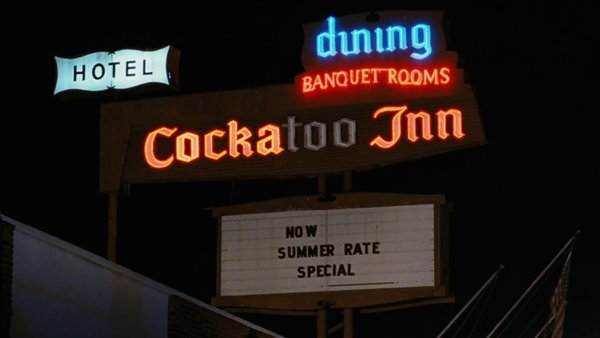
Neon signs are a very fun way for filmmakers to hide messages in plain sight, by having their gaffer rig up a neon sign to omit certain letters in the signage to spell out a cheeky secret message.
In Jackie Brown's case, Tarantino hid one in plain sight when Ordell and Louis (Robert De Niro) head to a bar named the The Cockatoo Inn for a drink.
An exterior establishing shot shows the sign with the word "too" de-illuminated, leaving behind "Cocka" and "Inn." And gee, what does cocka + inn sound like? That's right, cocaine, which of course plays a major role in the movie's plot.
12. Max Learns To Wash His Hands

Tarantino loves including subtle morsels of character shading in his movies which, while hardly necessary for the plot to unfold, are nevertheless fun and interesting for fans to spot.
Case in point, when Ordell shows up at Max's office near the start of the movie, Max flushes the toilet and returns to his office, where Ordell jokingly admonishes him for failing to wash his hands. Hilariously, Max doesn't go back to wash them and just... continues with the interaction.
But this pays off quite amusingly at the very end of the film when Jackie pays Max a visit, and after Max emerges from the toilet door we can see him rubbing his hands, having obviously just washed them.
Ordell may be many things, but at least he got Max to stop being such a dirty bastard.
11. The Visible Camerman

As technically sublime as Tarantino's movies are, even he isn't above the most basic of cinematic mistakes - a visible cameraman in a reflection.
It's something that filmmakers quite understandably hate dealing with, because they just want to tell their story, right? But camera placement is key, and in this case it ended up accidentally revealing how the sausage is made.
When Ordell argues with Jackie on his patio, keep a close eye on the patio door, especially when Ordell opens it up - the silhouette of the shot's cameraman is faintly visible in the reflection.
Ultimately it's better to get a great shot even if it means including a mistake that 98% of people won't ever notice, but even so, it's an imperfect moment in a largely perfect movie.
10. Bridget Fonda Watches A Movie Starring Her Father

Bridget Fonda meanwhile plays the unforgettable part of Ordell's kept lover Melanie Ralston, and spends a large chunk of the movie glued to the couch and getting high with Louis.
In one mid-film scene at night she's watching a movie with Louis, which eagle-eyed viewers might identify as the 1974 crime drama Dirty Mary Crazy Larry.
This wasn't a merely random choice by Tarantino, though: the film stars Bridget Fonda's own father Peter - who is thanked in the movie's end credits - and Tarantino evidently couldn't resist having Fonda watch a movie starring her own dad.
If you managed to catch this one for yourself, have a pat on the back.
9. The Racy Photo Of Ordell On His Fridge

Near the start of the movie, Ordell takes a phone call in his kitchen and, for a few seconds, we get a clear view of the fridge in his apartment. It seems totally unremarkable, right?
Save for the fact that the fridge has a photo of Samuel L. Jackson himself stuck on it, where he appears to be sitting naked in a bathtub while staring at the camera no less.
Though we don't get a great close-up look at the photo, it's clearly a picture of a much younger Jackson, with many online believing it to have been taken when Jackson was shooting his small but memorable role in Goodfellas back in 1989.
Either way, what a delightfully strange Easter egg.
8. Pam Grier Sings A Song On The Soundtrack

During the brief sequence where Jackie is shown being led to jail, the song "Long Time Woman" can be heard playing from the 1971 sexploitation film The Big Doll House.
Similarly, that film is centered around a group of women making it through daily life in a dingy prison, but beyond Tarantino's obvious affection for the genre, the real kicker is that Pam Grier not only starred in The Big Doll House as one of its incarcerated ladies herself, but even sang the aforementioned song.
If you caught this Easter egg without any prodding at all, very well done.
7. The $550,000 Was Real Money

The overwhelming majority of the time that you see money in a movie, it's fake, because of course, who wants to volunteer their own cash to be left sitting around on a film set all day, especially if large quantities are involved?
Movie money also often ends up being a little larger than real money or slightly altered so that it can't easily pass for legal tender, but in the case of the $550,000 that Jackie smuggles into the U.S. for Ordell, it was 100% real.
Tarantino, ever a stickler for details, insisted that prop master Steve Joyner find a way to conjure that amount of money the hard way, and though the source of the moolah has never been revealed, the money is indeed totally legit.
One can assume that whoever the money belonged to didn't let it leave their sightline for the entire time it was on set.
6. The Extremely Subtle Reservoir Dogs Reference

During the mid-film scene where Jackie, Ray Nicolette (Michael Keaton), and Mark Dargus (Michael Bowen) prepare to carry out a trial run of the money exchange, Ray says that the shopping bag for the hand-off is purple, while Jackie and Mark both attest that it's actually white.
Ultimately the trio go back and forth on the colours before finally agreeing that the bag is white, has purple on it, and also features pink lettering.
This is an extremely sly nod to Reservoir Dogs, namely the memorable scene where Mr. White (Harvey Keitel) and Mr. Pink (Steve Buscemi) argue over Pink's desire to change his name to Mr. Purple, with White and Joe Cabot (Lawrence Tierney) promptly shutting his request down.
5. Max Is Actually Watching Jackie Brown At The Mall

OK, this one's really weird and incredibly meta, even for the standards of Tarantino.
Just before the dry run, we see Max at the mall leaving the movie he'd just finished watching, and we can hear the end credits music loudly playing while the door is propped open.
This song is actually a track called "Monte Carlo Nights" from Jackie Brown's own original score, as ends up playing in the latter half of the movie's actual end credits.
While this was clearly just a mischievous gag on Tarantino's part, given that the song was made specifically for this movie, we're led to conclude that Max was somehow watching Jackie Brown itself. Wild.
4. The Buzzer Easter Egg

When Jackie goes to Ordell's apartment, keep an eye on the names of the apartment tenants on the buzzer for a quick Easter egg-y surprise.
First and most noticeably there's "S. Haig" - clearly a reference to Sid Haig, who of course appears in the film as the judge presiding over Jackie's case.
But two names lower is a much trickier one, "J. Hill" - a nod to exploitation filmmaker Jack Hill, whose movies both Haig and Pam Grier appeared in throughout the 1970s.
Basically if you see any random names written on-screen in a Tarantino movie, there's a good chance they're referencing something.
3. Danny DeVito POSSIBLY Makes A Cameo

Now, this technically counts as a bit of an urban legend given that it's still never been confirmed one way or another by anybody who actually worked on the movie.
But during the opening sequence where Jackie heads through the metal detector at the airport, a man who bears a distinct resemblance to Danny DeVito can be seen walking behind her for a second or so.
We never see the man's face, but his stature is startlingly similar to DeVito's at the time, and given that DeVito was a producer on Pulp Fiction, it's easy to believe he'd manage to wrangle himself in a cameo in Tarantino's follow-up joint.
Again, we still don't know for certain either way, but the quasi-trivia has become a piece of the movie's lore in its own right over the last 25 years.
2. Acuna Boys

Tarantino certainly loves inventing fictional brands and then featuring them across his subsequent films - most famously evidenced by his regular inclusion of Red Apple cigarettes somewhere in most of his projects.
But Jackie Brown birthed another cinematic tradition for the filmmaker, as when Jackie and Sheronda (Lisa Gay Hamilton) make the bag exchange at the mall's food court, note that Sheronda is drinking from a cup with the branding "Acuna Boys."
Acuna Boys have been featured in numerous Tarantino films since, though only once as another branded drink - as Acuna Boys soda in Death Proof.
Elsewhere Kill Bill Volume 2 has pimp Esteban Vihaio (Michael Parks) running a crime ring called the Acuna Boys, and the Acuna Boys are seen in an intermission ad in Grindhouse.
It's worth mentioning that Tarantino lifted the name from the name of the central gang in the 1977 revenge film Rolling Thunder.
1. It TECHNICALLY Has The Lowest Body Count Of Any Tarantino Movie

The majority of Tarantino's movies of course feature their fair share of death, but Jackie Brown is actually the least-deathly of his entire filmography, technically speaking.
The film features just four deaths - Beaumont Livingston (Chris Tucker), Melanie, Louis, and Ordell.
While Kill Bill Volume 2 only features three deaths in its direct chronology, we also witness a flashback where the entirety of The Bride's (Uma Thurman) wedding party is slaughtered, boosting the number significantly.
Jackie Brown is tied, however, with Tarantino's most recent film, Once Upon a Time in Hollywood, which also features a total of four deaths - an especially ironic outcome given the movie's focus on Charles Manson (Damon Herriman).