20 Things You Somehow Missed In The Matrix
There is no spoon, but there is a pen.

At over 20 years old now The Matrix remains the standard-bearer for boundary-pushing modern cinema. Nothing since has changed cinema in quite the way it did and, while its sequels may have proved divisive and its tropes become overdone to the point of parody, it still holds up as an incredible action movie.
The film considers the premise that humanity is secretly trapped in a global mental prison, created and maintained by the race of machines that had overthrown them, and exists now as only an emaciated, comatose energy source. It follows a group of freedom fighters as they attempt to liberate the human race through the arrival of a prophesied messiah known as "The One".
Also, the soundtrack is incredible.
Releasing in 1999, the movie was the last of the big blockbusters to be spared the constant easter egg hunting of modern message boards and movie threads. Which is a shame, because the Wachowskis stuffed it full of philosophical references, narrative secrets, and other delightful little things for the audience to find during a rewatch.
There is no spoon in this list, but there is a pen you're going to find particularly interesting.
20. The Matrix Is Green

Wanting to create a clear visual distinction between the real world and the Matrix itself, the Wachowski's used some clever cinematography to subtly create a distinction. Specifically, every scene that takes place within the Matrix was digitally given a subtle tint of green, to order to transmit both its artificial nature and create a sense of unease.
The colour was selected to give the feel of viewing the scenes through the screens of old PC’s, which specifically rendered information in a phosphorous green. The idea also being that, as well as appearing artificial, being in this world should make you feel slightly queasy.
19. The Real World Is Blue

That attention to detail didn't stop there though, as to better accentuate the putrid greens of the Matrix, Director of Photography Bill Pope gave the real world a contrasting blue hue all of its own.
Speaking in an interview after the movie, he said; "from the Nebuchadnezzar and the pods, ‘reality’ was given a cooler look, a bluer, more normal, less sickly look. The future in the film is cold, the sun is blotted out, there is no real warmth unless it is artificial heat, so that is why they went for the cool side. The Matrix should make you feel sick, and in ‘reality’ you should feel a little more at home, but never comfortable".
Finally, the training programme where Neo and Morpheus fight is tinted yellow, to represent the fact that it neither the Matrix nor reality.
18. Questions?

Neo's character arc is easily broken into two halves. Eventually, he becomes The One and, through fully utilizing his power to control The Matrix, rescues Morpheus, begins the human race's fightback against their maniacal overlords, and discovers Rage Against The Machine.
But prior to this, Neo's role in the movie is to extract the exposition from the other principal characters (something done at the request of the studio who were worried the audience wouldn't understand the plot otherwise). Thus, in the film's opening 45 minutes, Neo's 80 lines of dialogue contain an astonishing 44 direct questions.
This is almost one every single minute and makes it one of the most subtext heavy movies in modern cinema.
17. Bruce Lee

Despite being planned and storyboarded to within an inch of its life, The Matrix does include a number of unscripted or improvised moments. Ironically, they all tend to come during the most highly-choreographed moments of the movie, despite the actors spending literally months in training to ensure they had their routines down.
One of the most notable concerns a brief moment when Neo attempts to gather himself during the training fight with Morpheus. Setting himself up for the next bout, he quickly brushes his nose in what Keanu Reeves would later reveal was an ad-libbed tribute to Bruce Lee. Despite it not being the best take, he successfully lobbied to keep it in the film.
16. Walter Cronkite
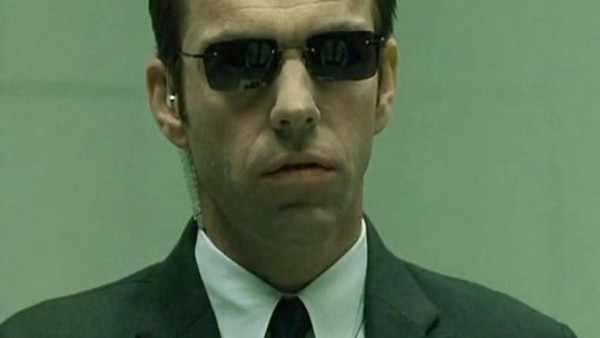
One of the most striking elements of the Matrix was the performance of Hugo Weaving as Agent Smith. It's a performance that perfectly encapsulates the androgyny of a villain that is neither entirely man nor machine, whilst retaining hallmarks of both.
However, when researching the role and building the physical performance, Weaving began modelling parts of his delivery on the dry matter-of-factness associated with Mid-20th-Century newsreaders. Specifically, Walter Cronkite, the legendarily US journalist and host of the CBS Evening News show for almost two decades.
After famously reporting both the Moon Landing and the Kennedy assassination, he was dubbed 'The Most Trusted Man in America", giving Weaving's performance a sinister familiarity.
15. "Drunken Boxing"

One of the cleverest easter eggs in the entire movie concerns the very brief shots of Neo's crash course in hand-to-hand combat. As he's sat in the chair having the knowledge and muscle memory uploaded directly into his brain, several different style briefly flash up on the screen. Including the amusingly named "drunken boxing".
This is a nod to the movie's fight choreographer, Woo-Ping Yuen. A man who partially made his name while working as the choreographer on Jackie Chan's Drunken Master, a movie where the titular character sets out to learn the martial art style of Zui Chuan. Or, as it translates back into English... Drunken Boxing.
14. The Glyphs

The coded green rainfall became an iconic image of the movie (and, indeed, everybody's screensaver in 1999) but the way it was created is actually a lot less clever than it looks onscreen. While the effect needed to have them tumbling down the screen required some extensive work, sourcing the characters themselves was quite straightforward.
Wanting to use both western letters, numbers and Japanese katakana symbols, the movie's production designer took one of his wife's sushi books and simply scanned in all the recipes. They then elected to reverse all of the charachters, to convey the idea that you're looking in from the wrong side.
13. Neo Doesn't Kick

Despite the rigorous months of training required to complete the film, Keanu Reeves entered pre-production while still recovering from severe neck surgery. This meant that while he was able to learn a lot of the choreography, he was without full use of his legs and sat out the bulk of the kicking training.
This required some alterations to the film and, as a result, Neo uses far fewer kicks than the other characters in the movie. In fact his only real flurry of them comes in the construct training fight with Morpheus, which was filmed near the end of production.
12. September 11th, 2001
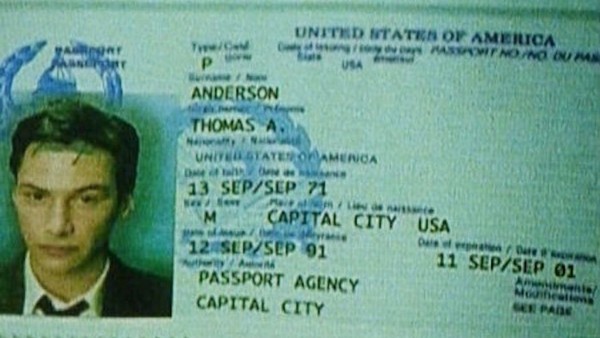
In the early scenes of the movie Neo is taken in for questioning by a trio of Agents who, in the hope of using him to apprehend Morpheus, begin to grill him on his criminal record. While being told that he's "guilty of virtually every computer crime that we have a law for", there's a very brief shot of Neo's passport.
As well as showing his place of birth as Capital City, it also shows that his passport expires on September 11th, 2001, the same day as the horrific terror attacks on New York's World Trade Centre. A harrowing coincidence that's caused all number of tin-hat conspiracy theories online.
11. MetaCortex
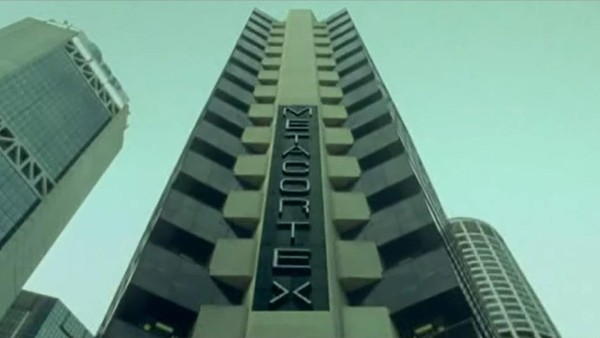
As well as being just the perfect name for a middle-of-the-road, 'respectable software company' from the turn of the Millennium, MetaCortex is also a clever piece of foreshadowing for the rest of the movie.
Breaking down the word gives us 'Meta', which when used as a prefix means "transcending", and Cortex which, of course, refers to the brain. Neo, a man about to transcend the limits of his own brain, works for a company whose own name means that exact thing.
His boss also tells him that "you think you are special, and that the rules do not apply to you" which, of course, is also true.
10. The Last Scene
Finally awoken from his sleep inside The Matrix, Neo is greeted by the horrifying reality of the world outside. Completely hairless, terrified, and covered in goo, he is confronted by a machine who unplugs him from his pod and flushes him out of the system.
In these scenes, Keanu Reeves looks much thinner - almost gaunt - as the reality of his confinement clashes harshly with the healthy, attractive man we'd seen prior. This scene was actually shot months after principal photography had wrapped, to enable Keanu Reeves to lose the weight and the muscle definition he'd gained for the rest of the film.
9. Dark City

Given that they both deal with the premise that the world around you might not be real, The Matrix often gets compared to the movie Dark City. They bear a lot of similarities in terms of tone, atmosphere, and plot, but upon closer inspection they've got a lot more in common.
Wanting to keep a sky-rocketing budget under control, Warner Bros. Turned down the request to film the rooftop scenes 'on location' and, instead, had the filmmakers use the existing sets from The Dark City instead. Some tweaks were made to disguise this, but by and large they're near identical.
8. Simulacra And Simulation

Prior to the casting stage, the filmmakers were determined that every major member of the cast should fully understand the story that was being told. After years of having the idea rejected because it was "too complex", having actors on board who grasped both the themes and the narrative was essential.
The Wachowski's required the actors to read Jean Baudrillard's Simulacra and Simulation, Kevin Kelly's Out of Control, and Dylan Evans's Evolutionary Psychology before even opening the script. In a small tribute to this, Neo hides his "product" in a hollowed-out copy of Simulacra and Simulation at the beginning of the movie.
7. Alice In Wonderland

As well as the required reading for the movie, there was also another heavy literal influence. Specifically, Lewis Carroll's Alice in Wonderland, which is referenced through the movie and informs a number of the main thematic points.
Neo "follows the white rabbit" in the form of Dujour's tattoo, and Morpheus himself asks him if he feels like the book's titular character as he's "tumbling down the rabbit hole". Even the choice between the red pill and the blue pill is evocative of the Caterpillar's "one will make you bigger and one will make you smaller" choice from the book.
6. Chicago

While The Matrix takes place in an unnamed American city, some guesses can be made about its location. Residents of Sydney will undoubtedly recognise a few locations, as virtually the entire movie was filmed there, but there are a few hints that it's also set in Chicago, the Wachowski's hometown.
All of the street locations mentioned in the film are genuine intersections from Chicago and, during the underground fight scene between Neo and Agent Smith, several signs can be seen for the 'Loop', another hallmark of the city.
5. The Cookie

When it comes to web-browsing, everyone has heard of 'cookies' - chances are you've been asked to consent to them when you opened this very article - but not everyone fully understands what they actually are. In short though, they're a small piece of important information, sent by a website, and retained by the browser to remember later.
It's a tiny visual motif, but The Oracle handing Neo a single cookie after she's informed him about Morpheus' impeding demise is an incredibly nuanced way of explaining the scene. She has given him a small piece of important information and, quite literally, given him a cookie.
4. "I Have No Mouth, And I Must Scream"

Possibly the strangest tribute to the source material that influenced the film comes in the Neo/Smith interrogation scene early in the movie. As well as the many books previously mentioned, Lost City, and Alice In Wonderland, The Wachowski's also drew inspiration from Harlan Ellison's science-fiction short story I Have No Mouth, And I Must Scream.
The book details how an artificial intelligence takes over the world and all but eradicates mankind, save for a few survivors that it keeps underground. As well as the obvious comparisons you can draw to the theme of The Matrix, the movie literally depicts Neo as having no mouth and trying to scream.
3. Neo As Jesus

Attracting numerous complaints from religious groups following its release, the comparisons between Neo and Jesus Christ are both profound and numerous.
Neo is, of course, a messiah-like figure whose arrival has been foretold and is here to bring salvation to mankind. Early on in the film, Choi greets him with "halleluiah" and refers to him as "my saviour", and towards the end he is declared dead but, through some sort of miracle, returns to life.
Finally, even Neo's original name of Anderson has its own religious connotations, tracing its etymology to mean 'son of man', a common title given to Jesus in religious texts.
2. Coppertop

In another deft piece of foreshadowing (although admittedly not very subtle) Cypher calls Neo a seemingly innocuous, but actually very apt, name during their first meeting. "Listen to me, coppertop! We don't have time for 'twenty questions."
Coppertop might not jump out initially, given that Neo has dark hair, but it's actually a common slang term for Duracell-branded batteries. Given that, at the time of this meeting, Neo is still plugged into the Matrix and is, thus, being used by and machines as a living battery, Cypher's name is absolutely bang on. Not that Neo would have had any idea why.
1. Red And Blue

The decision between red and blue is, ultimately, one that defines the entire story of the Matrix. By being offered the two different coloured pills, Thomas Anderson is forced to make one of the most profound decisions in human history. Keep dreaming, or awaken to the horrors of the real world.
However, it's actually a decision that's subtly telegraphed earlier in the movie. When receiving the mobile phone from Morpheus, Anderson is handed a form to sign and a pen with which to do so. Specifically, a pen that allows the holder to write in either red or blue ink. Clearly not ready to wake up yet, he chooses blue.