20 Things You Somehow Missed In The Social Network
Tyler Durden makes a "cameo."

The Social Network is arguably one of the greatest movies of the last 10 years, a near-miraculous triumph for director David Fincher, writer Aaron Sorkin, and an exceptional ensemble cast.
That it didn't win both Best Picture and Best Director Oscars is sure to be one of the Academy's great shames moving forward - no offense to the very good The King's Speech - though that has done little to diminish its enduring legacy as a masterpiece.
Yet no matter how many times you've soaked in Fincher's deeply absorbing depiction of the creation of Facebook, it's such a detail-dense film that there's a ton of subtleties, Easter eggs, gags, and even the occasional mistake you won't have picked up on.
These fantastic, easily missed details only deepen the movie's monumental level of filmmaking craft, and yes, even the mistakes are fascinating in their own way.
As so many tech-centric films begin to show their age within just a few years, The Social Network's engrossing human focus and continued societal relevance make it a movie sure to stand the test of time as the decades pass...
20. Fallout 3 Is In The Movie (But Wasn't Released Until 2008)

As much as David Fincher has a sure eye for detail, even he wasn't able to prevent a few factual errors slipping through the cracks, largely pertaining to things appearing in the movie which didn't actually exist in 2003.
Any gamers watching should keep their eyes peeled for a blatant mistake during the early Facemash montage sequence, where a Harvard student can be briefly seen playing the video game Fallout 3.
Except, as even a fairly casual gamer would know, Fallout 3 wasn't released until five years later in 2008.
Elsewhere there are other noticeable anachronisms, such as Dennis de Laat's 2008 song "The Sound Of Violence" being played during the main nightclub scene, while the "@harvard.edu" e-mail address Mark (Jesse Eisenberg) uses wasn't actually instituted until a few years later - in 2003 it was actually "@fas.harvard.edu."
Nitpicks? Perhaps, but such are the issues involved in making any period movie, especially one set in such relatively recent times.
19. That Winkelvoss CGI Mistake

Because Armie Hammer wasn't well known by mainstream audiences in 2010, many were shocked to learn that he and his twin brother didn't in fact play the Winklevoss twins, because Hammer didn't actually have a twin.
Instead, Hammer's face was digitally superimposed over another actor, Josh Pence, to create the twin illusion, an effect that remains incredibly seamless to this very day.
However, there is a moment where the mask slips - pardon the pun - early in the film, when the "Winklevi" first approach Mark to work on their website, Harvard Connection.
Just as one brother nudges the other, for around a second Josh Pence's face is plainly visible, but once the shot cuts to Mark and back to the twins, the face has now been digitally altered to resemble Hammer.
Once you see it, you'll catch it every single time.
18. Justin Timberlake Lost Weight To Play Sean Parker

Many eyebrows were raised when Justin Timberlake was cast as Napster co-founder Sean Parker, but true to form, David Fincher never gets a casting pick wrong.
You might've been so distracted by the sheer presence of J.T. in a Fincher movie, though, that you didn't notice the physical "transformation" he underwent in order to play Parker.
Timberlake ended up shedding around 17 pounds for the part, as he felt that looking thinner would allow him to more closely resemble Parker in his early-twenties rather than the more full-faced 28-year-old that he was at the time of shooting.
You probably never even noticed it, but then again, did you ever think that Timberlake looked too old for the part? It worked.
17. "Facebook" Is A Spelling Mistake

As a testament to Fincher's infamous eye for detail - that Fallout 3 gaffe excused, of course - he ensured to have Mark Zuckerberg's initial spelling of the word "Facebook" flagged as a mistake.
Mark is first seen writing the word during the early Facemash montage, and because the scene is obviously set before the genesis of Facebook as an entity recognised worldwide, we see the word underlined as a mistake by Mark's blogging software.
Nowadays of course Facebook wouldn't be flagged by any computer system on the planet, but back in 2003, you're damn right it would be.
This is one of those things nobody would've blinked an eye at had Fincher not included it, but it sure is neat that he did.
16. It Wasn't Actually Filmed At Harvard

Though to the lay-person the film looks like it was actually shot at one of Harvard's three main campuses, this wasn't the case at all, with the University generally refusing film productions to shoot there after the 1970 romantic drama Love Story was shot on-campus.
Rumour has it that the production disrupted students and also led to numerous trees being killed by fake snow, resulting in the crew being kicked off campus just a week into filming.
Since then, Harvard has generally been replicated by a nearby school, with Fincher deciding to shoot at the Massachusetts colleges Phillips Academy and Milton Academy, which are mere miles away from the main Harvard campus.
Though Harvard alums would presumably be able to tell the difference, to the outside world, it's an effortless magic trick.
15. Aaron Sorkin's Cameo

You'll probably be aware that the movie was written to Oscar-winning success by the great Aaron Sorkin, though you'd be forgiven for not knowing what he looks like - or at least, not noticing his cameo in the film.
Sorkin appears for around 30 seconds as one of the ad executives who Mark and Eduardo (Andrew Garfield) attempt to get onboard to invest in the website, though due to Mark goofing off with a glottal stop noise, he doesn't seem much impressed.
Apparently Sorkin had no intention of having a cameo role in the film, and only performed the part at the insistence of Fincher, who was very eager for him to do it.
14. No, That Wasn't The Real Bill Gates

During the movie, Mark and Eduardo attend a Harvard lecture given by Bill Gates, and you'd absolutely be understood for assuming that this was a cameo from the very real Microsoft co-founder.
But in actual fact, Gates was played by a professional Bill Gates impersonator, Steve Sires, yet the story gets even more interesting. According to Fincher himself, Sires didn't also sound like Gates, so a separate casting call went out for a voice double to be dubbed over him:
"It's funny, because I walked into the recording stage, and here's this 24-year-old African American kid with dreadlocks. And it's like, 'Oh. That's the voice of Bill Gates."
13. Facebook Hits 1,000,046 Members At Exactly 1:46:46 Into The Movie

During the middle of an intense confrontation between Mark, Eduardo, and Sean, the Facebook website passes the milestone of 1 million members, as is triumphantly flashed up on a large screen.
The precise number we see is 1,000,046, and in a fascinating quirk, Fincher actually decided to have this shot appear on-screen at exactly 1:46:46 into the movie to correspond with the number, delivering a ridiculous Easter egg that you'd only have a chance of noticing by accident.
Seriously, how the hell did anyone catch this?
12. Amy's French Dialogue

Dakota Johnson has a small but memorable role in the film as Amy, the Stanford student who spends the night with Sean Parker.
While grilling Parker over how much he actually remembers about her from the night before, she lets out a short quip in French, which is never actually subtitled for the audience's benefit.
In fact, she says, "Tu fais l'amour à la jolie fille," which translates to "You've made love to a pretty girl," seemingly expressing her exasperation at Parker's short memory.
He quickly figures out that her major is French, though.
11. The Tyler Durden Reference
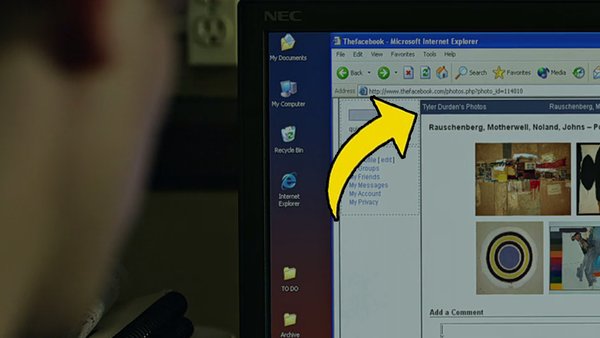
At one point in the film, we see Mark using a fake Facebook profile to cheat on a college art exam, and the name of that alias? None other than Tyler Durden.
Durden is of course a focal character in the film Fight Club, which was directed by Fincher just over a decade prior, and has remained a cultural monolith ever since.
Given how a more abundant reference to the iconic movie would've been embarrassingly on-the-nose, this one was sensibly concealed away where only the most attentive of viewers would have a chance of noticing it.
10. Trent Reznor's Secret Composing Trick

Composers Trent Reznor and Atticus Ross rightly won Best Original Score Oscars for their fantastic work scoring the film, and true to form, Reznor employed some deeply experimental tricks to keep the audience on edge.
The song that plays during the opening credits, "Hand Covers Bruise," is a leitmotif used a few times throughout the film, but each version is slightly different due to one very special technique.
Reznor decided to record the track's distinctive piano tune with the microphone placed further and further away from his piano each time, so that each subsequent time the song is heard, it has more of a distant echo, implying Mark's increasing isolation.
That's the sort of top-level thinking that wins you Oscars, folks, whether you consciously picked up on it or not.
9. Mark & Eduardo's Character Development Is Signified By...Beer

Character development can be signalled in deceptively simple ways, and that's certainly the case in this movie.
Mid-way through the film, Eduardo goes to the fridge to grab a beer each for himself and Mark, while a moment later an oblivious Mark goes into the fridge and grabs just one for himself.
It's a seemingly insignificant moment yet one which characterises the two men perfectly: Eduardo as thinking about the whole, while Mark is concerned only with himself and not giving Eduardo a second thought.
And so, they're set to become at odds with one another due to their inability to adequately communicate.
8. All The Cold Breath Is CGI

As exacting as Fincher tends to be about the visual effects in his movies - much of which is so brilliantly subtle as to be invisible - there's one scene in the film that doesn't quite measure up.
During several scenes set outside in the cold - especially following the Bill Gates lecture and during the fraternity's Caribbean Night - the cold breath coming out of everyone's mouths was actually added digitally in post-production.
This wasn't a necessity because these scenes were actually filmed in the height of summer or anything, but because Fincher felt that the real-life cold didn't show up well enough on-camera. He said:
"The breath in this is faked. Not that it wasn't ridiculously cold anyway, but we did not have the humidity that it required to have people's breath be visible, and I just felt to ask people to stand out in this kind of cold weather and not see the breath was unfair."
That...sounds like Fincher alright. Once you see it, though, you won't be able to un-see it.
7. Mark's Davening
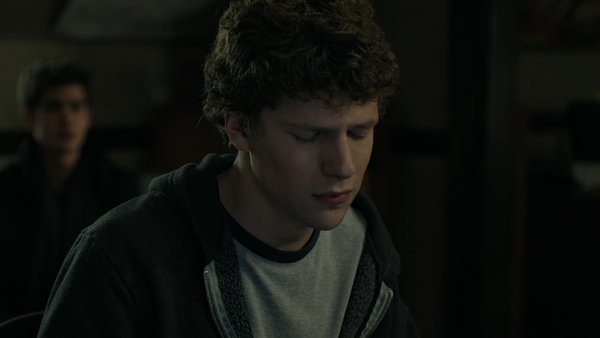
After Mark finishes up an epic coding session in his dorm, he closes his eyes and his head appears to move backwards and forwards rhythmically, after which Eduardo asks him, "Mark, are you praying?"
In the film's home video commentary, however, Aaron Sorkin explained that Mark was actually "davening," a Yiddish word for prayer recitation in Judaism, characterised by specific head and body movements.
Sorkin stated that he originally had Eduardo ask Mark, "Mark, are you davening?," though changed it to the more general prayer inquiry to ensure the audience understood what he was actually doing.
6. Sean Parker Reads What He Signs (But Eduardo Doesn't)
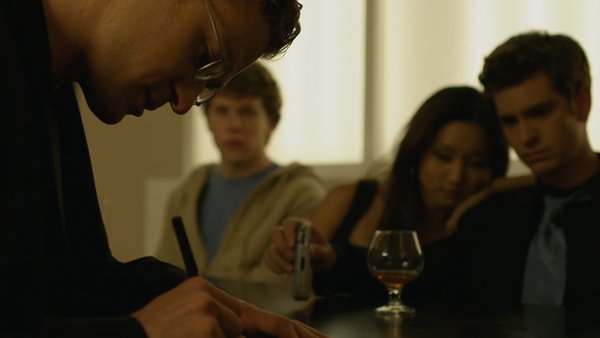
Another small moment which says a lot about the characters, now. When Sean takes Mark, Eduardo, and Christy (Brenda Song) to a fancy lunch, he ends up paying for the meal, and is briefly seen wearing his glasses while writing a check.
This seems to suggest that even though he's eating in a familiar place, he sensibly ensures to read anything he puts his signature to.
This appears to foreshadow the fate that's awaiting Eduardo, whose shares are of course famously diluted down from 34% to 0.03% because he didn't do his legal due diligence.
5. The Shares Don't Add Up

Talking of shares, when the initial Facebook stock ownership figures are laid out during the deposition near the end of the movie, somebody didn't check the figures, because they just don't add up.
Eduardo is said to originally have 34.4%, while Dustin Moskowitz has 6.81%, Sean Parker 6.47%, Mark 51%%, and Peter Theil 7%. In actual fact, these numbers add up to 105.68%, which of course makes no sense at all.
Presumably Sorkin had far more important things to anguish over - like the gorgeously witty dialogue - but even so, it's an oversight that so many detail-obsessed artists surprisingly happened to miss.
4. Mark Uses Erica's Roast Against The Winklevoss Twins

In the film's unforgettable opening scene, Mark tells his soon-to-be-ex-girlfriend Erica (Rooney Mara) that she should be more supportive of his attempts to get into the prestigious Phoenix Club, because if he makes it, he'll be taking her to events which will allow her to meet people in high society.
Erica fires back, "You would do that for me?", a quip which Mark doesn't appear to appreciate as sarcastic, at least not until later on in the movie.
About 20 minutes later, the Winklevoss twins invite Mark to help them make the Harvard Connection, suggesting it might aid rehabilitating his image on campus.
Mark then takes the opportunity to re-use the roast on them, but ever the business-minded types, they barely register it at all.
3. Josh Pence's Cameo

Though Josh Pence's role as Armie Hammer's Winklevoss double is ultimately pretty thankless, Fincher was at least charitable enough to give his mug a small cameo in the movie, during the scene where Mark and Eduardo are at a nightclub.
A man, played by Pence, attempts to enter the bathroom, only to be told by Eduardo that "a couple of girls are freshening up in there," after which the amused man utters, "Sweet," before walking off.
Pence gets a few seconds of screen time, at least. Curiously, though, this isn't even the biggest movie where Pence has flashed his face for just a single moment, as he also played a young Ra's al Ghul for mere seconds in The Dark Knight Rises' brief flashback sequence.
2. Mark's "Arm & Hammer" Shirt

During the climactic "I'm coming back for everything" confrontation between Mark and Eduardo, keep an eye on Mark's shirt: it bears the logo of baking soda company Arm & Hammer.
As odd as Mark wearing such a shirt might seem, this is actually a ridiculously specific Easter egg relating to co-star Armie Hammer.
You see, it's often stated that the company Arm & Hammer was named after legendary business magnate Armand Hammer, even though he wasn't actually born until 30 years after the company's formation.
And in case you hadn't figured it out, Armand Hammer also happens to be Armie Hammer's great-grandfather.
Given that it's tough to imagine why Mark would wear such a shirt otherwise, there's no way this wasn't an intetional nod to Arm & Hammer's mythic origin story.
1. There's A Single Handheld Shot In The Entire Movie

There are many, many wonderful things David Fincher does with a camera, but one thing he almost never does is shoot handheld unless he's given absolutely no choice. His record to date, for instance, is a reported five handheld shots on Se7en.
And so, The Social Network contains just a single handheld shot, and one executed entirely for thematic purposes.
When Sean Parker is at the 1 million users party which is busted by the cops, Fincher switches to handheld for the single shot where a dishevelled Parker nervously walks to the door.
The intent, clearly, is to show Parker's life losing its stability, given that this very incident is what leads to Mark breaking off contact with him. Genius.