22 Jump Street: 8 Funniest Meta Jokes

A sequel about sequels.
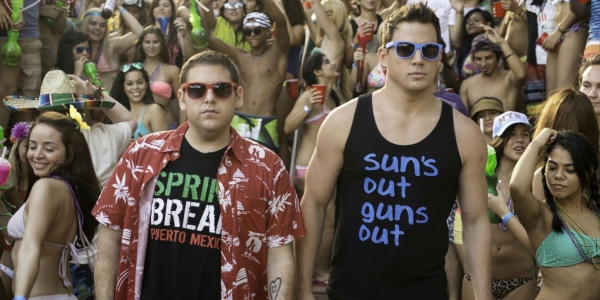
From Phil Lord and Chris Miller, directors of the awesome Lego Movie, 22 Jump Street presents Channing Tatum's Jenko and Jonah Hill's Schmidt, who shambolically go undercover in an educational institution to tackle drug crime, while exploring their brotherly-yet-slightly-homoerotic relationship and learning lessons about who they really are. Sound familiar? That's no coincidence. Much like its older brother 21 Jump Street, 22 Jump Street is full to the brim with gleefully self-aware and meta jokes. It knows it's a sequel, it knows it's contrived and it even knows it probably won't be as good as the first one - and it riffs on this near constantly. Self-awareness and comedy often go together hand-in-hand. It's one of the reasons why the now cancelled Community was so popular with its cult fanbase. It's why Deadpool is one of the most popular characters in Marvel. Who's to say you can't make something while mocking the medium its a part of? 22 Jump Street revels in this kind of meta humour, by taking shots at the industry, referring to other movies and even mocking its own narrative. Here are the 8 funniest ways in which it breaks the fourth wall. Spoilers ahead€

8. The Plainview Red Herrings

Early on in the movie, after studying a photo with the now imprisoned Mr Walters, Jenko and Schmidt stumble upon a clue which could be the key to their mystery - a tattoo of a man firing a bazooka appears to be on the drug dealer's arm. After visiting the tattoo parlour, they suspect a red-mohawked American football player to have said tattoo and therefore be the dealer. After some of the most unsubtle detection ever seen in cinema, it turns out that he does have a tattoo, but it is, to partially quote Star Wars, not the tattoo they are looking for. Instead, he has a tattoo of his home team's mascot, named the "Plainview Red Herrings." This is obviously a reference to the fact that this search for the tattoo on his arm is a red herring in that it throws them off the scent of who truly owns the tattoo. In fact, it then turns out that the search for the tattoo in itself is a red herring as they are not the dealer in the photo at all - it's revealed that the girl, Cynthia, is the dealer. It's a funny reveal that becomes all the more funny the more you think about it, and it's a nice reference to a literary technique that's clearly being used as the story is told.

7. Jenko's Operation Suggestion

This one is a case of thinking "Hmmm, that sounds awfully familiar..." before slowly realising quite what they are referring to. Towards the beginning, when meeting with the Deputy Chief, Jenko and Schmidt are suggesting what to do for their next operation after their last one failed quite so spectacularly. Jenko suggests an idea for operation in which they "go in the secret service to protect the White House?", and then goes on to defend the idea protectively when Schmidt calls it a "terrible idea that would never work". Could he be defending it with so much enthusiasm because Channing Tatum played a role in which he did exactly that only last year? Perhaps... It's a fun reference to Channing Tatum's blossoming career as an action star, as well as a nudge about White House Down's slight lapse in realism. The fact an action film is calling out another action film for being somewhat over the top and ridiculous (especially an action film like 22 Jump Street) is a funny jibe at the genre itself; one of many in this film.

6. The Benjamin Hill Center Of Film Studies

It has already been established how much directors Phil Lord and Chris Miller love to pepper their films with a good reference here and there (count them in The Lego Movie and you have a pretty long list), and they obviously have a great adoration and admiration for physical comedy (there's certainly a lot of well staged physical comedy moments on display in this movie). The two of these combine with this blink-and-you'll-miss-it joke hidden away in the background. During a chase scene set piece (more on that on the next page), the score changes briefly to some familiar sounding music as the footage is briefly sped up, and the cars move from the left of the frame to the other and back again. If you look up at the building in the background of this scene, you can see it's named "The Benjamin Hill Center of Film Studies.: This is a clear reference to the British comedian Benny Hill and The Benny Hill Show, with its most famous sequence being the fast-paced, farcical chase sequences to the "Yakety Sax" music. It's clear that Phil Lord and Chris Miller know their comedy well and are not afraid to pay tribute to their inspirations.

5. "The Budget"

One of the main rules for a sequel in the Hollywood Rulebook of Sequels (note - probably not a real publication) is that it must be more expensive. 22 Jump Street seems to love this idea, as it adheres to it while pointing it out. About halfway through the run time, Ice Cube's Captain Dickson berates the pair for spending too much of the "operation budget" already - he even points out it's gone on expensive shoes he's wearing which they (Jenko and Schmidt as well as the audience) can't even see - and they must therefore make the rest of their investigation less expensive. Ten minutes later, Jenko and Schmidt are involved in a car chase with their Helmet-mobile versus a big baddie jeep. They careen around the campus (look out for the "Benjamin Hill Center Of Film Studies"), "accidentally" driving through the gardens of sculptures, they wince about how needlessly expensive the carnage is as they crash into artwork and through buildings - Jenko even comments that a crash "looks cool but unnecessary." The fact the bigger budget is a plot point at all is a thinly veiled reference to the Hollywood's sequelitis and odd economic system - because, as Deputy Chief Hardy sarcastically says, "two times the budget means two times the profit, right?"

4. Poking Holes In Its Own Story

Plot holes and convenient coincidences are quite often common place in police action movies. Logic and common sense don't tend to enter into the equation much, and 22 Jump Street knows it and wants you to know it. The very reason it can be called 22 Jump Street at all (and not just so it does not have a confusing name with too many numbers in it) is referenced in a short scene outside the abandoned "Korean Jesus" church when Jenko mentions it's very convenient that an even bigger church was abandoned right next door for them to use, to which Schmidt replies: "You're right. It is convenient." When Jenko questions why they didn't just build a new base over the road, Schmidt tells him not to get ahead of himself, before walking away to reveal a huge sign saying "23 JUMP STREET COMING SOON". Not only is this a hilarious hint at what may be to come in terms of the franchise (more of that later), but it's also a poke at how conveniences and coincidences really can help movies out a lot in terms of their plot, as well as storylines justifying Hollywood's incessant need for sequels and franchises.

3. Captain Dickson

Did you know that the eternally angry Captain Dickson is in reality a rapper named Ice Cube? It's true! How's THAT for a factoid? Well, it's a factoid that 22 Jump Street doesn't want you to forget, as it has some jokes at its expense. For starters, when admiring their unnecessarily expensive new base, Schmidt points out that Dickson's office looks like a "cube of ice." But perhaps a more subtle poke at Dickson's identity the other side of the fourth wall comes is the midst of one of the funniest scenes in the movie. Schmidt and his parents are having dinner with Dickson and his family; when Schmidt's dad asks Dickson's wife where they're from. "Oh me?" she says. "I'm straight outta Compton. But my husband's from Northridge." This is, of course, a reference to NWA's classic gangsta rap album Straight Outta Compton, and a sly one at that. In fact, Ice Cube's casting as Captain Dickson could be considered a meta joke in itself; after all, the man who famously rapped "F*ck Tha Police" playing such a high ranking member of the force of "punk motherf*ckers with a badge and a gun" is an irony that can't be found in the casting of other movies...

2. Literally EVERYTHING Deputy Chief Hardy Says
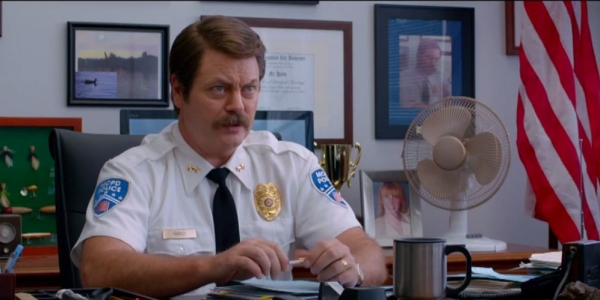
Deputy Chief Hardy, played by the wonderfully moustached Nick Offerman, may as well be renamed Captain Meta. Everything he says is a play on the fact it's a film, or is a dig at the film industry for coming up with nothing original and relying on reboots and sequels. Talking to the two boys at the beginning of the movie, he explains that "nobody gave a sh*t about the Jump Street reboot, but you got lucky. So this department has invested a lot of money to make sure Jump Street keeps going, even though it's never as good the second time around." He then goes onto explain that, with a bigger budget, they need to do the exact same thing as the first time because it somehow worked, before outlining what personal turmoil they will both go through with each other to the letter. Hardy is a character dedicated to having a dig at franchises and Hollywood's formulaic approach and tendency for unoriginality, and it pays off wonderfully here. It's worth saying that they try to do, as Hardy and Dickson both say, the "exact same" thing as last time ("infiltrate the dealer, find the supplier"), but it fails and they arrest the wrong person - is this, perhaps, the screenwriter and Lord and Miller's way of saying that sequels should do something new rather than stick to the same old approach?

1. The End Credits

Almost every review of 22 Jump Street has had one common observation - the ending credits are absolutely glorious, and are possibly the most memorable part of the whole film - and that is no insult, either. With tongue very, very firmly in cheek, it explores various adventures that the Jump Street team go on next (while, of course, sticking rigidly to the formula of going undercover and infiltrating the drug dealers), including over 11 sequels set at Magic School, Culinary School and Medical School and even a video game and merchandise, while gleefully using every single sequel/franchise cliche it possibly can. For example, the random inclusion of an overtly sexual new female recruit; a "Jump Street: Generations" film with old cast members; Seth Rogen replacing Jonah Hill as Schmidt and nobody noticing except Channing Tatum; the villain of this sequel somehow being alive and returning for another and a Gravity-flavoured poster for "2121 Jump Street", as well as a spin-off animated series, lunchbox sets and a toy in which you can shoot off Mr. Walters' penis all over again in the comfort of your own home. It's a brilliant, hilarious sequence which may be worth the DVD price alone just to pause and read the ridiculous taglines. Like this article? Which jokes did we miss? Let us know in the comments section below.

Contributor

This article was written by a Guest author. If you would like to become a regular contributor on WhatCulture, please submit an application.