25 Mind-Blowing Facts About King Kong
16. Killer Kong
 The original Kong may look at some moments like a malevolent teddybear, and children of all ages have sympathised with his last stand as the biplanes fly in to get him. But there's no denying that, his protectiveness of Ann aside, he really is a mean son of a bitch. When he breaks out of the village gates on Skull Island, he purposely stomps on some natives and devours one in his massive teeth. This scene, along with a parallel where he bites the top part off some city slicker in New York, was cut from the US prints available between rerelease in 1938 and the first showing of the original '33 print on TV, in 1971. But, despite Kong's entry into wider pop culture - via advertising, comic strips etc - as a cuddlier figure, his original incarnation was one of the most antisocial movie heroes of all time.
15. The Big Gorilla Is Way Out Of Proportion
 Though Kong is usually estimated at 50ft tall, his proportions change throughout the original film. When he chows down on a native he appears much bigger; when scaling the Empire State Building in long shot, he appears diminished by the skyscraper. It's only after his tragic last stand, when he places Ann in safety and falls wounded to his death, that he seems to return to his former scale. This is when Denham eulogises over the poor dead brute in the worlds of Cooper's original movie pitch: "It was Beauty that killed the Beast."
14. King Kong Was One Of Hitler's Favourite Films
 The Nazi Fuhrer apparently watched the movie over and over. Maybe he liked the idea of the will of a great beast trampling (literally) over the citizens of a western democracy. But then he was also a fan of Snow White And The Seven Dwarfs (1937) and Mutiny On The Bounty (1935). He may have been no one's idea of a nice guy, but he certainly appreciated the golden age of Hollywood - a creative community largely formed, of course, by Jewish migrants from Europe.
13. Was Daddy Kong A Hermaphrodite?
 When King Kong hit the jackpot in early '33, co-directors Cooper and Schoedsack were told to make a "bigger and better" sequel. Son Of Kong (1933) was in the cinemas by the Christmas of that year; as screenwriter Ruth Rose remarked, "If you can't make it bigger, make it more comical," was the compromise they eventually settled on. Discovered by a bankrupt Carl Denham (sued for damages by the City of New York), the smaller, benign white ape was sometimes written about as 'Kiko' (a truncation of King Kong) but called 'Little Kong' throughout the film. By the time he drowns to save the (smaller) crew and the latest girl Denham has brought along, the sentimentality is almost on a Disney level. But there's one point that disturbs: given Kong's solitary nature in the original film and the total absence of any female of the species, did he somehow give birth asexually?
12. King Kong Appears In Edo
 That's the literal translation of the title Edo Ni Arawareta Kingu Kongo (1938), alluding to the period of Japanese history spanning 1603-1868. This copyright-buster - but then the Japanese were not huge respecters of international law at the time - is a legendary lost film, of which 38 seconds of supposedly surviving footage (disputed as a hoax) apparently survives on YouTube. The giant apeman is far closer to an evolutionary missing link than a gorilla, echoing the criticism that the original Kong had definite non-simian characteristics. The back-projected actor in a monster suit foreshadowed the Japanese film industry's later 'kaiju eiga', which began with Gojira (Godzilla, 1954).
11. Second-Banana Kongs
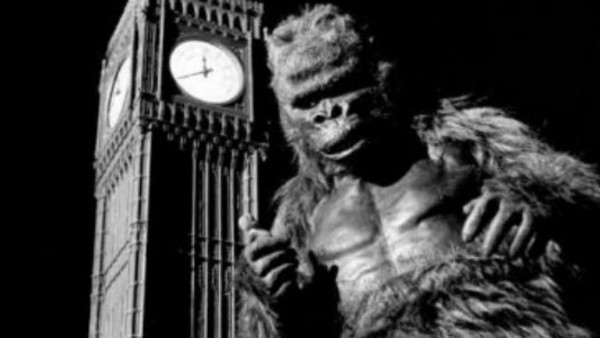 You can understand why Mighty Joe Young (1947) got a pass. He may have been just a simian nightclub act who got into a little mischief, but he was animated by Willis O'Brien and his young protege Ray Harryhausen, and remade in 1998 by Disney. Some of the other KONG knockoffs were outrageous: Konga (1961) was a chimp boosted to giant size (actually a man in a gorilla suit) by a mad doctor, but it's a wonder the title didn't get the British film sued; even he was a class act compared to The Mighty Gorga (1970) and his cheesy circus suit. South Korea's A*P*E (1976) was considered too close to the Kong concept and had an injunction placed on it by the producer of the 1976 Hollywood remake, as did cheesy British comedy-parody Queen Kong (1976). But Hong Kong's Goliathon (or The Mighty Peking Man, 1977) managed to pick up a small cult following - one of whom, Quentin Tarantino, rereleased it via Rolling Thunder in 1999.
10. King Kong Vs. Frankenstein
 It never actually happened - but it was animator Willis O'Brien's blueprint project for a new Kong film in the early 1960s. Hawked to Toho Films in Tokyo, prolific producer of the kaiju eiga monster movies, it seemed to subdivide into two movies: Frankenstein Conquers The World (1965), and Prometheus Vs. King Kong (after The Modern Prometheus, subtitle of Mary Shelley's Frankenstein), which in turn was changed again to
9. King Kong Vs. Godzilla (1962)

8. Cartoon Kong
 Produced by children's TV animators Rankin-Bass, The King Kong Show cartoon series ran for 78 Saturday morning episodes from 1966-69. Kong was by now relegated to the status of an outsize monkey superhero, as underlined by his last Toho film outing: King Kong Escapes (1967). The bug-eyed gorilla costume donned for this was a considerable step down even on the previous movie with Godzilla, and the plot was entirely drawn from the TV kiddie show. Kong, as the hero, defeated both a dinosaur and his own robotic counterpart, Mechani-Kong. When he swam back home (now called Mondo Island) at the end, it closed the most non-ferocious chapter in his career. Netflix have announced a new animated series entitled Kong: King of the Apes for 2016. Given the advances in animation techniques over the previous decades, and the revival of Hollywood interest in Kong himself, let's hope we'll see a slightly more feral beast this time around.
7. A Sophisticated 70s Style Of Simian
 Britain's Hammer Films had tried to acquire the rights to remake King Kong in the 60s, but had to settle for One Million years B.C. with Raquel Welch in a fur bikini and Harryhausen's dinosaurs. By the mid-70s the RKO rights holders had a change of heart, and Kong was up for grabs again. The winner was veteran Italian mogul Dino De Laurentiis, who wanted a blockbuster event to outdo Jaws. He almost succeeded, but his King Kong (1976) outraged fans of the original film. Disinterested in stop-motion, De Laurentiis and disaster-movie director John Guillermin spent well over a million of the film's $24m budget on a 42ft-high mechanised Kong robot. Unfortunately, it rarely worked, and for most of the screen-time Kong is actually makeup effects artist Rick Baker (who later designed Tim Burton's 2001 Planet Of The Apes) in a gorilla suit. No wonder Kong geeks carried protest placards at movie conventions reading, 'Don't Rape the Ape.'