25 Things You Didn’t Know About Pulp Fiction
Tarantino's masterpiece continues to fascinate 25 years later.
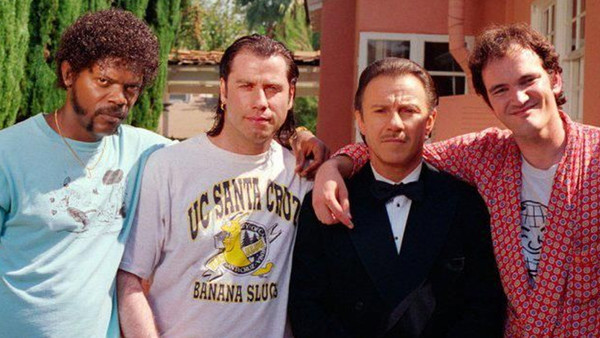
It's been over 25 years since Quentin Tarantino's Pulp Fiction was unleashed upon the world, premiering at the Cannes Film Festival that May and then releasing throughout the rest of the world during the autumn.
Unquestionably one of the most influential and iconic films of all time, its success led to a conveyor-belt of knock-offs - some good, many bad - through the remainder of the 90s and beyond.
And unsurprisingly, the film's production, while unexpectedly smooth, is nevertheless jam-packed with fascinating stories about how those most unforgettable moments came about, along with nixed ideas that almost made it into the final movie and so, so much more.
Pulp Fiction is one of those note-perfect movies where it's tough to imagine it being anything other than than it is, but by taking a peek behind the curtain and getting the low-down on how it all came together, we can see how Tarantino's definitive masterpiece was almost something very different.
Plus, who doesn't love a cute on-set story?...
25. Vincent Vega's Car Was Stolen & Recovered 19 Years Later
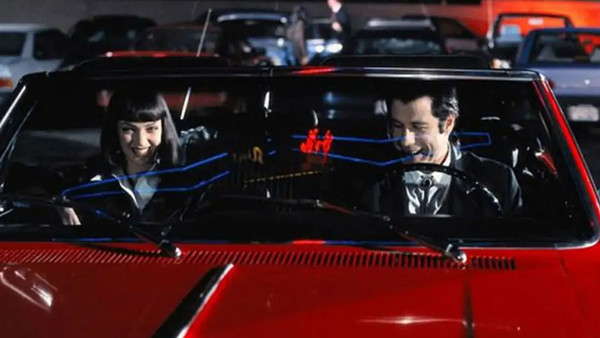
Throughout the movie, Vincent Vega (John Travolta) is seen driving a cherry-red 1964 Chevrolet Malibu convertible, which he memorably uses to drive Mia Wallace (Uma Thurman) to the Jack Rabbit Slim's diner and then, uh, rush her dying body to Lance's (Eric Stoltz) house for a shot of adrenaline.
The car actually belonged to Tarantino himself, and was stolen from the writer-director during production of the film, though clearly after its required scenes had been shot.
Though the thieves were never found, the car was astoundingly recovered 19 years later when, in 2013, a Sheriff’s Deputy chanced upon two men stripping a Chevrolet Malibu, ran the license plate and discovered it was reported stolen by Tarantino.
As it turned out, the owners of the car had themselves been duped, having bought the vehicle in good faith, though there's no word on whether or not the car was ever actually returned to Tarantino.
24. It Made A Profit Before It Was Even Released

Pulp Fiction was made for a sensibly modest $8.5 million, and though Bruce Willis' involvement accounted for a significant chunk of that budget, his casting also allowed Miramax to sell worldwide distribution rights to the movie for a stonking $11 million, largely off the back of his bankability.
As such, the film was a rare production to be in the black before it even landed in cinemas, and that it ultimately went on to gross $213.9 million worldwide, not to mention be a must-own home video release, was surely the delicious icing on the cake.
As an extra piece of trivia, Pulp Fiction was also the first independent movie in history to pass $200 million at the global box office.
23. Tarantino Turned Down Daniel Day-Lewis For Vincent Vega

Back when Tarantino was still considering actors to play Vincent Vega, Harvey Weinstein lobbied hard for Daniel Day-Lewis to take the part, who with a Best Actor Oscar under his belt for My Left Foot several years prior and a streak of acclaimed roles since, would've brought an undeniable prestige to the project.
But as perhaps the ultimate testament to Tarantino's confidence in his own instincts, he made the decision to turn Day-Lewis down and insist to Weinstein that it was John Travolta or bust.
Given that Travolta brought a singular heft to the role - considering his prior career highs and lows - it's tough to imagine anyone else doing what he did with Vincent, even if by any other metric you'd be mad to say no to arguably the world's greatest living actor.
22. Robert Rodriguez Directed Some Of Jimmie's Scenes

It's no secret that Tarantino and Robert Rodriguez have been close friends for basically the entirety of their filmmaking careers, but you might not know that this even extended to Tarantino allowing his pal to direct a few of the scenes where the filmmaker appears as Jules' (Samuel L. Jackson) friend Jimmie.
Rodriguez's work went uncredited, obviously, but he was able to return the favour to his friend barely a decade later, when he gave Tarantino a guest director spot for his film Sin City, shooting the scene where Dwight (Clive Owen) talks to a dead Jackie Boy (Benicio Del Toro) while driving.
This wasn't the only time Tarantino called upon help from a friend, though: in order to make a tight Cannes deadline for Inglourious Basterds, he had director-star Eli Roth shoot the film-within-a-film, Nation's Pride, for him.
21. The Syringe Shot Was Filmed In Reverse

One of the film's most iconic, distinctive and cringe-worthy scenes sees Vincent plunging an adrenaline syringe into Mia Wallace's (Uma Thurman) chest in order to save her from a drug overdose.
The scene is noted for its intensity and realism, and Tarantino achieved this by actually shooting the syringe shot in reverse.
Rather than have John Travolta pretend to slam it into Uma Thurman's chest and stop short of the mark, he had Travolta quickly retract the syringe backwards from Thurman's chest.
With the footage reversed, this created a violent urgency to the stabbing without risking Thurman being injured, and though the shot appears for scarcely a second in the final cut, it's undeniably effective.
Prior to this, Tarantino had actually bought a fake chest and planned to drive the syringe into that, but found a far more tactile solution which allowed Thurman to appear in the frame with the needle slamming down.
20. Jennifer Aniston Was Almost Cast As Mia Wallace

Tough though this might be to believe, according to Tarantino himself Jennifer Aniston was originally considered to play Mia Wallace and most likely would've won the part had it not been for the demanding schedule of the new TV sitcom she had just started working on - Friends.
Given that Aniston's only "notable" film role prior to being considered for Pulp Fiction was in 1993's so-bad-it's-good horror flick Leprechaun, it sure would've done wonders for her movie career.
But on the other hand, it's tough to imagine Aniston having any regrets given the fame and fortune Friends brought her. Plus, can anyone really imagine a young Aniston giving us a better Mia than Uma Thurman?
19. John Travolta Got Drunk In A Hot Tub To "Research" His Role

Despite the self-reflexive nature of John Travolta's performance as Vincent Vega, the actor did take a studious approach to researching the character, especially as it pertained to his heroin addiction.
Because neither Travolta nor Tarantino had ever used heroin themselves - thankfully - Tarantino hooked Travolta up with an addict he was acquainted with, in order to get a better idea of what taking heroin felt like.
The addict gave Travolta one very specific piece of advice: get wasted on tequila and lie down in a hot pool.
Travolta duly complied, happily explaining to his wife Kelly Preston that he "had" to get drunk and lounge around in the hotel pool, causing her to join him.
Cue the pair of them lining up tequila shots along the edge of the pool in order to help him "prep" for playing Vincent. Travolta ended up receiving a Best Actor Oscar nomination for his efforts, so you can't knock the method.
18. Tarantino Almost Played Lance

During pre-production, Tarantino knew he would be playing a small role in the movie, but hadn't yet decided whether it would be his eventual role Jimmie or Lance, Vincent's drug dealer who helps him revive Mia.
The deciding factor for the director was ultimately that he wanted to make sure he was behind the camera for Mia's overdose scene, rather than letting an assistant director handle something so pivotal.
And of course, this led to Tarantino drafting in Robert Rodriguez to help shoot most of the Jimmie material. Clearly, everything worked out for the best, plus Eric Stoltz totally killed it as Lance.
17. The F-Word Is Used 265 Times

It's no shock to anyone that Pulp Fiction makes liberal use of profanity, though it might surprise you to learn quite how much. The word "f**k" is used a staggering 265 times across the film's 154 minutes, accounting for 1.72 F-words per movie minute.
At present, this makes it the 28th most F-word-heavy movie in history, coincidentally falling one spot below Tarantino's previous film Reservoir Dogs, which pips it with 269 uses of the expletive (though with a mere 99-minute runtime, that's a far higher per-minute average of 2.71 F-words).
Hilariously, the incidence of profanity proves a major headache for squeamish TV networks when trying to edit the film for content: