30 Animated Movies That Are Not for Children
Hide your kids, because it's time to get the adult animation on.

Since the 1970s, as animation technology developed and became the dominant form in children's programming, more and more animations have been made with an adult audience in mind, strengthening and shaping the craft in new and exciting ways all across the globe.
Whether working in claymation, stop-motion, drawn cells, CG, or other multimedia approaches, animator innovators have been pairing animations of all shapes and sizes with talented voice casts, grand philosophical themes, and NSFW content for decades, and the results are a sight to behold. Charlie Kaufman gives us a disturbing new level of suburban malaise, the Wachowskis an essential entry in their Matrix franchise, Katsuhiro Otomo adapts his manga for the big screen, Adam Elliot introduces us to clayography, and Mikk Mägi and Oskar Lehemaa make sure we will never visit an Estonian farm.
Taking in the full spectrum of genres and forms of animation, spanning war movies, science fiction epics, anime classics, and surrealist deep cuts from all corners of the globe, we are shining a light on not just the big productions, but the indie features, the oddities that have still yet to enter the canon and the many non-English language films that haven't enjoyed the exposure they deserve.
Send the kids to bed and grab a glass of the heavy stuff, because these are 30 animated movies that are definitely not for children.
30. Cheatin' (2013)
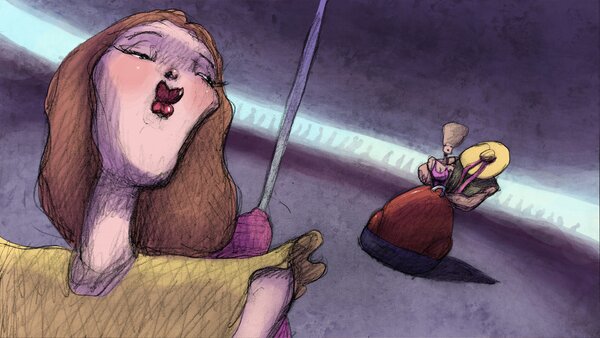
Animator extraordinaire Bill Plympton helmed Cheatin’ pretty much by himself, handling directing, writing, production and animation duties (only bringing on additional help to handle the digital colourisation and compositing of his work), and delivering what can easily be considered one of the most original animations this century.
We follow Elle, a voluptuous woman who seems unable to escape the attention of drooling, slavering, simian men, until she finds Jake, a drooling, slavering, simian man whose attention and affections she can not only stand but returns in full. What follows is a bawdy love affair constantly challenged by the advances of other women, which takes an unexpected dip into science fiction with body swaps and electrical reanimations.
The sketch drawing style contains an innovative plasticity that constantly plays with proportion and perspective, forcing us to pay attention and creating the space for beautiful and comedic compositions in equal measure; think Looney Tunes meets Charles Demuth. And no opportunity is wasted to sculpt an indelible image.
The sexual politics of the film may be a bit shaky at times, as most of the women in this film only want to get cracked open by the Neanderthalic male protagonist. However, the brilliance of Cheatin’ is that it manages everything without a line of dialogue, conveying all narrative detail visually - the sound design of the animated world, the score, and the squeaks and grunts of Plympton’s characters filling the space where dialogue might otherwise go.
29. I Lost My Body (2019)

Jérémy Clapin’s French-language fantasy drama I Lost My Body is the kind of film a street cat might make if you gave it a budget and taught it to use Blender.
Adapted from Happy Hand by Guillaume Laurant (who also co-wrote the screenplay for the film), I Lost My Body is set in Paris, where a severed hand makes its journey to the city to reunite with its owner, Naoufel, a young immigrant with eyes for his pizza delivery patron Gabrielle.
The movie often favours sounds over dialogue, making full use of the noises of the city, set to a synthesised soundtrack from The Dø’s Dan Levy. Levy’s score relies not on the kind of throbbing, pulsing John Carpeneter sounds that might have turned the story of a reanimated hand into a horror, but blends clean synth with organ and orchestral sounds, favouring stretched notes and a melancholy but hopeful tone that carries the film’s action from point to point, driving the dramatic and romantic beats.
It’s not complicated, extreme, or transgressive, but it hefts the same weight as a charming piece of literature, and rewards anyone with the patience to see it through.
28. South Park: Bigger, Longer & Uncut (1999)
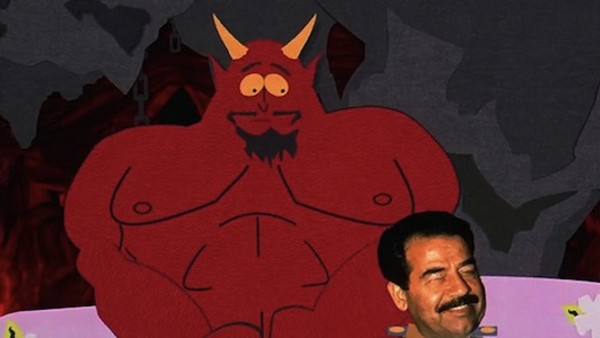
South Park: Bigger, Longer & Uncut is the kind of film that probably wouldn’t get the same budget or scale of release today, but that doesn’t mean it wasn’t controversial at the time. Trey Parker and Matt Stone took their penchant for physical humour and sending up American stereotypes and translated it to the big screen at the end of the '90s, bringing all the characters we know and love across from TV for a feature-length adventure that leaves no-one unoffended. And this time it’s a musical.
The film finds Stan, Kyle, Cartman, and Kenny at the centre of a moral panic, when swearing - inspired by trap-jawed Canadian comedy duo Terrance and Phillip - takes hold of the American public. But when the US declares war on Canada, the South Park gang must prevent the execution of Terrance and Phillip, stop the new axis of Satan and Saddam Hussein from conquering the world, and save the day.
There’s a lot to digest, and while (like any 20-minute animation extended many times its normal length) it doesn’t hold up as well as the regular show, the film manages to stand out thanks to its surprisingly catchy songs (which millennial or Gen Xer can’t tell you what Kyle’s mum is?) and ability to continue pushing the boundaries of taste.
27. When the Wind Blows (1986)

Jimmy T. Murakami’s When the Wind Blows is a rare stand-out effort of British animation from the ‘80s, which tackles some pretty heavy themes and serves as a neat yet devastating anti-atomic warfare film.
Jim and Hilda (voiced by John Mills and Peggy Mills) are a kind, average English couple who live a simple life - working hard, reading the papers, eating dinner together, and taking things slow - but they suddenly find their existence overturned by nuclear conflict between the West and the Soviets. Fallout is in the air, ash blocks the sun, and any sense of British life is a thing of the past.
Faithfully adapted in tone and style from Raymond Briggs’ graphic novel of the same name, the twee, British aesthetic is undercut by the film’s serious subject matter. While today we might not find it as compelling, it nonetheless perfectly captures the mood of the Cold War era, when nuclear warfare and global devastation seemed closer than ever. Add in a soundtrack from big hitters like Pink Floyd’s Roger Waters, David Bowie, Genesis, and Squeeze, and it’s a testament to how seriously everyone took the nuclear threat.
26. The House (2022)
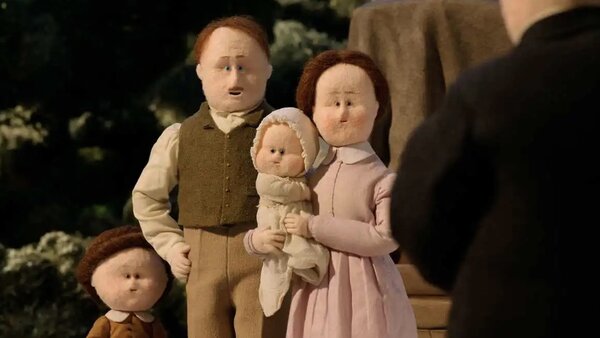
During lockdown, Emma de Swaef, Marc James Roels, Niki Lindroth von Bahr, and Paloma Baeza came together to direct The House, a stop-motion animation anthology film that looks like Wes Anderson and is packed with anthropomorphised animals, but has a sinister horror underpinning that would send Fantastic Mr. Fox to the hospital.
Each of the movie’s three segments possesses its own unique style, moving from the story of an Edwardian family haunted by their fancy modern home, to a rat property developer (literally) who is besieged by an infestation of bugs, and into the post-apocalyptic tale of a family of cats moving out of their homes in response to an ever-rising, Noah-like flood.
Despite being made from felt, fur, wool, and dollhouse parts, and featuring surreal characters, creations, and scenarios, each narrative feels authentic and lived-in, making the horror all the more real. The House has its roots in gothic horror, absurdism (especially Kafka), and body horror, and is not afraid to wear its influences on its sleeve. But it will take a well-watched set of eyes to spot and connect with them all.
25. The Timekeepers of Eternity (2021)
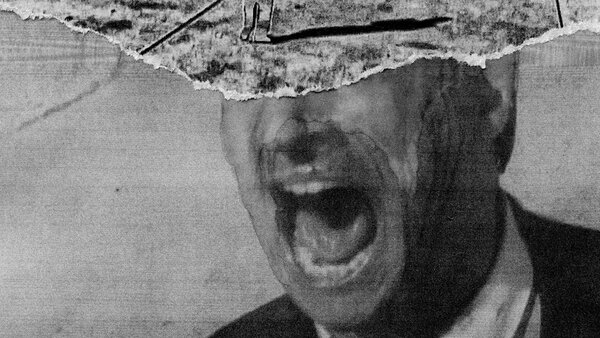
The Timekeepers of Eternity is an unusual beast in the world of animation because all its content originated as a live-action TV miniseries.
Adapted from Stephen King’s novella The Langoliers, Tom Holland’s 1995 series of the same name failed to enter the canon, being lost to time in the hit-or-miss way some King properties are (has anyone heard from Maximum Overdrive lately?). This made it ripe for director-animator Aristotelis Maragkos’ pickings.
The Timekeepers of Eternity takes the raw materials of The Langoliers and remixes it, producing from the three-hour show a tight, hour-and-four-minute feature about a passenger plane suddenly losing most of its passengers and crew mid-flight. The remaining few must land the plane and search for answers while time and reality close in on them from all sides.
Maragkos takes the fact that minor antagonist Mr. Toomy (Brosnon Pinchot), who holds the key to the whole conundrum, obsessively tears paper throughout and uses it as his north star when animating, or re-animating, Timekeepers. Each scene appears to have been (or at least gives the appearance of having been) photocopied and reproduced with tears, scrunches and intercut, overlapping sequences. The new details and contrasts added by the animating process gives the film fresh meaning and depth, and it’s one hell of a ride to watch, barrelling towards a terrifying conclusion made all the more real by its physical medium.
24. The Animatrix (2003)
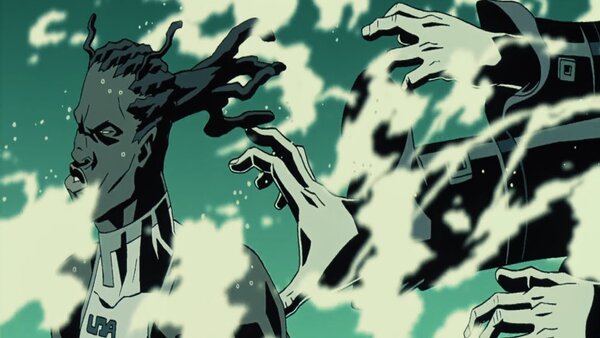
Time was, you couldn’t see a bargain bin without a copy of The Animatrix in it, but that’s no comment on the quality of the Matrix-adjacent anthology feature - more proof of how prevalent it was at the time.
Animated in a variety of different styles, The Animatrix brings together writer-directors from Japan and America on eight different stories, overseen by the Wachowskis, and forming a crucial part of the Matrix mythos. And the stories range from grand worldbuilding epics to small, personal curiosities.
In Mahiro Maeda’s The Second Renaissance we get to witness the decline of humanity, the rise of AI and the human-machine war in all its glory; Shinichirō Watanabe’s Kid’s Story shows the origins of Kid from the films, a young man who uses his awareness of and belief in Neo to wake himself from the Matrix; and Andy Jones’ Final Flight of the Osiris sees Captain Thadeus and his crew discover the machines’ efforts to drill their way into the free human city Zion, setting up the larger conflict of The Matrix Reloaded and Revolutions.
These are just a taste of what’s on offer, with lush 2D and 3D animation, in a range of styles both hand-drawn and computer-animated, including a surprisingly small-scale but affecting effort from visual master Takeshi Koike (Redline). And it should go without saying that there’s blood, violence and challenging concepts throughout.
23. Perfect Blue (1997)

The film that made Satoshi Kon’s name in the industry, Perfect Blue didn’t just establish its director but helped shift the landscape of Japanese animation, pushing psychological horror towards the mainstream.
Mima is a J-pop idol who decides to break away from her group CHAM! and move into the world of acting. Despite rising rapidly on popular TV detective series Double Bind, going from a cameo part to a central player in the storyline, chaos stalks her at every turn, as an obsessive fan makes attempts on her life and the lives of those around her.
While this would have been enough to make a compelling film (and is a pretty good reflection of Yoshikazu Takeuchi’s book, which it’s based on), Kon’s major influence on the narrative is what helped take things beyond a mere stalker-killer joint. He introduced a disappearing boundary between dreams and reality into the script, muddying the waters with a second, hallucinatory Mima who seems to be out to get herself, and winds up lending the film a thought-provoking, philosophical edge. This helped elevate Perfect Blue above its competitors and contemporaries, and has cemented the feature’s place in the canon, forming a core part of Kon’s legacy.
22. Persepolis (2007)
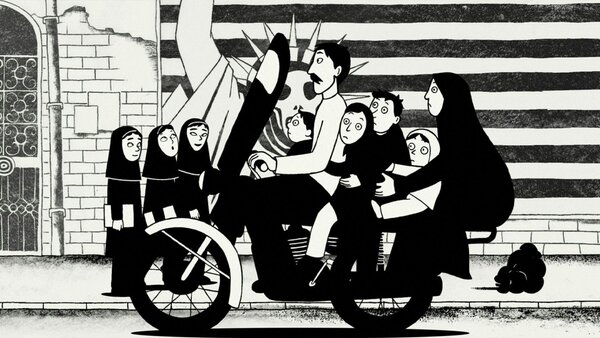
Adapted from Marjane Satrapi’s graphic novel of the same name, Persepolis is an unusually faithful representation of its source, but that’s in no small part due to the fact that Satrapi herself directed the film with Vincent Paronnaud, and that it’s based on her own experiences.
Presented in black and white with flashes of colour (used in a similar way as Spielberg deploys colour in Schindler’s List), Persepolis takes us with a young “Marji” to Tehran, showing us how her life, liberties, and middle-class family come into conflict with the turbulent political situation in Iran. We are with her during the Iranian revolution, when the victory of fundamentalism changes Iranian women’s lives forever. We are with her when the Iran-Iraq war again alters the face and shape of the country and curtails her liberties further. And we are with her as she rebels against her upbringing, is sent away to Vienna, thrown out of school, and attempts suicide.
Though the film’s aesthetic and narrative are true to the graphic novel, it manages to expand on the material by literally bringing it to life on screen. This fills in the gaps between panels and letting us understand how Marji moves and interacts with her environment, making her more of a girl than the page could and bringing us even deeper into the meaning of her story.
21. The Suicide Shop (2012)
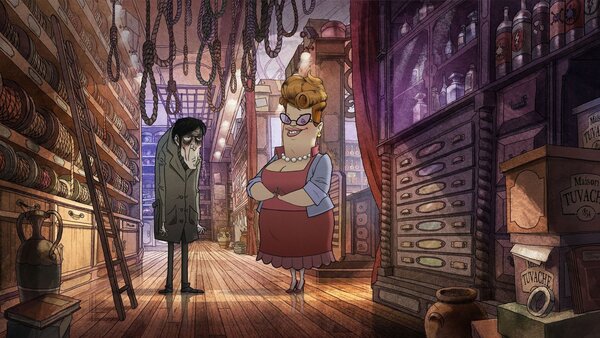
Writer-director Patrice Leconte’s adaptation of Jean Teule's novel The Suicide Shop adds an extra dimension to the book’s black comedy with two major changes: it’s animated, and it’s a musical.
In a French city where everyone suffers chronic depression and suicide rates are high, The Suicide Shop introduces us to the Tuvaches, a family who run the titular shop, where customers can find everything they require (including advice!) for their end-of-the-line needs. The natural trajectory of a population under capitalism living on a dying planet, and the natural endpoint of consumerism, we might think. But there is something like a light at the end of the tunnel in the family’s third child, Alan, who is a tonic to the world’s ills, bearing an unabashed happiness in everything he does, which comes into conflict with the rest of the family, their customers, and their business.
The film’s visual style captures the grime of city living and is unafraid of showing all the sharp edges, but also harkens back to our childhood Saturday morning shows. And it is in this juxtaposition of bleak subject matter with cartoonish 2D animation and musical numbers that The Suicide Shop finds its magic and proves far more than its somewhat disturbing premise.