5 Definitive Michael Clarke Duncan Performances
In memory of an acting personality who remained largely underutilised, we give you the five performances that defined Duncan's career.
5. Wilson Fisk/The Kingpin, Daredevil (2003)
 Ben Affleck described his time playing as masked vigilante Daredevil as 'degrading'; going so far as to suggest that he would not be comfortable reprising any such role. In a similarly negative tone, the critics piled scorn onto the 2003 film, stating that the hollow storyline and generally weak character development led to a rather dull comic book origins movie. However, there was one element of the film that critics consensually agreed on; the faultless display of Michael Clarke Duncan. The somewhat controversial decision to cast a black actor as the historically white criminal overlord had comic book fans split down the middle. These apprehensions were proven to be unfounded, as Duncan played the role of the Kingpin with the perfect measurement of menace, malice and calculated composure.
4. Attar, Planet of the Apes (2001)
 Admittedly, both Duncan's and the film's critical performances were of little note. However, the magnitude of the film's profile was certainly greater than of anything he had previously participated in. Indeed, the film's financial intake of just over $360m proved to be the most of any film that Duncan had played a leading part in. In Tim Burton's remake of the 1968 original, Duncan played as second-in-command to Tim Roth's volatile General Thade. Though technically playing in a supporting lead role, Duncan wasn't given enough opportunity to really make any significant impact to the film. In the brief instances in which he did appear, he performed very competently; unfortunately, the same could not be said of the film as a whole.
3. Franklin 'Frankie Figs' Figueroa, The Whole Nine Yards (2000)
 In a film which derives its title from a popular Second World War expression meaning 'to give it all you've got', Duncan played as Frankie Figs; the long-time friend and associate of Jimmy 'The Tulip' Tudeski (Bruce Willis). As an infamous contract killer, Jimmy wreaks havoc for Matthew Perry's character, Oz when he moves into the neighbourhood. The film is famous and responsible for establishing Duncan as an on-screen hard man. Undoubtedly, the figure he portrayed led him to attaining similar physically imposing figures in Daredevil and Planet of the Apes; proof, if ever there was any needed, that Duncan has both the brawn to match the intellect and good will when starring on the silver screen.
2. 'Bear', Armageddon (1998)
 Duncan's first role in a big-budget film turned out to be relatively minor; though the contacts and recognition he accumulated proved to be invaluable to his career. Boasting the likes of Bruce Willis, Ben Affleck, Billy Bob Thornton and Steve Buscemi, the film could be described as nothing less than star-studded. This played nicely into Duncan's hands as he repeatedly collaborated with his co-stars in later films. Indeed the friendship he struck with Willis in particular led him to many of the films in this list. Of course, as with all Michael Bay films, the film itself was a two and a half hour festival of nonsensical monotony. Though with that said, as well as promoting Michael Clarke Duncan's career to a level tenfold its previous state, it did spawn the Aerosmith classic I Don't Want to Miss a Thing; a definite positive.
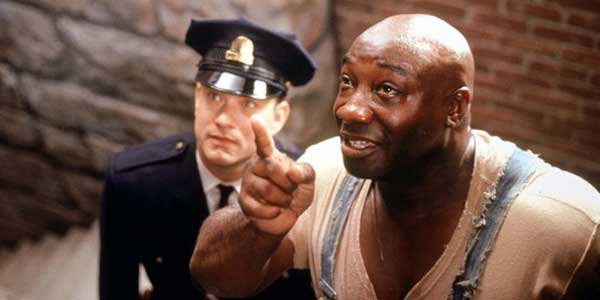
1. John Coffey, The Green Mile (1999)
 The obvious choice for top spot. In a film that starred two-time Academy Award winner Tom Hanks, it was Duncan's gentle-giant John Coffey that stole the hearts of an international audience. Playing in what proved to undoubtedly be the definitive role of his career, Duncan garnered award nominations from just about every film academy of worthwhile note, proceeding to attain a Saturn and Black Reel award in the process. Based on Stephen King's 1996 serial novel of the same name, The Green Mile centred around the story of Paul Edgecomb (Hanks), a death row corrections officer during the time of the Great Depression. Edgecomb believed himself to be role model of society, until the summer of 1935 led him to re-evaluate his self assuredness. As the man responsible for the overseeing of John Coffey's execution, Edgecomb suffers from inescapable guilt of the death of one of God's "true miracles"; bringing into question the justice of the death sentence's finality. As for Duncan, his portrayal of the misunderstood death row inmate broke the hearts of all who witnessed it, offering an insight into the pain caused by mankind that still resonates true to today's society. Now, with the turning of Duncan's death, the message of The Green Mile should be heeded with the same intensity as it was upon its initial release; for the best amongst us are just as susceptible to fall.