5 Reasons Why Tauriel Is The Best Addition To The Hobbit

The consensus seems to be: what's the deal with Tauriel? Here's why the haters are wrong.

Tauriel should have been in the novels. Seriously, there are no women at all in The Hobbit, and it is annoying (there should also have been more women in The Lord of the Rings, but that's neither here nor there). Still, Tauriel is so cool, and her presence and plots shine light on such interesting elements of Middle Earth, that she was really needed as part of this universe. Look, if you don't like Peter Jackson's adaptations, that's fine. Everyone's entitled to their opinions and interpretations. But there's a big contingent of the internet insisting Tauriel is an example of "bad writing" (although no one ever explains what they mean by that). Also: there are people who are glad to see a girl, but are furious that she has romantic subplots. I will say this once and never again: a love triangle does not automatically make a bad plot, and does not equal sexism. This is something we believe because of Twilight. Go back and watch Buffy if you do not believe me. There's nothing sexist about romance. There's nothing Twilight about the Desolation of Smaug. And the love triangle adds more than it subtracts, as I will talk about at length later. What I'm saying, then, is that Tauriel is a worthy addition to Tolkien's world. But not only is she that: she's a desperately needed and undeniably excellent character, too. Here are 5 reasons why Tauriel is the best (and most important) addition to The Hobbit films so far...

5. They Really Needed A Female Character

It's worthy saying again: THERE ARE NO WOMEN IN THE HOBBIT. You really cannot get away with that kind of crap anymore. Single-gender novels are no longer acceptable. Thank God. When I read the books to my kids, I fully intend to gender-swap the characters just because that seems like the best solution. I'm open to recommendations about the best character to do this with. There were 2 scenes with women in the first Hobbit movies, and it showed. It's annoying to watch a movie that is such a blatant boy's club. Women make up half of the human race: excluding us completely is bull, and it can make the levels of testosterone feel overwhelming. Call it what you like. Philippa Boyens talks about needing "feminine energy," Evangeline Lilly talks about wanting 9-year-old girls going to the movies to get the message that they belong in that world as much as any boy. I don't care: maybe it's all of those factors. But women are important, our journeys are important, our contributions are serious... and we should be included, damn it. Rant over.

4. A Third Elf Makes Elven Society Three-Dimensional
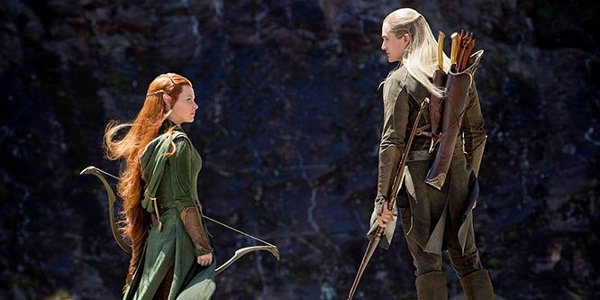
In The Lord of the Rings, Legolas was "the elf." That was basically his entire personality. Elven societies were seen very little, and they were passed through quickly by the Fellowship. We don't really know much about Lothlórien or Rivendell, except that they're Elven territories. Mirkwood is different. It used to be called the Greenwood, but isn't anymore. It's filled with giant spiders which the Elves can't keep under control. The Elves live in a cave carved to look like a forest. They worship starlight that, living underground, they never see. Tauriel is unusual for having walked in the starlight, for wanting something beyond the caves. A conflict between Thranduil and Legolas would have been contained within one division of Elven society. It would have seemed like a King-Prince power struggle, and a father-son thing. Adding Tauriel to the mix - an Elf of a different race, with motivations and desires beyond the ruling caste of Mirkwood - changes things up. Tauriel cares about the world beyond the forest, something Thranduil does not and Legolas has never considered. She occupies a different place in Elven society, one outside the ruling caste: something we've never seen before. Personally, I had no idea before I saw this movie that there were other kinds of Elves, or that there would be a problem if a blonde and brunette Elf wanted to get together (I have since started the Silmarillion: do not judge me, fanboys and fangirls). Tauriel occupies a different social and political position than the other elves, and she illuminates some of the struggles taking place within the Elven community. But she also occupies a different racial position, and when emotions are added to that - emotions that violate taboos of Elven society - it makes for some very interesting drama.

3. We Get A Serious Look At Racism In Middle Earth

This is where Tauriel's love triangle is a really, really great choice from the writers. It's far from a typical love triangle because there's no socially sanctioned choice for Tauriel - no way out. There are no happy endings, a situation extremely unusual in Middle Earth, and unheard of in Middle Earth romance. Tauriel is not good enough for Legolas, even though she is a great warrior, a good soul, and a clever mind. She's the wrong blood. We haven't seen something like this before: Aragorn and Arwen were fine as far as blood went, because Aragorn was a descendant of Númenor (I still don't know what that actually means, so feel free to scream at me in the comments). Racism is something that Middle Earth has skimmed over. There are very strict racial boundaries, and until now a lot of us didn't realize they were so deep that they divided societies up within themselves as well. An intermarriage almost never happens unless kingships are involved. You live in your territory, and you may trade with neighbours... but that's about it. Tauriel shows us the effect this racism has on the individuals trapped in it. The look on her face when she calls herself "a lowly Silvan elf" is heartbreaking, and when Thranduil basically says "yeah, you suck," it's all the worse. When Kili is delirious, and he asks "do you think she could have loved me?", it's painful because you become aware of just how wide the gap between these two people is. They are literally next to each other, but the racial lines between them are so powerful, so unbreakable, that it's as if she walks in another world. We haven't seen these things before. All we've seen is an elf-dwarf friendship (Legolas and Gimli), a pretty minor subplot that nudged racial lines without coming close to breaking them. With this triangle, we've got a crazy collision of racial taboos and divisions, and it's both great drama and great storytelling.

2. We Get A Window Into The World's Moral Triangle

Early on, Beorn says: "I don't like dwarfs. They are too quick to dismiss lives they deem of less value than their own." All through the film, we see characters making judgements about the values of people's lives. Thranduil carelessly tells an Orc: "I do not care about one dead dwarf." Then he kills the Orc he promised to free. Thorin leaves his nephew behind, sick, without looking back. Then he nearly doesn't go to help Bilbo, calling him "one burglar." The Master of Lake Town, Smaug, Thranduil: all these characters are treading on lives they don't care about. Legolas LITERALLY treads on lives he deems worth less than his own - using dwarf heads as stepping stones in one of the more ridiculous scenes in the flick. Tauriel doesn't do things like that. It's not how her mind works . She thinks like Gandalf, or Bard, or Bilbo (maybe) think. She looks at life and she judges it on its own merits, not on the categories others impose. When she turns back to heal Kili, she's making a decision about the value of his life. Legolas didn't even think Kili's life was important enough to say "that's too bad" about. Tauriel makes the decision to do what she can to save a life she thinks has value... even if others disagree. She's willing not only to kill, but to heal. Tauriel's moral surety doesn't mean she is an uncomplicated character. Everyone in this movie faces difficult choices without easy answers, and Tauriel is no different. She and Gandalf are the only characters acting from unselfish motives, who think in terms of evil sweeping the world and the need to fight it. But they still struggle, still wonder if they've made the right choices. They face pain and sanction for the choices they make, be it the wrath of King Thranduil or imprisonment in Dol Guldur. Tauriel's love triangle is an important part of her character, sure. But she's not contained by that plot. She comes into conflict with Legolas and Thranduil not just because of lovey-dovey stuff, but because of her belief in the need to fight evil, and in the need to protect lands beyond their borders. She's aware that everyone is "part of this world," and that they have the responsibility to fight evil. That sets her apart from a lot of characters, and simultaneously reveals both her own and others' motivations.

1. She's So Incredibly Cool

Yeah, seriously: look at her. She's just awesome, and gorgeous, and totally badass. Tolkien was wonderful, but he didn't quite get women and violence. He didn't get that women aren't peaceful healers by nature. Eowyn, out of the blue, throws away her warrior persona to become a healer? What is that all about? Tauriel is cool, beautiful,a and she saves the lives of a pile of male characters and never apologises for being awesome. Yeah, sure, being a "strong woman" isn't enough to make a character, but it doesn't hurt. Again, look at Buffy if you don't believe me. Tauriel has all the complicated character dimensions I've spoken at length about before, and she can also take out five giant spiders in less than two minutes. She has the skill set essential to just about any character in Middle Earth, she has the ability to affect change, and she has power both emotional and physical. And, having been the little girl who wanted to play Lord of the Rings with her brother and had to pretend to be a boy because there were no cool girls (ahem), that is something the world of Middle Earth sorely needed. Like this article? Agree about Tauriel? Let us know in the comments section below.

Contributor
Contributor

Rebecca Kulik lives in Iowa, reads an obsence amount, watches way too much television, and occasionally studies for her BA in History. Come by her personal pop culture blog at tyrannyofthepetticoat.wordpress.com and her reading blog at journalofimaginarypeople.wordpress.com.