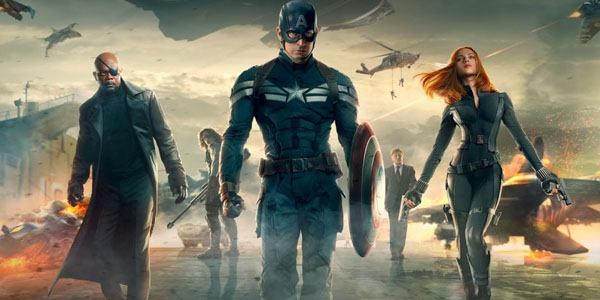
So far, almost every entry into the Marvel Cinematic Universe has been fairly simple in its execution. There's a villain with a nefarious plot and it's up to our heroes to thwart it. Along the way, there's conflict among the protagonists which gets neatly resolved through punching things... just in time for an all-out brawl to close it out. It's a simple but effective formula. Captain America: The Winter Soldier is perhaps the first film in this franchise that has attempted to carry more mature themes. It's a well-balanced film, perfectly blending the action and spy-thriller genres with topical discussion and strong character moments. Despite being enjoyable and well-executed, it's not a perfect film. There were times when the focus of the movie seemed entirely misplaced, gaping flaws (not in plot, necessarily, but in circumstance) and comic book weirdness that clashed horribly with the tone of the film. So here's a list of 5 bizarre moments in Captain America: The Winter Soldier... Naturally, it's going to be pretty hard to write this list without giving away some elements of the plot, so this is your spoiler warning. The article has been written as vaguely as possible, but it may be necessary to allude to parts of the film that you may want to experience for yourself.
5. Where's Hawkeye?
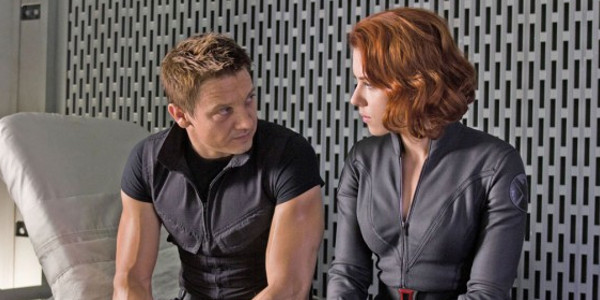
Natasha Romanoff, aka Black Widow, features so heavily in this film that it makes her role in Iron Man 2 look like a throwaway cameo. Much of her role in The Avengers was in relation to Clint Barton, aka Hawkeye, with whom she had an implied romance. Given how often the characters have been associated, it's pretty odd that he doesn't show up in this film, nor is he ever mentioned. It's perfectly reasonable to assume that they'd been given different assignments, one that put Hawkeye undercover so neither Black Widow or Captain America could call on him for help. It would have just taken a single line to explain his otherwise conspicuous absence. Even if we assume he never breaks cover to ask why his boss is dead and two of his friends are now considered fugitives, when SHIELD becomes defunct at the end of the film you'd think that any ongoing missions become somewhat moot. Moreover, given the events of The Avengers, keeping Jeremy Renner in the picture would have been a great opportunity to develop his fairly one-note character. In Thor: The Dark World, we saw that Loki's influence over Selvig had a profound effect on him, albeit one that was used almost entirely for comic relief. It would have been interesting to see how Barton, a trained SHIELD agent, deals with having been so easily manipulated and coerced into mass-murder. There were hints of this in The Avengers after Loki's mind control spell is undone, but this was never followed up on. Having said that, the film makes good use of every single character, so stuffing in an extra Avenger may have weighed it down. Particularly since - a point to be expanded on later - the film has problems keeping focus on the titular character. Maybe this will be addressed in a spin-off Hawkeye and/or Black Widow movie, or even in Agents of... hey, wait a minute...
4. Agents Of Fortune?
As already stated, the events of the film ultimately see the dismantling of SHIELD. Former agents are now seen wearing CIA gear, a large chunk of its workforce are (presumably) arrested as HYDRA infiltrators and Director Fury is thought dead. Though it'll probably be restored in a later film, right now as far as the MCU is concerned, SHIELD is no more. So how will this play out on the spin-off TV series that features the name of the now-defunct organisation in its very title? We know that the timelines are matched up based on events of Thor: The Dark World playing directly into the plot of an episode, more or less at time of release. Considering that Coulson must still be a little peeved at SHIELD (and Fury in particular) for what they did to him, how he responds will be interesting. Would Coulson grieve for the man he worked closely with for many years, who saved his life but robbed him of the will to live it? Will Skye lose the immunity she's had with SHIELD now that the CIA are involved? Will the usually agreeable Fitz/Simmons duo oblige to the CIA or join the splinter-faction that we're pretty sure Coulson will form? What if one of the team was a HYDRA infiltrator all along? Though it'll be fun to see Coulson's team dealing with the aftermath, for a series that is only 15 episodes into its run and hardly had time to establish a dynamic of its own, it's a big shake-up. But we always knew the TV series would be beholden to the films and, based on his other work, Joss Whedon - who is executive producer on the show and also the general overseer of the direction the MCU takes - probably has some grand plan that will take shape on TV and come to fruition in the next Avengers movie.
3. Fury Has Both Eyes Open... Somehow
Samuel L. Jackson gets his contractually-mandated quota of BAMF moments in this film, more than any other movie including The Avengers. But one of these moments doesn't make a whole lot of sense from a technical and biological standpoint. In the final act, Fury and the bad guy have to both give a retina scan to a SHIELD computer for reasons of plot. Like any competent systems admin, the villain has revoked the access of a high-ranking agent that underwent a mild case of death. So Jackson gets to stare down the camera and lift his eyepatch, revealing all the gore that a 12A rating will allow beneath. Somehow, this gives him access to the computer and the day is saved by badassery. Because badass moments are ruined if you have to explain them, particularly with technobabble - it's not exactly clear how or why this works. I suppose he could have created a secret backup user account for himself that SHIELD wouldn't think to delete, secured with his other eye, but that's not made clear in the dialogue. Even if his extremely scarred eyeball is in good enough condition for a usable scan (which is doubtful), it's still the same retina as his working eye, so what's going on?
2. Zola On Tape
About halfway through the film, the writers apparently decided that this comic book movie was far too realistic, so threw in the most over-the-top comic book element they could find. For reasons of plot, Captain America and Black Widow stumble across a bunker in a disused military training camp containing several dozen 1970s styled computers. It turns out that the bodily Zola, close to death, had his mind transferred onto magnetic tape so that he could exist as a giant supercomputer which our heroes natter with, revealing important information including the villain's dastardly scheme. It's a blatant exposition dump (Zola even admits that he's stalling) that is never mentioned again once the scene ends, meaning this bizarre sequence is wedged between the espionage and action so awkwardly that the tonal shift gave us whiplash. You can forgive a bit of fan service, but they really needed to dial-down the comic book campness and this scene didn't help. Though stylistic, it would have been more unnerving to show Zola trapped on a crumbling machine in a dank hovel, rather than a room so white it was probably designed by Apple. Furthermore, is it really necessary for HYDRA to condemn Zola to existence solely on a medium that could be wiped with a small magnet? We know that he became Cyber-Zola at a time when tape was the best and only means of storing data (assuming the technologically-advanced HYDRA doesn't have something better), but has he really spent four decades refusing to be transferred to a more svelte and robust digital home? They show that modern tech is present in the room to indicate the ongoing involvement of Zola with HYDRA, so it's not as though he's not had the chance to ask. They have the technology, they can reboot him.
1. The Winter Soldier?
What's in a name? Well, if you're a modern science-fiction movie, not much. Disney/Marvel and a lot of other studios are indulging in a trend of giving their movies evocative-sounding names that don't really have much bearing on the plot. For example, the titular world of Thor: The Dark World was more of a dull green and only had maybe 10 minutes of screen time. With a title like Captain America: The Winter Soldier, you would expect that the story focuses mostly on the two characters it refers to. But Bucky, as the Winter Soldier, has less screen time in this film than he did in the first Cap movie. They try to build suspense by pushing him to the shadows for two-thirds of the film, but the payoff is incredibly underwhelming. He and Cap only interact a handful of times, all of which brief, and Rogers only knows that it's Bucky for the last two. Though there was a fight-scene between them at the end, it was peripheral to the main story. His involvement is a sub-plot at best, with a sense that they're setting up the Winter Soldier storyline for a later film, which would be fine if his name hadn't been in the title. Surely the next time we see Captain America and the Winter Soldier clash should be called "Captain America: The Winter Soldier" and not the story that merely establishes their conflict. The underuse of the Winter Soldier does speak to the larger problem of misplaced focus rampant in this film. Even Captain America comes across as just one part of an ensemble cast, with the action constantly being drawn away to characters like Fury and Alexander Pierce, to the point that it feels like an Avengers 2 prologue rather than a film about Cap. Still, it's a fantastic movie with a great story - possibly one of the best entries into the Marvel Cinematic Universe so far - but it was no more about Captain America than The Avengers was. Like this article? Any weird moments to add? Let us know in the comments section below.