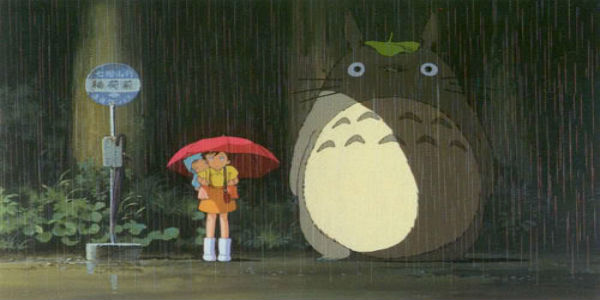
Theme: Childhood dreams...and nightmares. Few directors have so consistently and wonderfully captured the wide-eyed innocence of childhood as the Japanese master of animation, Hayao Miyazaki. His protagonists are frequently high-spirited young girls with lively imaginations, prone to daydreaming and fantasising about faraway lands and mythical creatures, and his early masterpiece My Neighbour Totoro can be seen as the template from which his later films would follow. Satsuke and Mei arrive with their father in rural Japan in the 1950s so that they can be closer to their sick mother, convalescing in a nearby hospital. As they settle into their new environment they begin to explore the natural world around them, discovering an assortment of woodland spirits and mythological creatures including Totoro himself; the "keeper of the forest". What is notable - and thoroughly appealing - about My Neighbour Totoro is Miyazaki's avoidance of overt dramatic tension and conflict; instead, the film ambles along a pace which matches the shifting sunlight on the open landscapes. The disappearance of younger sibling Mei and the hunt to find her may provide the core of the final act, but what lingers in the mind after the film closes are the minor attentions to detail - the passing of a frog on a wind-swept country lane summing up Miyazaki's unique approach, capturing something of the essence of a particular time and place. The fantasy realms explored in Guillermo del Toro's Pan's Labyrinth might come from a similar realm of fable, but they are a reflection of a time and place in history completely at odds to the woodland locales at the heart of My Neighbour Totoro. Like Sasuke and Mei, young Ofelia finds herself relocated to the remote countryside and she too has a mother suffering from an illness, but the parable offered by del Toro is of a significantly darker tone, reflecting the backdrop of Spanish fascism under the dictator Francisco Franco. Ofelia's escape into a fairytale world where she meets a faun is rooted in the deeply symbolic world crafted by del Toro using a variety of influences, from Greek legend to the fiction of Jorge Luis Borges and the artwork of Francisco Goya. We are no longer inside the imagination of a child governed by pure, untarnished wonder but one dictated by violence, torture and the destruction of freedom. Ofelia's journey is a reflection of her role in a world of harsh realities and she must venture into the underworld to face a spiritual rebirth in order to overcome the forces of darkness which threaten to consume her.