8 Iconic Movie Characters That Were Mostly Improvised

Apparently, there's no reason to hire screenwriters in Hollywood.

Let's do a little mental exercise. Think about one of your favorite movie characters of all time. Picture the way they move, the way they talk, their family background. Everything. Think of their most perfect line of dialogue. Now, chances are, a wiry screenwriter was probably hunched over their keyboard, carefully fleshing out every detail of this character's personality and crafting the dialogue that will eventually be repeated (and probably misquoted) for years to come. And in a lot of cases, that's probably a pretty accurate picture of how these characters were born. A few of them, however, weren't created until the actor playing them showed up on the set for that day's run-throughs. Because even though the majority of Hollywood's most enduring movies are carefully crafted, some of them don't even have a finished script when the cameras first start rolling. That lack of structure--with the right actors and a director who isn't afraid to let things happen naturally--can be responsible for bringing fresh, interesting characters to life. Characters that might have otherwise faded into oblivion.


8. Olaf - Frozen

Aside from that damn "Let It Go" song, there's probably nothing kids enjoyed about Disney's Frozen more than Olaf, the ultra-friendly snowman who loves a good hug. And the voice behind Olaf, Josh Gad, was the one responsible for the anthropomorphic snow sculpture becoming such an important part of the film. Taking a page out of the Robin Williams Voiceover Playbook, Gad went and ad libbed all over the newly-minted Disney classic, turning a bit role into a toy merchandiser's wet dream thanks to his skillful extemporizing and sheer persistence. From the first time Olaf is first introduced on screen (i.e. waved into existence with magic), the character is all Gad. In fact, for that first scene they ended up using the actor's very first take, which wasn't scripted in the slightest. No, that scene was a result of Gad just playing around and testing the waters, trying to figure out what the character was and how he would interact with the world around him. The talking snowman's endless optimism, benevolence, and childlike whimsy all came from Gad riffing in the recording studio. The director chose some of the best lines from those sessions--which Gad says he was spewing out to see if he could make the creative team laugh--and told animators to work them into the scenes. Alas, one of the most popular animated characters from this decade was born.

7. Sergeant Hartman - Full Metal Jacket

There may not be a single performance in the history of war movies that stands above R. Lee Ermey's incessantly vulgar Gunnery Sergeant Hartman. It's a work of brilliance that simultaneously acts as both a shocking comedy monologue and, eventually, a squirm-inducing plot device. Ermey's lines from Full Metal Jacket are without a doubt the most memorable, and so it would be easy to assume that Stanley Kubrick--a notoriously meticulous director--poured over each phrase before filming began. (There were probably no fewer than twenty variations of "You had best unf*ck yourself or I will unscrew your head and sh*t down your neck" written in Kubrick's notepad, right?) But that couldn't be further from the truth. Not only were about half of Hartman's rants not in the original script, but Ermey was initially only signed onto the movie technical adviser, but landed the role after asking Kubrick if he could audition for an on screen part. Ermey, having served in Vietnam as an actual drill instructor, whipped up an even longer string of insults to use on a group of background extras in order to prove to Kubrick that he was right for it. Some of that audition transcript was worked into the script, while a generous helping of further off-the-cuff vulgarity was performed on the spot during filming. All in all, the Sgt. Hartman character was expanded to twice the size that it was in the novel, The Short-Timers, which Full Metal Jacket was based on. Most of that extra screen time was self-penned by Ermey.

6. Fat Amy - Pitch Perfect

One might not expect a movie like Pitch Perfect to feature much in the way of improvisation. These kinds of movies tend to be carefully scripted and executed, lest any scene appear too natural or...what's the word...not cheesy enough. Luckily, Rebel Wilson was on hand to ensure the proceedings had a calm, free aura about them. As the self-proclaimed "fat sidekick," Wilson says she simply took the hilarious script given to her by the screenwriters and used it as a starting point. Then she just kinda...kept talking. Her onscreen partner for the most of the film, Adam DeVine, is also a gifted improviser, which resulted in nearly all of their scenes devolving into an unscripted back-and-forth that went on for as long as the people working the cameras could control their body-shaking laughter. According to Wilson, most of her scenes that made it into the final cut of the film were improvised, with an additional several hours of banter that was left on the cutting room floor. When asked which of her ad libbed lines that made it in are her favorites, she admits that, because none of it was rehearsed, she has a hard time remembering much. Though she has a warm place in her heart for this one: "I sometimes have a feeling I can do crystal meth. But then I think, Mmmm...better not." Also, she improvised the "mermaid dance" that introduces her character to the audience. Because the crew didn't know she was going to drop to the ground to do some "floor work" (and because she only did it for one take) there was a bunch of tape markers on the ground that had to be digitally erased in the editing room later. Evidently, that cost thousands of dollars to do, but the director liked the joke so much that he had them go through with it anyway.

5. Tony Stark - Iron Man

To hear Jeff Bridges tell it, there was no script for the original Iron Man. Bridges, who played lead villain Obadiah Stane, insists that the production of the popular superhero flick was like "making a $200 million student film." There was only a modest outline for the actors to work within, leading to a great deal of improvisation within each scene.
"We would show up for big scenes every day and we wouldn't know what we were going to say. We would have to go into our trailer and work on this scene and call up writers on the phone, 'You got any ideas?' Meanwhile the crew is tapping their foot on the stage waiting for us to come on."
Although Bridges says he felt anxious about having to come up with his own dialogue, he applauds both Robert Downey, Jr. and director Jon Favreau (who is also an actor accustomed to ad-libbing in his roles) for handling it all so adeptly, and with such a relaxed calm. This explains why Tony Stark ends up being so much like real-life Robert Downey, Jr., particularly in the first film. He, not a hired gun, came up with most of his own lines. It apparently didn't sit too well with Gwyneth Paltrow, who had the majority of her scenes alongside Downey. Reports from the set claim Paltrow often became frustrated because she simply couldn't keep up with what Downey was doing. And so one of the most memorable superheroes of our generation was essentially birthed from the mind and wit of Robert Downey, Jr.

4. Betelgeuse - Beetlejuice

For much of the 80s and 90s, Tim Burton seemed like a mad scientist. But one that had a really solid grasp on his own batsh*t ideas. Sure, his creations were bizarre and occasionally Frankenstein-esque, but it never seemed like he just showed up on set and started stitching limbs together at random. Yet, in a way, that's exactly what happened with Beetlejuice. Both Burton and Michael Keaton brought pieces of the Ghost With the Most to the party, and much of his creation occurred at the start of filming. Keaton says the Betelgeuse character was described to him by the director as "having lived in every time period, but no time period," which Keaton took to mean, basically "Do whatever you want with him, because I have no real clue what this guy's supposed to be but I thoroughly enjoy speaking in riddles." And so he did. He turned the character into more of a schticky, game show host version of the ghost, who was scripted with a wrier sense of humor. A generous portion of the dialogue was tweaked on set to fit the manic energy Keaton gave off. Even the Juice-man's famous outfit was patch-worked together on the set, with Keaton requesting the wild hairdo, moldy-looking makeup, and big buckteeth.

3. The Genie - Aladdin

In the immediate wake of Robin Williams' death, reports of his legendary comedy skills grew exponentially. By the time a few days had passed, it was widely publicized that Williams was such an extraordinary improviser that the screenplay for Aladdin was actually turned down by the Academy Awards for a nomination in the Best Adapted Screenplay category. Though the Oscar snub may have been oversold (it's rare for any animated films to be nominated in that category), there's no doubt that The Genie was largely a creation of the zany comic. Using a template of his favorite Warner Bros characters (including Bugs Bunny), Williams went into the studio with plenty of ideas for the filmmakers to use. According to Williams:
Initially they came in and I was just doing the scripted lines and I asked 'Do you mind if I try something?' and then 18 hours of recording later, they had the genie. I just started playing, and they said 'just go with it, go with it, go with it.' So I improvised the character. I think that in the end, there were something like 40 different voices that I did for that role.
Scenes where The Genie transforms into various celebrities, animals, and other well-known archetypes were all drawn up after Williams worked the impersonations into his rants. The animator has said they never expected him to ad-lib so much, nor did they anticipate the bevy of impersonations the first time they recorded the role. But they "readapted" and "incorporated Robin's riffs into the fabric of the film." Not just any voice actor would be able to get away with riffing that much, but this role was written specifically for Williams in a time before big name stars were used in animated movies.

2. Peter Venkman - Ghostbusters
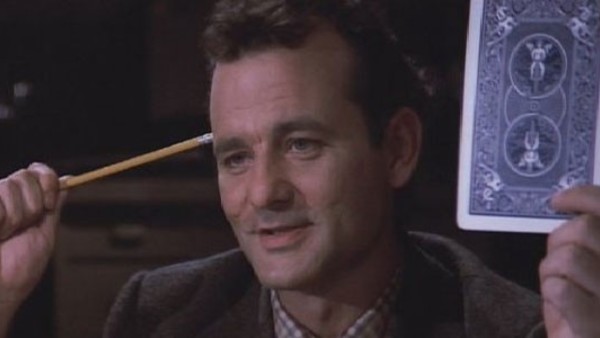
This is far from the first time Murray has improvised some sensational dialogue. The entire "Cinderella Story" monologue from Caddyshack was also made up on the spot, as were the bulk of his lines from Tootsie. According to the director Ivan Reitman's son, Jason, though most of the dialogue from the original screenplay winds up on screen, that's not the case with Peter Venkman, who was almost entirely improvised. "It's as if Bill Murray was given a mumblecore-style essay about each scene and then permitted to say whatever he wanted as long as he got the point across." This is due in no small part to the fact that the role of Venkman was actually written for John Belushi, but when Belushi overdosed before the final script was completed, Murray was brought in as his replacement. Rumors circulated that Murray didn't even bother to read the script, showing great disregard for the writers and director and underestimating how successful the film would be. More likely, however, is that Murray--a man who is nothing if not equal parts nonchalant and dry--just liked to goof around at the table reads and on set, causing his brilliant, unscripted lines to be added into the final cut of the film.

1. Dr. Strangelove - Dr. Strangelove, Or: How I Learned To Stop Worrying And Love The Bomb

Peter Sellers is a genius. That's not a disputable statement. If there's any confusion about this, one has to look no further than his work in Dr. Strangelove. Playing multiple characters in the film, Sellers is the core of the film. Which is weird, because his titular role wasn't even in the novel, Red Alert, from which the film was adapted. But that just goes to show that the brilliance of one man can occasionally overpower a script and inspire a mad man like Stanley Kubrick to go places even he wouldn't have thought to go. Speaking of Kubrick, most of the loose, impromptu vibe of the film came from a little white lie the director told his actors: namely, that the scenes they were "practicing" were actually being filmed and would be used in the final cut of the movie. This was because Kubrick decided to turn the serious political drama into a satire after he'd already cast guys like George C. Scott, who were serious, dramatic actors. The ridiculous nature of the film lent itself quite well to having Sellers go wild and basically tear the script up. The most iconic scenes from Dr. Strangelove were nowhere to be found in that original script. For instance, Strangelove accidentally referring to the United States President as "Mein Fuhrer?" Sellers' idea. The involuntary Nazi salutes? Seller's idea. Strangling himself with his possessed arm? Yep. Without Peter Sellers, there is no Dr. Strangelove. Literally.

Contributor

Jacob is a part-time contributor for WhatCulture, specializing in music, movies, and really, really dumb humor.