8 Things You Learn Watching Star Wars: The Force Awakens

J.J. Abrams delivers a new hope...

After rewatching all of the Star Wars films in anticipation for The Force Awakens (in order to see what we can learn form each), we're finally here. When it dropped last week, Episode VII was met with near universal acclaim, perceived as a stellar return to franchise form. And it's hard to deny these claims, for The Force Awakens truly is a great blockbuster, both of the Star Wars saga, and outside of it. While the immediate rush for articles understandably looked to delineate plot points and pinpoint saga symmetry and assess the narrative foreboding, I've held back a week or so to continue a series of articles which look at the Star Wars films in terms of iconography, performance, cinematography, and cultural relevance. And while it's true that this has been a rewatch series, a reflective account of revisiting each episode years after watching it for the first time, it remains that the same sort of process can be applied to viewing The Force Awakens even just a week after it opened (and technically I have watched it twice, so consider these thoughts made on the second viewing). While the fanfare isn't even close to dying down, the initial OMG-ness of Episode VII's opening days has slowed a little, allowing for a more measured look at where The Force Awakens stands overall in the saga. Note: all six previous entries can be found on my author page.


8. Never Has A Film Delivered So Well On What Fans Wanted

It€™s hard to remember a film that has delivered so emphatically on what the fans wanted. After the polarising prequel trilogy, which many believed strayed too far from the space-opera/western-in-space style of the originals, J.J. Abrams and co. have returned the saga to its nuts-and-bolts roots, supplying a film more in keeping with A New Hope than it is The Phantom Menace. The Force Awakens is of course still CGI heavy, but, unlike the prequels, the CGI here is a return to the grubby, uncleanliness of the originals, awash with rusty transporters and broken machinery and blasters that actually kick when they are fired. There are sleek new elements (the Stormtrooper lightsaber shield, for instance), but for the most part Episode VII is on the contrary to the pristine action of Episodes I-III (look at the lightsaber battles, which shun the agility and athleticism of the ones in the prequels for something closer to the straight-up sword fights of episodes IV-VI.) Add to that the genuinely spine-tingling moments of franchise nostalgia (which I'll get on to later), and the deviation from the insipid bureaucracy and trade-talk of the prequels to a war film which actually focuses on the war, and the not the machinations behind it, and you have a picture that presents Star Wars fans, young or old, with their dream new instalment.

7. The Casting Elevates The Film

If the Star Wars films have never really been about great performances or acting (aside from a few obvious instances), then The Force Awakens ardently corrects that. I€™ll talk about Daisy Ridley and John Boyega in the next entry, so here let€™s look at two of the best actors alive, a pair who undoubtedly lift The Force Awakens into a greater echelon: Oscar Isaac and Adam Driver. The former has the least screen-time of the leads, and it€™s fair to say that his arc is far less developed than that of Rey's, Finn's, and Ren€™s, but there€™s still enough here to suggest his monumental talent and his ability to be a franchise star as well as an indie actor. My vote for the best contemporary actor alive, Isaac brings a bona fide star-power to proceedings, taking up the charismatic, cocky Han Solo figure to add a bit of flair to a cast whose other main leads are relative unknowns (though clearly not for long). Driver, on the other hand, has much more to do, and in doing it he proves himself the newcomer MVP, a title which Boyega and Ridley could realistically also hold but which Driver just shades because he€™s so damn distinctive. One of the most unique actors around, Driver is a true oddball, his elongated face and inimitable delivery setting him apart from the majority of Hollywood€™s bland, young talent. And he€™s absolutely electric as Kylo Ren, menacing and foreboding with his mask on, distressed and susceptible to emotion with it off. Add to that the likes of Domnhall Gleeson and Lupita Nyong'o, and you have the Star Wars film with the best bench of acting talent in the saga so far.

6. And It's Progressive, Too

Not that I want to get too much into this aspect of the Star Wars saga (because it really is copy for another, more comprehensive article), but, to touch upon it slightly, let€™s just say that in a series which has, for one reason or another, been pretty whitewashed in the past, it€™s refreshing to have a young, black male lead here in The Force Awakens. It€™s further refreshing to see another great female lead role in 2015 (and there have been plenty), here exemplified by Rey, who refuses to be characterised as a damsel in distress, to the point where her constant refutations to Finn€™s insistence on holding her hand or pulling her up seem like meta rebuffs aimed at parodying the very idea that she might need any help at all (if anything, it€™s Finn who needs help). Respectively played (brilliantly, I might add) by John Boyega and Daisy Ridley, Finn and Rey are a true sign of progression in Star Wars, a franchise which was of course never overtly racist or misogynistic, but which was instead perhaps a product of its time, one in which white, all-American cowboy-style heroes were tasked with seeking out the women in dire need of their help. The Force Awakens looks set to put an end to that, and that can only be a good thing.

5. This Is An Intense Nostalgia Hit

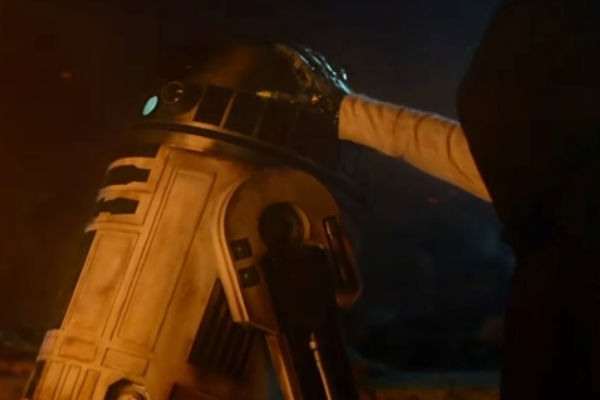
More than anything, The Force Awakens is an intense hit of nostalgia, especially in the first 45 minutes or so (which I€™ll look at next). From John Williams€™ famous opening twang, to the crawl of text, to the fantastic reveal of the Millennium Falcon, to Han and Chewbacca€™s already iconic re-entry into the franchise, Episode VII is a constant hit on the Star Wars fans€™ memory, delivering pleasurable strums to the G-spot of saga nostalgia which has been only teased by trailers and TV-spots up until now. The final reveal of Luke is one of the shots of the year, and for many it€™s the pent-up money shot that The Force Awakens promises for the best part of two hours. There are times when the nostalgia seems a little forced, as in when C-3PO is reintroduced late into the game, but for the most part Episode VII is a rip-roar through the space of memory.

4. The Opening 45 Minutes Is Bravura Filmmaking
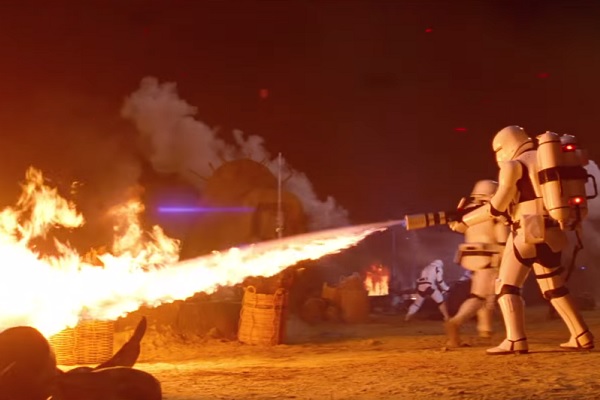
It€™s difficult to imagine a more satisfying, near-perfect stretch of blockbuster filmmaking than the first 45 minutes of The Force Awakens. The last stretch of Attack of the Clones comes close, as does the dénouement of Skyfall €“ a film which Episode VII seems indebted to in its constant nods to franchise history whilst all the while moving forward €“ but both are surpassed here, with Abrams landing punches left, right and centre in terms of iconography, set-piece and character introduction. Some highlights: The First Order€™s attack on a small village, which could be ripped straight from a Vietnam War film (as could the bloody hand-print smear on Finn€™s helmet, which is one of the series€™ most brooding moments); the reveal of the Millennium Falcon, with Finn and Rey sprinting past it, acknowledging some unknown junk not fit for flying only for the camera to swivel around to reveal the famous ship, which has fallen into disrepair; Finn and Rey€™s chemistry, which is staccato sharp and, more importantly, actually believable; and Han and Chewie€™s entrance, with the former€™s €œwe€™re home€ line already one of the best lines in the whole saga. This is how you open a movie.

3. This Is The Best Looking Star Wars Yet

Throughout this series of articles, I€™ve tried to consistently draw attention to just how replete with great shots the Star Wars films are, and, in The Force Awakens, this notion reaches its zenith, the film not just filled with gorgeous, redolent tableaux, but just aesthetically stunning in general. As shot by Abrams and his regular director of photography, Daniel Mindel (Mission: Impossible III; Star Trek; Star Trek into Darkness), The Force Awakens is a permanently brilliant opus of visual storytelling, rich in the arid deserts and star-filled vistas required of any Star Wars picture, but also filled with its own visual landmarks and and cinematic iconography. At times, Episode VII even touches the greatness of some of cinema€™s best looking movies, as in the shot of a fleet of TIE-fighters floating in a blood-orange sky, backlit by a blackening sun to evoke Apocalypse Now. Elsewhere, there€™s a band of Rebellion X-Wings bouncing in formation above the water, or a haunting shot of Ren watching a magnificent red beam (the product of the First Order€™s ultimate weapon) shoot across the sky to suggest The Force Awakens as far and away the most visually impressive film in the saga.

2. It's The Perfect Blend of Old-Saga/New-Saga Mythos

In blending the old and new mythology of the Star Wars saga, director J.J. Abrams and co. get it spot on, steeping the film in enough nostalgia and requisite franchise iconography to satisfy the old fans, but also building great new characters and worlds and stories to begin the process of creating a whole new generation of Star Wars lovers, too - something the prequels largely failed to do. It€™s not hyperbole to suggest that The Force Awakens could do now what A New Hope did back in 1977. The best example of this amalgamation of the new and the old is represented by Han Solo, Harrison Ford€™s beloved original-trilogy hero, here reintroduced for the first time since Return of the Jedi. Solo€™s appearance is a masterstroke: on the one hand you have perhaps the most iconic hero of the Star Wars saga, here back in his original guise as the loveable-rogue (if you€™ll excuse the cliché)/smuggler of A New Hope, before he went on to become a war hero. On the other hand you have a wise old sage, a man who can concede €œthat it€™s true, all of it€ when telling our new heroes about The Force and Luke. This presents Solo as both an embodiment of the old saga and a torch-passer for the new one, and by making the sensible decision to kill him off (in a great, great scene), Abrams ensures that the old-guard-hero sticks around long enough to acknowledge the past, but not too long that it takes away from our new band of heroes and the path(s) they will embark on.

1. This Is The 2nd Best Star Wars Film Overall
Surpassed only by The Empire Strikes Back, Star Wars: The Force Awakens, is the second best overall film in the franchise. Naturally, it eclipses all three prequels, and though I have recently defended those much derided films in this series of articles, it remains that they are films of moments; they simply can€™t compete with the sheer consistent brilliance of Abrams€™ work here. Episode VII too surpasses Return of the Jedi, which I found underwhelming when I revisited it after so very long. It€™s a toss-up, then, between A New Hope and TFA for second place - and this just edges it. Of course, A New Hope kickstared this whole thing, and it can lay claim to being one of the four or five most influential movies ever made. However, if we€™re going on sheer filmmaking, The Force Awakens is just superior. Not only is it acted and shot better (though this isn€™t really a competition), but it looks set to begin the same sort of legacy. I strongly believe people will feel about this film the way those who first witnessed A New Hope feel now. Episode VII can€™t quite touch the woebegone, all-encompassing tragedy of The Empire Strikes Back, and nor can it provide anything as defining as the Luke/Vader father reveal (though it does give it a damn-good go with the Han/Ren stuff), but it can be mentioned in the same breath, and that€™s some of the highest blockbuster praise you can get.

Contributor
Contributor

No-one I think is in my tree, I mean it must be high or low?