9 Horror Movie Remake Deaths That Were Way Better Than The Original
Because not everything about every horror movie remake sucks.

Whether it's remake, reboot, reimagining, reimaging, recalibration or whatever the latest buzz word of the day is, hearing that a once successful idea is being revisited is enough to induce a groan from the vast majority of horror hounds.
That's not to say that all horror do-overs are awful, of course. No, some can actually bring something fresh to the table or put a unique spin on an established IP while being respectful to what's been seen before. The problem is, the sheer amount of dross remakes out there means that it's tough not to instantly expect the worst from any such picture.
One way in which remakes have an opportunity to surpass an original film, is in the deaths that this redo serves up. You can already see what has worked and what hasn't worked about that original, and so the brutality and bloodshed can be tweaked accordingly when revisiting a tale that's already played out on the silver screen.
With all of that in mind, then, here are nine such times where horror movie remakes managed to impressively outdo their predecessors when it comes to some of their big death sequences.
9. Keith Jennings - The Omen

The decapitation of David Warner's Keith Jennings in The Omen is a moment that instantly takes you aback upon a first watch. After a sheet of glass slides out of the back of a truck, Warner's character ends up having his head sliced off by said glass.
While this is certainly a memorable death and one horror hounds often hold on a pedestal, the sad reality is that it actually looked a bit naff. Given the restrictions of the time, Richard Donner's 1977 film did the best that it could in making this decapitation look realistic, but the end result is one that clearly looks like a mannequin head has been tossed up in the air.
It may be the only way in which 2006's The Omen surpasses its namesake, yet it's hard to argue that the sheer advancement in technology doesn't make the decapitation of David Thewlis' Jennings look infinitely better than the character's fate in '76.
Of course, the demise of the 2006 iteration of Keith Jennings is slightly different to his predecessor. While his fate is still death by decapitation, that decapitation takes place when a sign swings down to sever his head from his body.
8. Eddie Kaspbrak - It

While there is clearly a certain charm to 1990's two-part It miniseries, that first adaptation of Stephen King's 1986 novel was surpassed on so many levels by Andy Muschietti's pair of It movies.
As Muschietti's picture drew to a close, it pulled at its audience's heartstrings as it killed off poor Eddie Kaspbrak (James Ransone). Eddie went out like a champ; coming to the rescue of Richie, so nearly killing Pennywise, before fatally being impaled by one of the nefarious creature's spider legs.
Following that impalement, we see Eddie use his last words to remind his friends to mock Pennywise in order to topple the beast. Adding even more emotion to the death of Ransone's character, his pals are forced to leave his dead body behind as their cavern setting implodes - all tinged with the implication that Richie and Eddie were maybe more than just friends.
How does this death compare to that of Dennis Christopher's Eddie from 1990? Well, that iteration of the character was briefly grabbed by Pennywise, dropped to the floor, then died. No impaling, no sense of terror, and no real emotion to what should've been portrayed as a far bigger deal for the Losers' Club.
7. Mr. Martin - Willard

2003's Willard remake saw Crispin Glover on the sort of form that forever had him suggested to play the Joker on the big screen. Across from him in that picture, it's R. Lee Ermey of Full Metal Jacket fame as the boss of the company he works for; a company that Ermey's Frank Martin took control off after Willard's father committed suicide.
Putting the screws to Willard, Martin abuses him at the workplace, tries to buy his house from under him once Willard's mother passes away, kills his rat Socrates, and then eventually fires the purportedly meek and mild Willard Stiles. It's then, though, that Willard and his army of rats fully put Martin in their crosshairs - leading to him bloodily ravaged by a pack of the furry sorts after being trapped in an elevator shaft.
In the 1971 Willard, it's the same basic plot as the 2003 picture. The one main difference, mind, is that instead of Frank Martin we have Al Martin (Ernest Borgnine) - who is exactly the same character.
For Al Martin, his demise is nowhere near as chilling as Frank's. Rather than playing up the dread, the blood and the sheer fear of the situation, Al falls out of a window before then being nibbled on by rats.
6. Claire - Black Christmas
Bob Clark's Black Christmas - alongside John Carpenter's Halloween, of course - is the movie that kickstarted the slasher subgenre.
Released in 1974, Black Christmas saw a group of sorority sisters stalked and slaughtered by a mysterious killer during the festive season. And the first to bite the bullet in that picture? Why, that would be Lynne Griffin's Clare.
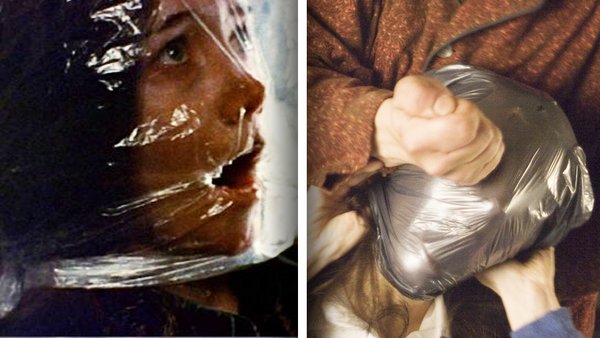
Hearing a noise in the attic, Clare goes to investigate, has a plastic sheet thrown around her head, then is killed off-screen. It's all very tame, and the death of this character is simply used to establish that sh*t's about to go down.
By the time Black Christmas was remade in 2006, it was again the death of Clair - spelt differently and played by Leela Savasta - that set the stall for what was to come. The thing is, this time out, this death was way more gnarly.
Rather than have the character head to the attic - something that would be saved for Jessica Harmon's Megan - Clair is attacked in her bedroom. A plastic bag put over her head, Clair is stabbed directly in the eye, establishing that the 2006 Black Christmas was going to be a tad more gruesome than the 1974 picture.
5. Johnny - Night Of The Living Dead
It's always tough to remake something that's viewed as iconic, and that was the task at hand for the legendary Tom Savini when he put a fresh coat of paint on George A. Romero's Night of the Living - complete with Romero writing the film's screenplay to update the tale for the modern day.
Much like the 1968 film, Savini's take had the opening act death of Johnny as a way to introduce the undead ghouls of the picture.
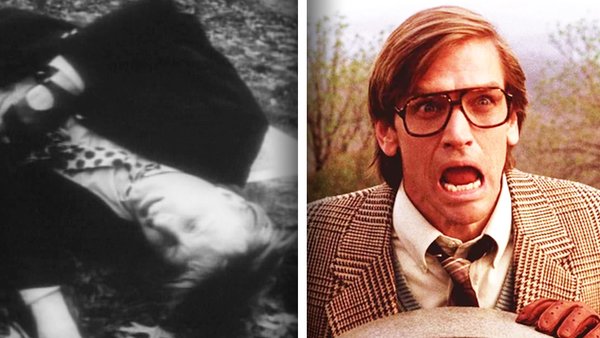
In Romero's effort, Russell Streiner's Johnny is killed after a scuffle with a zombie broke his neck. From there, Johnny's sister Barbra holes herself up in a farmhouse as she and some fellow survivors fight for their lives.
For Savini's Night of the Living Dead, Johnny was played by major genre fave Bill Moseley. And while it was still the same fate awaiting Moseley's Johnny during the film's opening scene, the death here was a whole lot more fun and definitive.
Having Moseley as Johnny in the first place was a stroke of genius. Throw in a genuine back-and-forth fight rather than the one-sided, brief affair of the '68 film - complete with amped-up, stunning make-up effects of Savini - and this death far surpasses what was seen from Streiner's Johnny 22 years prior.
4. Annie Brackett - Rob Zombie's Halloween

While Nancy Loomis' Annie Brackett is killed off in 1978's Halloween, the Danielle Harris version of Annie actually managed to survive until the second of Rob Zombie's Halloween pictures.
Annie's death in John Carpenter's Halloween is a shocking one - in her car, strangled, then throat slit - but Annie's death in Zombie's Halloween II is more gruesome, more emotional, and has more of an impact on the larger narrative at play.
For Danielle Harris' Annie, she just about survives an attack from the Shape in Zombie's first Halloween offering. Attacked while she and her boyfriend Paul are about to have sex, Annie sees Paul slaughtered by Michael and is then tortured by Haddonfield's most infamous son.
Following that, the barely alive Annie is found by Scout Taylor Compton's Laurie Strode, and a 9-1-1 call is made in time to keep her around for Halloween II. It's in that sequel, though, that Michael finishes the job - fatally stabbing Annie in her bathroom and leaving her for Laurie to find.
In how Zombie offed Annie, it added more emotion in how Laurie got to actually see her best friend take her last breaths. Likewise, it fuels Sheriff Brackett to eventually kill Michael in the finale of the unrated cut of Halloween II.
3. Big Bob Carter - The Hills Have Eyes

Like certain other characters featured on this list, the death of 'Big' Bob Carter in The Hills Have Eyes is a demise designed to set the tone and establish the threat that is on the table.
In Wes Craven's 1977 original, Russ Grieve's Bob is crucified and eventually set on fire by Papa Jupiter. As his family rush to his rescue, audiences got to see Bob toast up nice 'n' crispy before finally kicking the bucket.
This scene in and of itself is grim enough, with it firmly setting up the mutants of The Hills Have Eyes as being savages who will happily go to extremes. It's also heartbreaking to see the Carter family - in particular Bob's wife Ethel (Virginia Vincent) - reacting to this brutal sight.
For Alexandre Aja's 2006 version of The Hills Have Eyes, the exact same thing happens to Ted Levine's Big Bob. Where this outdoes its predecessor, though, is in how much more brutal this death is. Rather than a charred-up Bob, ala the '76 picture, Aja's film shows the character being burnt alive in chilling fashion - to the point his eyeballs start to melt!
2. Nancy's Mother - A Nightmare On Elm Street
They may have different names, but hey, they're essentially two versions of the same character, meaning Nancy's mother is fair game here.
In Wes Craven's iconic A Nightmare on Elm Street, we have Ronnie Blakley as Marge Thompson, the mother of central protagonist Nancy (Heather Langenkamp). By the time the Elm Street IP was dismally revisited and that first film remade in 2010, Marge had been swapped out for Dr. Gwen Holbrook (Connie Britton), who was the mother of that film's Nancy (Rooney Mara).
The Elm Street remake may have been a critical dud, but one thing that it did have going for it is in how it disposed of Nancy's mom during its shocking 'dream sequence' closing shot.
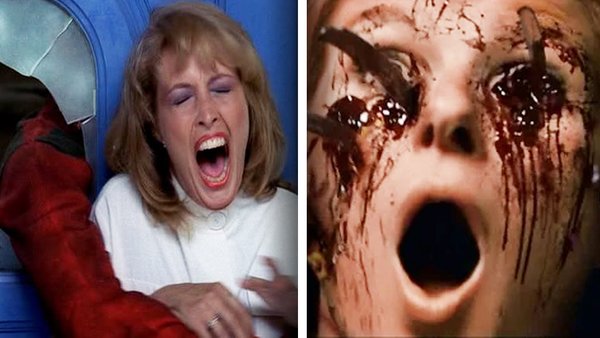
For both the original and the remake, the film ends with Freddy Krueger returning in a dream to take out Nancy's mother. The thing is, that final shot of 1984's A Nightmare on Elm Street looks absolutely awful. There, Marge - well, a horrendous-looking dummy of her - is pulled through a window in the Thompson household's front door by Freddy.
By time the 2010 picture rolls to a close, there's no such dummy downfall for Connie Britton's Gwen. Instead, Krueger appears in a mirror and stabs his bladed fingers through the back of Gwen's head and out of her eyes.
1. Chris Hargensen - Carrie
Not only was the 2013 Carrie remake a picture that simply didn't need to be made, but it failed to embrace any of the possibilities of retelling this tale in an updated setting. Sure, it dropped in modern technology, yet it didn't even scratch the surface of what could've been done with this to spin the themes of cyber bullying to the fore.
Anyways, pointless remake, right? Right.
One thing that this Chloe Grace Moretz-fronted redo does have going for it, is some admittedly impressive death sequences.
When the 2013 Carrie races through its final, carnage-laced act, one particularly gnarly death is the demise of Portia Doubleday's Chris Hargensen.
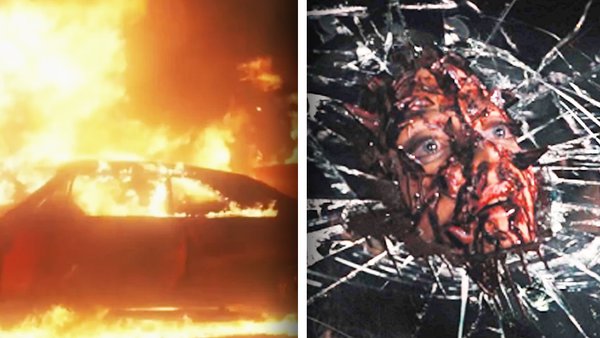
In Brian De Palma's 1976 Carrie, Nancy Allen's Chris died after her car was blown up by Miss White. This was a solid way to kill off the movie's main bully back then, but the later Carrie remake took the ball and fully ran with it for Chris' death.
Here, Doubleday's Chris similarly tries to hit Carrie with her car. Rather than the vehicle merely exploding, Moretz's character pushes it into a gas station, which brutally causes Chris' face to wedge in the windshield as Carrie then sets the whole goddamn scene on fire.