9 Movie Moments Too Exciting To Be Onscreen
 When you watch a movie or a television show you are given a guided tour through of the story by what is on the screen. As visual media, there is an expectation that the story will be told not only by what you hear (i.e. through the dialogue) but what you see as well. In fictional movies and TV the characters act in their own universe, and the camera is almost always there at the most exciting moments in their story. But this list is about the moments that aren't caught on screen, not because they aren't interesting or important to the story, but because they aren't shown. In a significant number of these cases it because what was written was too expensive to shoot, but it was too integral to the rest of the story to take out. But it can also be because there is a narrative reason why the director or showrunner withheld this information, whether it's to ramp up the suspense or create a more subjective narrative. Just a few notes about the list: no cliffhanger endings (only stuff that happens over the course of the story rather than after it is over), nothing that has to extrapolated by the audience (meaning that it has to be specifically referenced/talked about in the movie or show), and nothing that was left out because the plot wasn't entirely put together (meaning that if a bad B-movie has a dead character come back to life for no reason, his missing resurrection scene wouldn't count). This list isn't definitive, but these are some of the most exciting moments to ever not be seen.
9. Pacific Rim - Idris Elba's Flashback Fight
 In this year's Pacific Rim, Idris Elba plays a man named Stacker Pentecost who fought the Kaiju as a single Jaeger pilot before he becomes the commander of the Jaeger forces. In other words, he used to punch large alien monsters in the face using a big robot suit. The scene in question takes place years before the action of the main story, during Mako's flashback/breakdown during her Jaeger test. Mako, played by Rinko Kikuchi, remembers when a Kaiju attacked her city and she ran away in the growing wreckage. Right as the Kaiju seems to be gunning for the little girl, a Jaeger piloted by Elba's character distracts it and beats it to death offscreen as the camera focuses on Mako. This could have been for budget reasons as the digital effects necessary to believably render each battle must have been costly, but due to the large budget of the movie it was more likely a story decision. First of all, it makes sense to focus on Mako because this particular moment in the film specifically comes from her memory (and the audience/Raleigh sees it through the neural link from the Jaeger, see this comic for more details if you're confused). Also, due to the sixteen other robot vs. monster alien fights in the movie and the dramatic nature of this scene it made more sense for it to be about something other than behemoths fighting one another. But seriously, who wouldn't want to see another beatdown courtesy of Idris Elba?
8. Buffy the Vampire Slayer - Excursion Into Heaven
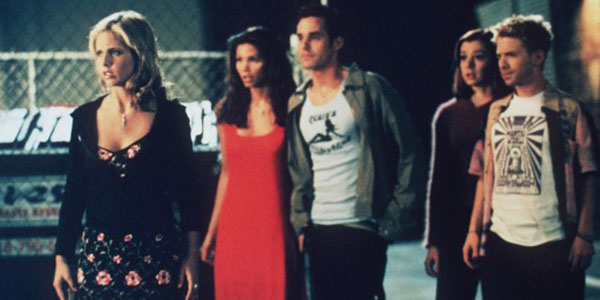 This is a spoiler for anyone who is still hoping to see a TV show that ended its run over ten years ago, so if you haven't made it to season six yet then you should skip to the next one. At the end of season five Buffy dies (again) to save the world (again), and at the beginning of season six her friends resurrect her by using a complex spell, because the show was going to be on for another two seasons. Willow and the rest of the gang think they are doing Buffy a big solid by bringing her back from hell, but it turns out that Buffy was actually in heaven during her latest venture into the afterlife. But we only get that information after she emotionally confesses it to Spike, and we never actually see what heaven is like in the Whedonverse. The realities of a TV show budget probably played a role in this, but the biggest reason for not showing the audience what heaven was like for Buffy was probably that any depiction of actual paradise is going to be disappointing (see the end of This is the End for proof). Also, Buffy's description of heaven as a peaceful and serene place gave you enough detail to realize that her return to her constantly hectic life as the slayer was going to be a difficult transition. So it was, "Point made, time to move on."
7. Catch Me If You Can - The Bar Exam
 In Catch Me If You Can, Leonardo DiCaprio plays smooth-talking con man named Frank Abagnale Jr. who evades the FBI (and an FBI agent played by Tom Hanks) at every turn. He uses his considerable skills to create millions of dollars in forged checks and has a fake medical degree and license, but he also obtains a law degree after taking the dreaded Bar exam. This entry is different than the others on this list because this movie was inspired by a true story, but the way this particular part of the narrative is carried out is pure movie magic. Tom Hanks's character can piece together every other part of the case, but he cannot figure out how the whiz kid cheated the Bar exam. Frank says that he didn't cheat, that he passed it by studying, but we aren't treated to a Billy Madison-style learning montage that shows us that he was even capable of pulling something like that off. Like almost everything else in the movie we believe Frank because of Leo's overwhelming charm, but is the rug being pulled over our eyes as well. It's an admittedly minor plot point, but it functions as a microcosm for the whole film. Is he really a super genius or is he just clever and handsome enough to trick you into believing he is?
6. Doctor Who - The Time War
 After Russell T. Davies brought the show back he threw a wrench into the Doctor's world by basically destroying every Time Lord that ever existed, maybe the audience expected to see a little something from the epic sounding Time War. But up until this point (the 50th anniversary special may change things) there haven't been any scenes showing the Time War. This can be explained pretty easily - the first series of the revived show takes place after the war is over and it takes place on a fixed period of time that the Doctor cannot un-fix in order to re-fix it. But we all know the real reason why we haven't seen any glimpses of the most epic battle in Who history: money. It would take a boat-load of cash in order to make something even remotely close to what fans can think of in their budget-free heads. It's probably for the best that it was left out and it provides the newer and broodier Doctors with more noticeable angst, but that doesn't change the fact that seeing the Time War would make for some exciting television.
5. Predator - Billy Sole's Last Stand
In Predator Billy Sole is the Native American hunter who is with the group that is terrorized by the titular Predator. In his last scene he stands knife-in-hand and prepared to take on the dreadlocked monster before the movie abruptly cuts away. It's a move that's supposed to build tension for the rest of the movie, not seeing what the Predator is capable of makes you think that it could be capable of anything. But it also sets up an epic fight and doesn't give you any pay-off: would it have been a hard-fought evenly pitched battle, or would the Predator quickly make Billy a fillet-of-Sole? It doesn't seem like this was done for budgetary reasons because if quick deaths are expensive then the Predator series would have been one of the most expensive franchises of all-time. The scene could have been shot but left on the cutting room floor, but it still doesn't change the fact that it was intentionally left out of the movie. Billy might have deserved a better send off, but Predator still couldn't have been more action-packed.
4. The Life And Death Of Colonel Blimp - The Duel
 The Life and Death of Colonel Blimp is a classic British film directed by the magnificent duo Powell & Pressburger. Made in 1943 during World War Two, the story is centered around an officer from the British military and an officer from the German military that become friends after a shared stay in a hospital. But they don't simply happen to meet one another there, after the British officer insults a member of the German army the Germans insist upon a fencing duel to protect their honor. The German officer that fights the British officer is the same man who eventually becomes his closest friend. But just as the duel takes place the camera cranes away outside their arena. This could have been done for several practical reasons: the actors couldn't fence and they didn't want to hire stuntmen, adding a lengthy fight sequence to an already epically long film might have been wasteful, or maybe they just couldn't get the action right. But not showing the duel allows the audience to believe that they could still be friends after permanently scarring each other. If we saw these dignified men fighting for their life we may lose empathy for them. Anyway, the scene takes on a light and comedic tone which allows their ensuing friendship to come more naturally, and the film is fantastic just the way it is.
3. Pirates of the Caribbean 3 - Oh Snap, Kraken Got Popped
 In Pirates of the Carribean: Dead Man's Chest, the big bad Kraken is controlled by the even more mythical Davy Jones, and after it is summoned it destroys everything in its path. As far as havoc-causing ocean-dwellers go, a mammoth tentacled creature that can destroy entire ships makes it probably the most fearsome thing in the Pirates franchise. But after it eats Jack Sparrow, it is destroyed by Jones somewhere between Dead Man's Chest and At World's End. This is referenced very briefly by a British commander and we briefly see the Kraken's corpse, but just how it was killed is not shown. This is a beast that had gun powder blown up on its limbs several times, essentially ate significant portions of several ships, and killed Jack Sparrow (albeit temporarily), and we are just supposed to accept that it was dispatched by Davy Jones quickly and easily? Just a bit of speculation, but I think the real reason behind the Kraken's demise is that they no longer needed it in the story, and they realized having a ten ton trump card in the hands of one of your villains makes the game a little unfair. So the Kraken went away, but it would have been pretty great to see just how you kill a seemingly unkillable fiend.
2. A Separation - A Fall Down the Stairs
 A Separation is a 2012 Iranian film directed by Asghar Farhadi, and although it operates under the guise of a low key inter-family drama, it is actually a thriller operating at a Hitchcockian level of suspense. A woman working as a maid in an upper-middle class apartment has a falling out with her boss which leads to a confrontation near the door. The woman is pregnant, and the man tries to push her out of his residence, and in the commotion the woman falls down the stairs. The audience can't see whether or not the man was truly responsible for her fall, they both took part in the confrontation and they are both the heroes in their own stories and the villains in each others. It's an incredibly tense sequence, a sensation that is only heightened by your inability to know the "truth" of what actually happened. This is perhaps the most pivotal scene in a movie where every scene is eminently important, and budget has nothing to do with how this scene was shot. Would it have been exciting to see what happened from a better viewpoint? Absolutely. But A Separation doesn't give you the easy way out, and having to contemplate the consequences of these actions is the hard part not only for the characters but the audience as well.
1. Reservoir Dogs - The Heist
 This is probably the most famous example in the history of film: Quentin Tarantino's Reservoir Dogs is about a jewel heist and it doesn't actually show the jewel heist. Reservoir Dogs mostly takes place in a warehouse that serves as the rendezvous point for a group of jewel thieves after they successfully rob a store but unsuccessfully handle the situation. Although the movie thrives on genre conventions, it delights in subverting them as well. The undercover "good guy" cop kills a woman, the tough guy thief cries and genuinely cares for his wounded accomplice, Steve Buscemi is maybe the most handsome guy in the movie. So not giving the audience the quintessential part of every heist movie (the heist itself) serves as another reminder that even though you're watching a movie that you feel like you've seen before, it is nothing like the movies you've seen. This isn't to say that it wasn't a budgetary issue either, the movie was supposed to be shot by Tarantino with his friends as the actors on 16mm film for $30,000 before Harvey Keitel got involved. So maybe the genesis of the idea came from what was initially a low-budget quick flick, but the movie stands the test of time because it took the basic concept of a genre movie and turned it on its head. Are there any other major examples that I left out? Let us know in the comments.