9 Movies That Prove Capitalism Isn't All Bad

RIsky Business For the record, I don't think that capitalism is all good either, I just think it has proved itself to be slightly more workable than previous attempts at economic organisation. No doubt one of those 'capitalism is crisis' types in a tent outside a Starbucks would shout at me for saying that, but it's what I believe. In compiling this list I have realised that it is far easier to find films that roundly criticise capitalism and blame the system for all that is wrong in the Western world than it is to find movies actively celebrating its benefits. It seems the creative types who go into film-making are a radical bunch. You'd have thought the fact that the movie business has made many of them incredibly wealthy would merit a degree of gratitude to the economic system that permits such a state of affairs. In American Psycho for instance it is very easy to criticise the shallowness of Patrick Bateman's lifestyle, and the fact that he likes to hack people to death with axes. No one focuses on the fact that Patrick does have a very nice apartment, as well as a truly impressive collection of business cards. (I should point out here that this is intended as a joke. In my last list I realised that some internet folk do not understand tongue-in-cheek humour unless you use that annoying emoticon, which I refuse to do.) So anyway, I tried to find films that highlight the benefits of capitalism, not just the increasingly hipster-ish ideal that it somehow holds us all back. To quote Mark Corrigan from Channel 4's Peep Show: "It's only the miracle of consumer capitalism that means you're not lying in your own s**t, dying at 43 with rotten teeth".

9. Iron Man
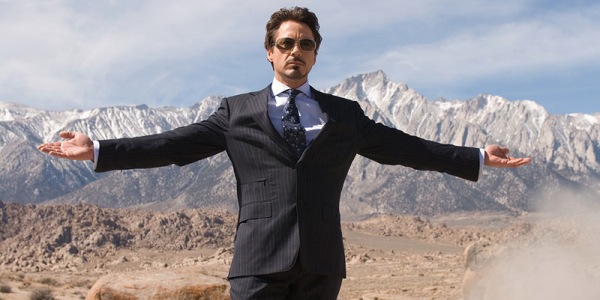
Iron_Man

The first of two superheroes on this list (I bet you can guess the other one) that owe a significant part of their status to the capitalist system. Tony Stark is a very rich man. He has reached that level of wealth that a certain few will always reach in a market economy. Really, he has too much money. But there's no doubt at all that he needs every penny, as being Iron Man is an expensive business. A recent estimate put the eye-watering cost of being Iron Man at around $1,600,000,000 . While Tony Stark is clearly a very clever man who has a talent for building some impressive weaponry, a major asset continues to be his huge bank account. And this huge bank account was built in a market economy. So capitalism can't be all bad - after all, there's a chance you could become Iron Man.

8. The Great Gatsby

Gatsby

Now before people jump down my throat, I know that Gatsby's wealth doesn't make him all that happy. But let's face it, it doesn't make him depressed either. It's the lack of Daisy in his life that makes him depressed. Nevertheless, capitalism isn't black and white in Gatsby. The eponymous hero may be a self-made man, but we're led to believe he got there via illicit means. In the book we get a clearer picture of the young Gatsby as a ruthlessly ambitious man willing to do almost anything to get rich. For such characters, capitalism (particularly in early 20th century America) provided ample opportunity to do so. For Gatsby at least, as well as the Buchanans and the majority of guests at Gatsby's famous parties, capitalism meant opulence and good fortune, at least on a material level. But I still don't believe that Fitzgerald was a believer in out-and-out venture capitalism. Take George Wilson, the downtrodden garage owner. He is the only character in the book trying to make his money through a traditional blue-collar job, and in comparison to the obscene wealth of the others he has nothing. Literally nothing. To add insult to injury his wife is also cheating on him with a much wealthier man. So Fitzgerald succeeds in showing the inherent injustices within capitalism - Tom Buchanan inherits huge wealth without much hard work; Gatsby gets it illegally. And poor George Wilson works his fingers to the bone for nothing. Brilliant for some, not so brilliant for others. Still, those parties are pretty impressive...

7. The Social Network

1 - CORRECT SIZE - Social Network

From the director who brought you the distinctly anti-capitalist Fight Club comes probably the most incredible business story ever committed to film. Mark Zuckerberg changed the world. And like anyone who changes the world in this day and age, he made an awful lot of money out of it. The refreshing thing about The Social Network is that Zuckerberg did not set out purely to make money. He set out to bring people together, an altogether more noble intention. (Actually he set out to rate the attractiveness of fellow students, but he quickly progressed). He had a good idea, worked at it, refined it, worked at it some more, and, with a large amount of luck and good timing, made an incredible success out of it. It's one of those stories that you could not make up. Whether you subscribe to the view that success has corrupted the initial communitarian doctrines of Facebook or not (and there's no doubt it's nowhere near as fun as it used to be), you can't help but admire its colossal rise. And it makes for quite a film, one of the most impressive business movies ever made (although the competition for that accolade is not fierce).


6. The Dark Knight

The Dark Knight

Another superhero who owes the majority of his success to his wealth, arguably more so than Iron Man. Tony Stark was a child genius who could build high-tech weapons and even his own suit. Bruce Wayne just hired Morgan Freeman to do it for him. He hollows out a cave and a vast workshop below his mansion, pays Michael Caine's salary, and forks out for the Batmobile (which apparently has an extortionately high mark-up price). Basically: no capitalism, no batman. Then there's the Joker, who displays an alarming indifference to the value of money. Although 'anarchist' seems like too trivial a title for such an iconic villain, it is essentially what he is. In essence, he "just wants to watch the world burn". A rare Hollywood instance of the billionaire capitalist caricature broadly being on the side of good rather than evil.


5. The Pursuit of Happyness

pursuitOfHappyness

Probably the best film in the string of 'feel-good' Will Smith vehicles that came out around the late-ish 2000s, this could have been a pretty standard rag-to-riches tale. Two things elevate it above normal Hollywood fodder however. The first factor is the strength of the lead performance. Will Smith is excellent in his role as the struggling salesman turned stockbroker, managing to portray both a sense of quiet desperation and unwavering determination. Without exception you are rooting for Chris, which leads into the second point - Chris Gardner goes through absolute hell. It is one life-shattering blow after another, pounding the viewer into submission until we're left reeling from the pure sadism of it all. The now infamous low-point of Chris and his son having to stay the night in a public toilet goes beyond normal Hollywood down-then-up plot trajectories. This is dark stuff, the lowest of the low. (SPOILER) So when at the end of the film we find out that Chris has got the coveted paid position, any notions of cynicism at typical Hollywood sentimentality are absent. Instead we are genuinely pleased for him. After all, isn't that the so-called American dream - work hard enough for long enough and you can achieve anything?

4. Risky Business

RIsky Business There's a conversation near the start of this quintessentially 80s movie where the group of friends agree that they want to make money. Lots of money. Joel (a very young Tom Cruise) on the other hand want to "serve his fellow man kind". This turns out to be nonsense. He too enjoys making money, not to mention driving around in his dad's Porsche and having sex with beautiful women. What an oddball. He's also into this free enterprise thing. That's the only high Joel needs. That and marijuana. The free enterprise that Joel eventually puts his efforts into is probably not what the teacher had in mind. He carelessly allows his dad's Porsche to fall into Lake Michigan, a useful plot device that means Joel has to acquire a significant amount of money in a couple of days. Luckily he has befriended a couple of prostitutes. But don't worry, these are good prostitutes, sort of like 1980s American versions of Billie Piper with business acumen and cashmere sweaters. The one Joel has fallen for (played by Rebecca De Mornay) has a taste for the "shameless pursuit of immediate material gratification" that he finds particularly endearing. Joel then turns into the yuppie-era Tom Cruise from Rain Man and sets up a sort of frat party/brothel in his parent's home. If you swallow your morals for a moment, it is pretty enterprising. To top it all off, he only goes and gets into Princeton. Moral of the story - prostitution and bribery get you an Ivy League education. True 80s capitalism.

3. Trading Places

NYE - Trading Places

The film on this list that does the best job of showing both sides of the capitalist coin. The overall message is actually rather cynical of the whole system - good for some, not so good for others, easily exploitable and shallow. And it has to be said, the two ultra-capitalists in this film are not admirable people. They like to conduct human experiments and place wagers on the outcome. Luckily, this particular experiment works out rather well for Eddie Murphy (who is to be made a 'gentleman'). Less so for Dan Aykroyd (who is to be made a 'bum'). The more socially liberal of the two rich folk believes Eddie Murphy can be made into a model employee if he is given ample opportunity, and that, if all privilege is taken away, Dan Aykroyd will descend into criminality. It's an interesting social experiment that also makes for a very funny film. And it does show the potential materialistic upsides of capitalism, which is why I've included it. It also however shows its fickle nature. Everything you take for granted can be taken away from you in a moment. So enjoy it while it lasts. At the end we also learn that pure capitalism is absolute bloody chaos.


2. Forrest Gump

forrest gump

Forrest Gump is a simple film. It doesn't have any underlying political motives. Perhaps in an attempt to match its hero's innocence, Zemeckis focuses on pure story-telling. This was a wise move, as the tumultuous times that Forrest lives through speak for themselves. Our hero stays completely apolitical throughout the Vietnam war, his encounter with the Black Panther movement, Ping-pong diplomacy and meetings with three Presidents. And this is the film's genius - that most of the extraordinary things that happen to Forrest are down to luck. So when Forrest accidentally becomes a financial success we don't hold it against him. As with Chris Gardner in The Pursuit of Happyness we are pleased for him. There is however less sheer graft in Forrest's path to riches than Chris'. He happens to be naturally good at ping-pong. Luckily he discovers this just when ping-pong is being played against the Chinese and therefore is at the forefront of the national consciousness. As a result the sponsorship deals are far more lucrative than they would have been a couple of years earlier. Forrest's second stroke of luck comes when (SPOILER - although let's face it, everyone's seen this film anyway) a storm wipes out all the other shrimping boats on his patch, leaving him to collect the entirety of riches. This is Forrest economics - encounter a stroke of well-timed good fortune that wipes out all of your competition. Good luck with that.

1. There Will Be Blood

29. There Will Be Blood, I've Abandoned My Child

This is a tricky one. By the end of this masterpiece, Daniel Plainview (SPOILER) has fallen into misery, alcoholism and isolation. He has also amassed tremendous wealth. So the moral of the story is that money doesn't buy you happiness. But I don't think it's as black and white as all that. Before he loses himself, Plainview is able to build up his business from nothing. He begins his journey lying, broken almost, at the bottom of an oil well. He ends it still lying, finished, on the floor of a bowling alley in his mansion. In between these shots he has lived the American dream and it has destroyed him. This is a film about the power of the capitalist ideal, so potent in turn of the century America. It's an all consuming ambition that can chew you up and spit you out. Plainview rises to the top, yet it is his own bitterness that eats away at him, about the fact that his adopted son isn't his, about the things he does not yet own or control. Plainview is someone who lives for the fight, whose sole purpose was to build an empire. Once he's accomplished this, he has nothing left but the empty halls of his vast house. Plainview is one of early American capitalism's victors. The system delivers all that it ever promised - possessions, wealth, power. Yet it's not enough. It's not capitalism that's flawed, it's Plainview himself. Did we miss any films that celebrate capitalism? Share your picks in the comments thread.

 
Posted On: 
Contributor
Contributor

Phil is a politics graduate interested in film, TV and tweeting Alan Partridge quotes to obscure British celebrities. He is currently reviewing every film he watches between Halloween 2013 and Halloween 2014 over on his blog - www.philfilmblog.blogspot.co.uk