Alien: Covenant - What Does The Ending Really Mean?
Want answers? You're probably looking in the wrong place.

After the mind-bending trip that was Prometheus, it was widely hoped that sequel and mooted Alien-prequel would peel back some of the confusing mythology of Ridley Scott's demystifying sci-fi and tie some of those strands with the original Alien movies. Obviously, it was equally hoped that the film would prove to be entertaining in its own right, as well as as scary as the trailers suggested.
It's not all entirely successful, regardless of how many fans the film will have. Sure, it's gorgeous and atmospheric and the story is excellent, but some of the specific story-telling decisions are odd and every character is basically an idiot. There's also nothing like the horror spirit that was initially promised, despite how great that would have been.
It's entertaining, but as with Prometheus there are some significant problems with its mythology that aren't helped by the agenda to replace the terrifying, visceral impact the aliens once packed with pseudo-religious philosophy and - at times - dangerously impenetrable lore.
There are more answers here than there were in Prometheus - that's for damn sure - but the end of Covenant still leaves a lot of space open for interpretation, not only of what we saw but also what could follow.
So what does it all mean?
10. The Ending
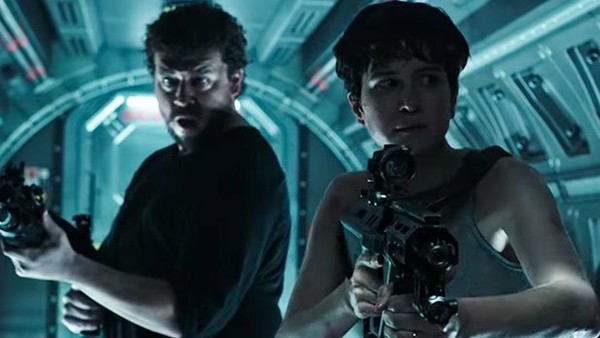
After the incredibly slow build of the first two acts of the film, the Covenant crew are decimated by the alien pathogen in various ways (two are killed directly through exposure, others by the neomorphs who burst out of the first two - directly or indirectly) only to discover that their sanctuary in the Engineers' temple is a trap set by David.
When his secret is revealed, David reveals that he spent the time following the Prometheus incident "experimenting" with genetics - partly from the pathogen and partly using Elizabeth Shaw's oddly well-preserved DNA (she's dead, Jim). The results of his various experiments have eventually led to the development of the traditional Xenomorph eggs containing Face-Huggers, which he "feeds" with captain Oram (Billy Crudup).
He's infected, the xenomorph bursts out and kills almost everyone else before it is eventually killed by Daniels in a mid-air battle on the outside of a rescue ship and David is apparently killed by fellow android Walter. Naturally, there's a second Xenomorph inside one of the survivors, which then kills everyone aside from Daniels, Walter and Tennesee, who work together to kill it before it too is killed and the human survivors head into stasis.
Obviously, it turns out that Walter is in fact David in disguise, who adds two Face-Hugger embryos to the colony payload and continues on to the original colony planet.
9. Weyland-Yutani Continues To Learn Absolutely Nothing From Its Missions

Rather unfortunately, almost every plot advancement in the Alien movies occurs thanks to someone being an unfeasible idiot. Prometheus suffered from that pretty badly, and Covenant follows suit, with the colony crew splitting up, talking like horror movie cliches and generally not observing the universal truth that space is terrifying.
Instead of heeding the warning of the disappearance of the Prometheus and being doubly sensible, they visit an uncharted, uninvestigated planet they'd "missed" up to that point and then all proceed to be morons until they're all killed off. They deserve most of what happens to them.
But when you think about this mission and the disappearance of the Prometheus, and then consider that the Hadleys Hope colony programme still pushed ahead, it's hard not to accept that they're short-sighted idiots as well. They seem to wilfully ignore the evidence of the past, and forge ahead with plans to expand humanity's presence in the universe.
Covenant actually changes the main thrust of humanity's condition in the future: they aren't just corporate overlords seeking to remain the premier species in the galaxy, they're a dying breed, looking for new life because of the impending death of Earth. So at least Wu-Yu's idiocy can be explained a little more deeply as the desperate acts of a dying species.
8. Walter Died, David Lives

As the film hurtles towards the climactic encounter with the Xenomorphs, David attempts to seduce Walter to the dark side, explaining his vision for genetic perfection (his alien clones) but the newer version rejects him and is "killed" for his sins. But he survives and reappears rescuing Daniels, and the pair of androids fight in the temple, with Walter seemingly getting the upper hand and smashing David's head in.
Later, it's revealed that David actually freed himself and killed Walter (we saw him reaching for a knife as Walter brought the stone down), and disguised himself as the American-accented droid to infiltrate the crew once more. It would perhaps have been better for David's fate to have been left slightly unresolved, but then again it's nice to have some sort of concrete answer in this franchise these days.
How he managed to escape and somehow get the time to remove his hand using acid and redo his hair remains to be seen, especially as he also manages to get Walter's security clearance codes our of him (and ignore his valuable memories at the same time).
And the most important part of his survival, of course, is that he also has two Face-Huggers with him, which will presumably be the key to birthing the queen responsible for the eggs seen later in Alien and Aliens. At least some further steps down the line, anyway.
What his actual plan is now is still a little unclear.
7. Who Created The Xenomorph? Is It Even The Finished Item?

On the surface, this film seems to suggest that David is responsible for evolving the Xenomorphs from the DNA available from his human host and the weaponised alien pathogen, but a reading that simple isn't really the whole story.
If he was responsible for creating the monster, how did the Engineers have a mural of the same beast in their temple in Prometheus? Were they already on the experimental track towards creating this "perfect" creature themselves without putting the final pieces of the puzzle together that they needed the right hosts?
It's curious to see David appropriate the creature's creation for himself, but there's also a suggestion that this isn't actually the same creature we see in Alien and its sequels. Sure, it initially looks like the same beast, but the design is slightly different: it looks taller, sleeker and actually more refined (if slightly less terrifying), so it may be that David's Xenomorphs are entirely different to the Engineers' iterations.
That would also explain how he's able to "tame" his aliens, how he avoids being immediately killed by them (they have no issue killing Bishop despite him not being biological) and why the new-born Xeno mimics him weirdly when it's born. It wouldn't be at all surprising to reveal that this wasn't the real birth-point of the famous aliens at all.
6. The Engineers Are Gone, Or Are They?
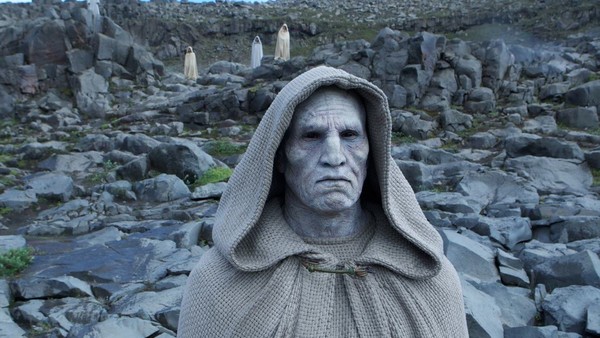
Having discovered the alien pathogen pay-load's weaponised purpose, David reveals in a flash-back that he turned it against the Engineers, killing them all on their homeworld for some reason.
Quite why he does this remains to be seen: it could either be because one of them pulled off his head, or that he suspected they created mankind and wanted to punish them for it or that he didn't want to have to potentially answer to any master. Perhaps it's just a combination of all three, as well as his desire to explore his own potential as a creator in peace?
Perhaps it's merely his commitment to the line from Prometheus: "A king has his reign. He dies. It's the natural order of things" - that he appoints himself the deliverer of that inevitable fate, just as they killed Weyland looking for his own immortality.
But are the Engineers really gone entirely? Their destruction makes the appearance of the "space jockey" seen in Alien somewhat confusing: its warning about the Xenomorph danger doesn't really make sense unless it died after this point (unless it was a rogue railing against its own species' attempts to make the Xenos?)
5. How Will The Xenomorph Eggs End Up On The Ship In Alien?
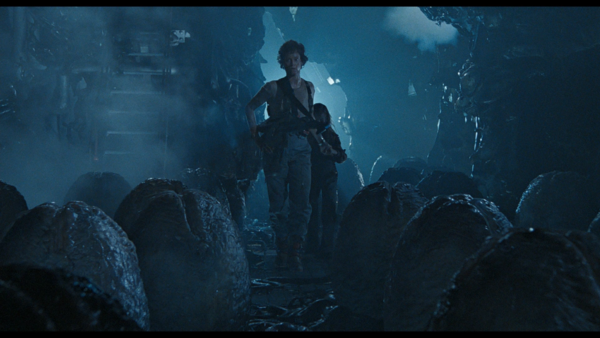
Inevitably, the ending doesn't offer a concise, clear ending (after Prometheus, nobody could have expected that, surely?)
If we are to accept that the Xenomorphs are indeed David's own creation and not that of the Engineers, that makes that whole key Alien scene extremely difficult. If the Engineers are dead and David is headed elsewhere with his remaining aliens, how do the alien eggs all end up on the Engineer ship in the first film 20-ish years later?
The idea of that Space Jockey being a rogue seems to be the most likely, and perhaps that's the direction we'll see in one of the sequels. Maybe the only remaining Engineers will realise their mistake in creating the pathogen when they see it used in its most extreme form (in full Frankenstein spirit), and will take on David to steal his crop of eggs and maroon them on LV-426?
If that isn't going to be the case, the idea of the Engineer warning against the aliens they helped create as weapons and seem to worship is just confusing. In short, we need a lot more story-telling to tie the end of Covenant to Alien.
4. David Is Broken

One of the most interesting revelations in Covenant is that David is not only fundamentally flawed as a creation of humanity (since he's poisoned against his creator), but that he's also broken. He has something amiss that has him mis-identify Ozymandias as written by Byron, rather than Shelley.
In other words, his very philosophy of perfection - which compels him to play God and create in his own image - is wrong-headed and so too could the products of that philosophy be. But then perhaps that's precisely the point: in seeking to replace humanity, David is the victim of the most human problem - fallibility.
How that will be explored in future remains to be seen, but we do now know that David is aware of his problem, which might also be the reason for his transition from an apparently neutral presence compelled by duty in Prometheus into full villain in Covenant. And looking at the precedent of human and android characters in past Alien films, it's that flaw that will undo him.
3. Will David Infect The Entire Colony?

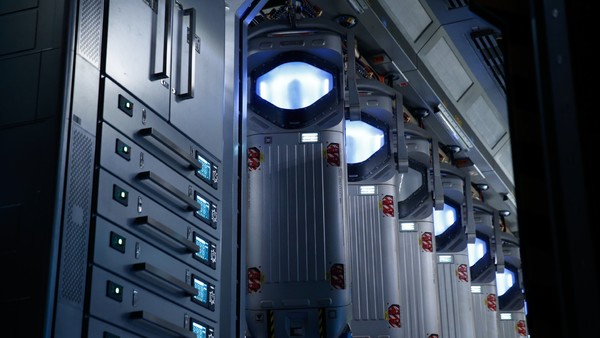
In the final scene of Covenant, we see David revealed as Daniels realises that Walter has been replaced just as she heads into cryo-sleep and the harrowing stinger to that sees him adding two frozen Face-Hugger embryos to the Covenant's payload.
Given that he feels he reaches genetic perfection with the Xeno, it's curious that he seems to literally put his creation on ice until the colony gets to its mission objective and are awoken. Why would he do that, rather than simply waking up a couple of unknowing hosts first, allowing them to be infected before waking the rest of the crew to kill them?
And more purely, if his intention is to kill humanity, why not simply wipe out the colony as they sleep?
It seems that David has a thirst for the sport of his creation: he wants to see them hunt and terrorise and feast on targets who are unaware and terrified. He has, at this point, transcended beyond his new primary objective (to use the Xenos to kill humans) and into true Hollywood villainy.
2. Daniels Surely Can't Return

The fact that Daniels is aware of David's survival and his grand plan surely means there's absolutely no way she can be kept alive, right?
Why would David allow one of the only keys to his potential failure to wake up from cryo-sleep as intended to simply tell everyone what really happened when he's worked so hard to cover up the incident as a disaster that wiped out the crew? It's unfeasible.
So it would seem that we won't get to see Daniels again, despite her apparent initial survival: what remains now is the specifics of her death. Could she end the same way as her husband?
Tennessee is a different matter entirely: he's unaware that David is the issue, he barely knew the reality of the android's plan or how the Xenomorphs came to be, and we could quite easily see a sequel with him as the star. I can't be the only one who would watch that...
1. We Still Don't Really Know Who Created Mankind
As Ridley Scott said in the run up to Covenant's release, it wasn't the Engineers who created humanity, and Covenant doesn't really offer a great deal of evidence for that. We know they probably wanted to destroy humanity - or at least David seems to believe so - and that they possessed evolutionary accelerant technology, but there isn't a definitive answer here.
The most likely theory seems to be that the Engineers and humanity were created as rival genetic experiments, and that both were implanted naturally with the urge to dominate the universe by their unseen creator. It follows then that the unknown creator also instilled the God-like urge to create as the means for each species to "win".
The Engineers were "given" the idea of the Xenomorphs, and chose them as a symbol of worship (hence the almost spiritual mural) while humanity raced towards recreating themselves in their own image (hence the fascination with androids). In both cases, their creations would rise to kill them, as they killed one another. Perhaps the Engineers failed in their attempt to get there, and settled on the pathogen solution?
This is all speculation of course, but it's pretty compelling and explains somewhat why any race would seek to kick off an extinction level event by unleashing the Xenomorphs on Earth.
Alternatively of course, the Engineers might believe themselves to have been created by man (hence the humanoid head in the temple) and designed the pathogen as a means to wipe out their own creator? That would be a fairly ironic development given what we've been led to believe this far, and it would explain how the Engineers themselves look so much like a creation.
What did you think of Alien: Covenant? Share your reactions below in the comments thread.