Ghostbusters: 7 Scientific Facts To Make You Hate It Less
Who wants a proton pack?

Whether or not you hate the new Ghostbusters movie, one thing that you can't fail to notice about it is that there's a lot of science babble in it.
If they're not talking about ionization and proton streams, then they're knocking together miniature particle accelerators. The great thing is that somewhere beneath the quick fire nonsense and absurdly oversized guns, there's actually a fair bit of solid (ish) science.
Given that this is a kids' film, and one that features slimy green cartoon ghosts from another astral plane at that, they probably needn't have bothered. I would have been perfectly happy to sit and let the technobabble and casual racism in this film wash over me and not batted an eyelid (okay, maybe not the racism part), but when they start chucking around some science, I'm all ears.
The scientific accuracy is obviously not rigorous - I, as the saltiest science geek you'll meet, would want to sit through two hours of people saying "ghosts aren't actually real" even less than two hours of mildly underwhelming ghost train comedy. But, where they have had the opportunity to plug a bit of casual particle physics into the script, they've definitely done their homework.
So, let's delve into the ins and outs of Proton Packs and Ghost Traps and finally figure out what would actually happen if you crossed those damn streams.
7. Proton Packs

Simply put, those proton packs are miniature particle accelerators, just like the Large Hadron Collider.
The packs were updated slightly for the 2016 version, replacing the cyclotron with a synchrotron, But the principle remains the same: They fire out a powerful stream of protons and nuclear energy to capture the ghost.
As ghosts are apparently made up of "Psychokinetic Energy", which consists of electrons, neutrons and ectoplasm, this would make them negatively charged (although we don't actually know the charge of ectoplasm, a ghost made of "negative energy" is canonically fitting). The positively charged protons in the proton pack trap the negatively charged electrons like a statically charged balloon sticking to your head and, boom, you've caught a ghost.
The Proton Packs are actually remarkably scientifically sound, apart from the whole trapping-the-wandering-souls-of-the-dead thing, and of course the fact that they occupy the size of a backpack, as opposed to several miles of the France/Switzerland border.
6. Ectoplasm
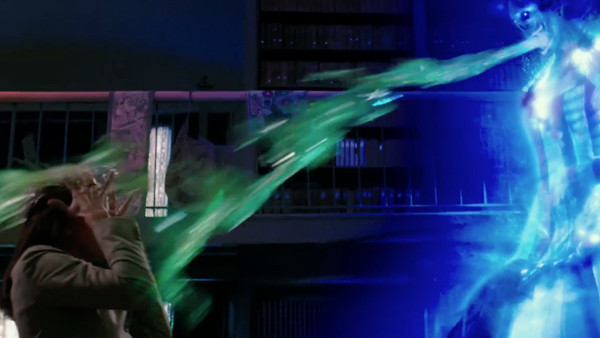
Scientifically speaking, ectoplasm is the outer, non-granulated part of a cell's cytoplasm, but I have a funny feeling that's not what they meant.
Ectoplasm was used as a scientific "proof" of a ghostly presence and was wildly popular during the golden age of Victorian charlatanism, in which mediums would produce vast quantities of the white, viscous fluid (oi oi) from various orifices - usually the nose so get your mind out the gutter. This was mostly done in the dark, as it was claimed that ectoplasm was destroyed by light, which is lucky considering that the ectoplasmic "ghosts" were generally less than convincing.

Far from being the physical evidence of a paranormal presence, ectoplasm was generally found to be made of a mixture of egg white, gelatin and soap, or even just a piece of white muslin or cheesecloth. Some psychics went further - Helen Duncan used to swallow lengths of cheesecloth and then throw it back up, and Mina Crandon made a replica of a hand from animal liver then threw that up for her delighted crowd. Who knew Victorian mediums and frat boys had so much in common?
Anyway, ectoplasm can be roundly dismissed as a Victorian hoax, but perhaps the ectoplasm in Ghostbusters is actually more closely related to the stuff in cell walls? It could be that this is how the spirits' energy can maintain a physical form in our world ... or just a bit of paranormal fluff.
5. Ghost Trap
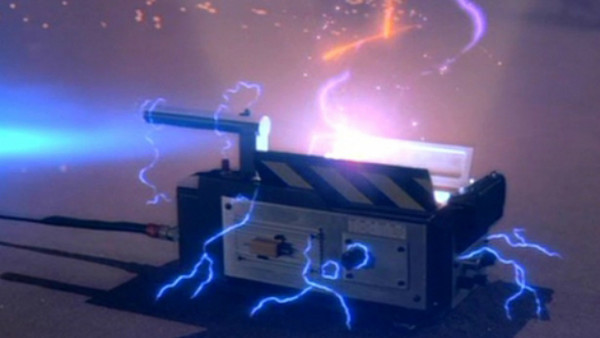
The Ghost Trap is used to, er, trap ghosts and its alternative name, the Muon Trap gives us a clue as to how it works.
A muon is a subatomic particle similar to an electron, but smaller and heavier. Given that we've already learnt that ghosts are made up of those negatively charge electrons, with a little bit of sciencey hocus pocus, muons could be used to contain the spooks.
If you could find a way, and of anyone can it's Holtzmann, of converting the electrons in the ghost's form into muons, it would shrink the atomic radius down by 200 times without changing any of their properties and conserving mass.
In short: It's a compression field.
This supernatural trash compactor allows the ghostbusters to wrestler a 30 foot spook into a container the size of a lunchbox by cutting its electrons down to size.
4. Those Equations

Despite the super-cringe "No one is better at quantum physics than you" line from the trailer (which, from memory, was mercifully cut from the film, but I might have just blocked it out), those equations on the board behind Erin are not only legit, but relevant to what she is saying.
Thank god for set dressers.
Kristen Wiig plays a theoretical physicist who is, as far as we can gather, working on the Grand Unified Theory (or the GUT for short). The thing is that we have a lot of theories about the universe, but not all of them match up, which is understandably equal parts frustrating and embarrassing for all involved.
The holy grail of GUT is a unified theory of gravity, as well as unifying the the other universal forces: the electromagnetic, the weak and the strong. The various equations behind her, which include a Feynman diagram, theories regarding SUGRA (super gravity) and proton decay, all indicate that Wiig's character is indeed working on a theory of everything.
Then, at the top we have an equation that actually spells out a website (ParanormalStudiesLab.com).
3. Psycho Kinetic Energy
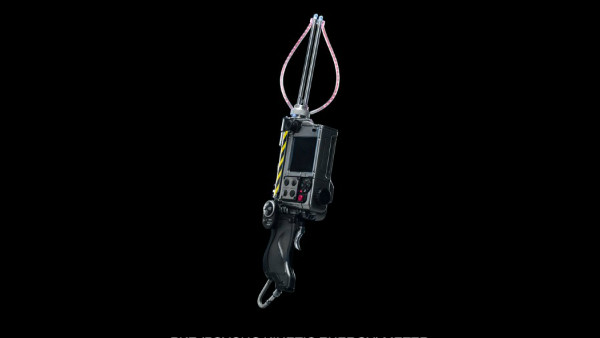
In Ghostbusters, a PKE (Psycho Kinetic Energy) metre is used to detect any ghosties in the vicinity, presumably detecting some kind of energy being given off by the spectres. For real ghost hunters (and we use the term "real", quit wrongly there), the weapon of choice is some description of EMF (Electromagnetic Field) detector.
Ghost hunters take these metres into haunted buildings and keep an eye out for spikes in the readings. A spike indicates a sharp increase in electrical activity in the immediate area - which is why EMF readers are so good at their day jobs of checking for live wires - and this is supposedly a rock solid indicator of a ghostly presence.
Quite why ghosts should give off electromagnetic fields remains unclear. It possibly has something to do with the fact that living creatures give of electromagnetic fields and that this somehow hangs around long after the physical body is not only absent and dead, but probably long decayed.
It has also been proposed that the presence of electromagnetic fields doesn't so much indicate the presence of ghosts (no sh*t), but actually cause people to see ghosts in the first place, which brings us onto our next point...
2. 'Real' Ghosts
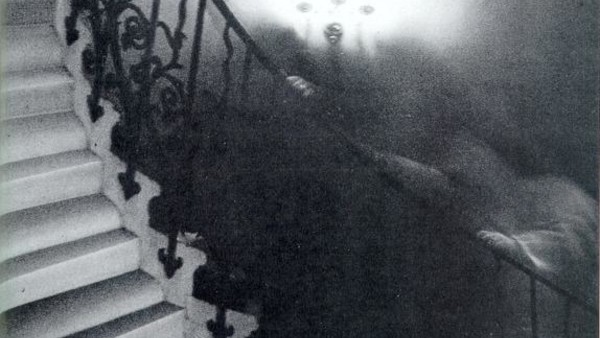
Obviously, the ghosts in Ghostbusters are pretty difficult to put down to a trick of the light, but why do some many people in the real world claim to have encountered the supernatural? They can't all be mad and/or liars, so some think that there could be some real physical causes behind the apparitions (Hint: it's not the wandering souls of the restless dead).
As previously hinted, there are those who think that the presence of electromagnetic fields could be a cause rather than a symptom of paranormal experiences. Strong magnetic or electrical fields have been known to cause bright flashes of light to zoom across people's vision. As well as this, a strong magnetic field to the temporal lobe can cause people to sense a mysterious unseen presence and even have a religious experience. Someone has even made a God Helmet to prove it.
Aside from electromagnetism, a phenomenon known as infrasound has been put up as a possible explanation for alleged hauntings. As the name suggests, infrasound is a noise so low that it is below the register of human hearing. Despite this, you can still feel its effects, with a similar sense of a "mysterious presence", and it can even cause blurred grey shapes to move across your vision.
All this, coupled with confirmation bias and a healthy imagination, can explain a lot of hauntings - although the research is still inconclusive with regards to what in the name of sweet jesus the slimer is.
1.Don't Cross The Streams
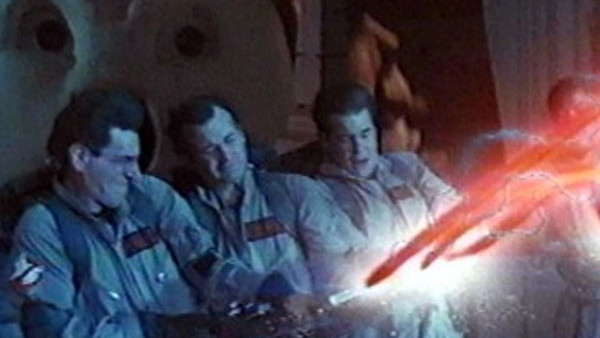
Don't cross the streams… It would be bad… Try to imagine all life as you know it stopping instantaneously and every molecule in your body exploding at the speed of light.
We know that crossing the streams is a bad move, but exactly why is still a little vague. This is odd, considering we have a real-world analogue of the proton packs here on Earth and, what's more, it crosses the streams all the time.
As we've previously discussed, those proton packs are essentially miniaturised particle accelerators like the one at CERN, and the raison d'etre of particle accelerators is pretty much exclusively to smash beams of protons together just to see what happens.
As it happens, each proton collision is like a mini Big Bang. As the beams of protons whizz through the tunnels, they are travelling at impossibly high speeds, just under the speed of light in fact, which means that when they collide, a vast amount of energy is released and exotic subatomic particles are spontaneously created. Colliding a beam of just 3,000 protons will produce enough energy to melt 1,100 pounds of copper. Remember we're talking about just a few thousand protons here, a beam that is even remotely visible, let alone able to hold a wriggling ghost, will contain quadrillions more, releasing cataclysmic amounts of energy.
So yeah, don't cross the streams.
You could write for WhatCulture Science! Click here to find out how you could get paid to write about what you love.
If science gives you the warm fuzzies, like us on Facebook or follow us on Twitter to stay up to date.