Jurassic World: 10 Reasons Why It’s Such A Huge Success

Bigger. Louder. More teeth.
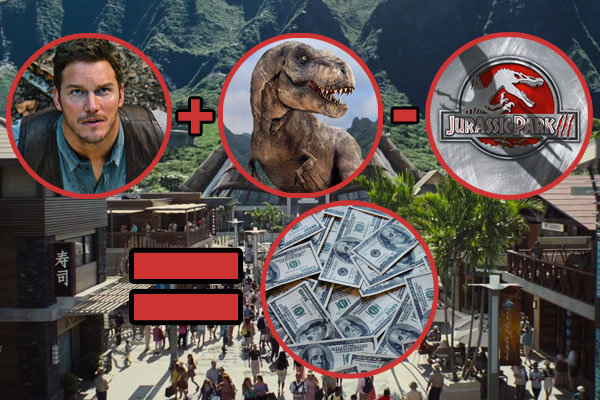
When Jurassic Park arrived in cinemas in June 1993, a big hit was always on the cards. Based on a bestselling novel of the same name by Michael Crichton and with box office supremo Steven Spielberg at the helm, Jurassic Park met expectations and promptly trampled them under foot to become the highest-grossing film ever made. Spielberg would return to the director€™s chair to oversee The Lost World: Jurassic Park four years later, but the sequel €“ while also a big hit €“ failed to match the original's gargantuan haul. And when Jurassic Park III followed the trend of diminishing returns on its release in 2001, the franchise was, thankfully, put on ice. Fast forward a decade or so and the rumblings of a fourth instalment grew louder. Relative newcomer Colin Trevorrow was charged with bringing Jurassic World to life and a release date was set for June 2015. As the release date neared, tracking figures became increasingly optimistic, with trade experts suggesting the film could even top $100 million in the U.S. on its opening weekend. Which it did. Plus another hundred million or so. Plus another $320-odd million worldwide. Jurassic World is the biggest box office surprise in recent memory and has been so ridiculously successful it€™s quicker to name the records it hasn€™t broken than the ones it has. To say Jurassic World€™s impact caught out industry insiders doesn€™t remotely do justice to its unprecedented numbers, but why exactly has the film become such a cultural phenomenon? Time to open the gates, head inside and uncover the secrets behind its extraordinary success.

10. Perfect Timing

At the rate things are going, it won€™t be long before the summer blockbuster season kicks off before the Christmas decorations come down. Ever since the release of Jaws in 1975 and Star Wars two years later, the summer months have become the chief stomping ground for large-scale, big-budget movies. And now that it€™s become commonplace for heavyweight studios to mark their territory years in advance by snagging the key dates in the summer calendar, so it is that some of the most high-profile releases each year land in May or even earlier to avoid a profit-eating logjam. So it€™s fitting that Jurassic World €“ an old-fashioned blockbuster reminiscent of less Lycra-clad times €“ made its bow in early June. The most pertinent reason why there€™s such a thing as the summer blockbuster season in the first place is that it coincides with school holidays across the globe, providing a perfect excuse for a few hours in an air-conditioned theatre and a diversion for families at a loose end. By arriving in cinemas just as Age Of Ultron was finishing its theatrical run but well before the likes of Minions, Ant-Man and Mission: Impossible €“ Rogue Nation arrived, Jurassic World carved out a perfect window to maximise potential profits €“ something it€™s managed with aplomb.

9. International Appeal

Whereas it used to be the case that a movie succeeded or failed on the basis of its performance in the U.S., nowadays the international box office is of increasing importance and often the final arbiter of profitability. One of the better examples of this in recent years is Pacific Rim, Guillermo del Toro€™s ambitious 2013 sci-fi spectacular that cost close to $200 million but barely limped over $100 million domestically. Overseas, however, it was a different story, with Pacific Rim raking in $309 million and proving a big hit in China in particular, where its earnings outgrossed the U.S. equivalent. And it€™s China where Jurassic World has found its biggest audience abroad, raking in $167 million in its first week on release. The international take currently stands at almost $830 million and, with a domestic haul now pushing $560 million, World now lies in fifth spot on the all-time list. What€™s more, the films in third and fourth spot €“ The Avengers and Furious 7 €“ will probably be left for dust inside a week, leaving only the James Cameron double of Titanic and Avatar left to topple (unlikely but not inconceivable). Simply put, Jurassic World has a rare global appeal that has enabled it to cut across countries and cultures like no other film before it.

8. Carefully Managed Marketing

The marketing of a movie has become an essential part of a film€™s pre-release hype and can prove the difference between a soft opening and a break-neck start. In the case of Jurassic World, the marketing men judged their campaign to perfection. Simon Hewlett, the executive vice-president of Universal Pictures International in London, has spoken about how the film was brand and concept tested in major territories 18 months before its eventual release. UPI sought to establish a sense of what fans of the original movies and newcomers wanted to see in the franchise going forward, finding that the original Jurassic Park €œwas still seen as a treasure and a significant point in people€™s cinema-going history; a lightbulb moment like Star Wars to a certain generation.€ Through focus groups UPI discovered a high level of brand awareness in Asian markets and considerable intrigue about the science of John Hammond€™s original vision coming to fruition. The Jurassic World cast staged a major press junket in China that included TV appearances to reinforce awareness in a pivotal market, and the movie€™s first trailer was specifically geared to connect the upcoming movie to the original while also showcasing a legitimate new story for the uninitiated. All told, the Jurassic World marketing campaign struck a perfect balance of nostalgia and new ideas to ensure there was something for everyone.

7. A New Start

The shortcomings of the first two Jurassic Park sequels could easily justify a separate article of some length. However, one issue the films shared was the over-reliance on familiar characters that hampered efforts to create original stories. That Jeff Goldblum and Sam Neill were brought back as the leads in The Lost World and Jurassic Park III respectively, not to mention several other key cast members also making fleeting appearances, was perfectly understandable. After all, Spielberg himself and threequel director Joe Johnston were clearly intent on honouring Jurassic Park and its fans by bringing back Ian Malcolm and Alan Grant to spearhead new instalments. However, shoehorning in characters with firsthand experience of malicious dinosaurs required flights of plot fancy that were difficult to swallow. No such issues for Jurassic World as screenwriter Derek Connolly and director Colin Trevorrow opted for a clean slate that all but ignored the two previous sequels. BD Wong returned as Dr. Henry Wu and served an organic plot function following his original work extracting dino-DNA in Jurassic Park, but otherwise a new cast of characters was decided upon to give the franchise a facelift and fresh impetus.

6. Nostalgia Nods

In this movie Easter egg age we live in franchise films are almost duty-bound to include nods, winks and hat tips to previous instalments. True to form, Jurassic World includes plenty of nods to the three films that came before it to reward the eagle-eyed. John Hammond, the man that started it all, is commemorated via a statue in the Visitors Centre and the suitably named Hammond Creation Lab, Ian Malcolm makes an appearance of sorts via his book €˜God Creates Dinosaurs', and exposition expert Mr. DNA makes a colourful cameo. And then there€™s BD Wong returning as Dr. Wu, John Williams€™ wonderful original score repurposed by Michael Giacchino, (Stan) Winston€™s Steakhouse as an homage to the late special effects pioneer and any number of other reminders to keep the fans happy. Crucially, Jurassic World isn€™t over reliant on nostalgia to the point of it being obtrusive and/or distracting, and reminders of Jurassic Park III and The Lost World are kept to a strict minimum. The end product is a movie that infuses the DNA of Spielberg€™s classic original to a respectful, satisfying degree while maintaining enough distance to craft a new take and kick-start an ailing franchise.

5. (Almost) No Sequel Baiting

As Jurassic World continues to trample almost every box office record in sight, a sequel couldn€™t be more inevitable (in fact, it€™s actually rather refreshing that Universal is still holding back on an official announcement to that effect). Nonetheless, in a movie climate where practically every movie studio is seeking to emulate Marvel€™s success by doubling down on its biggest franchises and spinning off from them wherever possible, Jurassic World€™s almost singular focus was laudable €“ no €˜Jurassic Universe€™ tease here. The Amazing Spider-Man films grossly misread audience appetites and tolerance levels by wasting valuable screen time on plot strands and setups that would never be paid off. Likewise the farcically optimistic plan for Terminator Genisys to be the first of three new films in the space of three years has, in all likelihood, been put to bed by the critical savaging and lukewarm audience reception that€™s greeted Alan Taylor€™s disappointing reboot. There were no irksome announcements of a new trilogy ahead of Jurassic World€™s release and next to no concessions in its runtime as regards potential sequels; not even a mid-credits sting. True, Dr. Wu€™s exit paved one avenue for future adventures, but that aside the film€™s focus remained on the story it told and nothing more. As it should.

4. In New Talent We Trust

Not so long ago high-profile tentpole movies were exclusively the preserve of established, battle-worn directors with proven track records, but nowadays the onus on giving relative unknowns big budgets to play with is an encouraging trend. The British director Gareth Edwards was recently given just such an opportunity when tasked with bringing Godzilla back to the big screen; with only the micro-budget Monsters under his belt, Edwards performed his duties with admirable assurance. Rian Johnson will helm Star Wars: Episode VIII despite a relatively low-key filmography, and Joss Whedon, James Gunn and the Russo brothers were all entrusted with precious Marvel properties and fully vindicated by the results. Universal used the same template by hiring Colin Trevorrow, a man with only the charming indie Safety Not Guaranteed to his name, to oversee Jurassic World, and he in turn brought Safety screenwriter Derek Connolly on board. The two quickly remodelled the groundwork laid by former screenwriters Rick Jaffa and Amanda Silver to bring back the Amblin vibe that permeated Jurassic Park and a host of classics from yesteryear. Producers Frank Marshall and Patrick Crowley deserve plenty of credit for trusting new blood with an old property, and Trevorrow and Connolly brought a freshness to the franchise that has been MIA for two decades.

3. A Proper Popcorn Flick

You needn€™t be too concerned by the smattering of doom-mongers heralding the death of cinema: people have been writing off the pictures since before the Lumiere brothers even breathed their last. That being said, the high-def age of oversized TV screens has had an unquestionable impact on global ticket receipts. With miniature movie theatres in their own homes and an ever-closing window between cinema and DVD/digital releases, most people are less inclined to rush out to the cinema than was once the case. The escalating costs of a family day out at the flicks are also increasingly prohibitive, yet some films downright demand the biggest available screen. Films like Jurassic World. Simply put, Colin Trevorrow€™s film is the epitome of an experience you can€™t do justice in the comfort of your own home (unless your home has a sizeable cinema in it). The sheer scale of dinosaurs crashing around deserves a large canvas, perhaps even a 3D enhancement €“ if you see it as one €“ or an IMAX splurge. Add to the mix the fact that Jurassic World is a family-friendly affair, suitable for almost ages by default, and its remarkable impact at the global box office becomes a little easier to understand.

2. Chris Pratt

There can be little doubt that Chris Pratt is the biggest movie star in the world right now; pretty amazing considering he was practically an unknown all of a couple of years ago. True, fans of Parks And Recreation had already developed a love affair with the actor for his game turn as loveable schlub Andy Dwyer, but Hollywood remained largely oblivious to the presence of a hidden gem. Pratt has spoken of his experience auditioning for G.I. Joe and how €œhalfway through I saw the director's eyes just glaze over,€ but those days are long gone. After knocking it out of the park as Star-Lord in Guardians Of The Galaxy, it will be a long time before he has to worry about someone not returning his calls. Still, while Pratt obviously had leading man chops and had acquitted himself well in smaller roles in the likes of Her, Moneyball and Zero Dark Thirty, the jury was still out on whether or not he was a movie star. Which is no longer the case. How much of Jurassic World€™s success can be attributed to Chris Pratt is open to debate. What is certain is that the actor€™s easy charm and inherent likeability added up to a big plus for the film, as will likely be the case for whatever he shows up in next.

1. Dinosaurs

A movie star Chris Pratt may be, but it€™s impossible to make a case for him being the star of the show. And no, that doesn€™t mean the correct answer is Bryce Dallas Howard, Irrfan Khan or Vincent D€™Onofrio. No, the single biggest reason for the success of Jurassic World is dinosaurs. People. Love. Dinosaurs. And the Jurassic Park franchise pretty much made itself the only real game in town 22 years ago. Steven Spielberg€™s seminal 1993 juggernaut came along at just the time when computer-generated imagery had advanced to the point where the his vision could be fully realised. Jurassic Park set a new benchmark for visual effects, with the cutting-edge CGI augmented by animatronics and old school knowhow to create an unprecedented moviegoing experience. And now a new generation has been given a taste (albeit a watered-down one). With 14 years of clearance since the last instalment, Jurassic World arrived and those same children who€™d waited in line over two decades ago are back in the queue, this time with children of their own. What the kids don€™t realise is their parents remain nearly as wide-eyed at the sight of the giants that once roamed our planet as their sons and daughters. How many times did you see Jurassic World? And how much do you think it'll make when all's said and done? Share your thoughts down in the comments.Like this? Then make sure you check out our Jurassic World page for more great content.

Contributor
Contributor

I watch movies and I watch sport. I also watch movies about sport, and if there were a sport about movies I'd watch that too. The internet was the closest thing I could find.