Star Trek Beyond: 10 Reasons It's Better Than Into Darkness
Beyond is classic Trek in the best way.

Though the common expectation from Star Trek Beyond's fairly lackluster marketing campaign and change in director was that it would fall short of the previous movies, what a pleasant surprise it is that Beyond is another exciting, fun and thrilling entry into the beloved franchise.
Review-wise, it's hovering around 90% on Rotten Tomatoes, leaving it pretty much on par with Star Trek Into Darkness, which was itself a critically-acclaimed film that nevertheless ended up meeting a violent backlash from Trek fans for a variety of reasons.
Thankfully J.J. Abrams has, with the help of director Justin Lin and co-writer Simon Pegg, listened to the fans and delivered a largely entertaining threequel with a lot more to offer the hardcore crowd while still appealing to the newer, younger fanbase. Roll on Star Trek 4.
Here are 10 reasons Star Trek Beyond is better than Into Darkness...
10. The Tone Is Closer To The Original Series

It's fair to say that a lot of hardline Trekkie fans don't care for the new rebooted franchise because it doesn't feel like the Trek they grew up loving. For all the good J.J. Abrams did on the first two movies, he freely admits he isn't a big Trek fan and as such ended up crafting his own distinct take.
With Simon Pegg co-writing the script, however, Beyond feels much more like classic 1960s Star Trek, and in fact, this is basically a self-contained, two-hour Star Trek episode, complete with the planet-hopping, outlandish alien characters and superb character banter you would hope for.
Sure, it may lack the grit and complexity of Into Darkness in particular, but the tone also feels a good deal more faithful to the source material, and it's focused more on being fun than taking itself too seriously.
9. There's No Casual Sexism

Easily the most cringe-worthy scene in the new Star Trek trilogy is Carol Marcus' outrageously unnecessary and gratuitous underwear display in Into Darkness, as received a ton of criticism upon the movie's release.
Thankfully, Beyond completely dispenses with any such sexist bile, and while it's fair to say that Uhura does get the short-shrift this time, this is compensated for by the show-stealer that is Jaylah. She's easily one of the best characters in the new trilogy, male or female.
In short, the movie's female characters exist as people rather than objects to be leered at or fawned over, and it seems clear that after the vocal criticism about Into Darkness, the filmmakers took this to heart.
8. Stronger Character Development

Simon Pegg really doubled down on the character development in Beyond, and while Into Darkness certainly wasn't terrible in this regard by any means, Pegg's love for the characters just shines through so much stronger here.
In particular, Spock and Kirk have their own deep personal issues to mull over, while the conceit of pairing the Enterprise's crew off was a clever way to get some lengthy interactions between characters, the Spock-Bones and Kirk-Chekov team-ups proving easily the most effective and entertaining.
Beyond serves as a reminder that the reason people love Trek so much isn't just the visuals and the immense universe-building, but those lovable characters fans understandably feel protective of.
7. Jaylah Is An Excellent Addition To The Franchise

Idris Elba does a solid job as Beyond's villain Krall, but the most noteworthy addition to the series is Sofia Boutella's alien scavenger Jaylah, who becomes fast friends with the Enterprise crew and helps them take Krall on.
Who could've easily been a token alien character is instead the most refreshing and enjoyable part of the film, even when faced with all the characters fans already know and love. On the other hand, Into Darkness certainly didn't come up with a single new character as fun to watch as Jaylah: she proves herself capable in action, has great banter with Scotty, and looks to be sticking around for future movies, so what's not to like?
6. It Doesn't Rely On J.J. Abrams' Mystery Box

As everyone knows, J.J. Abrams is obsessed with the idea of the "mystery box", in creating suspense through building up an enigma, usually with a pay-off that's nowhere near as satisfying as the journey to get there.
Into Darkness was so heavily hinged on the real identity of Benedict Cumberbatch's John Harrison character, and when the Khan reveal came half-way through the movie, it fell rather flat because most fans had already guessed it months and months in advance.
Thankfully, Beyond isn't weighed down by the same arbitrary baggage, and simply focuses on telling a fun sci-fi story without attempting to pull wool over the audience's eyes.
As such, Beyond will probably age better than Into Darkness, whereas the Khan reveal is just rather cringe-worthy given how much of a non-revelation it was, even upon first viewing.
5. There's Less Lens Flare

One of the most vocal complaints about J.J. Abrams' directorial style is that he abuses lens flares to the point of distraction, shining light sources at the camera to intentionally create the effect, to the extent that even his own wife told him to calm it down when shooting Star Wars: The Force Awakens.
Thankfully, while Justin Lin arguably isn't quite as assured in the action stakes as Abrams, he tones the lens flares way down to the point that you'll probably go the entire movie's run-time without having a conscious thought about it. Isn't that nice?
Considering that Into Darkness had more than 800 lens flares, what a relief.
4. It's Incredibly Emotional

Star Trek Into Darkness, for all the things it got right, wasn't a terribly emotional film full of feeling. After 2009's Trek was a sweetly nostalgic tribute to the original series with a terrific supporting performance from Leonard Nimoy, Into Darkness couldn't quite replicate the same emotion despite Nimoy re-appearing briefly.
Beyond, by virtue of some real-life tragedies that have surrounded the production, certainly does tug at the heart strings, but in a manner that doesn't feel manipulative or exploitative.
Firstly, Leonard Nimoy's passing is acknowledged with the death of Spock Prime, resulting in some touching introspection for Spock, as well as an extremely moving moment near the end of the film that nods to Nimoy's extraordinary legacy among the original Trek cast.
Then there's Anton Yelchin, who nails it once again as Chekov in a larger role than normal, and he receives a "For Anton" tribute in the middle of the film's end credits.
Beyond is rarely better than a contemplative moment early on when Bones and Kirk share a drink while toasting to absent friends: it feels all-too apt given the recent losses that have hit fans hard.
3. The Plot Is Simpler & Less Convoluted
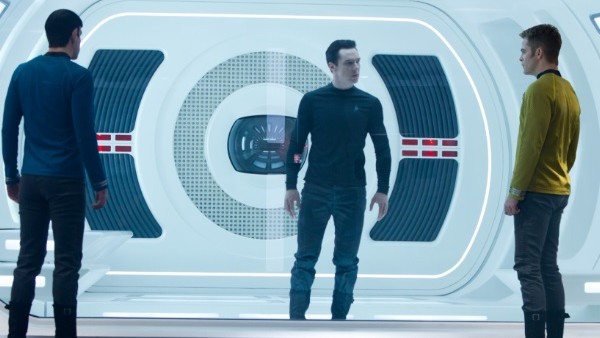
Some might call Into Darkness "complex", while others would simply say that it's far more convoluted than it needs to be. Khan's plan is such: he manipulates a man into becoming a suicide bomber in order to save his daughter, which leads to a Starfleet summit which Khan attacks and kills Captain Pike, and Khan then leads the Enterprise on a merry chase that relies on a ton of supernatural intuition and coincidence.
Beyond may be a far simpler beast by comparison, but it's also less frustrating to watch because there's no blatantly apparent, overt contrivance: the reason for the Enterprise crew meeting Krall is tidy and makes easy sense, and so does pretty much everything else that follows.
Sure, it's a movie, so there's some level of coincidence to some things, but on the whole it isn't trying too hard to seem smart or over-complex, and such is the benefit of not having Damon Lindelof write your movie.
2. Less Lazy "Homages" To The Originals

A key complaint from many fans was that Into Darkness crossed the line from homage to straight-up self-plagiarism with many of its "references" to the original movies.
The sticking point was how closely the movie's third act reflected Star Trek II: The Wrath of Khan, to the point that it just seemed like a lazy rehash rather than putting some effort into the script and actually coming up with something original.
Though Beyond does contain more subtle nods to the series' past, it's thankfully much more confident to function as a standalone movie without being overly tethered to its legacy. It certainly tones down the egregious navel-gaving and fan service, even if at the same time it holds what came before in an affectionate regard. It's all about balance, and Beyond nails this where Into Darkness didn't.
1. It Totally Forgets Khan's Magic Blood

And finally, the single biggest reason why Beyond is better? It totally, 100% disregards the most egregious Into Darkness plot point: Khan's magic blood which Bones uses to save Kirk's life at the end of the movie.
The inherent problem with introducing something like this to Star Trek is that it calls into question everything that follows: if someone is mortally wounded, why not just use more of the magic blood and save them?
Justin Lin and Simon Pegg did the smart thing by completely ignoring the blood's existence, and it's probably for the best if we all pretend Into Darkness didn't conjure up this absurdly contrived plot point.
What did you think of Star Trek Beyond? How do you think it compares to Into Darkness? Shout it out in the comments!