Suicide Squad Review: 3 Ups And 7 Downs
It's not the Ballroom Blitz we were expecting.
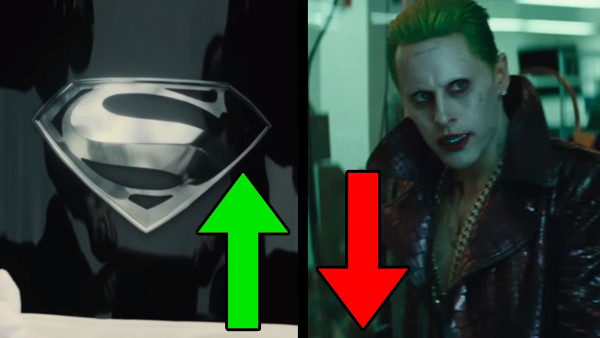
You know who deserves an award? The guys who edited together the Suicide Squad trailers. They took a movie that was light on real vibrancy or fun and managed to turn in some of the best pieces of marketing we've had in years. It's just a shame that to realise their amazing work we had to suffer through the third DCEU mistake.
Yup, unfortunately the movie they were selling isn't up to snuff, an arduous, confused slog that actually left me a little lost for words. Not because it wasn't what we were sold (even though it wasn't - quite literally in some cases, with entire scenes missing from the finished cut), but because it was so messy on a full range of filmmaking levels.
It's a disappointment of the highest order. The director was proven in dark and grimy action, the cast was a mixture of sure-fire winners and exciting gambles and the premise - a team of villains brought together to take on the tasks no good guy would touch - seemed to be exactly what the superhero genre needed.
So why didn't it work (and what were the few things that did)? Here's seven downs and three ups from Suicide Squad.
Ups:
3. It Plays Neatly Into The Wider Universe

In an unexpected surprise, it turns out that Suicide Squad is actually motivated by the events of Batman V Superman; following the death of Superman, Amanda Waller became incensed to form her own team of supers to protect the world from threats. It sounds like she's tried to get Task Force X off the ground in the past, but with the rise of the metahumans finally manages to twist the government's hand and get shaky approval.
Now as you may know I'm not a big fan Dawn Of Justice, but having the movies link into this larger continuity in an unobtrusive way (something BvS certainly failed at) is a really nice touch and contextualises a lot of what comes later. I also really appreciated the nods to the various DC Universe locations, as well as a neat (if already spoiled) brief cameo.
The only place it doesn't work as well as it should is with the minor Batman appearances. He's there to primarily stalk and capture the Squad, but the movie is confused with how to present him. He's shot distant and mysteriously, yet because we know the character there's no real purpose. It's not like he's being presented from the villain's perspective either; you do get close-ups, so it seems the film's having to cut around him to avoid revealing they only had limited access to Ben Affleck.
2. There's Nice Moments Of Flashy Style

David Ayer is a director known for his distinct, gritty style, and the trailers for Suicide Squad suggested that would be present and correct with a slight infusion of comic book neon here. In the film itself, however, things are much less exciting, although that doesn't mean none of the style makes it through.
The opening of the film sees Amanda Waller pitching Task Force X by introducing us to each member of the Squad, providing little vignettes of the inmates' origins, complete with low-down stats cards that set-up a few chucklesome in-jokes later on (Boomerang's secret fetish is Pink Unicorns). It's a rather jarring idea and feels somewhat like a run of character trailers, but there's something intriguingly bonkers about it, with a frantic coverage and bright, dream-like visuals that promise an interesting film.
At points the film delivers on that promise, like when the music is treated with respect and used to actually guide the edit, or the delightfully crass sexual references lead to completely out of place jokes. Those parts are sadly few and far between, and aren't prominent enough to influence the overall feel of the movie, but there's good stuff hidden in there (to begin with at least - I'll get to that in Downs).
1. The Squad Members Are Intriguing (Independently)

For the past few months there's been a lot of talk of spin-offs from the film that'll take a closer look at individual members of Task Force X. It sounded a great idea at the time and, while this film's ultimate failure sullies that notion a bit, there's enough interesting about the various characters to still make it an interesting possibility.
Individually, the characterisations of the Squad work well, especially those in more supporting roles, Killer Croc and Captain Boomerang especially. Whereas the main group can get stuck in the purgatory between lead and secondary, these guys have the freedom to just relish in their parts unencumbered. Jai Courtney's hammy as hell as the fool-ish Boomerang, but even though it's a bit obvious he's a fun (and funny) enough presence. Likewise, Adewale Akinnuoye-Agbaje goes all in for Croc, owning the hunched demeanor, brutish movement and snarling delivery (which makes it a shame not given more to do).
The others are a mixed bag, which is down to "The Will Smith Effect"; trying to make these characters more relatable than they have any reason to be. The actors all put in a fair show (Margot Robbie's Harley Quinn is nicely unpredictable, although the accent is a bit iffy and pre-transformation is a caricature), but they're somewhat hampered by having to be interchangeably despicable and lovely with very basic arcs.
Downs:
7. The Excessive Use Of Pop Music Just Doesn't Work

At first I thought the music of Suicide Squad was going to be a bonafide Up. Like the trailers, the film has lots of different pop songs, with one track or another playing constantly in the first act, getting you toe-tapping and giving the film a strong tonal grounding.
However, the approach is wholly noncommittal, incredibly basic and winds up irritating after twenty minutes. Amanda Waller is introduced to Sympathy For The Devil (which was oddly also in Focus, the last film with Will Smith and Margot Robbie), because she's the bad guy, geddit? Then, as the team heads to Midway City, Spirit In The Sky plays in almost wilful ignorance that it was Guardians Of The Galaxy that re-popularised retro soundtracks in the first place. As it wears on the choices are even more obvious, and the whole trick is eventually dropped for more generic scoring,
The overall effect isn't one of entertainment, but simply the impression that David Ayer's listened to some classic songs and become so obsessed with them he just had to put them in the movie.
6. Everything About The Villain Is Lazy

There was very little made about the villain the Squad would be facing in the film in the marketing, leading to all manner of speculation. The explanation is sadly the most limp of the lot; there just isn't much to the villain to show.
So yeah, it's Enchantress, which the later TV spots had pretty much already revealed. Quite what she's up to is sloppily thrown out across the movie and full of logic holes, but essentially she's an ancient spirit wanting revenge on all of humanity for something or other who's roped into the Task Force X program and uses this as an opportunity to wreak havoc. It's underbaked as an idea and is given very little time to actually breath in the film itself.
Cara Delevingne isn't up to much either; she is, as always feared, marketing casting, an attempt to draw in her millions of Instagram followers rather than provide a truly threatening antagonist. Her normal June Moone is a generic mousey suit, and while there's something unnerving about the physicality of her mystical alternate form, most of the time she's just stood in place screaming.
The wider problems with the story - why Task Force X have to be called in - stem from this and how utterly ineffective the threat is, which is depressingly hilarious; there's something perverse about the villain movie having such a bad villain.
5. It Repeatedly Has To Explain The Characters Are "Bad Guys"

Suicide Squad vehemently subscribes to the "tell, don't show" school of filmmaking. Why waste time carefully building character motivations when you can just tell the audience what's going on? As such, not a scene goes by without reiteration of what's going on or a character having to remind another about something crucial and life-threatening, as if the film has an overwhelming lack of confidence in your ability to keep up.
However, that's nothing on the fact the film has to repeatedly reaffirm that these bad guy characters are indeed "bad guys". Someone points it out every five minutes, almost as if DC's accidentally formed a team of neutered anti-heroes and are just pretending they're villains for posterity (funny that). We never really see them be all that bad, so the irreverent hook the whole movie sold itself on is rendered moot. The same is true of the film's Nick Fury, Amanda Waller - she's called "mean lady" and has moments of manic evil, but it all feels so forced.
This speaks of a conflict in what the film's trying to be. On the one hand it really wants to embrace the Suicide Squad idea and go full on crazy, yet has to keep reigning itself back into more standard superhero convention.
4. The Team Never Feels Like A Team (Until They Just Say They Are)

For all that does work in the team's constituent elements, the ensemble never really gels. There's no believable chemistry between them, which is fine when you consider these guys are criminals forced here against their will, but as things shift in the third act and they're all pals helping each other out (El Diablo even describes the gang, who he's known for two days, as "family"), it feels wholly disingenuous.
There's two essential storytelling mistakes that lead to this. One is that the moments of interplay that establish the potential of a team-up are few and far between, so there's no real chance to see relationships develop; any exchanges are usually a couple of lines at the end of an action beat quickly shared between just two of the characters. You then have how they integrate once they have taken up a sense of honour; there's no synergy - Boomerang might as well not be there - so it's scrappy, and not in a plucky sense.
It really burns in the second act, where the group is suddenly all about working cohesively, rather than out for themselves, yet without the justification of having the final threat to deal with.
3. It's Edited To Sh*t

Part of the previous points is down to the poor screenplay, although just as much to blame is the editing. As I said in my full review, the ultimate effect is not dissimilar to Batman V Superman (random plotting with no real structure where things happen because the movie simply demands it), although while there it was parsing down a four hour movie into two-and-a-half, with Suicide Squad it seems to be a case of attempting to stitch together something from nothing (or at least very little).
Scenes change to just about anything at random (Harley Quinn's flashback origin is this film's Knightmare), with characters across the US and turning up where they have no right to be. Regular shot-to-shot continuity is even worse; it's shocking the amount of cuts that don't match up, with characters in completely different positions and entire groups moving across the room. It's annoying in dialogue scenes, and kind of exhausting in action sequences, where things happen independently and you have to kind of just accept the onslaught.
What really struck me was how there's multiple plot points that are clearly intended to be shocking twists, but despite being interesting ideas, consistently fall flat thanks to the way they're presented; the pacing is so matter-of-fact and no time given for them to breathe. One particularly poor reveal just spells out something we saw already pretty explicitly earlier in the film. It's all in the presentation, and what could have been engaging moments become an excuse to question, "are we meant to be surprised at this?"
2. It Changes Tone Halfway Through (For No Reason)

Suicide Squad starts off interestingly. I'm not going to say good or strongly, because that'd be way too much praise, but the first twenty minutes or so is certainly unique; I've talked about the intriguing introduction Amanda Waller gives the team, but there's also a plethora of jokes and barbs coupled with stark visuals that lay the building blocks for a heightened, almost zany feel.
Contrast this to the finale, which is the same old "bright light in the sky" (only this time it's purple) with the heroes gallantly taking on insurmountable odds in a showdown filled with slow-motion and forced emotion. That's a little different, isn't it?
The tone of the movie flip-flops a bit throughout (which, as I said earlier, could have been intriguingly bonkers), but by the time we're at the finale things are dry and generic. There's no clearly defined point for when this siwtch happens, and sometimes the film does still dip back into the more off-kilter side of things, but when it does those moments of style I talked about earlier become laughable for all the wrong reasons.
The fact that the story is so basic only highlights this more. When you have so much style and so little substance, shifts in that style are so much more jarring.
1. Joker Is A Simpering Love Interest

So much of Suicide Squad's hype has centred on Jared Leto's take on the Joker. Tales of his on-set antics became legend and rumours abounded it that he was going to be so psychotic there was no way the film could even get an R-rating. It was going to be an unnerving, character-redefining performance that dominated the DC Extended Universe going forward.
Well, he's a bit of a lame duck in the film itself. Ignoring the limited screen-time (that's not really much of a problem in a Task Force X movie by itself, although an awful lot has been reportedly cut) his characterisation is just a clusterf*ck. This "Puddin" is a career criminal with extensive resources and a minor predilection for the theatrical, with any psychological issues downplayed by a complete lacking of scientific grounding.
Who we spend most of the time with, though, is Joker The Star-Crossed Lover. His entire motivation in the film is to get Harley Quinn back, which he executes by cashing in on a range of debts with meticulous foresight. Maybe those deleted scenes gave him much more to do, but that's the extent of his role here. And when we're seeing most of this through Harley's eyes, that makes him little more than a love interest, a side-character to her arc.
Leto's performance is so erratic and nonsensical he can't push anything more through either, leaving us with the limpest Clown Prince of Crime yet.
Have you seen Suicide Squad? What did you think? Have your say down in the comments.