Terry Gilliam: Ranking His Films From Worst To Best

Hey, he's nothing if not original. But is this always a good thing?

Few directors working today have such a unique and distinct aesthetic style as Terry Gilliam. With his use of wide angle lenses - cameras tilted to distort the perspective towards abstraction - and detail-ridden production design in which each frame is filled with organized clutter, his movies have visual language all of their own. Equally, few filmmakers have so divided audiences and critics alike - revered and reviled in equal measure, responses to Gilliam's movies can almost be used as a litmus test for a person's taste in cinema as a whole. Terry Gilliam began his career in America working in advertising before moving to the UK and taking up animation, initially on the children's cartoon Do Not Adjust Your Set and then, where he first achieved fame, with the Monty Python team on the television series Monty Python's Flying Circus. It was here that his distinct animation style truly emerged, with his own surreal, outlandish artwork blended with photographs and other media in collages which became synonymous with the Python oeuvre. As the Python team began to drift apart in the late 1970s, Gilliam moved into film making, building on his experience with Monty Python and at the same time forging a new path as a visionary director with his own recognizable style. Moving between low budget personal projects and expensive Hollywood blockbusters, Gilliam's movies explore recurring themes in an inimitable manner - from the function of the imagination and the dark recesses of the disturbed mind to the absurdities of bureaucratic institutions and oppressive totalitarian societies, Gilliam satirizes, lambasts and exaggerates both the world within the mind (in its multifarious manifestations) and the world of "reality", frequently juxtaposing and blurring the line between the two. The themes and motifs are as distinctly Gilliam-esque as the imagery on screen. It is hardly surprising that, over the course of his long career, an iconoclast and maverick like Gilliam has run up against a host of production problems in his efforts to bring such unique movies to the screen. Inevitably with such a contrast between personal vision and commercial imperatives, some of these films appear compromised while others are wild, exuberant successes. The following list - inevitably and necessarily subjective, which readers are encouraged to challenge and discuss - attempts to chart his illustrious career, from the noble failures to the cinematic masterpieces.

12. The Brothers Grimm

The stories of the Brothers Grimm remain as popular today as when they were first published in the 19th century - from Hansel and Gretel to Snow White, they collected much loved, famous German folk tales and injected them with a unique writing style of their own, collecting them in beautifully illustrated volumes beloved by generations of children around the world. As their surname suggested, these tales were often infused with a dark psychological edge, with cruelty and violence sitting alongside suggestions of Freudian sexual wish fulfillment and Jungian archetypes drawn from deep within the shadow self. On paper Terry Gilliam sounds like the perfect choice for bringing to the screen a fictionalized account of the Grimm brothers - Gilliam's sharp understanding of the macabre machinations of the imagination lends itself perfectly to their twisted tales. Unfortunately the results were far from expectations. Matt Damon and Heath Ledger star as the eponymous siblings, portraying them as traveling con-artists faking supernatural events in order to extort hard earned money out of superstitious townsfolk. Inevitably, real supernatural beings emerge, and they're forced to put aside their illusions and trickery in order to save a village from the evil Mirror Queen (Monica Bellucci). If any Gilliam film epitomises the conflict between the artist and the studio it is surely The Brothers Grimm, with tales of persistent tensions between Gilliam and the Weinstein brothers during production near-legendary, tensions which only escalated once photography was completed and post-production began. The film certainly looks sumptuous - if over-laden with CGI (Gilliam tends to eschew computer graphics in preference for practical effects), and the performances are delivered with as much enthusiasm as the meandering script allows for. But in terms of tone and narration it is uneven to say the least - and while you could argue that much of Gilliam's work has something of a scatter-shot approach to structure, with The Brothers Grimm this feels less like a deliberate consequence of Gilliam's fascination with the whims of the imagination and more a product of an artistic force pulling incessantly against the dictates of producers controlling the purse strings. In an interview following the release of The Brothers Grimm, Gilliam said of Hollywood movies, "I keep feeling like 19th century academic painting. You'd see the huge canvasses they're brilliant, the technique is brilliant. Horses, the people, the battles. They're fantastic, but you don't respond to them and along came people like the Impressionists. Which must have looked incredibly bizarre and crude, but suddenly there was stuff there that grabbed the imagination again. And I just keep feeling that it has to happen in films." The Brothers Grimm - for all its visual flair and panache - feels rather like a part of the very problem he's describing.

11. Jabberwocky

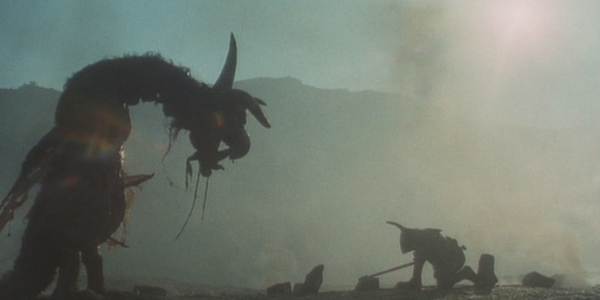
Gilliam's first solo feature as director also adopts a 19th century fairy tale as its premise, loosely adapting the Lewis Carroll nonsense poem of the same name and transforming it into a darkly humourous tale of misguided heroics amidst a near-farcical medieval landscape. Python member Michael Palin stars as Dennis Cooper, a typically witless protagonist who stumbles from one scenario to the next, too dumb and clueless to be the architect of his own fate (Palin is perfectly cast in this role, all dumb stupefaction and head-scratching bemusement). As the titular beast terrorizes the medieval town, corrupt officials profit from their fear while religious fanatics catapult themselves into walls, all in the midst of copious amounts of mud, filth and fog. Inevitably, Dennis winds up unwittingly facing off against the Jabberwocky and defeating it less through his own skill and bravery than through a large stroke of good luck. Jabberwocky is nothing if not silly fun, and already Gilliam's visual style and thematic obsessions can be seen emerging. It's also perhaps his funniest films, much in keeping with the comedy of Monty Python - indeed, some of the locations and costumes appear to have been lifted directly from Monty Python and the Holy Grail, just as some of the gags and slapstick humour could be mistaken for outtakes from the Python movie. Gilliam was, of course, none too happy with the marketing team in America associating the movie directly with Monty Python for its premiere, but in a sense it can be viewed as a half-way house - albeit a thoroughly entertaining one - between Terry Gilliam member of the Python troupe and Terry Gilliam the auteur.

10. The Fisher King

The first of Gilliam's Trilogy of Americana, The Fisher King marked a distinct move away from the excessive fantasy realms of his previous work and towards something both modest in terms of production values and - relative to his previous films - grounded closer to reality. Jeff Bridges stars as the insensitive and scathing radio host Jack Lucas, whose thoughtless remarks to a psychologically disturbed caller leads to a massacre in a Manhattan bar. Three years later and the guilt and depression has taken its toll to the point where he decides to commit suicide, only to be set upon by thugs who try to set him on fire thinking he's a homeless man. Enter Parry (Robin Williams), a deluded homeless man who comes to his rescue and tries to convince Jack to help him track down the Holy Grail (sometimes it isn't too hard to play "connect the Gilliam films"). When Jack learns that Parry's disturbed state of mind came about from the death of his wife in the massacre he'd inadvertently triggered as a radio DJ, he feels compelled to help him overcome his demons (which sometimes manifest in the form of a hallucinated red knight) and find love again. The Fisher King is perhaps Gilliam's most earnest and affecting movie - despite Parry's delusional state of mind it rarely transforms into visual flights of pure fantasy and the emotional core - guilt, grief, reconciliation and rediscovering the potential of love - are grounded in the contemporary New York setting and characters.

9. The Zero Theorem

Terry Gilliam's latest film The Zero Theorem was in and out of the cinemas so quickly that if you blinked you probably missed it. It was as if the marketing department - who no doubt dread the arrival of even the most accessible Gilliam movie - decided to not bother at all, and the distributors followed suit, conceding to a limited release in the hope that it would recoup its budget from hardcore fans in the home market. Which is of course a shame, not least because Gilliam is such a striking visual director even when working with a modest budget, and even the best home cinema can't compare to the big screen. The final part of what Gilliam is alleged to have referred to as his "Orwellian triptych" (while some news outlets claim that Gilliam has debunked any connection to Brazil and 12 Monkeys, the comparison is nevertheless striking), The Zero Theorem takes place in a bizarre future world, with computer whiz Qohen Leth (Christoph Waltz) working to solve the mathematical theory of the "Big Crunch" and determine once and for all that existence is meaningless. Much of this is familiar territory and if it wasn't intended as a companion piece to Gilliam's earlier work it nevertheless retains both a look and thematic feel which is readily identifiable. While it isn't his most successfully realised alter-world, at the same time you can't help but admire Gilliam's commitment to presenting audiences with a dystopian vision as anarchic and ramshackle as presented in The Zero Theorem.

8. Tideland

Tideland, adapted from Mitch Cullen's novel of the same name, is perhaps Terry Gilliam's most audacious, frustrating and misunderstood movie. Made while The Brothers Grimm was languishing in post-production hell, it's also perhaps his most personal work, a film which straddles sublime poetry and psychological horror. Tideland tells the story of a young girl by the name of Jeliza-Rose (Jodell Ferland), alone after the death of her parents in rural Texas and left to her own devices, who slides further and further into a dark and twisted fantasy land in which multiple fractured personalities manifest themselves in the Barbie doll head she wears on her fingertip. Her father Noah (Jeff Bridges) - dead from a heroin overdose - decomposes in an armchair in the living room, a fact that Jeliza-Rose fails to understand since she has grown accustomed to him sitting in his chair comatose. As she ventures out of doors she encounters her neighbours, a young mentally impaired man called Dickens and his strange sister Dell (Brendan Fletcher and Janet McTeer). While Gilliam is no stranger to exploring childhood fantasies, Tidelands is perhaps his darkest movie, not least with the uncomfortably semi-erotic nature of the relationship between Jeliza-Rose and Dickens, which the young girl initiates, and the blending of morbid obsessions with childhood innocence. That said, the controversy - and undeserved critical panning - was ill-founded in terms of how you'd expect such dark subject matter to play out, and Gilliam's eccentric visual flourishes never overwhelm the psychological core, leaving the characters (real or imagined) at the heart of the film, however damaged that heart may be. Certainly no masterpiece, but perhaps the most underrated film in his body of work.

7. The Adventures Of Baron Munchausen

From the fractured psyche of an abandoned young girl to the fantastical reveries of an old man, The Adventures of Baron Munchausen lightens the mood as much as it ups the ante in its scope and ambition. Fantasy and reality collide in what is perhaps Terry Gilliam's most out and out entertaining cinematic romp, following the titular Baron from one tall tale to the next. Opening amidst the cannons and smoke of warfare in a late 18th century unnamed city, we begin - appropriately enough - in a run-down theatre, where a production of Baron Munchhausen's life story is taking place. A man proclaiming to be the real Baron interrupts, and proceeds to regale the audience with logic-defying stories of his adventures. As the assault on the town continues and the Angel of Death closes in, the storyteller becomes the story, and together with a band of eccentric companions - accompanied by the theatre owner's daughter Sally Salt (Sarah Polley, who recently wrote and directed the remarkable documentary Stories We Tell) - the Baron sets off to bring an end to the war. From the giant king and queen of the moon who remove their heads so as not to mix up the intellectual with the carnal, to giant sea monsters and the Goddess Venus, the increasingly improbable action culminates in a grand battle against the marauding Turks. The production woes of The Adventures of Baron Munchausen has achieved near legendary status in the annals of movie history - over budget by millions and considered a harrowing experience by many of those involved, it was inadequately marketed and ended up being a commercial flop. And yet, the film itself is a real gem - vibrant and colourful with an outstanding production design from Dante Ferretti, wonderfully acted €“ particularly John Neville's central performance €“ and beautifully paced from start to finish. For a film made in 1988, the effects are as engaging and appealing as many of the CG-laden blockbusters released in the 21st century €“ indeed, they possess a charm that many movies today often lack - and it's so much fun to watch. Rarely has a film so beset with troubles turned out so polished and rounded.

6. The Imaginarium Of Doctor Parnassus

If the lead actor tragically dies mid-production, most films end up being shelved, so when Heath Ledger tragically died a third of the way through the filming of The Imaginarium of Doctor Parnassus it was assumed by many that the film would become yet another Gilliam project cut short. The fact that it wasn't €“ and the fact that it was salvaged in such an ingenious manner with little detriment to the final product €“ is noteworthy in itself. The Imaginarium of Doctor Parnassus is a traveling street theatre troupe led by the eponymous Doctor (Christopher Plummer), who made a bet with the Devil many centuries ago (known as Mr. Nick and wonderfully portrayed by Tom Waits), and leads members of the audience through a mirror which serves as a portal between reality and their subconscious. Inside, they must choose between the arduous ascent to spiritual enlightenment or indulging in their basest of pleasures, as represented by a seedy, neon-lit bar. One evening, as the troupe cross a bridge, they come across a man called Tony (Heath Ledger) hanging underneath. After rescuing him he joins them on their travels, until Mr. Nick arrives once again and challenges Parnassus to a game in which he must seduce five souls or lose his daughter Valentina (Lily Cole). Transforming the character of Tony into the various forms of actors Johnny Depp, Jude Law and Colin Farrell not only saved the movie from the scrapheap, it also fits perfectly into the idea of the magical subconscious realms within which portions of the film are set. The fact that all three actors were friends of Ledger seemed to make the decision a fitting tribute to the deceased star, and the film - at least as far as audiences were aware - didn't suffer noticeably from the changes: The Imaginarium of Doctor Parnassus remains an intriguing morality tale injected brought to life with Gilliam's trademark eye for visual flair; a near-mythical representation of the epic battle between the forces of good and evil, virtue and vice. Gilliam often includes scenes which allude to themes of spiritual and esoteric motifs and symbolism and The Imaginarium of Doctor Parnassus is perhaps his most occult movie to date, with the strange fantastical realms behind Parnassus's mirror reflecting the idea of psychological transformation and the spiritual aspect of alchemical purification. Not surprisingly, movie conspiracy theorists had a great deal of fun analyzing the imagery of Heath Ledger hanging from beneath the bridge, suggesting that it foreshadowed his own real-life death.

5. Fear And Loathing In Las Vegas

None of Terry Gilliam's movies have been quite as polarizing as his adaptation of Hunter S. Thompson's hallucinatory literary masterpiece Fear and Loathing in Las Vegas. Its detractors lambast it for being a messy, delirious, incoherent cacophony assaulting the senses, while its fans laud it for being a messy, delirious, incoherent cacophony assaulting the senses. Of course, they're both right €“ it's all a matter of personal taste when it comes to adapting source material which was considered inherently "unfilmable". Anyone who's read the original book understands that if you were to attempt to craft a cohesive plot you'd be missing the point - the story of Raoul Duke (Johnny Depp) and Dr. Gonzo (Benicio Del Toro) heading to Vegas and getting loaded on an array of mind-bending psychedelics is almost an irrelevance; the trip itself is far less important than "the trip" and all that it represents. The drug experience by its nature lacks logic and an affinity with the real world - indeed, it distorts, refracts and flips reality on its head, puking a bleak rainbow from its gargling mouth. Gilliam's ability to render this surreal mental landscape in such an acutely intuitive manner is a testament to his mastery of the form and function of cinema in perhaps its purest forms. Perhaps only Gaspar Noé's Enter the Void achieves the same objective presentation of the subjective nature of a mind under the influence of powerful psychedelics. Terry Gilliam was himself a product of the late 60s and early 70s who left America disillusioned by the corruption of the State under President Nixon (although he claims to never have taken psychedelics), echoing the theme in Fear and Loathing in Las Vegas concerning the end of an era €“ falling from the crest of the wave of the counter-culture movement €“ and the end of the hope the movement had inspired. In this sense, the drugs €“ and by extension the movie itself €“ are a metaphor for America's season in Hell, where the American dream gave way to an endless nightmare characterised by political corruption and endless war.

4. 12 Monkeys

Gilliam's films are often densely packed with ideas and it's perhaps no surprise that critics often lambast him for not being able to order them in a coherent fashion. These ideas and themes sometimes seem to freewheel around one another as if vying for supremacy, and nowhere is this perhaps more noticeable than in 12 Monkeys, his 1995 sci-fi dystopian time travel thriller. In the year 2035 the surface of the planet has long since been rendered uninhabitable by the outbreak of a virus in 1996 which killed all but 1% of the population. In order to determine the root cause of the apocalypse, the authorities send criminals back in time - one such prisoner is James Cole (Bruce Willis), who is accidentally sent back to 1990 and soon finds himself locked up in a mental asylum under the care of Kathryn Railly (Madeleine Stowe). Here, he meets Jeffrey Goines (Brad Pitt) the deranged son of an eminent virologist (Christopher Plummer) - Jeffrey may or may not be the future leader of The Army of the 12 Monkeys, believed to be the cause of the deadly outbreak. After hopping back and forth through time, Cole finally lands in 1996 where he kidnaps Railly and forces her to help him save the world. The wonderful first act is a delirious exploration of sanity and madness, as Cole starts to question his own mind. Brad Pitt's performance as Goines is deserving of his Oscar nomination - all twitchy inflections and wild gesticulations - but Willis himself deserves praise for what is certainly a highlight of his career, in which brooding vulnerability sits at odds with outbursts of violent rage. As the plot moves forwards at a relentless pace, the folly of science, the need for environmental conservation and apocalyptic nightmares all converge in a story held together by the increasingly doomed love story centering around Cole and Railly. It is no coincidence that the cinema they hide out in at one point is screening Alfred Hitchcock's Vertigo, a film which also deals with the fractured nature of memory and identity. The final reel, which ramps up the tension, is similarly Hitchcockian in its structure. Almost too clever for its own good (the script by David Peoples - who wrote the screenplay for Blade Runner - and his wife is certainly crammed full of ideas), 12 Monkeys is one of the most cerebral mainstream science fiction movies to have come out of Hollywood.

3. Time Bandits

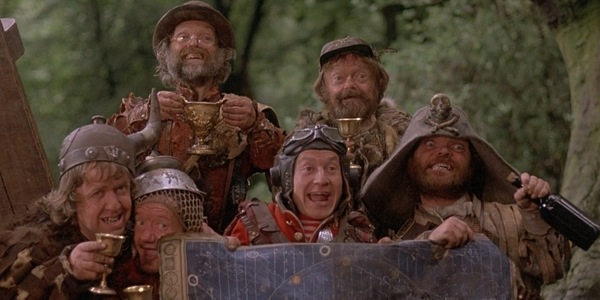
If Tideland explored the warped psyche of a young girl traumatised by the death of her parents, the imaginative landscapes of Time Bandits resides closer to the other end of the spectrum, where exuberant fantasy and creative escapism run free. 11-year-old Kevin's historically informed adventures enthralled a generation of kids who grew up with Gilliam's second solo feature - a star-studded romp through the ages which gave audiences their first hint at the true flair for his visually exciting and playful style. Kevin (Craig Warnock) wakes up one night to find his bedroom overrun with a group of ragtag renegade dwarves who proceed to drag him through the ages using a stolen map with magical properties which allows them to traverse both space and time. On their journey they visit Napoleon (Ian Holm), Robin Hood (John Cleese), Agamemnon (Sean Connery) and a host of other historical figures, unaware that all the time there is an Evil Genius (played to perfection by David Warner) watching from afar and manipulating events so that he might acquire the map for his own nefarious ends. They soon find themselves plunged into the Time of Legends, where giants roam the oceans with sailing ships perched atop their heads and beasts and monsters roam. Some critics at the time of its release lambasted The Time Bandits for being too episodic - a criticism which surely misses the point completely. The entertainment value of the film is precisely the random, unpredictable manner in which they crop up in wildly contrasting locations - just as the unfettered imagination of your average young boy playing with his toys might veer from knights to cowboys to astronauts. Despite the leaps between time and place, the action never feels incongruous - Gilliam grounds the hectic narrative in witty and assured dialogue (co-written by Michael Palin) and imagery which is both bizarre and beautiful. Time Bandits remains today one of the greatest children's fantasy movies ever made, and like all great cinema the appeal for adults is just as strong (especially for those who made the wise decision not to grow up too much simply because they aged).

2. Monty Python And The Holy Grail

A common misconception about Monty Python and the Holy Grail is that Terry Gilliam was responsible only for the animated sequences and that all the live action was directed by fellow Python Terry Jones. The truth is, the direction for the film was split between the two Terrys, with Jones directing the actors and Gilliam handling the photography. It is with this in mind that The Holy Grail fully deserves a place in the Gilliam filmography - to omit it would be to do him a great disservice. Few readers will be unfamiliar with the plot even if they haven't seen the movie - King Arthur (Graham Chapman) gathers his most trusted knights and sets off across medieval England in search of the treasured Holy Grail, encountering along the way an oddball assortment of French soldiers, peasantry, witches, three-headed giants and the dreaded enchanter by the name of ... Tim. In typical Python tradition, the lead actors take on most of the parts themselves, with the silly plot playing second fiddle to an endless stream of gags, one-liners, slapstick and satire which relentlessly assaults the funny bone. Rarely does a film come along which is so inventively and gleefully stupid and entertaining - and few have endured the test of time quite so unscathed by changing tastes. Eminently quotable - from the fight with the Black Knight (declaring "tis but a scratch!" after losing a limb) to the Knights Who Say "Ni!" demanding a new shrubbery - few comedies have surpassed Monty Python and the Holy Grail. Except, perhaps, Monty Python's Life of Brian.

1. Brazil

If Time Bandits was the opening chapter in Gilliam's "Trilogy of Imagination", representing childhood, and The Adventures of Baron Muchausen the closing chapter, dealing as it does with the mind in the twilight of life, Brazil deals with the fantastical escapism of a man in middle age. Jonathan Pryce stars as Sam Lowry, a government bureaucrat who escapes from his dull conformist life with literal flights of fantasy in which he rescues an enigmatic woman. When a deadly administrative error leads him to the home of widow Jill Layton (Kim Greist) he immediately recognises her as the woman of his dreams, and Lowry is soon inexorably drawn into the labyrinthine world of the Ministry as he tries to determine who exactly she really is. The ideas and themes which preoccupy much of Terry Gilliam's movies before and since - the distinction between reality and imagination, lucidity and delusion; the Kafkaesque absurdity of mindless bureaucracy and authoritarian control; the post-Enlightenment tug-of-war between cold rationality and unbounded spirituality - all coalesce perfectly in Brazil, widely considered to be not only Gilliam's masterpiece but one of the greatest films of the 1980s. An acutely observed satirical take on George Orwell's seminal dystopian novel 1984 (at one point in production the film was known as 1984 1/2), Brazil examines that rare breed of human in the face of totalitarianism - a spirited individual who refuses to capitulate to the system, preferring instead to become a silent martyr than submit to the stamping boot of unchecked power. Obviously a round-up of the works of such a monumental talent as Terry Gilliam can only ever be subjective - everyone has their own favourites especially from a selection of movies which elicit such wildly different emotions. Do you agree with these choices? Why not post your own selection of Gilliam favourites below?

Contributor
Contributor

Andrew Dilks hasn't written a bio just yet, but if they had... it would appear here.