The Single Biggest Mistake Each Star Trek Movie Has Made
No Star Trek film is free of error but some crimes are worse than others.

We don't mind being the ones to stick our neck out on this; some of the Star Trek films are damn near perfect from start to finish. The Wrath of Khan gave the audience the best villain of the franchise, First Contact re-invented the Borg, The Undiscovered Country produced arguably cinema's first-ever big-budget political thriller set in space, and The Final Frontier... exists.
Look, we said "some", alright?
But despite this incredible standard that's been maintained for decades now, each film still has its flaws. They might not be a big deal, and they certainly don't always ruin your enjoyment, but they are still there nevertheless. Be it a glaring plothole that actually undoes the entire premise of the film, or just one hair-brained decision that could easily have been snipped out at the writing stage, once you've noticed them it's pretty hard to notice anything else.
But, as we've already said, Star Trek usually produces damn near perfect movies. These mistakes are more to be celebrated as loveable flaws in the great intergalactic rodeo than they are catastrophic gaffes that undo over 50 years of boldly going to the local multiplex.
13. Star Trek: The Motion Picture - LSD Time

The Mistake: The Wormhole
Why?: The wormhole scene in Star Trek: The Motion Picture is an example of too much being thrown at the audience. While we have been enjoying the beautiful re-design of the USS Enterprise and marveling at the slow departure from drydock, having the ship then get sucked into a random wormhole feels a bit... off.
The scene was included to show that the ship couldn't fire phasers while at warp, as the energy from these weapons came from the core itself. Unfortunately, the direction and depiction in the scene makes it very difficult to take the threat seriously. A stray asteroid in the wormhole does nothing to heighten this tension.
Decker's overruling of Kirk makes perfect sense, though the shot that lingers on Shatner's shocked reaction asks the audience to ignore the situation and believe that this Admiral wouldn't know that his Executive Officer would be acting in the best interests of the ship. The scene ends quickly and the ship is able to use normal warp drive again but it sticks out as an action scene that would have been better left on the cutting room floor.
12. Star Trek II: The Wrath Of Khan - Overqualified Away Team

The Mistake: Sending your Captain and First Officer down to an unsecured location.
Why?: Although this one is a bit self-explanatory, it's the disastrous fallout that comes later that reinforces the issue. Captain Clark Terrell and Commander Chekov beam down to what they believe is Ceti Alpha VI to investigate an unidentified lifeform. It's really quite difficult to understand why they, out of everyone in the crew, were the ones who had to go.
Starfleet has a strict set of rules in place when it comes to the captain of a starship going on an away mission. The events of this movie can only have served to validate this. Terrell beams to an unknown situation and is quickly captured, brainwashed and enslaved by Khan. While the loss of a captain is bad enough, it then results in the loss of a starship.
The USS Reliant is overrun by Khan's forces, allowing them to finally escape from the surface. Meanwhile, the entire crew of the Reliant are stranded. The ship is later destroyed in battle. While it was necessary for Khan to gain control for the sake of the plot, literally any other crewman should have joined Chekov in that transporter room.
And all of this is just quietly ignoring the continuity error about Khan recognizing Chekov, of course...
11. Star Trek III: The Search For Spock - Boy's Club

The Mistake: Uhura doesn't join the mission to Genesis.
Why?: Well there's the question, isn't it? Uhura is very clearly on-board with the mission to recover Spock's body. In fact, she plays the long game, taking a position in a lonely transporter room so that she can help get the crew aboard the Enterprise. Then, nothing. She says that she will meet them at the rendevous on Vulcan and she exits the film until the finale.
The novelisation goes much farther toward explaining this. Here, she remains behind so that she can scramble any messages being sent about the Enterprise. She does the same for the Excelsior as a personal attack on Captain Styles, who she felt usurped Sulu's command. Once this is completed, she runs to the Vulcan embassy and seeks asylum from Sarek, which he grants.
That is an excellent explanation as to why she remains behind, though none of this is in the film! Also depicted, she hits energise and the audience is left to assume she either threatens 'Mr. Adventure' beside her into not reporting her or finds another way to cover her actions long enough to make it to Vulcan.
10. Star Trek IV: The Voyage Home - Pollute The Past Much, Pavel?

The Mistake: Chekov reveals WAY too much information during his interrogation.
Why?: What was Pavel thinking? He is captured by the guards aboard the contemporary USS Enterprise after he and Uhura steal the fuel they need for the Bird-of-Prey. Sitting in front of him, the interrogator grills him for information. Chekov then gives him his name, rank, and service number. Repeat: Chekov tells the American Navy about the existence of Starfleet.
This could have an enormous impact on the timeline. Frankly, Chekov is blessed as the interrogator doesn't believe a word of what he says, yet he leaves his technology behind to confirm his story. A Klingon phaser and communicator remain in a highly guarded military location and no one thinks to return for them? There was an entire episode of Enterprise about this very topic!
Finally, though this is of course accidental on Chekov's part, he requires emergency brain surgery at a local hospital. McCoy is able to save him easily, though the surgeons in place witness the use of highly advanced machinery in the process of this, not to mention Kirk casually firing a phaser at the door handle.
The Voyage Home is easily the most fun Star Trek film but it would have been a nightmare for Temporal Investigations.
9. Star Trek V: The Final Frontier - Are They Brainwashed Or Not?

The Mistake: The rules of Sybok's control are extremely wooly and make it look like the crew were just looking for a reason to betray Starfleet.
Why?: Throughout the film, the audience witnesses Sybok use his telepathic abilities to help people deal with their inner pain. Although sometimes presented in a melodratic way, it is actually one of the strongest elements to the character. He is a spiritual leader, even though he is moulded from cult personalities.
Once he boards the Enterprise-A, he takes over the ship in about twenty seconds. It is assumed that he uses his healing powers on every member of the crew, a number we can assume to be between 200 and 400 people. Fair play to the Vulcan, that's quick work. When we see him use his powers on McCoy and Spock, they are able to choose not to turn against Kirk.
This implies that Uhura, Chekov and Sulu all chose to support Sybok, with Scotty opting out. While it is perhaps slightly understandable that Sulu would betray Kirk at the first opportunity, it stretches belief to breaking to assume that the entire crew would turn so quickly.
8. Star Trek VI: The Undiscovered Country - Unauthorised Phaser Levels

The Mistake: For the first time an alarm sounds if someone fires an unauthorised phaser aboard a starship, alerting security.
Why?: It introduces a lot of questions, while also offering a clue as to the eventual identity of the conspirator. Star Trek VI is up there with Wrath of Khan for the best Trek films, so this is a small nitpick. But, Yeomen Burke and Sano are killed by phaser fire, set to stun, at point-blank range. Valeris had previously demonstrated that firing an unauthorised phaser is prohibited on a Starship.
So, assuming it is Valeris who fired the shots at the two men, why was the helmsman of the Enterprise-A authorised to use a phaser? If it is only authorised at the stun setting, does this mean that any officer can use a phaser set to stun on the ship? Finally, in a strange choice that is related to this, why take the time to properly hide the assassins uniforms but not their bodies?
While the Undiscovered Country is an excellent political thriller, action film and a swansong for the crew, these small nitpicks stand!
7. Star Trek: Generations - The Enterprise Does Nothing

The Mistake: The Enterprise-D, a Galaxy-class starship, does next to nothing to fight a Klingon Bird-of-Prey.
Why?: The Duras Sisters, thanks to their access to Geordi's VISOR, are able to correctly match their weapons' frequencies to the Enterprise's shield modulations. This allows them to fire at the vessel as though there were no shields at all. While this is devastating to the Starfleet ship, there is no reason whatsoever as to why they can't fight back.
In the entire battle, the Enterprise fires one phaser blast and one photon torpedo. Frankly, it looks as though they wanted to be destroyed at that point! A twenty-year-old D12 class ship stands no chance against the Federation's flagship, even with its shields down. It may level the playing field slightly, yet still, the offensive capabilities of the larger vessel should have made it a very quick fight.
When the ionic pulse caused the Bird-of-Prey's shields to drop, a single photo torpedo destroyed the entire vessel. How strong were those shields to begin with? Considering the volleys that the Enterprise were able to throw against the Borg at a moment's notice, this seems very iffy.
6. Star Trek: First Contact - Why Rely On Phasers?

The Mistake: After discovering that projectile bullets are as lethal to the Borg as they are to humans, no one thinks to replicate any.
Why?: Star Trek: First Contact is fairly close to being the perfect Trek movie, so finding mistakes is thankfully not the easiest job to do. An easy option to go for would have been the continuity issue with the number of decks on the ship but then we got to thinking about this little point.
On the holodeck, Picard takes Lily into one of his Dixon Hill programs. There, he gets a Tommy gun, switches off the holodeck safeties, and blows two Borg back to their alcoves. Having discovered this wonderful technique, he is then in a perfect position to encourage all members of the crew to replicate projectile firearms to take on the drones.
Now, if we assume that some replicators have restrictions against this very option, surely the captain of the starship can override this? If, for whatever reason, they can't do that... why not? This isn't the first time that Starfleet has faced the Borg!
Having said all of that, when a film is that good that we're down to nitpicking, that's a good place to be in.
5. Star Trek: Insurrection - Ignoring The Prime Directive

The Mistake: Either the Federation knowingly got themselves involved in a blood feud, or somebody did absolutely no background checks on the Son'a.
Why?: This is a pretty big issue, whichever way you look at it. In the first option, the Federation is well aware that the Son'a and the Baku are the same race. Therefore, they abandon the Prime Directive entirely. Involving themselves in the internal affairs of another world and people is strictly against everything they stand for. While the possibility to cure many illnesses is a tempting target, it is highly unlikely that Starfleet would sanction this.
So, let us now assume that Starfleet doesn't know the true origins of the Son'a. Admiral Dougherty says that the Prime Directive doesn't apply as the Baku aren't indigenous to the planet, besides which there are only 600 of them to move.
Who does the research on Starfleet new allies? Does everyone who knocks on the door get allowed into the Federation's inner circle? There is serious misstep in the checks on the Son'a, as a quick scan with a tricorder reveals their ancestry. Whichever way you look at it, Starfleet acts totally out of character in this film.
4. Star Trek: Nemesis - The Reman Reputation

The Mistake: Making the Remans out to be the greatest warriors that the Galaxy has ever known, then revealing them to be as threatening as the average Ferengi.
Why?: This was a let-down. For the first time in Star Trek's then-40 year history, the Remans were revealed to the audience. We are told in the early stages of the film that they are some of the most brutal soldiers to have fought in the Dominion War, serving as effective slave labour to their Romulan overlords. The opening scene suggests a ruthlessness that the audience can look forward to.
And then, nothing!
Shinzon is the primary villain with the Viceroy being suitably frightening to look at but if these are the most devastating soldiers in the Galaxy, the Dominion War would have ended in a matter of weeks, with the Alpha Quadrant races on the losing side. The Remans are simple fodder, standing and firing and being fired at. Shinzon is a human-clone, so he can hardly be counted. The Viceroy puts up a good fight but it still overpowered by Commander Riker.
They were an anti-climax of an introduction, wasting the potential of their mystery for a fairly ho-hum finale to The Next Generation's film saga.
3. Star Trek - My Name Is James Tiberius Kirk

The Mistake: Young James TIBERIUS Kirk rides his uncle's car off a cliff, then announces his full name to a robocop and a cringing audience.
Why?: Jimmy Bennett is a very nice young man who is doing his best.
Having said that.
The scene was a massive lapse in judgement. While the reboot film was definitely playing for the Mission Impossible crowd, the character that everyone is supposed to root for is introduced as a punk kid intent on destroying this antique. The scene is a step below fun, leaning a little closer to cringe. The Beastie Boys would eventually serve as a nice set-up for Beyond, yet apart from that, it feels like the film is trying too hard to be 'cool'.
James TIBERIUS Kirk skids the car off the cliff and performs an incredible feat of acrobatics, leaping from the falling vehicle and grabbing the rockface to prevent himself from falling to his death. Then, in a deliverance that leads the audience to believe James TIBERIUS Kirk is Trek speak for Go F*ck Yourself, he gives his full name to the officer.
It is uncomfortable on the side of embarrassing to watch, while in the very next scene the depiction of young Spock is next to perfect.
2. Star Trek Into Darkness - John Harrison
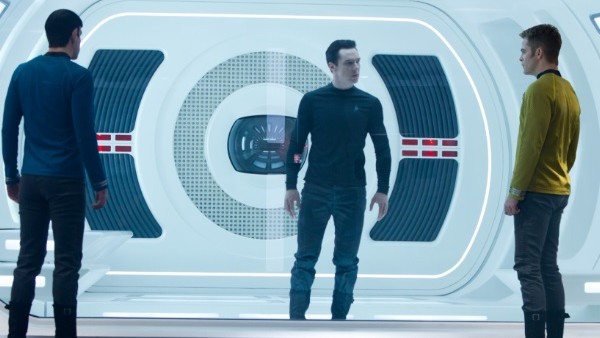
The Mistake: Take your pick really. John Harrison in general. Fine. Let's go with that.
Why?: We all knew this was going to be Khan. I knew it. You knew it. The neighbour's dog knew it. Still, the film decided to make this a reveal. While this is not nearly the worst crime in this film, it just feels far too forced, too desperate. John Harrison could have been an engaging villain in his own right, exploring the dark side of morality and motivation.
The name of the character aside, the fact that he has super blood that can prevent death immediately renders all other points moot. Kirk is killed while saving the Enterprise. McCoy, having already effectively shown that he was experimenting with Khan's blood on a Tribble for no apparent reason, watches the creature come back to life, then eurekas his way to the bridge.
Khan is captured, Kirk is zombified and the day is saved. Never again will Starfleet face any serious threats as their entire armed force just became immortal. The fact that this is then dropped and never mentioned in Star Trek Beyond feels like a retcon, which makes it all the more obvious here.
1. Star Trek Beyond - Pretty Poor Starbase Design
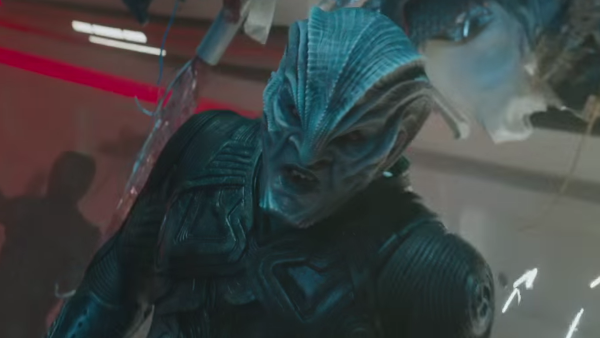
The Mistake: Having the entire air supply for an enormous starbase located in one, easily accessible spot.
Why?: To be fair, Star Trek Beyond is pretty good. While Krall is more of a plot point than a villain, the swarm is suitably menacing and there is a little lump in our throats watching the Enterprise bow out under their assault. The relationships in the film feel real and Jaylah is an excellent addition to the ensemble.
The issue centres on the plan that Krall puts in effect. He wants to introduce a deadly device that will destroy all life on the starbase. Despite feeling abandoned for 100 years, the swarm flies through the nebula with ease. What was stopping them from doing that 100 years ago? Then, how did Krall know the layout of Starbase Yorktown, at least enough to put his plan into motion?
How did he fall so far into monsterdom in the intervening years, with no hope of redemption by the time he encounters the Enterprise? The issue with the film really is the wafer-thin depiction of this supposedly manic ex-soldier, who really feels like a carrier pigeon for the plot and some threats. The Enterprise deserved better.