Think You Know Last Action Hero? Think Again
Arnold Schwarzenegger's infamous box office bomb is actually one of his greatest movies.

There was once a time when Arnold Schwarzenegger could do wrong. After breaking into the public eye with his bodybuilding exploits in the late 1970s - immortalised in the all-timer documentary, Pumping Iron - Schwarzenegger would star in a number of seminal action films in the following decade, propelling him on a rise that would take him to Hollywood's summit and define an entire genre in the process.
Conan the Barbarian. The Terminator. Commando. Predator. These films reinvented action archetypes and were themselves a reflection of Arnold's unimpeachable drive for success and fame, each character a conduit through which to flex the Austrian man mountain's physique, stunt acumen, and bravado.
At the same time, these roles also intimated Schwarzenegger's erudite grasp of his own performance and image. Just as quickly as he pioneered eighties action he was also deconstructing it, most successfully in genre master John McTiernan's Predator, which assembled a team of immaculately sculpted eighties strongmen, only to have them be torn apart by a slasher villain from beyond the stars. Forays into comedy - such as in Ivan Reitman's Twins, in which Schwarzenegger starred opposite Danny DeVito - once again illustrated a willingness to have fun with his persona.
This understanding of and drive to interrogate his image proved to be the making of Arnie's Hollywood career, which reached a cultural and critical peak in 1991 with James Cameron's Terminator 2: Judgment Day. But it also led to its decline. Just two years later, Schwarzenegger would star in his most introspective film yet, and one that ultimately became one of the most notorious box office bombs ever made, codified into pop culture legend as a hubristic example of genre indulgence. That movie, John McTiernan's Last Action Hero, is widely regarded as Schwarzenegger's lowest moment - but it should be seen as one of his best.

Released in 1993, Last Action Hero has long been considered the nadir of Schwarzenegger's career - or at least the first film to show a weakness in what had been until that point an unshakeable box office winning streak. With a meta but affectionate plot all about a young boy being transported into the action movies he loved, Last Action Hero was roundly criticised for having an ostensibly messy focus that undermined its potentially cutting premise. Its critical and commercial failure quickly became a gag, with critics reveling in the big-budget behemoth stumbling out of the gates next to Steven Spielberg's Jurassic Park, which famously went on to become one of the biggest movies ever made.
Throw in a tumultuous production and a sentimental storyline that stretched Arnie's dramatic chops, and you were left with a recipe for mockery - a reception best exemplified a year after Last Action Hero's release by The Simpsons, with Chief Wiggum exclaiming "magic ticket my ass" to a downtrodden and dejected Rainier Wolfcastle - a surrogate Arnie - in the golden age episode, "The Boy Who Knew Too Much."
By that point, in 1994, the narrative had set in. Last Action Hero was consigned to box office bomb status along with the likes of Heaven's Gate, soon to be followed by the other commercial failures of the decade like Renny Harlin's Cutthroat Island and Kevin Costner's Waterworld. And there it has largely remained, with director McTiernan and co-writer Shane Black having spoken candidly of their regrets with the film and of its infamously tempestuous production, essentially agreeing that it did not live up to their own standards.
But this perception of Last Action Hero isn't fair, and today, you'll be able to find plenty of people who hail the film as a career highlight for Arnie and McTiernan. For his part, Schwarzenegger agrees that the film is his most underrated, stating in a 2023 interview with The Hollywood Reporter that "it was slaughtered before anyone saw it... now, more and more people are seeing it and saying 'I love this movie.'"
Now, for my part, I have always loved Last Action Hero, so I need to qualify any defence I put forward for the movie with the fact that it holds a lot of personal nostalgia. That said, Arnold is absolutely right. While flawed, Last Action Hero is his most unheralded film - an affectionate send-up and send-off to eighties action cinema that reiterates McTiernan's masterful understanding of the genre, as well as a willingness on Arnie's behalf to interrogate his own filmic legacy. It is arguably a smarter film than the sum of its messily-produced parts should allow, but the end result is still a funny, gorgeously shot entry into the genre canon that remains undervalued 30 years on from its release.
[Article continues on next page...]
"Not To Be" - How A Messy Production & Studio Arrogance Doomed Last Action Hero

When it fully entered production in 1992, Last Action Hero was being plotted as Schwarzenegger's next big home run, but the script had more humble beginnings. As detailed in "The Life and Death of Last Action Hero" by Empire's Nick de Semlyen, what would eventually become Columbia's most expensive nineties picture was initially conceived as a small-scale genre parody by screenwriters Zak Penn and Adam Leff called "Extremely Violent". The duo were promptly booted off the project after it attracted Schwarzenegger's interest, with Lethal Weapon's Shane Black and screenwriting partner David Arnott overseeing heavy rewrites.
This was but the first of many adjustments made to the script over the course of its whizz-bang production, which eventually sucked in screenwriting talents such as William Goldman and Carrie Fisher. Director John McTiernan also implemented extensive revisions before shooting, which led to tensions spilling over on set, as well as a seeming lack of focus as to what Last Action Hero was actually trying to achieve. Matters were exacerbated by a rushed production schedule and a general awareness of the film's ballooning production costs. On top of this, McTiernan only had a few weeks to cut the film before its June premiere, by which point Jurassic Park had landed like a cataclysmic asteroid, dooming the movie's chances of success following a number of high-profile marketing gimmick misfires.
The end result of all this behind-the-scenes turmoil and the size of the production itself meant that Last Action Hero was probably never going to get a fair shake when it released in '93. The bigger the object, the louder the impact, and the presence of a peak-of-his-game Schwarzenegger, plus a studio willing to go toe-to-toe with Steven Spielberg despite warnings from both within and out, gave the impression - wrongful or not - of arrogance.
Sure enough, when Last Action Hero premiered a week after Jurassic Park, it was met with almost scathing derision from the Hollywood press. A consensus quickly developed, with critics labelling the film's sentimental yet comedic approach a jarring reflection of its discordant shoot, that McTiernan and Schwarzenegger hadn't been able to settle on a singular vision, and in doing so, had condemned the film to a bizarre and tonally incongruous middle. The post-mortem examination led to one enduring conclusion: Last Action Hero had tried to be two, totally opposing things - a fatal but obvious error the filmmakers and Columbia simply didn't recognise because they were blinded by Arnie hype, as well as the perils of a rushed production schedule.
This assessment isn't totally misleading, and has even been supported by those involved in the development of the film itself - McTiernan most notable of all. However, I do also think that it's somewhat limiting, because genre deconstruction and sincere, sentimental storytelling are not mutually exclusive - or at least, they shouldn't be. They can clash, certainly, but it seems wrong to condemn Last Action Hero for broaching multiple things at once, especially since it does so in a far more clever way than it was ever really given credit for. That might have been more difficult to see in '93, with its hubristic production and marketing campaign in mind, but in 2023, where we're now in the twilight of Arnie's career, the introspective brilliance of Last Action Hero should be more apparent.
[Article continues on next page...]
Last Action Hero Is Basically Arnold Schwarzenegger's Unforgiven

There's a really good quote in the aforementioned Empire article that discusses what drew Arnold to Penn and Leff's original script, and I think within that lies the most admirable qualities of the film. “Having a kid come into a movie awakens certain fantasies I had as a kid in Austria, like sitting on a horse with John Wayne”, Schwarzenegger reportedly said in a meeting with Columbia before production formally commenced. Now, it would be easy to categorise this exchange in the old narrative of Arnie's ego knowingly or unknowingly contributing to Last Action Hero's destruction - comparing himself to such an inimitable slice of Americana like John Wayne - but what it really does is reiterate his grasp over his own image and persona.
"Brand Schwarzenegger" had proven to be an increasingly profitable one in the years leading up to Last Action Hero's release, but it contained within that a diverse portfolio, one that branched into different facets of action, comedy, and even horror while intimating a willingness to examine the actor's presence - his voice, his physique, and personality - within those spaces. By the close of the eighties, Schwarzenegger's films had left an indelible mark on the action genre and on movie culture more generally, literally outmuscling the competition and inspiring both imitators and genre innovators. While not a sole influence, Arnold had helped reshape an entire genre, his boisterous personality and sculpted abs marking a new chapter in movie legend.

It wasn't arrogant for Schwarzenegger to be conscious of this when he helped mould Last Action Hero, a film that displays the same reverent, inward-looking approach to a career seen in films like Clint Eastwood's Unforgiven. That may seem like and probably is a wild comparison to make on the surface with a film that features a talking animated cat voiced by Danny DeVito, but it comes from the same place.
Earlier this year, after rewatching Last Action Hero, I came across a really good review of the film by Josh Lewis of the Sleazoids podcast on Letterboxd which neatly encapsulated the above idea. In his review, Lewis described McTiernan's film as "one of the best movies about a movie star literally wrestling with their own Hollywood fantasy image and myth", quoting the "you've brought me nothing but pain" exchange between Slater and Arnold as a moment that acutely crystallises this theme - and I have to agree. The heart of Last Action Hero lies in Arnold's awareness of his career, Hollywood persona, and the mythmaking abilities of the industry, as is reflected in the film's approach to violence, genre convention, and the cinema itself, which is framed as both a source of tragic escape and dazzling inspiration for young Danny Madigan (Austin O'Brien).
The sincere and sentimental streak present in Last Action Hero was mocked as another example of the film's out-of-touch nature, but it isn't all schmaltz. As much as McTiernan's movie reiterates Arnold's legend, so to speak, it also clearly makes fun of him. He's in on the joke the entire time, affectionately and hilariously ribbing on cliches and his own business-focused appetite, having the fictitious Jack Slater punch the real Arnie once he reaches the real world, and just after the latter abruptly starts an awkward Planet Hollywood promotion on the red carpet.
It could be seen as toothless, but Last Action Hero begins to work once you embrace its affection for the movies. There's an acknowledgment of the artifice and ridiculousness of the industry, but the point isn't to roll its eyes. It's a teasing celebration of the kind of film Arnie ushered in, culminating in a moment that heralds the restorative and sometimes deeply personal effects "the movies" can have on all of us.
[Article continues on next page...]
Why John McTiernan Was The Perfect Director For Last Action Hero
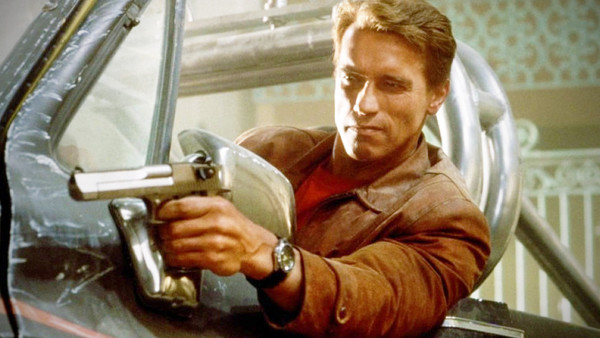
It's on brand for Schwarzenegger, but also McTiernan, illustrating again his talent for genre deconstruction and recalibration, which he achieved excellently with Predator and Die Hard. Original screenwriter Zak Penn remarked in that Empire piece that they had foreseen a filmmaker like Robert Zemeckis or John Landis taking on "Extremely Violent" - directors who, in his view, had a "history of pulling genres apart" - rather than an action heavyweight like McTiernan, citing a belief that genre mockery is more difficult for those who come from that space to begin with.
But this feels like an underestimation of McTiernan. Predator, perhaps the greatest action movie of all time, is also one that is extremely conscious of genre convention, starting out like a traditional "men on a mission" movie before shifting gears into sci-fi horror. Die Hard (and, to a lesser extent, The Hunt for Red October) spotlight action protagonists spiritually at odds with their contemporaries, with John McClane showing that it was just as cool for an action hero to get chewed up and spat out as much as it was to see them gun down hordes of gun-toting bad guys. These films describe a filmmaker invested in or at least intimately familiar with genre mechanics, which made him a natural fit for Last Action Hero - even with the oscillating tonal pulls and influences that occurred during its production.
Despite those tonal battles being plain to see in the finished product (as well as the madcap few weeks he was left with to get the film edited), it's impressive how well McTiernan was able to thread it all together. The end result is more than cohesive, with McTiernan anchoring the story of Last Action Hero around a young boy who has lost his father and is trying to fill that hole with the movies. As an emotional crux it's aged superbly; Austin O'Brien is funny, believable and sympathetic as Danny, and plays off excellently against Schwarzenegger, whom he greets with a mixture of wide-eyed wonder and incredulousness. The latter is clearly having fun playing around in the exaggerated and cartoony sandbox that is Jack Slater's world, until eventually he is forced to mature and confront reality. Once Danny takes him out of the movie universe, Arnie's performance shifts into a balance of affable, paternal concern and existential anxiety, McTiernan providing the perfect stage for which to poke fun of and process the actor's Hollywood legacy.
It's a shift that's reflected brilliantly in Last Action Hero's visuals, which may be some of the best in McTiernan's locker. Shot by Dean Semler, the film strikes a perfect contrast between glum reality and Hollywood majesty and silliness. In many ways, it's a film of varying temperatures. New York City is cast in greys, blues, and blacks, while Nick's cinema - decaying though it may be - is presented in a golden hue. Danny enters a new dimension even before he makes the literal leap into Slater's films, which are themselves rendered in bright, block colours that intimate a new level of fantasy. The way McTiernan and Semler blend these temperatures together in the neon-lit and rain-soaked finale makes for one of the most vibrant and expressive action movie third acts we've ever gotten, as Jack confronts The Ripper and Charles Dance's Benedict, and parts ways with Danny.
This conclusion is as much a clash between worlds as it is a confrontation with reality. Jack has to reconcile fantasy with real life and carry his new humanistic experiences with him, thereby transcending caricature status, while Danny essentially has to make peace with losing his father and how the movies, while a comfort, can't be a replacement. There's lots of fluid, dynamic action, starting with Jack gatecrashing the Jack Slater IV premiere and saving (and then punching) Arnold Schwarzenegger, before moving to the rooftops in a traumatic redux of one of his older movies' endings. It all culminates with the deaths of The Ripper and Benedict, who manages to mortally wound Jack - a sentence that means he must return to the movie world if he is to have any chance of survival.
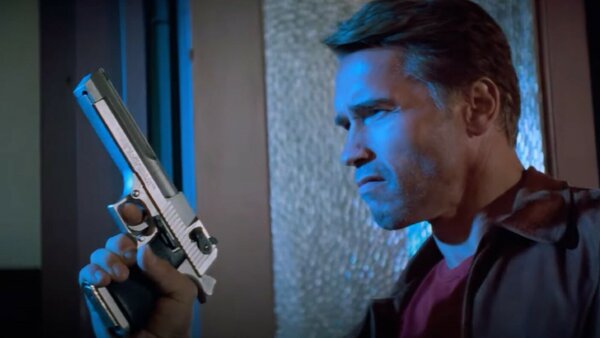
What follows leads to some of the most emotionally raw acting in Schwarzenegger's career, as surrogate father and son make their tearful but necessary goodbyes. O'Brien is excellent here as well, crystallising all that unspoken trauma as he loses yet another father figure, before eventually coming to terms with death (a literal manifestation, in this case) and accepting his own future. It's the kind of journey that feels reflective of Last Action Hero's introspective instincts, particularly as it pertains to the idea of Schwarzenegger taking stock of his own legacy. Arnold confronts "Arnie" - Danny confronts death. These are two tonal and emotional extremes, but the idea of taking a step back and looking inward is conveyed both literally in the story and through its metatextual elements, with Danny and Jack learning to live beyond the movies, but still carry them with them.
In what could be seen as a typical example of Last Action Hero's tonal dissonance, in and amongst all this emotional heartache is Ian McKellen as the version of Death seen in Ingmar Bergman's The Seventh Seal, brought to life by Benedict's magic ticket hijinks. McKellen plays the part with full theatric commitment, and it adds plenty of levity to the scene, but not in a way that undermines the film's emotional peak. Rather, it exemplifies how deftly Last Action Hero handles its contrasting tones and worlds, with McKellen getting arguably the most uplifting line in the film, telling Danny that he dies a grandfather and thus reminding him in the process that he has so much more left to live for. It's bizarre, funny, and heartwarming all at once - a moment that epitomises the film's best elements, as well as its infectiously charming incongruities.
[Article concludes on next page...]
Last Action Hero Remains Arnold Schwarzenegger's Most Underrated Film

All these aspects of Last Action Hero coalesce to create something uniquely chaotic and brilliant. That chaos - exacerbated by behind-the-scenes tumult and a ballooning, easy-to-root-against budget - may have made it harder to see, but I still think that it's a picture McTiernan and Schwarzenegger can be proud of. Great movies can emerge from less-than-ideal conditions, and Last Action Hero is a testament to that. It's just unfortunate that its production and even Arnie's prior success stacked the deck against its favour. Had it been released at a different time, and been marketed in a different way, then maybe it would have been looked upon more fondly. Instead, rightly or not, Last Action Hero came to epitomise Hollywood hubris, the magic on the screen being obscured by gleefully critical trade headlines and the reams of money invested into the picture by Columbia.
In any case, it's clear that Last Action Hero's failure wounded both McTiernan and Schwarzenegger. The Netflix-commissioned documentary series Arnold - which reflected on Schwarzenegger's life and career - only devoted a few minutes to the movie, but lingered heavily on the emotional blow its reception dealt the actor. Schwarzenegger confesses that the reception to the film both "embarrassed" and "upset" him, while James Cameron - who reunited with Arnold a year following Last Action Hero with the relatively more successful True Lies - said that the actor "took it as a deep blow to his brand." If we look at the film in the context of Arnold reflecting on his legacy, then this level of upset becomes even more understandable. Beyond simply refuting his business instincts, if Jack Slater as a character possessed any personal significance to Arnold, then it wasn't just his brand that was rejected, but rather his immediate place in the Hollywood canon.
Such a position may not be in doubt today, where Schwarzenegger is widely considered one of the greatest action stars and athletes of his generation, but there was a seeming reluctance to take him seriously with Last Action Hero. Perhaps that was a result of his off-screen, stogie-smoking personality belying his mindful approach to performance, or as Arnold himself less realistically posits, a "political attack" for his support for George H.W. Bush in the 1992 Presidential election. In either case, the backlash towards Last Action Hero changed Arnold from a domineering force of the action genre into something of a joke, a decline hastened by Simpsons-style mockery and a middling pivot to comedy, bookended by bombs like Batman & Robin or unremarkable action efforts like Collateral Damage and Terminator 3: Rise of the Machines.
What started out as a victory lap for the kind of action movie McTiernan and Schwarzenegger ushered in in essence became a send-off, albeit not quite the last hurrah. McTiernan followed Last Action Hero up with the magnetic Die Hard with a Vengeance, while Schwarzenegger starred in less emphatic but still enduring successes in True Lies and Jingle All the Way. Neither recovered their pre-Last Action Hero eminence, however, with both fading as forces in cinema in the early 2000s for separate and sometimes controversial reasons.
For all that said, time has and will continue to be kind to Last Action Hero, a film whose sincere yet meta introspection stands in stark contrast to a box office landscape that has become increasingly dominated by films that apologise for their own weirdness or vulnerability. That MCU-style, "well, that just happened" arrangement - which does thankfully seem to be passing as we exit 2023 - has also been accompanied by meta comedies that are nowhere near as incise as McTiernan and Arnie's genre send-up. Think Steven Spielberg's Ready Player One or the Ryan Reynolds-led Free Guy - movies that trade their existence solely on the basis of amassing as many pop culture references as possible, and never interrogate them beyond generic "isn't this cool?" status.
Last Action Hero avoids those pitfalls precisely because of the thing it was criticised most roundly for in 1993 - it had a heart. It took a genre specialist like McTiernan to marshal those discordant elements, resulting in a film that works as both a straight-action flick and a meta comedy. I'm not sure someone like a Landis or a Zemeckis had the baggage to make that work - at some point, that introspection would feel less introspective and more cutting. That may have been the intent with Penn and Leff's original script, but the end result is something more interesting - a flawed but weighty production that drew in a genre legend like Arnold Schwarzenegger, and made him confront a legacy that, in his time, was sorely underestimated.