What Does The Ending Of The Prestige Really Mean?
"Now you're looking for the secret. But you won't find it because of course, you're not really looking."
 Now you're looking for the secret. But you won't find it because of course, you're not really looking. You don't really want to work it out. You want to be fooled - Cutter Of late its sometimes easy to forget that Christopher Nolan, the genius behind the Dark Knight trilogy adrift amidst a sea of awards and accolades as a result of his labours with the franchise depicting his vision of the caped crusader, previously made a quartet of insidiously intelligent films: Memento, Insomnia, The Prestige, and Inception. All of these films are amazing in their own way and worthy of separate analysis, showcasing Nolans developing directorial talent throughout the first decade of the new millennium. Today Id like to discuss The Prestige, Nolans dark and bleak visually spectacular mind-twister of a movie, and my own personal favourite from this quartet of films, which was adapted from British writer Christopher Priests 1995 prize winning epistolary novel of the same name. Over the past few years I've discussed my interpretation of the events of the movie and its key overarching themes with so many people that I decided it was time to put my thoughts into an article. The ingenuity of the movie arises from Nolans handling of the non-linear exposition of the film which, at its core, revolves around two talented magicians in the early 1900s who become engaged in a lifelong game of progressively daring one-upmanship. The movies narrator- Michael Caines Harry Cutter- is an ingénieur; he conceives then concocts the mechanisms which facilitate the magicians dazzling of their audiences. Cutter explains to the viewer the three key elements of any magic trick... every trick, he tells us, has three crucial stages: The Pledge the preliminary object or action; The Turn- the action or the deed that misdirects and distracts the audience from the true purpose of the trick; The Prestige- the final reveal which leaves them spellbound. If youre reading this article then you probably know the story which, in a nutshell to refresh you, charts via a series of flash-backs and flash-forwards the events surrounding the sentencing of Christian Bales Alfred Borden for the murder of Hugh Jackmans Robert Angier. The murder seemingly occurred as the culmination of a series of escalating trade-offs between the two magicians which had their origins in the death of Angiers wife Julia who, in tragic symmetry to the death of Angier, drowned performing a water cell act. Next we will discuss the ending, and then seek to understand how it is representative of the key themes embodied within the movie's narrative
4. The Ending
 Which hat is mine? Angier to Tesla When the credits roll the first thing the typical viewer will do is revisit the movie in their mind and arrange the series of twists, turns and misdirections in chronological order. We then begin to understand that Angier was actually always Lord Caldow, but he adopted the alias of Angier/ The Great Danton so that he would not bring shame on his well-to-do aristocratic family, and so that he could perform his magic without anyone knowing who he truly was. When his wife was killed in a stage accident, he set out on a course of revenge against the man he believed was culpable- Borden. Angiers version of The Transported Man utilised Nikola Teslas machine, which duplicated his body each night. The key here is that the duplicated Angier would take over from the previous version of Angier every night of the performance, whilst the previous version of Angier would be drowned and killed as the unseen part of the trick- the duplicate would retain the memories of the previous version of Angier up until the moment that Teslas machine duplicated him. Borden in actuality had a twin brother, and each of the twins would take turns being the man we know throughout the movie as Borden. When one brother was Borden, the other would play the part of his ingénieur Fallon. Bordens version of The Transported Man used the double, which was exactly how Cutter relayed to Angier that the trick had been performed all along. One of the twins loved Sarah, the other loved Olivia; one of the twins was jailed and killed by hanging, the other twin explained his secret to and then shot Angier, before being reunited with Jess. There are rafts of clues presented throughout the movie to show us the reality but, testament to Nolans genius, these only become apparent on subsequent viewings. The key clues** for each character are as follows:
3. Borden
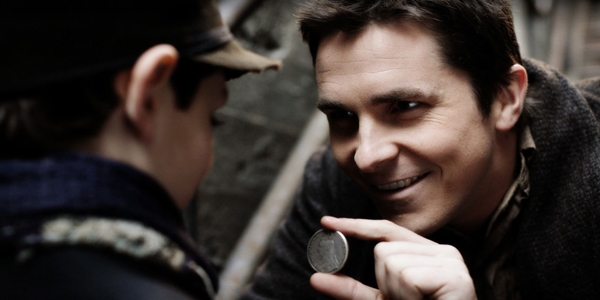 When Sarahs nephew asks of the bird early on in the movie wheres his brother? this is a clear foreshadowing of the fact that Borden has a sibling. Also Borden can spot the oriental magicians ruse so easily (This is the trick! he says of the magicians limp and seemingly feeble visage) because his own trick it has so much in common with his own trick. This is also why Borden is insistent that no one can perform his trick (No one can do my trick!)- because of the special circumstances (the twin) and the fact that he has channelled his entire life and energy into the secrecy necessary to pull it off. Olivia tells this to Angier: He lives his trick! Yet Angier will not believe her, even though she explains that there are items unaccounted for backstage such as wigs and props (which Angier, in his growing obsession, believes are all part of Bordens scheme of misdirection). Borden even admits the trick to Root, Angiers double. When Borden tells Sarah he loves her, and she disagrees, this is because on that day the Borden who loves her is playing the role of Fallon. Fallon also has to wear gloves to hide the fact that he is missing the same fingers as Borden (and when these fingers are cut off, Sarah cannot understand why they are bleeding again). Revealingly, when Sarah says shes pregnant, Bordens response is Thats great, we should have told Fallon. Borden reacts in this peculiar way because Fallon was actually the father! Perhaps the biggest clue of all is when Borden says to Fallon whilst in prison You were right, I should have left him to his damn trick. Im sorry. Im sorry for a lot of things. Im sorry about Sarah We can see then that at this point of the film the twin playing Fallon was the one who was in love with Sarah. I should have left him alone harks back to a point several minutes earlier in the film, when the twin dressed as Borden insists that Fallon is to leave Angier alone. The twin then playing Borden who said leave him alone is now the twin playing the role of Fallon.
2. Angier
 Many of the clues related to Angier are laid out in the opening prologue: the opening shot of multiple top-hats indicates that Teslas cloning machine does in fact work; Angier is using blind stage-hands so that they will not be able to see the drowned duplicates and report any ominous occurrences to the authorities; additionally we have the prologue shot of Angier drowning (and the key final shot of the movie showing one of the dead drowned duplicates which confirms everything). There is also the curious comment that Tesla makes to Angier when he begins to understand his intentions: Have you considered the cost? The cost he is referring to manifests itself as the process of perpetual murder- effectively killing oneself night after night would take its toll. I called Teslas machine a cloning machine above, but I dont think that clone is an apt term for the copy of Angier that is created, because of the pejorative implications the word carries. Teslas machine duplicates Angier, so in essence both men are the real Angier. Consequently both Angiers are governed by the same all-consuming obsession, narcissism and the desire to be the man on stage during The Prestige, which is why Angier can never allow a copy to live. He is unwilling and unable to make the sacrifice that Borden has made, effectively taking a shortcut, and this is the cost that Tesla refers to. One element I find fascinating in this paradoxical ritual of sacrifice and rebirth is the fact that the duplicated Angier who appears on stage during The Prestige will never actually have the memory of being the man drowning in the water cell. From his perspective he has stepped into the machine a set number of times and has come out alive the same number of times. From the perspective of the drowning Angier it will be the first time he has drowned each night but he will never be able to relate the abject horror of his death to the other Angier: the memory dies along with the drowning man. This is why Cutters admission of the true horror of drowning (he said it was agony) is devastating to Angier, since his only solace in his uninterrupted string of murders was in falsely believing that drowning was like going home... (a lie Cutter had uttered initially in order to ease Angiers pain in relation to the manner of his wifes death). **The list of clues is by no means exhaustive- I am happy to discuss additional clues in the comments below.
1. Key Themes

Secrets are my life - Borden to Sarah
Nolan explores and dissects The Prestiges key themes of secrecy, obsession, duality, rebirth and sacrifice against the backdrop of the gradually escalating tension and animosity between the two magicians. The initial tension between the two stems from the fact that both seem to recognise that, though Borden is the greater magician, Angier is the better showman. This rivalry spirals out of control though after the accident with Angiers wife and the water cell. Many movies have their narrative buoyed by portraying both an out-and-out hero and villain, but its key to Nolans vision here- certainly for the first two thirds of the movie- to portray both leads as antagonist and protagonist, since their drive for glory has eroded their morality and destroyed not only their own lives but the lives of the ones they love too. Its another clever example of Nolans use of ambiguity. The magicians embody the motif that great art often comes at a cost of terrible sacrifice- Borden lives a double life, whilst Angier not only hides his true aristocratic origins but commits murder every night (perversely via the same method which claimed his wife's life). After his wife dies, Angier begins to realise that the true way to beat Borden is to become the seemingly better magician- this will destroy Borden more than mere sticks and stones. He relentlessly and obsessively embarks on this task, willing to stop at nothing to ensure his success, figuratively and literally destroying himself in the process. Tesla helps in this task, and its difficult not to see the animosity between the two magicians as being representative of the real life rivalry between Nikola Tesla and Thomas Edison. The concept of twins, pairs and duality is central to the movie too. Angier represents the upper-class with Borden representing the working-class. Bordens key to his Transported Man trick is the use of a twin. Likewise, in a rather warped symmetry, so is Angiers- since Teslas machine duplicates him- effectively creating a twin each time it is used. Ultimately the viewer sides with Borden because we realise how depraved Angier has become: Angier has slowly poisoned his humanity and diluted his soul each time he used the machine and murdered his duplicate. This is in stark antithesis to the twins who effectively reaffirm their humanity by the use hard work and natural sacrifice (compared to Angier's enforced sacrifice). Refusing to take unnatural shortcuts in the way that Angier does ultimately leads to the victory of Borden over his rival.