Why Hellboy Failed
Behind-the-scenes disputes and actor meltdowns are just the beginning...
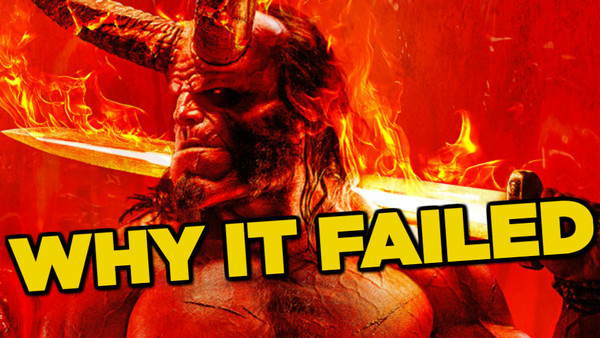
The Hellboy movie franchise has never had a smooth ride. The comics themselves have such a die-hard fandom, and Guillermo Del Toro’s two adaptations received similar love, with a third instalment being one of the most sought-after sequels of the early 2010s.
Sadly, that project was never to be, but the blow was softened with the announcement that a new Hellboy movie was on the way - this time a full-on reboot, with a hard-R rating and the grit to do the character justice.
And for the first few months of production, the project made all the right moves. Stranger Things’ David Harbour was an inspired choice for the titular role, and the first poster showing him in full costume blew everyone away.
Neil Marshall seemed like a great choice of director as well - known for his blistering action and mad prior cinematic achievements. It looked like the filmmakers were getting everything so right.
But, as it turns out, they absolutely did not get it right. Currently, Hellboy is sitting on a 9% Rotten Tomatoes score, with plenty of critics declaring it as the worst film of the year. So, only one question remains:
How did it all go so terribly wrong?
6. A Clash Of Creatives

One of the biggest issues, as is often the case with big superhero movies like this, was trouble behind the scenes. Thanks to an exclusive investigation into the film’s production from The Wrap, we know that shooting the picture was just as hellish as the visuals audiences eventually got on screen.
A major cause of friction seems to have been the war for creative control that was going on behind the camera. Although Neil Marshall was there as the director all the way through shooting, he wasn’t the only one calling the shots, and he allegedly butted heads with producers Lawrence Gordon and Lloyd Levin at every stage.
According to unnamed inside sources, Levin would interrupt Marshall’s rehearsals with the actors, undermining his direction and even giving the performers different orders, essentially resulting in a bunch of wildly different characterisations.
The conflict between the director and the producers eventually became so toxic that, according to The Wrap’s report, it culminated in the producers having Marshall’s longtime collaborator and cinematographer, Sam McCurdy, fired. Though unconfirmed, those close to the set said the sacking was a power play to let the director know he wasn’t in charge.
5. The Botched Performances

Obviously, this kind of on-set environment isn’t conducive to making a good movie. The Wrap even reported that these tensions boiled over into the cast, with David Harbour allegedly storming off set after calls for more takes from Marshall.
The clash of visions between the producers and the director evidently made its way to the screen, and can be seen right back in the first trailers for the blockbuster, with the tone clashing with the marketing and set photos that had been released before then.
Still, it’s unclear who’s to blame for the actual performances in the movie. While Harbour is pretty good as the title character, it might just be because everyone else around him is really bad.
I genuinely love these actors; Milla Jovovich is always fun to watch, Sasha Lane is incredible in American Honey and Daniel Dae Kim is similarly always solid. Here, though, it’s like they were set up to fail.
Not only are the lines they’re delivering impossible to sell without sounding a bit dumb, they’re all delivered in some of the worst British accents I’ve ever heard. At least Ian McShane and David Harbour are having some fun, but some of the other actors feel like they’re from a different movie altogether.
4. Rewrites And An Aimless Script

Next up is something which happens on a whole bunch of movies - although some deal with it better than others. Again, according to The Wrap, the script was undergoing significant rewrites while production was in full swing. The details are admittedly a little iffy on this one, as the website's sources indicate that pretty much everyone was contributing to the screenplay, including stars David Harbour and Ian McShane, while Martin Singer - Lloyd Levin’s attorney - provided a response downplaying the revisions, claiming that only a few scenes were altered and the actors didn’t touch the script.
Either way, the screenplay ended up being baffling inconsistent, lacking clarity, and making it confusing to know what characters actually know at any given moment about the plot. So much is crammed into this film that it at once feels far too bloated yet far too simple.
The endgame of Milla Jovovich's villain is just… be evil, while Hellboy himself kind of has an arc, with him wondering whether or not humans should be killing monsters, but it comes out of nowhere and the conflict lasts for about 5 minutes of screentime.
That’s kind of a problem with the script in general; there doesn’t seem to be any long-term plan, just isolated scenes that don’t sustain drama for more than five minutes. Factions are introduced and killed off before you get a chance to know or care about them, while moments of peril are solved within seconds.
This problem could be down to how the filmmakers handled the source material. So many volumes of the comics are squashed into this story, and while it pays lip service to them all, none get the focus they deserve.
3. The Humour Never Lands

Away from the rewrites, there's also another problem with the script: it’s painfully unfunny. There are some jokes that land, and an always great delivery from David Harbour sometimes manages to make you laugh even when the material doesn’t deserve a chuckle, but there’s so many one-liners packed into this thing that undercut any tension.
Hellboy’s wacky sidekicks are particularly bad for this, always cracking these terrible, terrible jokes in baffling British accents.
And then there’s the meta humour, which is half-heartedly thrown in seemingly just because Deadpool did it and Deadpool’s popular, right? It’s the kind of film that thinks just swearing is funny - and it will make you appreciate all the films it was inspired by, like Deadpool, which managed to do this brand of comedy so much better.
2. The Editing Is Shocking

The film’s edit is also a major reason why it's faceplanted so hard. Like Suicide Squad, from moment one the flick bombards you with exposition, characters and world building in such an uninspired way - obviously all to the tune of the very best indie rock tracks 2011 had to offer. The opening prologue in particular makes a bad first impression, delivered like one of those fake trailers for movies-within-movies. For a second, I genuinely thought that’s where they were going to go with it.
The film never stops to breathe, jumping around at a breakneck speed, introducing key players but never giving you a reason to care for them or understand who they are. It’s frustrating, because when the film does get a chance to slow down and actually let its characters interact, it shows real flair and highlights the potential of what could have been - particularly one strong sequence in an alternate dimension.
Unsurprisingly, this might also be the fault of the struggles between the directors and the producers. The Wrap reports that Neil Marshall, after finishing the movie to meet his vision the best he could, delivered a cut of the picture to the studio - which, the producers threw straight in the bin. In response, Singer again pointed out that Marshall wasn’t promised final cut on the movie - which admittedly a lot of directors do not get on major studio pictures.
However, The Wrap reports that even little things - like the design of a tree that recurs throughout the movie - became a source of contention between these two parties. Allegedly, Marshall wanted something a little more realistic, asymmetrical and normal, which Levin changed to something more surreal and symmetrical. But then, in post-production, Marshall changed it back once more.
The fact that the design of a tree became this war of attrition is indicative of just how broken the creative process was, and why a lot of the more promising features that made it into Hellboy feel compromised, unexplored, and haphazard.
1. Even The Action And CGI Don't Hold Up
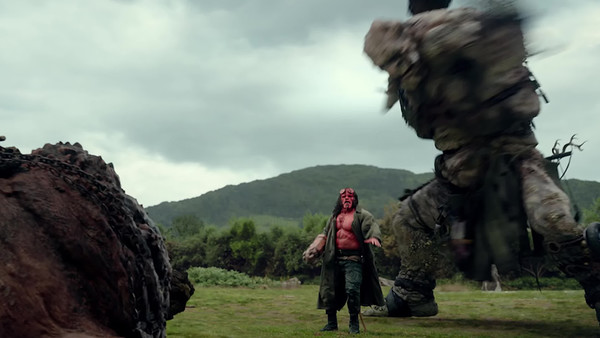
These post-production woes could also explain Hellboy's poor action and shoddy CGI. There are flashes of some inspired superhero bouts in here, with a fight against a group of giants being a particular highlight. In this scene, it actually feels like a set-piece that had been planned out, storyboarded and prepared for maximum impact. Unfortunately, this is an anomaly, and the vast majority of the action comes across like it was handed off to the second unit, choppily edited together with poor effects work that muddies the flow of the battles and, at times, even makes them difficult to follow.
The CGI in general is kind of terrible as well. One emotional moment right at the end is hampered by this Scorpion King-esque render of one of the characters. It’s frustrating because there’s some really great physical prosthetics work in there; Hellboy looks awesome, and some of the monster designs are so well realised. It’s just when these real animatronics and the make up gives way to the CGI, which sometimes even looks a little unfinished.
And that’s the most annoying thing about Hellboy. There are brief flashes where you see the film it could have been. That said, while executive meddling no doubt didn’t help the end result, I don’t know if it would have been a great film even if Marshall had full creative control - there's just too many issues at the core of it.