10 Great Video Games That Should've Started Franchises
Even though sequels to these games would be welcome, it never happened.

To survive in the turbulent gaming industry, studios can't just release successful games, but successful franchises.
Even though Pokemon, Call of Duty, and The Sims games can be hit and miss, their marketability and recognisability has allowed them to thrive for decades. And when consumers demand more of a specific IP, it's no surprise when it leads to an avalanche of sequels and spin-offs.
Now, that's not suggesting every video game has to be turned into a series. Although Grim Fandango and Shadow of the Colossus were incredible, there was no need for a follow-up, since these self-contained stories tied up every loose end.
But when a video game is well-received, highly creative, and has potential to grow, it's practically begging to be franchised. The ten entries on this list never went beyond one game, despite brimming with potential. Due to the unique premise, gripping story, or creative mechanics, it's scandalous - even criminal - how certain games never spawn a single sequel.
Rather than releasing a Star Wars title for the 4,000th time, it would be nice to see a lot more of these singular games.
10. Darkwatch

In High Moon Studio's first-person shooter, you play as a vampire gunslinger called Jericho Cross, who's tasked by the Darkwatch organisation to dispose of undead beasts.
Even though Darkwatch could've been a run-of-the-mill shooter, there were elements that elevated the supernatural cowboy title over its competition. It successfully juggled steampunk, horror, and spaghetti western styles into a cohesive story. The world-building is explored subtly, so it never feels forced or vague. There was also a lot to expand upon in later instalments, especially surrounding the institution Jericho works for.
Interestingly, the developers always intended Darkwatch to launch a series, with every follow-up set in a different period, like the Crusades and World War II. Head designer, Paul O' Connor, stated in an interview with DreadCentral that each entry would expand on the Darkwatch organisation, from "its origins in Roman times to its ultimate fate in Earth's future".
A tech demo of Darkwatch 2 was released at Games Developers Conference 2006, indicating the franchise was moving forward. And when a film adaptation was announced, Darkwatch's future seemed secure.
But after the company merged with Activision, all work on Darkwatch was put on hold to focus more on licensed games.
9. Return Of The Obra Dinn

Although deduction titles like Ace Attorney and Professor Layton could've been one-and-done, they've blossomed into successful franchises that are still going strong years later.
However, there's another detective game that could theoretically become an ongoing series. In Return of the Obra Dinn, you play as an investigator who must determine the fate of a ship's missing crew. Using a magical pocket watch, you can travel to the moment of each crewmember's death to uncover the truth.
Although the 1-bit monochrome art, sound design, and voice-acting is 10/10, it's the concept that leaves the biggest impression. Even though the mechanics are masterfully utilised, there are countless other scenarios it could be used for. It'd be intriguing to see this detective investigate a mystery in a ghost town, a haunted mansion, or a prison. Rather than sticking with one setting, the protagonist could visit numerous places, adding variety to the gameplay.
New mechanics could be incorporated, including fast-forward, rewind, replay, or zoom to find clues. You could also interact with people in the past, but be limited in your actions to avoid time paradoxes, creating a strategic component.
Although the creator, Lucas Pope, stated he has no interest in devising a sequel, seeing more of this property would be a delight.
8. Vanquish

Developed by PlatinumGames, Vanquish was a kickass title that combined high-octane combat, cover-based shooting, acrobatic gameplay, and kinetic pacing.
At the time, the third-person shooter genre was overcrowded with titles like Uncharted and Mass Effect, so it was no surprise when Vanquish didn't do great financially, despite receiving solid reviews. PlatinumGame's other major title, Bayonetta, sold well the previous year, so the company decided to focus on that series over Vanquish.
It was a sensible decision, but it doesn't seem fair, considering how revolutionary Vanquish's gameplay was. It beautifully incorporated bullet hell and beat 'em up mechanics, which was a rarity in 3D shooters at the time. The boost-slide, which allowed players to jet around the battlefield at breakneck speeds, was a breathtaking mechanic, which is just as exhilarating and addictive now as it was when Vanquish was released.
Though the political tension and space warfare themes were touched upon, there was a lot more to examine. Sam Gideon felt like an archetypal hero, so it would've been nice to see him fleshed out in future stories.
There's never been any serious buzz about Vanquish being turned into a franchise, but it would be nice to revisit.
7. Death's Door

The isometric action-adventure title follows a soul-reaping crow who works for a bureaucratic afterlife agency. When a soul is stolen, the Reaper sets out to reclaim it.
Though Death's Door draws heavily from The Legend of Zelda, it never feels derivative. Acid Nerve's wonderful game boasts rewarding combat, innovative puzzles, and precise gameplay. The enemies are tough as nails but they telegraph their attacks, so battles always seem fair. Death's Door has an amazing ability of being simultaneously silly and poetic, utilising goofy humour one moment before reflecting on the collective demise of all living things the next.
But much like the lives The Reaper extinguishes, the end of Death's Door comes too soon. The game only offers three dungeons, which is a shame, since there is so much that could be expanded upon.
Sequels could explore different aspects of the afterlife, including mythologies from different cultures. A prequel centred around how The Reaper's agency came to be would be interesting. The final boss is so intriguingly cryptic, you could make a whole game revolving around him.
Even though The Reaper only has a few abilities, the developers provided a huge variety in combat and puzzles. As a result, it'd be fascinating to see our avian hero have more powers and more elaborate puzzles to deal with.
But since there's no word of a sequel, we may never know.
6. Call Of Cthulhu: Dark Corners Of The Earth

Even though H.P. Lovecraft is renowned for his cosmic horror stories, transitioning his work into other mediums has never been easy.
With that said, Call of Cthulhu: Dark Corners of the Earth came close. Headfirst's ambitious title follows a private investigator who uncovers a conspiracy involving cults and ancient inhuman civilisations.
Call of Cthulhu was a bold project since it juggles action-adventure, first-person shooting, and stealth. Rather than adapting one Lovecraft tale, the horror survivor game effectively implements elements from various stories. Though Lovecraft is niche, Dark Corners of the Earth was surprisingly accessible for players unfamiliar with the author while still remaining true to the source material.
As promising as all this sounds, Call of Cthulhu: Dark Corners of the Earth tanked and Headfirst went bankrupt months after its release. This was disappointing since the developers intended to release two follow-ups. The first sequel, Tainted Legacy, would've continued the mythos from a contemporary perspective. The final chapter, Beyond the Mountain of Madness, would serve as a direct sequel to one of Lovecraft's most famous stories, At the Mountain of Madness.
If the sequels came to pass, it could've helped H.P. Lovecraft's become more mainstream.
5. Singularity
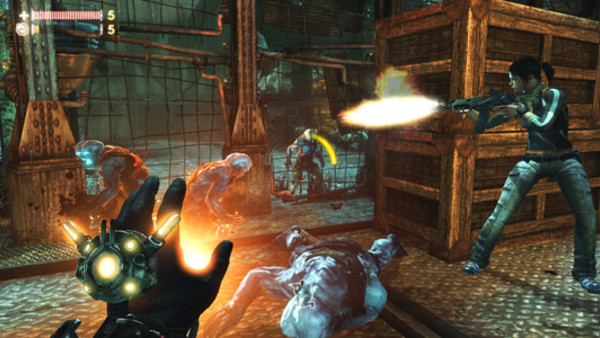
There are two key components that should be taken into account when turning a game into a brand - innovative mechanics and world-building.
Fortunately, Singularity had both aspects in spades. Raven Software's horror shooter centres around a secret Soviet device called the TMD that manipulates the flow of time.
Throughout the main campaign, players travel between the 1950s and modern times to wage war against mutated creatures. Using the chronological gizmo, you can move objects and enemies backwards or forwards in time, holding them indefinitely. The timey-wimey gadget could be used to solve puzzles and create paths by removing rubble or fixing collapsed bridges.
Despite having legs to grow as an ongoing saga, Singularity was overshadowed by other releases at the time, like Red Dead Redemption and Call of Duty: Black Ops (also developed by Raven).
The game's failure was frustrating since the time-travel aspect offers endless possibilities. Not only could the sequels take place in virtually any era, they could centre around alternative timelines, since the time manipulation can change any event in history. The TMD's abilities could be upgraded in later instalments, so it could create time-loops, heal wounds, age enemies to death, or fast-forward the action.
If Singularity didn't come out at the wrong time (no pun intended), it could've launched a thriving series.
4. Gorogoa

Since being founded in 2016, AnnaPurna has published or developed many imaginative and emotionally-rich indie titles. Even though the company is better known for The Outer Wilds and Stray, one gem that deserves more attention is Gorogoa.
Gorogoa is a tile-based game where players manipulate a 2x2 grid of illustrated panels. By zooming in and out, overlaying panels, and aligning different scenes, you can solve pattern-based puzzles and create new paths.
There's no instructions or hints, so it's deeply satisfying when you figure out something by yourself, especially since puzzles can only be solved through deduction rather than chance.
As wonderful as Gorogoa is, the whole thing can be completed in under an hour, leaving players hungry for more. Although a sequel would be appreciated, there's no suggestion that will happen.
But due to the unique concept, it''s sad to see the world of Gorogoa end after a single entry. Sequels could retain the frame-shifting mechanic but expand the story, world, and mechanics. There could be additional grids or more interconnectivity between puzzles, adding another level of complexity.
But considering Gorogoa took six years to develop, the chances of a sequel, not to mention a franchise, coming to fruition is unlikely.
3. Split/Second

There are plenty of racing franchises that focus on smashing into opponents, such as Twisted Metal, Burnout, and Mario Kart. With that in mind, it was risky when Black Rock Studio threw their hat into the ring with their own racer, Split/Second.
Although the game could've been a carbon-copy of other chaotic driving titles, Split/Second stood on its own, thanks to its inventive gameplay. Drivers take part in a reality TV show where they trigger explosive events to alter the track and sabotage opponents. By tripping switches, you can take drivers out with booby traps, block off roads, or collapse bridges. This adds a tactical layer to races since players have to adjust their strategy accordingly if the road ahead is compromised.
Although the traps sounds gimmicky, it stops the gameplay from getting repetitive. The track-altering events means no two races feel the same, offering a ton of replayability.
Even though racing fanatics would love to see more of Split/Second, it doesn't look like it's going to happen any time soon. Due to the studio's closure and poor sales, the intended sequel never saw the light of a day.
2. Bully

One Rockstar property that players are desperate to see getting resurrected is Bully. The open-world action-adventure title follows a teenage misfit called Jimmy Hopkins who must navigate the social hierarchies of his school.
Although Bully was a great game on its own, it opened the door for so much more. Later instalments could focus on Jimmy falling back into his thuggish nature in a different school or environment. Follow-ups could take place in the future, with Jimmy in college or as an adult. The franchise could take the spin-off route, focusing on a different character but maintain the same themes and mechanics.
Over the years, there've been rumblings of a Bully sequel again and again and again, but they never come to pass.
Be that as it may, gamers shouldn't be ready to give up. Not only does Bully still have a strong fanbase after almost 20 years, it hasn't lost a shred of is relevancy in the modern world.
In fact, the concept is more applicable nowadays than when the game debuted. Thanks to the internet and social media, bullying is sneakier and more tactical than ever. As such, a modern Bully game would work well now without being a retread of its predecessor.
1. Eternal Darkness: Sanity's Requiem

Silicon Knight's enthralling horror ticks almost every box needed to manufacture an enduring franchise. It has a complex storyline that spans centuries, a dozen characters to play as, and a diverse variety of weapons, spells, and locations. (Also, the magnificent soundtrack never gets enough credit.)
Of course, Eternal Darkness' most memorable feature is the Sanity Meter. Encounters with demons and monsters causes the heroes' sanity to diminish, triggering hallucinations. These visions can be extremely meta, convincing players the game has reset, the disc is broken, or their memory card has been wiped.
The ending reveals another malevolent evil will soon awaken, indicating a sequel was on the horizon. Even though a follow-up and a spiritual success were heavily considered, neither of them materialised. Even if another instalment didn't tie directly with its predecessor, there are so many ideas this property can explore.
Although the Sanity Meter was the standout feature, the mechanic has so much untapped potential, especially with how different gaming is nowadays. By pretending the controller is dead, their internet is down, or the console needs a system update, there are many ways a modern sequel could mess with players' heads without pulling the same tricks as before.
Unfortunately, all crowdfunding for a continuation has failed, so Eternal Darkness' future doesn't just look bad but non-existent.