10 Video Games Better Than The Sum Of Their Parts
Two wrongs don't make a right, but three or more totally can.

At the climax of the 2024 Game Awards, previous GOTY winner Swen Vincke gave a standing-ovation worthy speech about the formula for creating a Game Of The Year contender (essentially, "don't treat your employees like dirt and your customers like suckers").
It was a powerful speech, and it prompted the thought: What else makes a great game?
As well as the outside factors Swen focused on, what happens in the game itself is obviously crucial to how its perceived by the player. If a game is well made, well written and consistently fun to play, then it'll clearly be in with a shout come awards season.
But what about those games that botch nearly every one of these factors, yet still manage to leave the player with a smile on their face?
This article will take a look at games that screw up many of the fundamentals of game design, assaulting the player with a hodgepodge of poor graphics, badly executed core mechanics and nonsensical writing - sometimes all three. Yet somehow, each title on this list transcends their base ingredients to create something miraculous. And few games exemplify that concept better than the first entry...
10. Sonic Frontiers

The above photo is one of the first images SEGA released of Sonic Frontiers. As a statement of intent it works well, showcasing the large, open areas that Sonic would be exploring in his largest ever game.
What the photo doesn't show, however, is the incredible amount of jank the blue hedgehog would come across in almost every step of his journey.
Even after two years of updates, Frontiers still feels like a working prototype for an open-world Sonic game rather than an actual finished product. Graphics pop in with a frequency that would shame the N64, Sonic's movement is somehow too sticky and too loose, and the Cyberspace levels are a haphazard jumble of assets from previous games that feel like they were put together by a hungover AI.
Yet, when you're just exploring the world, all those problems melt away. Zooming around Sonic Frontiers' open areas gives the best impression yet of what it would be like to actually be Sonic, and there's a simple, pure joy in just bombing across the map at ludicrous speeds. It's perfect podcast gaming, something you can just switch on and enjoy the vibes to while your brain learns about the agricultural yield of 1970s Kentucky.
As a game, Frontiers is a buggy, frustrating mess. But as an experience, it's utterly compelling.
9. NieR

The original NieR felt like a cult classic the instant it launched in 2010 - unpolished, ugly yet bursting with so much creativity you loved it in spite of itself.
Having said that, there are times it feels like NieR is daring you to even tolerate it, let alone love it. Even the recent remake couldn't paper over its most glaring cracks - the bland open world, the tedious dungeons, the achingly slow introduction. This is a game that hides its charms well, but once you fall for them you're rewarded with an experience you'll still be raving about fifteen years later.
NieR is a game of moments that transcend the rote gameplay that surrounds them. The thrilling battle against Jack of Hearts (still the best giant boss fight in any game that isn't Shadow of the Colossus); the Resident Evil homage in Emil's mansion; the surreal visual novel segment... these are just a handful of NieR's greatest hits, with each level, boss and plot point further enhanced by a soundtrack that deserved to turn composer Keichii Okabe into a household name.
It's NieR's moments of magic that will stick with you after you put down the controller for the last time, and they're worth every second of mundane temple trudging and simplistic button-bashing combat. And hey, the remake takes care of the latter problem!
8. Fallout: New Vegas

Just look at that screenshot. Beige, beige as far as the eye can see.
It's fair to say Fallout: New Vegas isn't winning any awards for visuals. Or, indeed, gameplay, as New Vegas' combat is as clunky and unsatisfying as you'd expect from an RPG developer's first attempt at making a game where you shoot things in the first person (someone really should come up with a name for those).
Yet despite these drawbacks, New Vegas is routinely championed as the best Fallout game, and with good cause. New Vegas is a staggeringly generous RPG which only Baldur's Gate 3 has subsequently surpassed in terms of open-ended quest design. Seemingly every major and minor quest can be finished in a myriad of ways, and even your companions aren't safe from your poor decision making (Sorry Cass - how was I to know that arranging a face-to-face meeting with your guarded, heavily armed nemesis would end badly?)
Factor in some of Fallout's best ever quests ("Beyond the Beef" being a particular highlight in writing and player choice), as well as the series' best ever main plotline, and you can see why so many players overlooked New Vegas's less-than-glamourous facade and settled themselves in to experience the best show in town.
7. Deadly Premonition

There are some moments in video games you never forget. For this writer, one of them was loading up Deadly Premonition on the XBox 360, seeing the opening cutscene start and thinking "Good grief, did this start life as a launch title for the Dreamcast?"
Low poly trees, boxy cars and protagonist Francis York's stretchy-faced character model gave the impression of a game that started development in the late nineties and wound up trapped in development hell for 10 years. This feeling persists in the game's opening act - a combat-heavy corridor crawl that feels like a programmer was told to copy Resident Evil 4, but was only given a grainy, 20 second YouTube clip of Capcom's masterpiece to take inspiration from.
Yet once Deadly Premonition opens up and lets you explore its world, all is forgiven. Set in the Lynchian town of Greenvale (one of the side quests is literally a sub-plot from Twin Peaks), Deadly Premonition's cast of misfits carries the game. From the shy, retiring Detective Thomas to the gas mask donning millionaire Harry Stewart, Deadly Premonition does a fantastic job making you care about its core cast so that when the knife twists, it hurts in the way all the best stories do.
Much like the David Lynch work it takes inspiration from, Deadly Premonition asks you to look past the surface and appreciate the beauty, fragility and tragedy of the people at the core of its story. That it succeeds in evoking the legendary director's spirit so well is testament to the remarkable work done by director SWERY and his team.
(RIP David Lynch, and thank you for inspiring this and countless other works. The world is a more interesting place because you were in it).
6. Shenmue

Shenmue may have wowed the world back in 1999 with its unprecedented level of graphical realism, but those who actually sat down to play SEGA's open-world innovator definitely needed time to adapt to the game's idiosyncrasies.
Despite billing itself as a martial arts epic, Shenmue's pace is as laid back as the sleepy rural suburb of Yokosuka in which it takes place. As protagonist Ryo Hazuki, most of your time will be spent playing capsule machines, petting cats, hanging out at the arcade and quizzing the appallingly voice-acted locals (at least in the English dub). The actual martial arts part of the equation is barely a factor, with Ryo only getting into a handful of fights across the course of the adventure.
Yet Shenmue's glacial pace and barely-there plot has its own unique appeal. Shenmue's obsessive detail with minutiae, and its obsession with clock watching (each inhabitant follows a schedule you need to keep track of) make it feel like a prototype for today's life simulators. Collecting trinkets, hanging out with kooky citizens, keeping track of the time - it's like Animal Crossing, except set in real life. (A theme SEGA returned to with Like A Dragon's Dondonko Island).
Treat Shenmue as less of a game, and more of a chance to simulate life in eighties Japan, and you'll walk away treasuring one of gaming's most unique experiences.
5. Earth Defense Force 2017
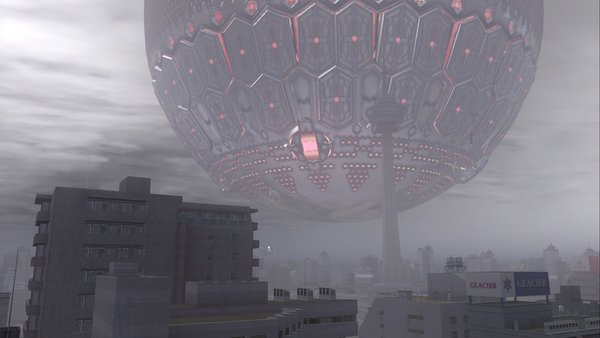
Earth Defense Force 2017 may not have been as prescient as the previous entry - its eponymous year passing with nary a hint of alien invasion - but what it lacks in foresight it makes up for in sheer batsh*t exuberance.
EDF 2017 is a riotously entertaining bug hunt that still feels fresh today. The Earth Defense Force franchise was almost entirely unknown in the West upon EDF 2017's release, but the third entry in the series soon converted a generation of gamers to the series' goofy charms.
Well, it did once they managed to see past the game's ramshackle presentation. Even for a game released in 2006, EDF 2017 looks dated, with cities that look like they were made out of paper mache and hordes of poorly animated insects jittering around like monsters in a Ray Harryhausen film. Not to mention the seemingly limited gameplay - you run, you gun, and that's your lot for the 53 mission campaign.
But EDF 2017 succeeds by making a virtue of its limitations. Those paper mache cities are just as fragile as the building material they resemble, crumbling under fire to create wonderfully tactile battlegrounds that sell the scale of the battles you engage in. The hordes of enemies may look crude, but that just means the developers can cram dozens of the buggers on-screen to rush you at any given moment.
And although the campaign may be little more than blam-blam-kill-kill, EDF 2017 does a great job of doling out different armaments and enemy types across the breadth of its campaign, creating an ever-increasing crescendo of ludicrous cartoon violence that keeps you grinning ear to ear.
EDF! EDF! EDF!
4. Metal Gear Solid 2

Raiden's journey across the Big Shell (the offshore facility the majority of the game takes place in) is blighted by Kojima and co's tendency to throw every idea they have into the game.
Have the player wave a microphone around for ages to listen to a conversation? Go for it! Turn into a platformer for a bit, despite woefully inadequate controls? Why not! These constant gimmicks and distractions utterly wreck the pacing of the game, turning what started as an enjoyable stealth title into a barrage of shallow, mostly tedious faux-minigames.
Yet, in spite of itself, the second Metal Gear Solid is still worth playing today.
As a technical achievement, MGS 2 is still an astonishing piece of work. It's opening Tanker level is arguably worth the price of admission alone, just to admire how Kojima and his team pulled off such a stunning piece of engineering on the PS2's architecture. Plus, time has only proven its story to be terrifyingly far-sighted, as the AI-led dystopia that fuels MGS 2's plot feels less like science-fiction and more like reality every day.
3. Wanted: Dead

To play Wanted: Dead is to touch the face of a god who has gone mad.
You will not have experienced it before.
You likely won't ever again.
But you will remember it.
Oh yes, you will remember it.
In weeks, months, years to come you will remember it as a fever dream - a paradoxically short six hour game, that seems to stretch into infinity with endless, endless corridors of identikit soldiers and ninjas waiting to be massacred by you and your crew. And oh, that crew! From player character Agent Stone, who sounds like a concussed Tommy Wiseau with exactly as much acting ability, to... actually, you won't remember anyone else's names.
But by God you will remember their actions. Putting in a bizarrely lengthy breakfast order; telling the world's most nonsensical joke in a lift; a tone-deaf rendition of 99 Luftballoons; consuming endless bowls of ramen in an overly elaborate, one-off mini-game; conversing with seemingly important NPCs who drop out of the plot as soon as they're introduced...
Wanted: Dead is terrible. Wanted: Dead is incredible. Wanted: Dead cannot be recommended to anyone, and should be played by everyone.
You will love it. You will hate it. You will never, ever forget it.
2. The Elder Scrolls IV: Oblivion

Ah, Oblivion. Your NPCs look like they were carved from turnips. Your writing is bland, poorly delivered and riddled with errors. Your combat is clunky, your bugs are plentiful, and you have been surpassed by nearly every open-world RPG released in the 19 years since your launch.
But damn it, there'll always be a special place for you in gamers' hearts.
Oblivion is the perfect example of a game whose mistakes are just as important as its flaws, its janky charms playing a huge role in its enduring appeal. If it looked good, where would be the appeal in searching for its ugliest NPC? If it ran well, how could we enjoy moments of comedy like seeing the Imperial Guard fail to navigate a boat (as well as the laws of physics)? If its NPCs were less brain-damaged, would it have stopped the same hilariously inane conversation about mudcrabs being repeated across every settlement in the game?
The upcoming Oblivion remake may smooth out the game's ragged edges, but if it does it's hard not to imagine the game will lose an important part of its soul in the process. Hopefully Bethesda leave a few blemishes in place once they're done slapping make-up on one of gaming's most adorkable pigs.
1. Indiana Jones and the Great Circle

A one sentence review of Indiana Jones and the Great Circle would read, "Brain-dead combat, rubbish stealth, incredibly basic platforming - great game."
It's rare to play something that gets so many fundamentals wrong, yet absolutely nails what it sets out to do. Even the imperfections feel like they're paying homage to one of cinema's most ramshackle heroes. After all, what could be more Indy than constantly teetering on the brink of disaster only to somehow pull through?
For every irritating stealth section or button-mashing brawl, The Great Circle pulls you back in with some trademark Indy magic. Most obviously, developers MachineHead Games chose an excellent selection of locations for Indiana's latest globe-trotting jaunt. From the corridors of the Vatican to the jungles of Siam, it's a treat to just soak in the sights as you explore whichever corner of the globe Jones' journey takes him.
Fortunately, the developers also made sure the player has plenty to do other than play virtual tourist. There are a bevy of collectables, satisfyingly difficult puzzles and excellently-written sidequests to stumble on. The latter in particular are aided by another of the game's saving graces - the beautifully acted and directed cut-scenes, held together by Troy Baker's Harrison Ford-approved performance as the titular grave-robber.
As a game, the Great Circle is fundamentally flawed. As an experience, it's as striking and unforgettable as one of its title character's smirking grins (and just as likely to melt your heart a little).