8 Reasons The Video Game Industry Is Headed For Disaster (Again)
The games industry needs to pull its socks up.

Isn't it odd, how games released in today's modern industry are often singled out for not including microtransactions and aggressive monetisation models? It was once the case that triple-A stalwarts like Call of Duty introducing loot boxes would have generated backlash on a cosmic scale, but now? It's a (reluctantly) accepted part of the triple-A market that has wormed its way into normality through desensitisation.
That outstanding games like Breath of the Wild, God of War and Spider-Man, to name but a few, are congratulated for shunning such shady practices shouldn't be an extraordinary occasion, but the norm.
Instead, it's mega-publishers like Activision and EA that have standardised the rules and in doing so, inflated their profit margins with unsustainable growth. The bubble is going to burst eventually, and when that day comes, it'll be the increasingly corporate-minded entities mentioned above that, quite rightly, attract most of the blame for the industry going to hell in a handbasket.
Then again, if BioWare and Bethesda's current trajectory is any indication, they'll both have plenty to contribute to the games industry's headstone. If there's one growing trend that popular opinion hates enough to rival loot boxes, it's being treated as unpaid beta testers for so-called 'triple-A' experiences.
Will Anthem and Fallout 76 achieve their final forms before or after the crash, I wonder?
8. Live Services

Contrary to what the likes of EA and Activision believe, time is not an infinite resource.
Ever since Bungie popularised the model in 2014 with Destiny, publishers have been infiltrating the market with their own alternative 'Live Service' games, vast playgrounds filled to the brim with an unending gameplay loop meant to keep its player base running the hamster wheel until the end of days.
The Division, Anthem, even Ubisoft's flagship single-player series Assassin's Creed: all of them have taken cues from Destiny in pursuit of their own slice of the pie, ignorant of the unsustainable saturation resulting from total homogenisation.
Diminishing returns is all that awaits any of the inevitable copycats to come, as the available pool of potential 'one-game' players shrinks until sooner or later, the bubble bursts. Even for the fortunate few able to sink hundreds, potentially thousands, of hours into several such games at once, familiarity will inevitably lead to fatigue.
Hell, if BioWare's beleaguered Anthem is anything to go by, the downward trend has already begun.
7. Lack Of Regulation

The games industry's continued autonomy is in jeopardy and it has nothing to blame but its own greed.
With monetisation methods growing increasingly aggressive and in-game storefronts peddling content that should otherwise be free of charge in full-price products, certain sovereignties have tired of the industry's own inaction and begun passing its own legislation to curb the current trend.
Both Belgium and the Netherlands have taken steps to ban the sale of digital blind boxes in games like Overwatch and with more taking an increasingly large interest in its affairs, sitting idly by and hoping the problem resolves itself is no longer an option.
The ESRB's so far weak attempt to quiet negativity has done little to halt such monetary aspirations, only adding a blanket term to all titles with in-game purchases, regardless of their severity. It's not enough. Underhanded attempts - as was the case recently with Black Ops 4's post-launch insertion of microtransactions - to bypass initial negativity is just one exploitative example that simply wouldn't be possible if proper regulations were in place.
By all means, continue to ignore the warning signs. If the offending parties don't exercise some self-restraint soon, it'll be done for you.
6. Follow The Leader

There's nought wrong with taking inspiration from other success stories, but when imitation becomes as shameless as that seen with the Battle Royale phenomenon, it's tough not to accuse certain major players of creative bankruptcy.
In truth, that's rarely the reality. The reason for triple-A heavy hitters like Call of Duty and Battlefield shoehorning in their own take on PUBG and Fortnite comes down to faceless investors noting their unparalleled success and questioning why the multi-million dollar corporations they have stakes in aren't following suit.
The result, as if the writing wasn't already on the wall, is a sea of derivative safe bets reluctant to push the genre further with forward-thinking ideas. Activision and EA both have the financial clout to invest in innovation, but why would they bother, when a by-the-numbers knock-off generates a healthy cash flow all the same?
Like most fads, it'll be milked dry until stagnancy creeps in and tossed to the curb in favour of the next best thing to come around.
5. Customers Are NOT Beta Testers

Thanks to the gift that is digital content delivery, returning to the days of a one-time purchase equalling ownership of everything a game has to offer is a pipe dream. The ability to patch, hotfix and add-to an existing base has become the standard form excuse for releasing games in an unfinished state and, really, it's unacceptable.
Ludicrous as it is, to consider the concept of paying full price to watch half a film or read half a book, that's exactly the buyer-seller contract institutions like Bethesda have come to rely on as commonplace practices.
Fallout 76 crashed and burned in a hellfire of its own making upon launch for believing it could get away with charging full retail price for a product that all but the blind could see was fundamentally unfinished.
In lieu of its fall from grace, Bethesda has continued to remedy the mess it made with massive patches and bug fixes, but why, oh why, wasn't the base game simply withheld until these features were ready from day one? Not only could it have saved itself from committing corporate suicide, but justified an otherwise insulting upfront cost.
Customers are NOT beta testers. Stop treating them as such.
4. Unrealistic Expectations

The Call of Duty franchise will celebrate its sixteenth birthday in 2019, no mean feat for any long-running franchise, let alone one that continues to guzzle up cash like there's no tomorrow. Treyarch's latest addition to the illustrious series, Black Ops 4, notched up an eye-watering $500 million within three days of launch, comfortably securing the military shooter's future for years to come, right?
That's a negative, according to Activision's investors. Following the news break, share prices in the publisher continued their freefall, implying that investors weren't impressed with a single video game generating revenue in excess of half a billion dollars, believing it should have made more. To put into perspective how ridiculous that is, Avengers: Infinity War's record-breaking opening weekend gross in the US pulled in $258 domestically and $640 million globally.
Placing the blame on Activision isn't entirely fair, mind. Square Enix, EA and Capcom have all been guilty of the very same practice with the likes of Tomb Raider and Resident Evil 7, both games that, despite attracting overwhelmingly positive receptions, fell short of expectations.
Please, folks, stop expecting sequels to your most popular IPs to outperform what came before based on arbitrary projections.
3. Ignorance Of The Consumer

In light of Blizzard's announcement that Diablo would be moving to mobile for its next instalment, consumer outrage inevitably followed, prompting certain outlets to criticize the loudest of the bunch for being entitled, somewhat glossing over the issue.
Obvious trolls excluded, the genuine grievances longtime Blizzard supporters took with Diablo Immortal was its tone-deaf delivery. De-planting Diablo's traditional PC roots in favour of a move to mobile was always going to cause some friction, but it's the climate in which it was announced that beggars belief. With Diablo 3 already long in the tooth and being left on life support for the last several years, a bonafide sequel is what the existing fan base have been anticipating with each passing BlizzCon. To know that's the case and tease big news for the series, only to announce a mobile spin-off in its stead is a remarkable failure in communication.
The punchline from this entire debacle? Blizzard's already known to be working on Diablo 4. Had it teased the sequel in tandem with the new mobile venture, nobody would have batted an eyelid.
2. Loot Boxes

The coup de grâce of detested industry trends, loot boxes have graduated from ignorable irritants to a detrimental plague on the triple-A industry in a dizzyingly short timeframe, and major publishers show no intention of slowing down with their inclusion, even in spite of certain territories mandating they be outlawed.
Even if the hotly-debated similarities between them and problem gambling is laid to rest for good, that doesn't solve the other glaring issue.
Additional costumes, colours, customisation options, miscellaneous rewards: all of this content, once available as in-game unlocks by performing various tasks, are being consciously removed, repackaged and resold at additional cost to bolster revenue, despite being present on the game you already paid cash-in-hand for.
It's the very same attempt at anti-consumerist practices that Capcom tried with Street Fighter X Tekken when it locked additional characters already present on the disc behind additional purchases, just with a different method of delivery. Loot boxes deserve to be received with the same level of hostility and vilified, especially so, in the case of full-price games.
1. Counter-Productive Management
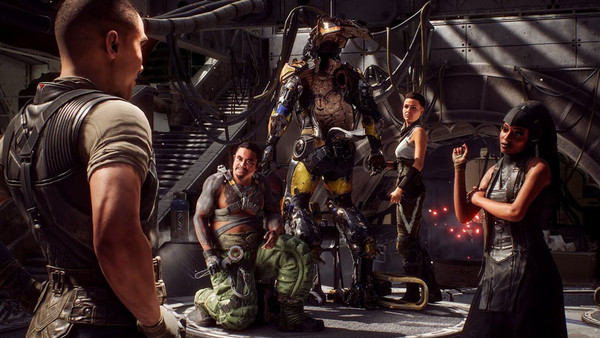
BioWare is braving a storm of negativity right now, over Anthem's lacklustre launch and piecemeal method of content delivery, but how much of its ill fortunes are a direct result of EA's poor choices?
For a studio that forged its reputation on single-player RPGs, Anthem pitching itself as an always-online, multiplayer-focused experience has always been accompanied with a healthy dose of scepticism.
At its core, Anthem shows signs of brilliance; it's the structural mess resulting from inexperience with always online worlds that have attracted the worst of its criticisms. Care to take a guess as to who's idea was it to stretch Anthem's javelin-shaped shell around a live service framework?
EA's made no big secret of its desire to cash-in on the live service model, but why, of all its subsidiaries, did it choose BioWare, a studio with zero experience with how to make an always-evolving online world work, for the job?
Did nobody learn anything from Microsoft's poor judgement call that ultimately resulted in Lionhead's premature closure?
Don't be surprised if, this time next year, BioWare joins the long list of studio closures caused by EA.