8 Video Games That Changed The World
Now you're playing with power.

Can a video game change the world?
Ask that question a decade ago and it would raise eyebrows. Ask it 20 or 30 years ago and you'd be laughed out the room.
Now though? Gaming is every bit a part of pop culture as any movie or book. Arguably more so than the latter in the current climate. Call of Duty's annual releases are damn-near a holiday, seeing social media explode with Doritos and energy drinks as millions take a day off work the world over.
Wii Sports, Fortnite, Pokémon GO - some titles blow up to such insane highs, they become talking points from office water coolers to late night talk shows.
All of this just scratches the surface of how much gaming has infiltrated the public consciousness, and still, I'm only talking about popularity. The two week media cycle (if you're lucky) could rotate through the return of Jesus himself and we'd be back to talking about the next MCU movie like nothing had ever happened.
So, what about influence? Which titles came into our collective lives in such a way, that nothing would ever be the same again?
8. Pong - Bringing Video Games Into The Home

Want to thank one game for popularising the idea of a home console? Thank Atari for making the 2600, and Pong for existing.
Now, gaming historians will point to a tennis-style game with no name, invented by a Brookhaven National Laboratory physicist in 1958 as one of the first video games ever, but nothing made a splash in pop culture quite like 1972's Pong.
Centre of various TV and magazine adverts, the 2600's runaway popularity would go on to feature classics like Pitfall, Asteroids and Missile Command, with Pac-Man speaking for himself.
The whole thing was so successful, it would instead spell disaster for the gaming industry. Following scores of titles rushed to market to capitalise on the craze, E.T. was the straw that broke the camel's back, seeing the public turn on gaming as a medium.
It was thought that video games were a flash in the pan gimmick; not to be taken seriously, and it would take something mighty special to convince the masses otherwise...
7. Super Mario Bros & The Legend Of Zelda - Saving The Gaming Industry In America

Following the debacle and implosion of the Atari 2600, Nintendo saw an opening in the West - one where if they'd only play their cards right; focus on creative visions and quality control rather than making a quick buck, video games could matter again.
Only a year had passed since E.T. was buried in New Mexican desert, but in came the legendary Nintendo Entertainment System, and two immediately memorable franchise-starters: Super Mario Bros., and The Legend of Zelda.
The former was designed with literal pixel-perfect precision to appeal to as many people as possible, with loveable affectations like Mario's moustache, overalls and level aesthetic aiming to create memorability from moment one.
Shigeru Miyamoto wasn't done there though. His next masterwork was The Legend of Zelda, inspired by how his imagination would run wild when exploring the forest behind his old house, and how discovering a cave made him wonder about all the possibilities within.
Both of these games prioritised artistry, the former still regarded as one of the best platformers of all time, and the latter laying down a template for exploration and wonder that's followed to this day.
Brilliantly, Nintendo offered NES units and signage to video game stores for free, only taking a cut if the systems sold. This encouraged outlets to stock consoles once again, and you can thank this whole movement for video games existing in the West to this day.
6. Mortal Kombat & DOOM - Forcing Video Games To Be Rated As Artforms

Once Mario and Zelda had made gaming worthwhile again, the following decade saw a TON of experimentation into macabre subject matter and mature themes.
Gone were the cartoonish mascots of 80s gaming, and in was the blood n' guts brawling of Mortal Kombat, the creepy AF stalker-sim of Night Trap, or the shotgun headshot combos of DOOM.
The only problem? Video games didn't have their own ratings board, and as an overall product, were still thought of as "toys" - something designed for children thanks to all those rounded character models and chirpy sound effects.
Midway's fighting game about ripping out spines or iD's shooter with chainsaw kills certainly didn't fit that description, and with their rising popularity, a whole bunch of parent groups and lobbyists campaigned to have this "filth" removed from their TV screens.
It all ended with the formation of the ESRB - gaming's first officially recognised legal ratings board, and though some thought at the time it would restrict the possibilities of envelope-pushing titles, it legitimised and protected them.
Now games could be seen for what they really were: Artistic creations from creative minds, coding worlds, characters and mechanics in the name of entertainment and expression.
Nintendo set video game viability in motion, and the runaway rebellious attitude of the 90s helped cement it.
5. Space Invaders - Inventing The Difficulty Curve

It's taken decades for things like roguelikes to truly play with the concept of death and checkpoints in video games, as the very idea of challenge largely came from the arcades.
Making a game harder will result in more tries and more money, but why is this even a thing? Why is challenge so inherently connected to video games in the first place?
Well, years before the arcade boom of the early 80s, coder Tomohiro Nishikado was hard at work creating Space Invaders.
Obviously iconic and a staple part of any gamer's diet, the most fascinating part of this game's development came from Nishikado stumbling into the idea of difficulty curves.
Coming from the fact he had to create custom hardware using imported microprocessors from the U.S., when creating the movements of the aliens, Tomohiro noticed the processor would ease up and render more of them faster, the quicker they were destroyed.
The duplication glitch was down to how he was trialling a frame refresh rate, and it combined to create what we'd now refer to as a difficulty curve - where the screen fills up with more enemies to shoot, the more you attempt to keep at bay.
Needless to say, difficulty is a core tenet of gaming as a medium, and it makes you wonder about an entire landscape of tech demos and interact-able elements, without the necessary challenge to really make them memorable.
4. Bioshock - Asking WHY A Character Is Doing Anything

Another fundamental advancement in gaming as a medium, before Bioshock, nobody was asking "Why?"
Why does Sonic want rings? Why can Mario fly with his winged cap?
Any number of titles gave you a hero, a gun or weapon, some enemies, and said "Have at it". And we did.
It was a simpler time, but then came Bioshock, and nothing would be the same again.
Spoilers for Bioshock itself, but that game's biggest twist is realising that the most trustworthy characters in its story - the ones that tell you where to go or what to do - have been lying to you the whole time. Not only have they been lying, but the everyday phrase of "Would you kindly" followed by an instruction was a trigger phrase for protagonist Jack, alongside being something we responded to as players, because why wouldn't we?
Before Bioshock, an unreliable narrator hadn't been done, and especially not like this. In piecing together what YOUR decisions were, vs. those your character would've done anyway, it blew the medium wide open, maturing video game storytelling and giving us even better narratives going forward.
3. Super Mario 64 - Perfecting 3D Space & Revolutionising 3D Camera Control

I can't imagine how insanely hard it must have been to get your head around coding in 3D.
Like trying to understand the fourth dimension or something like Avengers: Endgame's rules for time travel, many developers of the time discussed the problems with having to reconsider everything they thought they knew about visualising video games.
We take it for granted now, but gaming went through scores of wireframe mesh demos and things like Star Fox or Mario Kart on the SNES, before Nintendo fired out the gates with the fully-formed Mario 64.
Mario 64's 3D sensibilities didn't just blow your mind, but were baked into the console's controller, giving us four "C buttons" to rotate the camera as we saw fit. A tap of the shoulder button lets you decide between a "follow" perspective behind Mario, or one that hangs to the side, but every rule Mario 64 laid down for 3D in video games has held true.
In a wider sense, Mario 64 helped endless designers conceptualise and understand movement within 3D space, creating a generation of people that now take up key positions in movie studios and technology spaces the world over.
2. Metal Gear Solid - Making Voice Acting & Cinematography Matter In Gaming

Remember the first time you saw Metal Gear Solid in-action? It was jaw-dropping. It didn't matter that the bodies barely animated and the faces themselves were mushed-together messes of pixels that nodded sporadically to simulate mouth movements... this was a playable movie, dammit.
Creator Hideo Kojima would then suitably disappear up his own hole with a fantastically ludicrous plot involving clones, lifelike A.I.s and cancer-preventing blood cell-computers in the sequels, with a devoted fanbase forming in tow.
Since then, the very act of 'directing' your game's story beats like a movie or TV show became commonplace, with titles like the Devil May Cry series or Platinum Games' many releases employing heavily-stylised camerawork.
By twinning immaculately produced cutscenes with real-world locales and awesome voice acting, this completely changed everything we thought we knew about video game storytelling.
1. UEFA Champion's League 2006-07 - The Rebirth Of Loot Boxes & Gacha Mechanics
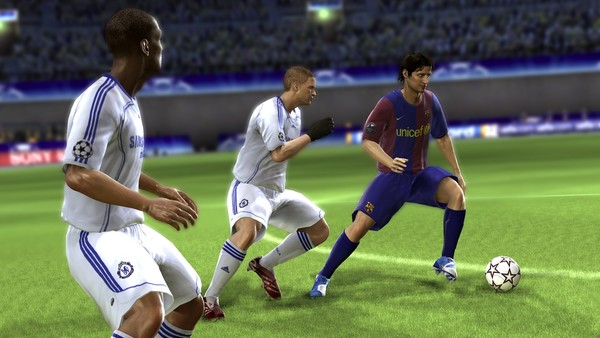
The current state of loot boxes, paid DLC, gacha and "surprise" mechanics in games is very much out of control, but how did we get here?
While the first game to include lootboxes at ALL was 2007's ZT Online, this free to play Chinese release didn't showcase the value of the mechanic anywhere near as much in pop culture as UEFA Champion's League 2006-07.
The first of EA's football games helmed by greedy businessman Andrew Wilson, the UEFA titles were essentially testbeds for mechanics that could then be rolled out into the likes of FIFA and EA's other titles.
It's here where the card pack-based version of Ultimate Team was born, and with many reviews at the time championing the mechanic and comparing it to collecting cards or football stickers in real life, it was off to the races for loot boxes and loot box mechanics.
Since this first UEFA release, every one of EA's titles has included some sort of additional spending method, with FIFA and Battlefront 2 being some of the most controversial. Even Mass Effect 3's multiplayer had loot boxes for its multiplayer, much to the dismay of literally everyone.
Obviously Team Fortress 2 and Overwatch made these mechanics more appealing with colourful aesthetics and appealing animations, but we wouldn't have any of it in the West whatsoever, without Andrew Wilson rolling loot mechanics out in UEFA Champion's League.