Ghost Of Tsushima REVIEW: 7 Ups & 2 Downs
3. There's A Wealth Of Customisation Options
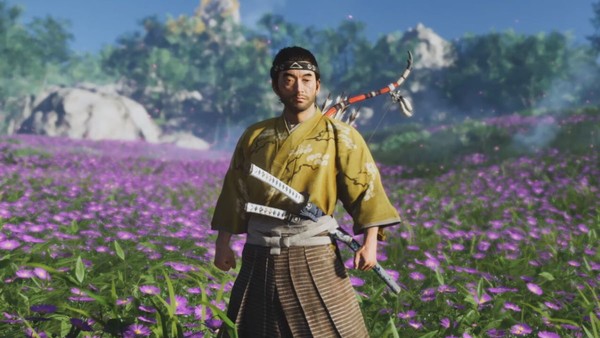
Of course, Tsushima has the style to match the substance - so much so that I've spent untold hours customising my version of Jin to adopt all sorts of different outfits during my time in the game.
The customisation in Tsushima is simple, but layered. Various template outfits can be found and upgraded and come with their own unique benefits. Equip the Traveller's outfit, for instance, and you'll have less armour but will clear more fog off the map, whereas more armoured outfits provide more defence at the expense of stealth. (It's also worth noting that, while upgrades change the overall look of a given outfit, players can choose which cosmetic iteration of which garb to use and retain all the benefits of the upgrade.)
Collecting flowers will give access to different dyes to change the colour of Jin's garb, and composing Haikus (a standout feature, honestly), provides new headbands to wear too. Add to that various hats, helmets, masks, bandanas, bows and katana sets, and you have all the materials you need to craft your own perfect samurai.
It would be remiss to omit the various presentation and photo mode options when discussing customisation too. Players can elect to play the game with English or Japanese dialogue, or even play entirely in black and white with English subtitles. I started off with English, but switched to Japanese soon after. Still, it's disappointing to see that animations are only lip-synced to the English voice acting, and an argument could be made that Sucker Punch should've committed to making the Japanese version the default option.
Either way, the photo mode is a major highlight. As was the case with Insomniac's Spider-Man, I am so excited to see what players come up with when the game releases.