Super Mario 3D All-Stars Review
Mario 64, Sunshine and Galaxy on Switch. What's not to love?

Rating: ★★★★☆
(Copy provided by Nintendo)
After years of requests and endless fan-demanding videos begging Nintendo to do something with their classic 3D back catalogue on Switch, our collective dreams have come true.
Super Mario 3D All-Stars is - almost to a T - exactly what is says on the tin: A collection of Super Mario 64, Super Mario Sunshine and Super Mario Galaxy on the go. Just don't expect the same treatment as 1993's Super Mario All-Stars, which saw the original 2D trilogy redesigned to match the graphical detail of Super Mario World, which had become the standard for Mario overall.
3D All-Stars is 99% a collection of ports, and that's a supremely mixed bag. Some of the finest games of all time, given the barest work to bring them into the modern day.
The conversion from N64, Gamecube and Wii misses what feels like quality of life improvements, and although this is a highly recommendable package by default, each title has notable negatives that stand out in transition from old to new.
Bottom line, though? If the idea of Mario 64/Sunshine/Galaxy on Switch is a "Yup, just throw my money at the screen" proposition, you'll be catered for. I'd be remiss however, to not point out what contributes to a feeling of things being "off" with these particular remasters.
Let's break down each game.
Super Mario 64

The very idea of such a legendary title; such a genuinely game-changing, industry-moulding work of art being accessible on current hardware - touched up in HD, no less - is immediately a landmark event for millions of Nintendo fans.
Simply put: The DS quasi-remake did far more wrong than right, and though it's a simple request, scores of N64 players just wanted the original game updated, but in a way that didn't lose that old-school charm.
Thankfully, the Switch edition of Mario 64 gains widescreen, 720p resolution with overhauled texture work.
If you're someone who's long been into the modding scene on PC you've likely already seen this game's textures cleaned up - likewise to those who snapped up an HD converter for the base N64. Needless to say, this version of the Mushroom Kingdom never looked better in an official capacity.
As for the game itself, Mario 64 was - like Ocarina of Time - built for the unique charms of the N64 pad. Its button layout and feel is iconic and welcoming for a reason - something that takes some adjusting when you're now crouching with a shoulder button and moving the camera with the analogue stick.
For the latter, Nintendo sadly haven't coded a full 360 sphere of motion for your perspective, nor done anything other than map the C-buttons to the analogue stick. This results in you still moving your view move in "chunks" like 1996, snapping from one perspective to the next rather than anything more fluid.
It feels like a massive missed opportunity, and you'll likely overshoot a lot of camera movements just by holding the stick in a certain direction for a fraction too long, when in the past this was governed by a button press.
I doubt anybody thought there'd be a scenario where we'd prefer the C-buttons to analogue camera movement, but here we are.
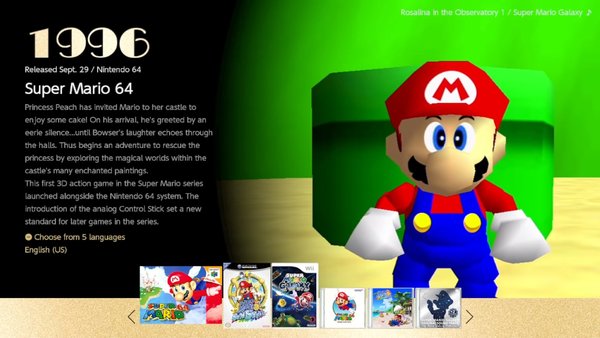
Aside from this, in terms of level design, progression, characterful charm and world variety, Mario 64 is still one of the finest platformers ever made.
Putting it right next to the immaculately inventive Galaxy shows just how far Nintendo came across a decade, but it's straight-up gaming royalty, and from the music to Mario's weighty movement, you simply need to see it through.
Super Mario Sunshine

Something of a black sheep of the Mario canon and the game that "let everyone down" after Mario 64 made such monumental waves across the 90s, Sunshine feels novel and fresh removed from the hype of 2002, but it's still the weakest offering here.*
*(Honestly though, the "weakest offering" against Mario 64 and Galaxy is still a level of quality very few could hold a candle to.)
Centring on a cleanup mission where a vacationing Mario is tasked with mopping up the gorgeous Isle Delfino, Mario Sunshine is a strange old beast. Almost like how Majora's Mask saw Nintendo steer deliberately away from trying to "one up" the majestic Ocarina of Time, Sunshine bases the majority of Mario's abilities and traversal options around "FLUDD", a robotic companion that doubles as a jetpack and water hose.
Again, the passing of time does this favours its release window never could, as amongst the company of Mario 64's purism and Galaxy's experimentation, donning a machine to clean up a gorgeous island feels like a nice change of pace.
Sadly, Mario's movement feels the worst of the bunch. He's far too twitchy and overly responsive - almost like an over-correct after the mould-breaking 64. Twinned with levels that introduce more verticality and repeat too many mini-bosses for their own good, for me at least, Sunshine simply doesn't flow like the others.
Lacking the finesse of Mario 64, I'm sure GameCube stalwarts will be happy this game has a new lease on life, but considering the company it's keeping here, you're far better off clocking Mario 64 or Galaxy first.
Super Mario Galaxy
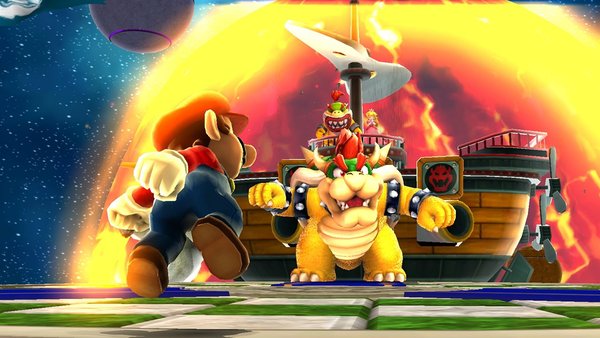
Onto the pièce de résistance; the best game on the Wii and the one that benefited the most from being revamped for modern hardware. Why? Because until this new release, Mario Galaxy forced you to use unnecessary motion controls as a way to sell the Wii itself.
Rather annoyingly, that's still the case in some instances, but Nintendo have tried to split the difference, resulting in a cumbersome overall control scheme.
See, Mario Galaxy's genius relies in its level design; the idea of an evil intergalactic Bowser whisking Princess Peach, the Mushroom Kingdom and a ton of Toads off into space, only for Mario to go planet-hopping to the rescue.
This setup let Nintendo go hog-wild with their level designs, and area to area you'll get everything from a tiny planet of overlapping Bullet Bills to another where conveyor belts made of confectionary try to slow you down. There are always scores of enemies to flip over and kick into the cosmos, catapulting stars to launch you to the next environment, and hundreds of Star Bits to hoover up.
These latter items are where the motion controls came in. You'd be forever waggling the Wiimote so your reticule passes over them, or you could target an enemy and do damage. Neatly, Galaxy on Switch lets player two control the reticule to help Mario on his journey, but the cursor still appears on-screen at all times.
Already that will be an annoyance as Nintendo are letting you hit a button to attack rather than shake the controller, but in all respects, this is still the original Wii game, transposed to Switch.
That said, get inventive and you CAN play without motion controls.

First up, on handheld you tap/swipe to collect Bits anyway (something that gets a bit intrusive mid-challenge or combat), or docked, point your Joy-Con off-screen and tap R to "re-centre". After bringing the controller back to its natural position, the game will still think the centre point is off-screen.
Voila: A version of Mario Galaxy without that damn cursor, that's still mostly playable thanks to new face button controls.
Minigames like the penguin race or other one-offs still require motion controls to complete, but you can use Y to perform a spin attack or climb vines. Handheld you'll be tilting the Switch to steer or direct an item through an obstacle course, and all-round it stands out that motion controls should've been removed entirely.
Thankfully, level designs are stellar, the score is stellar, Mario's movement became the standard for the character in 3D, and there are buckets of charm lavished overtop.
Make no mistake about it: These are the three games we collectively requested, put on Switch.
Besides the HD resolutions and in Mario 64's case, being widescreen at all, these are the same games as on the N64, GameCube and Wii. Mario Galaxy's menus are the exact same, with the chunky Wii U dashboard being your save button in between levels.
You can't knock the quality of these as individual titles, but considering how easy it would've been to add proper camera controls to Mario 64, better movement to Sunshine and zero motion controls for Galaxy, I can't help but think Nintendo missed an opportunity.
Rating: ★★★★☆