15 David Bowie Songs That Showcase His True Genius
Celebrating the genius of the greatest artist of the last 50 years.
15. The Laughing Gnome (1967)
https://www.youtube.com/watch?v=5SQdBxVjZx4 1969's Space Oddity may have been the song that saw David Bowie explode into popular consciousness, but two years before he released a little known self-titled baroque folk pop record. The album was released on the same day as The Beatles' Sgt. Peppers Lonely Hearts Club Band, received with a shrug and soon disappeared without trace. Following what was regarded as a critical and commercial failure, Bowie would not release anything for another two years. There is one song from the sessions for this largely forgotten debut that still lingers, though, even today. The Laughing Gnome was not included on the album proper, but released a standalone single in the same year. The song, which features Bowie meeting the titular creature, is little more than an attempt to score a chart hit using novelty value alone, but the technique of speeding up the vocal track to make the gnome's voice would be revisited later to greater effect in songs like The Bewlay Brothers (from 1971's Hunky Dory) and Fame (from 1975's Young Americans). For that alone, the song deserves to be remembered, and it's worth noting it did eventually chart when re-released in 1973 to capitalise on Bowie's new-found superstardom.14. Space Oddity (1969)
https://www.youtube.com/watch?v=cYMCLz5PQVw After the failure of his debut album in 1967, Bowie returned at the turn of the decade with the song that launched him from little-known folk-pop troubadour into a genuine star. Space Oddity was his first really big hit, ingeniously timed to make the most of both the Apollo 11 moon landing and Stanley Kubrick's 2001: A Space Odyssey (released the year before). Written after he was dropped by Deram Records when his debut had flopped, Space Oddity is one of the rare songs that is simply perfect for its time and place. It capitalised on the public's enthusiasm for almost anything space related and the notoriety it gained by being initially banned by the BBC could have only helped in getting Bowie's name out there. The song is otherwordly, like the man himself, and the single helped make the second self-titled album it comes from (yeah, another self-titled one, though it may have been called Space Oddity or Man Of Words/Man Of Music depending on when and where you bought it) a chart success, especially in the UK.13. Life On Mars? (1971)
https://www.youtube.com/watch?v=v--IqqusnNQ Bowie followed hot on the heels of his second album's success with The Man Who Sold The World in 1970, an album that further solidified his reputation as a promising, if inconsistent, talent. Just a year later, though, Bowie took his talents to a whole new level with his fourth album Hunky Dory, which spawned a #3 hit in the UK charts: second single, Life On Mars? The song is an odd kind of sing-a-long, full of surreal imagery and impenetrable lyrics that somehow manage to be resonant with personal meaning - and it's a different meaning for everyone who hears it. Hunky Dory was a mix of the rock that permeated The Man Who Sold The World and the folk-pop that made up Bowie's second album. A rarity among the man's back catalogue, this was not necessarily a stylistic leap forward but a consolodation of everything that had come before. But on Hunky Dory his rock songs rock harder, his pop songs have catchier hooks, and his folk songs have better lyrics than what had come before. Life On Mars? helped to make Bowie a genuine superstar. But Bowie wasn't done, he was about to go - almost literally - out of this world...12. Five Years (1972)
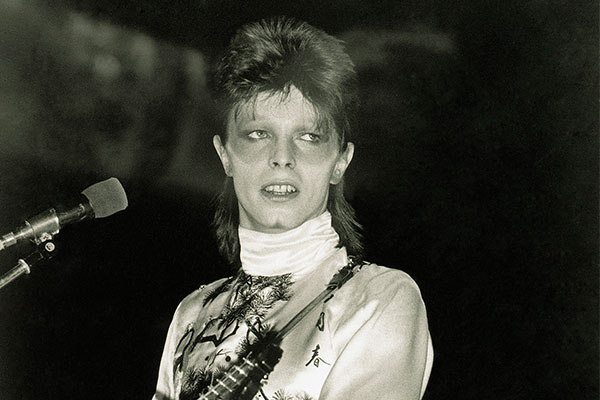
https://www.youtube.com/watch?v=IWm03wYBTbM The year after Hunky Dory marked the most infamous period in Bowie's chameleonic career. 1972 marked the "birth" of Ziggy Stardust, Bowie's alien-messenger alter ego, and his band The Spiders From Mars. Bowie, as Ziggy, brought glam rock to the masses and his make-up, spandex and sexual ambiguity scandalised a nation. The loose eponymous concept album opens with Five Years, setting the scene for what's to come as it tells the story of an Earth with only five years left before destruction. It's a beguiling, intriguing opening track; how could you hear it and not want to hear the rest of the album? The Ziggy Stardust era is the point where Bowie became imprinted on every music fan's consciousness. To hear an androgynous man dressed as an alien wailing "you're not alone" at the end of the album's closing track "Rock N Roll Suicide" is to hear Bowie singing to every misfit, every awkward teenager, every outsider in his generation and every generation to follow. And all of that started with Five Years, the best opening track in Bowie's oeuvre.11. The Jean Genie (1973)
https://www.youtube.com/watch?v=CGQo6zpVzt8 Another year, another iconic look for Bowie. The cover of 1973's Aladdin Sane saw his angular face adorned with a lightning bolt in what is one of his most instantly recognisable album sleeves. Though it wasn't officially another Ziggy Stardust record, Aladdin Sae continued in that vein, described by the man himself as "Ziggy goes to America". It took the glam rock of his last album and gave it a tougher, harder edge, reminiscent of his work on The Man Who Sold The World. The Jean Genie is the perfect example of the album's sound, the crunching, instantly-recognisable riff brings about a chugging, blues-influenced rocker whose lyrics describe, according to Bowie, "a smorgasbord of imagined America", which fits with a lot of the album. Aladdin Sane features an out-of-place Bowie's ruminations on America, but soon enough he would be diving head first into that culture, with yet another sudden musical shift.10. Fame (1975)
https://www.youtube.com/watch?v=J-_30HA7rec Bowie followed Aladdin Sane with Pin Ups (1973), an album of covers, and then Diamond Dogs (1974), another glam rock concept album, this time based on George Orwell's 1984. He soon moved on from his glam rock phase - but no one but him could have seen a move to soul music coming. 1975 saw the release of Young Americans, an album of Philly soul (or what Bowie himself called "plastic soul") sung by a translucent-white Bowie, blonde and be-suited, a world away from the spandex-clad Ziggy. This was no temporary mask worn by him, Bowie said he had obsessed by soul music throughout the '70s, and recruited the likes of Luther Vandross and Andy Newmark (the drummer for Sly & The Family Stone) to play on the album. For the album's most famous hit single, Fame, he recruited his friend John Lennon to co-write (and provide backing vocals), and the song's funky riff and altered vocals made it a number 1 single in the US charts. Bowie would stretch his new persona into weirder directions after Young Americans, he would not be this mainstream for quite some time...9. Station To Station (1976)
https://www.youtube.com/watch?v=ZY77zDzNmYw The late 1970's saw Bowie tweak his "Philly soul" look from Young Americans into a persona he called The Thin White Duke; a character most associated with 1976's Station To Station album. For Station To Station, Bowie took elements of the funk and soul that had characterised the previous year's Young Americans and merged it with the emerging sounds of synths and chugging motorik rhythms, influenced in part by bands like Kwaftwerk. It was a heady musical mix that, combined with Bowie's cocaine-numbed mental state (he claims to recall nothing of the album's production) made for an icy, claustrophobic, at times paranoid record - but that said, it was brilliant, too. The album opens with its title track, a ten minute opus that begins with droning guitars and builds to a brilliant crescendo. It's an abrupt shift from the funk, soul and pop that had characterised his last few albums and a shift into the direction that would come to be known as his "Berlin Trilogy".8. Sound & Vision (1977)
https://www.youtube.com/watch?v=WoDamvrfUbQ 1977's Low is the first of Bowie's revered "Berlin Trilogy" (though it was actually recorded in France) and his first after quitting the cocaine habit he feared would take his life. Split into two distinct "sides" (which made much more sense in the days of vinyl than CDs/MP3s), side one was full of conventional songs, while side two took in longer, experimental, instrumental compositions, inspired by Brian Eno. The album was originally meant as a soundtrack for the Bowie-starring film The Man Who Fell To Earth, but Bowie's compositions went unused. The standout track of Low's more straightforward compositions, Sound & Vision combines a bouncy, upbeat guitar part with the downhearted lyrics that cover every track. Given that he was quitting drugs at the time, it's understandable that there was "a lot of pain" on the album, but Sound & Vision showed that even at his bleakest, Bowie could still craft a perfect pop tune,7. Heroes (1977) https://www.youtube.com/watch?v=Tgcc5V9Hu3g The title track from David Bowie's follow up to Low (released in the same year) is probably the man's most famous, iconic and beloved track. When The Big Book Of Rock is finally written, Heroes will have a whole chapter to itself. The feedback filled guitar part, supplied by Robert Fripp, contributes to the "wall of sound"-esque beautiful noise. Bowie's vocals, initially quiet and subdued, rise to the extent that he's shouting to be heard by the end, mirroring the desperation of the song's characters, and sounding, well, heroic. The rest of the album builds on the iciness of Low, building brooding instruments in amongst more conventional songs. Bowie's time in Berlin was a time of rebirth, both musically and personally. Though he - along with his friend Iggy Pop - had left L.A. to land in what he called "the smack capital of Europe", they were both able to get off drugs and the self destructive paths they were on. Heroes would be followed by 1979's Lodger, the final piece of the "Berlin Trilogy" and, remarkably, the 11th album he released in the 1970's. He would never again be as prolific as he was in that decade, but he still had plenty more reinventions to come.