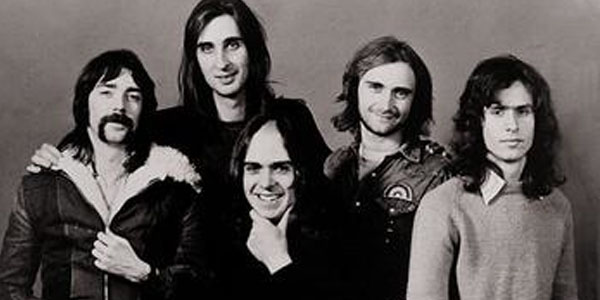
Genesis is perhaps the most beloved progressive rock band of all time. The band's debut release came in 1969 under the confusing title, "From Genesis to Revelation" prompting record store owners to file it in the religious/gospel music section, a problematic scenario at best. The album had a very strong Moody Blues vibe with relatively short tracks and nary a hint of what was to come in 1970's which fans consider to be the band's golden era. The 1981 release of "Abacab" saw them shifting away from their prog roots and mining Phil Collins' pop proclivities for a leaner, more radio friendly sound. While the stylistic shift gained the band millions of new fans around the world it did little for those of us who loved the earlier albums, particularly those with original vocalist Peter Gabriel who left in 1975 to be replaced by Collins. It with those sentiments that we present ten awesome '70's Genesis tracks that you've probably never heard.
10. Looking For Someone (Trespass, 1970)
http://www.youtube.com/watch?v=fOqDpNJgqgI The opening track from the "Trespass" album beings sublimely, the angelic of voice of Peter Gabriel warbling with emotion alongside the gentle keys of Tony Banks. As the track builds with tasty fills from soon to be departed guitarist Anthony Phillips, it becomes clear that the band has matured into something much more than was promised on their debut, "From Genesis To Revelation". Featuring not one but two dynamic instrumental sections, the track is prophetic both in its musical complexity and the closing lyric sung by Gabriel: "All that I am I will give". "Trespass" made little impact on the musical landscape of the day and the few press reviews were, to put it kindly, less than favourable. In hindsight there is much to love about the album, particularly for Genesis purists who consider Peter Gabriel's time as lead singer to be the band's golden age.
9. Return Of The Giant Hogweed (Nursery Crime, 1971)
http://www.youtube.com/watch?v=wgWtlls6Cno One of the band's great early epic narratives, this track tells the whimsical yet terrifying tale of a life and death struggle. It seems that a Victorian gentleman has smuggled a Royal Hogweed out of Russia and has gifted it to the royal gardens at Kew. Unbeknownst to him said botanical is sentient and not at all happy about its move to England. Soon after, the horrifying herbal hellion has spread throughout the land and threatens the survival of our race. The song's instrumental closing features some terrific interplay between keys and guitars, creating visions of frolicking Hogweeds attacking en masse and dancing with glee. The release of "Nursery Crime" saw Steve Hackett (guitars) and Phill Collins (drums) join the band replacing Anthony Phillips and John Mayhew respectively. Gabriel's story telling was developing at a rapid pace as heard in the album's opening track, "The Musical Box" a staple in their live show. While "Nursery Crime" did well in Italy it was not a huge hit at home.
8. Harold The Barrel (Nursery Crime, 1971)
http://www.youtube.com/watch?v=G9qBB3mxQW4 The strangely titled "Harold the Barrel" is an upbeat, cherry little ditty about the suicide of our unfortunate subject. Apparently Harold has gone quite mad, having cut off his toes and served them for tea. A chase ensues during which the authorities discover that Harold is on a window ledge, much to the horror of his mother as his shirt is filthy and the BBC is there. An angry crowd has also gathered to gawk at the spectacle, hoping Harold will jump in spite of their assurances that they are there to help him. Written by Gabriel and Collins, the track is sarcastic commentary about media, modern voyeurism and shallowness. Driven by piano and drums the track has a great groove and tells a tale as only Gabriel can.
7. Time Table (Foxtrot, 1972)
http://www.youtube.com/watch?v=3DJVfgXi57o "Time Table", from the band's fourth album, "Foxtrot", is a beautiful piano composition written solely by Tony Banks which explains the shift from Gabriel's story based lyrics to Banks' introspective meanderings. The chorus is the plaintive cry of a man seeking answers that cannot be grasped in finite terms and the accompanying music, while melodically pastoral in the verse, finds its tension there as well. The track seems at odds with the grand story telling found on "Foxtrox" with the likes of "Watcher of the Skies" and the twenty-two plus minute "Suppers Ready" dominating the proceedings. "Foxtrot" was Genesis' first taste of commercial success with the album breaking into the UK top twenty an peaking at number twelve.
6. The Battle Of Epping Forest (Selling England By The Pound, 1973)
http://www.youtube.com/watch?v=vFuIYyXiD5w At over 11 minutes in length and featuring a plethora of time changes, "The Battle of Epping Forest" tells the story of rival gangs battling over territory. The track is a musically adventurous odyssey that tells the tale over no less than twelve verses. Gabriel's trademark humour is front and center with such quips as, "Amidst the battle roar, accountants keep the score: 10-4." In the end it seems that nobody has survived and a coin is tossed to declare the winner. "Selling England By the Pound" was the band's breakthrough, reaching number three in the UK and number seventy in the US. The album was also the first to be certified gold by the RIAA. "The Battle of Epping Forest" was performed live during the tour for this album but was subsequently dropped do to the length of the lyric as well as the myriad time and musical changes which made it difficult to perform.
5. Squonk (Trick Of The Tail, 1976)
http://www.youtube.com/watch?v=TzL-up4ZKgI "Squonk" has an aural palette that is sonically huge with Steve Hackett's shimmering guitar chords layered over a thumping bass line that forms the song's backbone. The song tells the story of the legendary Squonk, a rare and complex creature whose interactions with humans have a decidedly unhappy ending, an ending for which you may even shed a tear. Phil Collins, taking over the vocal duties for the now departed Gabriel, demonstrates why the band continued to build a legacy even after that unfortunate turn of events. The track is a Rutherford/Banks composition and was featured in live sets until 1980. "Trick of theTail" was the band's first without Peter Gabriel and few thought that the band could carry on in the same fashion without him. They were wrong.
4. Eleventh Earl Of Mar (Wind And Wuthering, 1976)
http://www.youtube.com/watch?v=xxc0IGNthNo The opening track on "Wind and Wuthering" begins with an ethereal Steve Hackett lead that hinted at his coming solo material, this being his final album with the band. A Rutherford/Hackett/Banks composition "Eleventh Earl of Mar" seems to continue the grand tradition of epic story telling but in this instance they miss Gabriel's lyrical clarity and it's not very apparent what exactly the song is all about. Mike Rutherford has been quoted as saying that its subject is a real Scottish historical figure who led a failed rebellion against the English but there is little in the lyric in terms of a narrative. The track's strength is its fantastic music, melody and composition rather than its lyric. "Wind and Wuthering" was the band's second release after the departure of Peter Gabriel and while it received favourable reviews the general concensus was that the release was not quite as strong as its predecessor, "Trick of the Tail".
3. All In A Mouse's Night (Wind And Wuthering, 1976)
http://www.youtube.com/watch?v=BsOlHrxgpAg "All in a Mouse's Night" is an absolutely delightful flight of fancy told from the perspective of its characters, a husband and wife awakened at night, a hungry mouse and a cat. Apparently said mouse has sojourned into a household under the cloak of darkness only to find the owners wide awake. While the humans debate the mouse's fate, its imminent death versus capture, the mouse escapes to be discovered by the family cat which then renders itself embarrassingly unconscious during the chase. The cat then has a fantastical story of its own to tell. This Tony Banks penned track features some of the finest keyboard work on the album and Phil Collin's does a masterful job (Gabriel-esque?) of voicing each character. Banks has been quoted as saying that "Wind an Wuthering" is one of his two favourite Genesis albums, the other being "Abacab" from 1981.
2. Undertow (And Then There Were Three, 1978)
http://www.youtube.com/watch?v=BOd6wYKKB9o "Undertow" is a melodically and lyrically haunting track written by Tony Banks that again moves away from narrative to introspection, as in our previous Bank's example, "Time Table". In it a message of incredible hope is delivered to a person who is apparently considering the end of their life though whether by illness or suicide is not clear. Musically the time of introspection is characterized by its quiet piano and pacing while the chorus explodes majestically with an inspirational message of life. The album's title, "And Then There Were Three" refers to the departure of guitarist Steve Hackett who had decided to pursue his solo career full time. Mike Rutherford took over guitar duties and this is the form that the band has taken since, relying on excellent touring musicians to round out their live show.
1. Deep In The Motherload (And Then There Were Three, 1978)
http://www.youtube.com/watch?v=JqfYYrr-Zt4 "Deep in the Motherlode" is a Mike Rutherford penned track whose setting is about a young man going west during the gold rush during the 19th century in the US. While suggestive rather than narrative the track's strength is in its passages and the melodic instrumental parts between them. The interplay between Collins' voice and instrumentation is both magical and memorable. This track holds a difficult middle ground between what Genesis was in the 70's and what they would become in the 1980's. "And Then There Were Three" did extremely well on both sides of the Atlantic and spawned the hit, "Follow You, Follow Me". The album rests somewhere in that uncomfortable ground between what was and what was to be. With the release of 1981's "Abacab" Genesis took a stylistic turn that is unmistakable when the two releases are heard back to back. Did we miss an obvious entry and want to share it with us? Use the comment section below an let us know.
Ross Ingall is a 52 year old ordained Canadian baptist minister who has been listening to hard rock and metal quite literally since each was invented. A second career pastor who attended seminary in his 40's, the Rev hosts Too Metal For Church on Metal Nation Radio. Writing both under his own name as well as the psuedonym/nickname Reverend Rock, Ross has been writing music articles on the web since 1999.