4 Times Disney Got The Science Right (And 4 Times It Didn't)

Little nuggets of good science in our favourite childhood films.

As made up, magical children's entertainment, maybe it doesn't make much sense to hold Disney movies up to scientific scrutiny. You know, what with a lot of it being magic and all. That said, there's a surprising amount of scientific accuracy hidden away in some of your favourite childhood films, whether intentionally or by sheer chance. Seeing as we spend so much time picking them apart it might be nice to recognise some of the stuff they got right for a change. But, as scientists we know that for every action there must be an equal and opposite reaction, so we'll also be taking the opportunity to flag up some more of our favourite scientific inaccuracies. Just to keep balance in the universe, you understand.

8. Inside Out: Surprisingly Accurate Anatomy

Disney Pixar sensation Inside Out had children and parents alike bawling their eyes out (oh, Bing Bong), but is was also a surprisingly faithful depiction of the goings on of the brain. Okay, there isn't literally a little control room filled with people inside your head (if there is, you might want to see a doctor), but the basic principles are pretty spot on. The idea of "sending memories down to long term" during the nightshift is a nod to the process of memory consolidation during slow wave sleep. The actual "headquarters" itself is basically representative of the limbic system. This includes structures such as the orbitofrontal cortex, which is involved in decision making, the hippocampus, which is instrumental in the creation of new memories, and the amygdala, which is involved in lots of emotional processes. This is all connected up to the rest of the brain via the fornix, a fibrous bundle of nerves that connects the limbic system to the rest of the brain, particularly memory, much like the systems of tubes and tunnels that transfer memories in the film.

7. Inside Out: Personality Islands Unfortunately Not A Thing
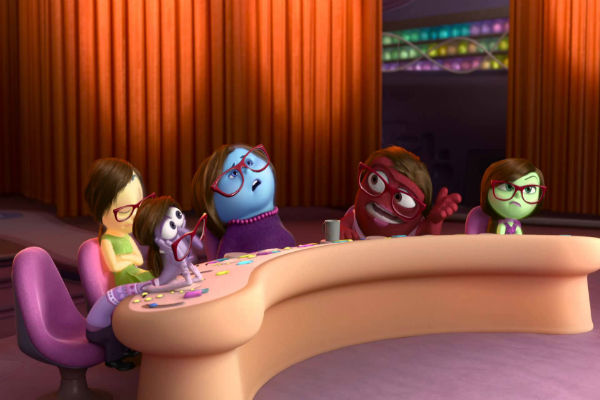
Whilst the "personality islands" are a nice representation of how strong formative memories can influence our sense of self, it's more likely that the real life "personality islands" in humans are basically all the same, such as conscientiousness and extraversion, but in different quantities. These kinds of traits probably don't "exist" in the same way as the limbic system either, they're more to do with levels of activity in lots of different areas. Similarly, we don't really have any idea what's up with imagination. We know that it's probably different from memory (so points for giving it its own "land"), but it actually takes place in virtually every part of the brain (so, points off again for giving it its own "land").

6. Frozen: Loneliness Is Actually Cold

We're all familiar with the meaning of being "left out in the cold", but actually the link between loneliness and temperature might be a bit more literal than we once thought. A study at the University of Toronto found that when people felt socially excluded, much like Queen Elsa, they would actually, literally feel colder. When asked to guess the temperature of the room they were in, those who were subjected to social exclusion would guess lower than those who were included. In a separate study the connection between physical and emotional warmth was made even stronger. They found that people experiencing loneliness were likely use warm baths and showers to make themselves feel better. This is pretty instinctive, as well all know a nice hot shower can make everything seem better, but they demonstrated that physical and emotional "temperature" can be somewhat interchangeable and that maybe it is possible to almost literally "melt" a snow Queen's heart.

5. Frozen: She's Powerful, But Not That Powerful

We all know that the Ice Queen is pretty powerful, raising an ice palace out of thin air is no mean feat after all, but it might be that Disney slightly underestimate how powerful Elsa would have to be. The thing is, in boring old physics, you can't just change the states of things without putting in work and freezing the fantasy equivalent of a medieval Norwegian kingdom would take a hell of a lot of energy. A student of integrated science called Aaron Goldberg decided he was going to figure out exactly how much energy (because that's the kind of thing science students entertain themselves with). He estimated that the amount of ice that would be needed to cover Arendelle would be about 99,043,217,000 kg. He then figured out exactly how much energy it would take for a super-efficient Carnot refrigerator to produce that amount of ice. The answer was equivalent to somewhere in the region of 115 atomic bombs. Now, even if Elsa eats all of her porridge in the morning, producing that kind of energy is like, I don't know, magic or something.

4. Jungle Book: Got The Animals Right...

Whilst kid's films sometimes have a habit of smooshing animals together ("lions and tigers and bears, oh my!"), the animals in The Jungle Book would definitely cross paths in real life - yes, even the bear. Baloo is not, as some people think, a black bear, but a sloth bear, native to India. Luckily for Mowgli, this is probably one of the better species of bear to be around as a vulnerable little man-cub. Sloth bears are generally pretty docile, living on a diet of insects, climbing trees, and generally shambling around the place. The male bears are known to be particularly gentle with their cubs and they often go swimming for fun. Sloth bears have also been known to be the victims of bengal tigers such as Sher Khan, just like in that scene. Although it has been known for feral children to occasionally be raised by wolves, such as Mowgli is in the film, the non-bitey relationship with Bagheera the jaguar might be a bridge too far.

3. Jungle Book: ...Apart From The Monkeys

All that said, there's little explanation as to how King Louie the orangutan came to be in the middle of the Indian jungle. Orangutans are non-swimmers, so making his way over from his island home in Indonesia would have been no mean feat. This seems to be an accuracy of Disney's own creation, as King Louie, nor any other orangutan, appear in the original Rudyard Kipling stories They also fall into the trap of the "snake hypnosis" myth that still proliferates as Kaa captures Mowgli. It's thought that the misconception that snakes are able to hypnotise their prey comes from a combination of their lidless eyes and the the defense mechanisms of their prey causing them to completely freeze up (in the animal kingdom, stillness often equals invisibility), making it look as though the snake is exerting a power over them.

2. Lion King: How We All Learnt What Stars Are

Whilst some science in The Lion King has already been roundly dissed by yours truly, you have to commend them on their little knowing nod to scientific accuracy. Whilst Simba, Timon and Pumba all lay back and look at the stars, they wonder what they could possibly be. Simba, the supposed brains behind the operation, reckons that they're all his dead royal predecessors, revealing himself as the tory monarchist that he is. Timon, the other supposed brains insists that they're fireflies, but the allegedly thick one, thinks that they're "balls of gas burning billions of miles away", getting a thumbs up from the science police (although if we're being really picky, stars don't burn, they generate energy by nuclear fission). This is presumably before Simba attempted to eat them both but was gored to death by Pumba, one of the most dangerous animals on the savannah, in the film's beautifully tragic denouement. I forget how it ended.

1. James And The Giant Peach: How Much Lift?

James and the Giant Peach is one of those films people tend to forget about, but it's still hella nostalgic. Some people who didn't forget about James and his peach were a group of physics students from Leicester University, who each poured their time and energies into taking apart a well loved classic (who doesn't love doing that?). Everybody's favourite adopted uncle, Roald Dahl, claimed that it would take 501 seagulls to transport the eponymous giant peach across the atlantic. This struck those canny students as woefully naive (*smug science snort*) given that the the peach was "as tall and wide, in fact, as a small house". According to the students' calculations, they estimated that a peach of those dimensions would require 4,890,579 newtons of force to lift it into the air. As the average seagull is able to provide a net lift of around two newtons of lift, that would add up to nearly 2.5 million seagulls. That's a lot of bird poop. Does science make you tingle in your special place? Like us on Facebook or follow us on Twitter for plenty more.Want to write for WhatCulture Science? Click here to find out how you could get paid to write about what you love.

Contributor
Contributor

Writer. Raconteur. Gardeners' World Enthusiast.