10 Dark Doctor Who Moments You Weren't Allowed To See
“Everybody dies!” would've been a very different ending to THAT story…

Doctor Who is renowned for sending people scurrying behind the sofa, but it always has to tread the line between frightening and nightmare-inducing. After all, it’s a family drama, not a horror film!
But that doesn’t stop the writers from testing boundaries, adding dark moments to their scripts to see what they can get away with.
In some cases though, these moments never make it to screen, because they’re either too scary or too violent. Sometimes there are other factors, such as whether there’s enough budget for a certain scene, or whether the story would be more streamlined without it.
Fortunately, many of these dark moments still exist in draft scripts, or have been talked about in interviews. Some made it to concept art, or were filmed but omitted from broadcast.
Whatever the case, there's a good reason you haven't seen them, and in a way, this only serves to make them more tantalising. After all, the suggestion of horror is often more effective than horror itself.
10. Everybody Dies! (New Earth)

Doctor Who stories where nobody dies are few and far between, with Steven Moffat’s first story The Empty Child/The Doctor Dances being a rare example. “Just this once, everybody lives!”
But as fans have often joked, it wasn’t “just this once”. From Rory to River Song to Osgood, loads of other Moffat characters have visited the God of Death and been resurrected in the years since.
This inclination to save characters has changed several stories over the years – it was Moffat who persuaded Russell T Davies to let Jenny live at the end of The Doctor’s Daughter.
He also inadvertently prevented a much more downbeat ending to New Earth.
Originally, the Doctor created a very different type of ‘cure’ for the diseased patients – one which killed them all. “He had set them free and it was their only form of release”, RTD explains in the episode's online commentary.
For a story all about new beginnings, this would hardy have been the right note to end on. And so, once again, everybody lived! Which is just as well, because “everybody dies!” doesn’t quite have the same ring to it.
9. Forbidden Fury (Fury From The Deep)

These days fans can watch a new episode of Doctor Who as soon as it’s released, whatever country they live in. And the version that appears on BBC iPlayer is the same as the one that appears on Disney Plus.
But as you can probably imagine, this wasn’t always the case.
When classic series stories were sold abroad, broadcasters were free to cut material at their own discretion. So, overseas viewers could end up watching a slightly different version of an episode to viewers in the UK.
When 1968's Fury from the Deep was screened in Australia, censors removed some of the story’s scariest scenes – including the sequence in Episode 2 where Maggie Harris is attacked by Mr Oak and Mr Quill.
It's a pretty disturbing moment, with the quietly menacing Oak and Quill creeping up on Maggie and effectively suffocating her. But if you watched Fury from the Deep in Australia, you wouldn't have seen it.
All copies of the serial, including this one, were eventually junked. But ironically, because this scene was physically cut from the Australian film print, it's one of the only parts of the story that survives today!
Umm... yay for censorship?
8. The Spindleman (It Takes You Away)

In It Takes You Away, the Doctor and friends contend with flesh-eating moths, Ribbons of the Seven Stomachs (whatever that means), and a sentient universe craving company.
However, the episode was originally meant to feature one more antagonist – the Spindleman, played by Britain’s tallest man, Paul Sturgess.
This snout-faced creature was an inhabitant of the anti-zone, like Ribbons. In scenes which were filmed but cut from the finished episode, it stalked Ryan and Yaz, then was trapped by them.
Certainly sounds and looks like a solid concept, but in practice, the team wasn't able to do it justice.
“It just didn’t work,” Chris Chibnall admitted in one interview. “It was great on the page. But it needed to be really big and really imposing. And somehow it didn’t quite read on camera.”
Despite the Spindleman falling through a crack in time, It Takes You Away still has its fair share of skin-crawling moments. Just go back and find the shot of Ribbons’ moth-ravaged carcass, and pay attention to the creature crawling out of his eye socket. Juicy!
7. Macra Terror (Gridlock)

Returning enemies in the early years of NuWho included the Autons, the Daleks, the Cybermen, the Master, and the Macra.
Previously seen in the now-missing 1967 serial The Macra Terror, these creepy crustaceans weren’t exactly an obvious choice for a return. RTD only brought them back because he wanted Gridlock to feature crab-like creatures, and there just so happened to be a suitable candidate in the show’s back catalogue.
The combination of a limited CGI budget and Gridlock not needing to focus on the monster means that the Macra end up literally blending into the background. However, they were originally set to have a more prominent role.
RTD's early outline explored other parts of New New York besides the motorway, with fully-grown adult Macra lurking in the oceans. Also cut from the episode was the gruesome concept of insect-like 'baby' Macra, devouring drivers unfortunate enough to use the fast lane.
It’s one of those ideas that was simply too expensive to make a reality – which, for anyone who doesn’t like creepy-crawlies, was probably for the best.
6. Vetoed Violence (The TV Movie)

Much like the Doctor Who of 2024, the 1996 TV Movie was an American co-production, and needed to appeal to both UK and US audiences.
In practice this meant many things, including a more grounded approach to peril and violence. Nothing epitomises this more than the scene where the Seventh Doctor steps out of the TARDIS in San Francisco and is immediately shot dead.
That was all well and good for the US, but back in the UK, some of the more extreme moments of violence were deemed too shocking, and had to be removed in order for the movie to land a pre-watershed slot, and a ‘12’ certificate, rather than a ’15’.
Specifically, the classification board ordered the removal of the gunfight that takes place prior to the TARDIS landing – about 40 seconds of material in total – and some of the more distressing parts of the Doctor’s surgery. A close-up of the Master snapping Chang Lee’s neck was also taken out.
The uncut version was eventually broadcast in the UK in 1999 and has since been made available on home media, but curiously, the version currently on iPlayer is the censored edit. Yet another reason to support physical media!
5. Emperor Explosion (The Parting Of The Ways)

By the end of Series 1's Dalek, the lone pepper-pot infused with humanity is something of a tragic figure – so much so that you feel sorry for it when it self-destructs.
In contrast, the Dalek Emperor is a self-proclaimed god whose downfall is fully deserved, though his offscreen death doesn't give us the satisfaction of watching him die.
But as the script for The Parting of the Ways reveals, this wasn’t meant to be the case.
Had the budget allowed for it, we’d have cut back to the Emperor as its casing “divides into particles”. This would've been followed by a close-up of the creature inside “screaming its rage” as it “shrivels and turns to dust”.
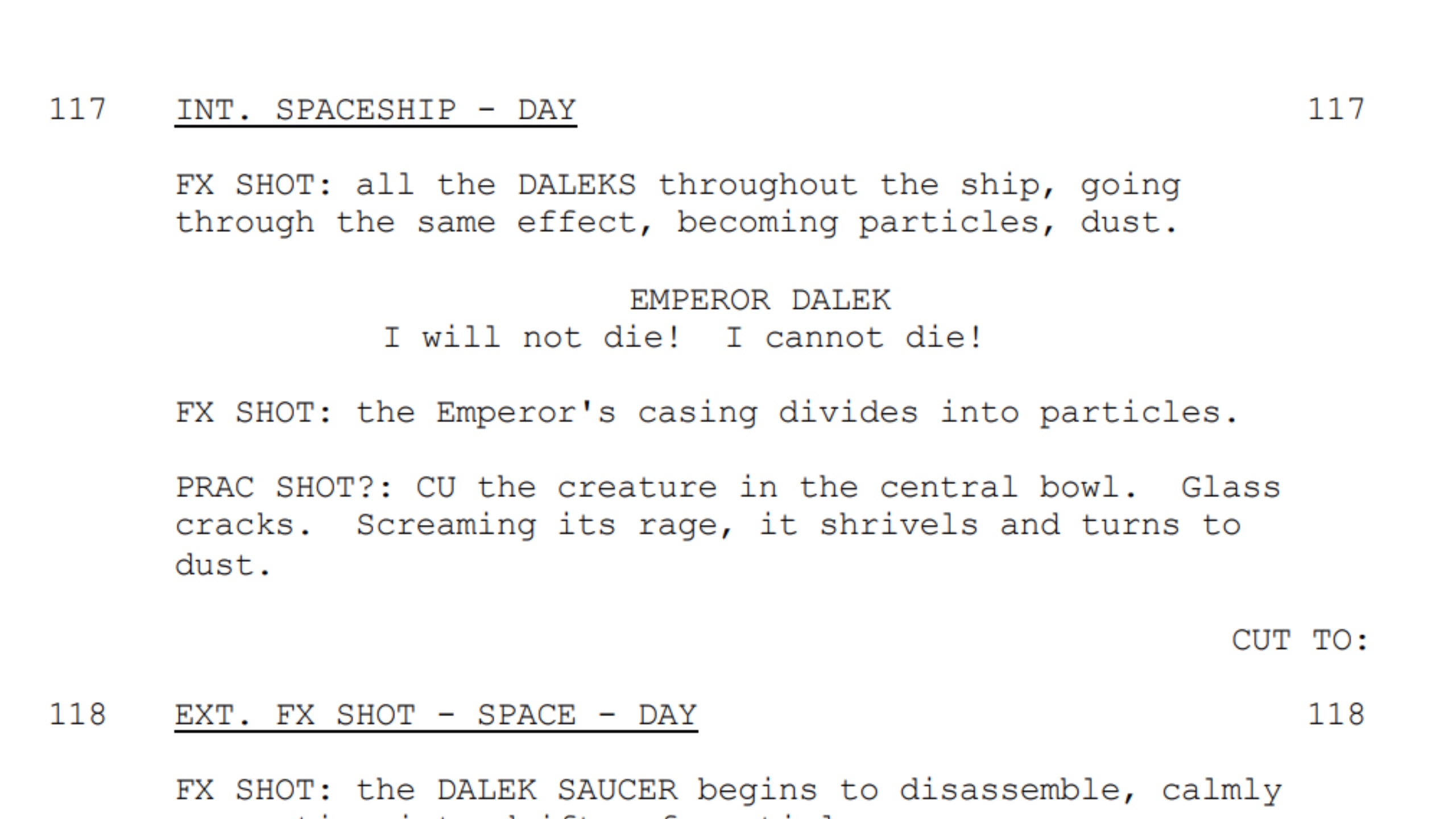
It’s a real shame this didn’t make it to screen, because who doesn't love a good villain death?!
What’s more, all the close-ups of the Emperor were achieved practically, using the puppet originally created for Dalek. So there was potential to do a really cool effects shot, with the mutant dissolving in water or deflating like a balloon.
Gruesome indeed, but ah, what could have been.
4. Noor’s Fate (Spyfall)

The Chibnall era shined a light on lesser-known historical figures like Ada Lovelace, Joseph Williamson, and Mary Seacole.
Appearing alongside Lovelace in Spyfall was Noor Inayat Khan, a British spy stationed in France during World War II. She helped the Doctor defeat the Master and the Kasaavin before being returned to her own time, not long before her real-life capture and execution at the hands of the Nazis.
Actress Aurora Marion revealed on Instagram that Noor’s death was originally set to appear in the episode. The scene was scripted and even filmed, but never made it to screen.
It's hard to say how it would've played out without seeing the scene for ourselves, but it was almost certainly cut because it was deemed harrowing and perhaps even distasteful.
It does seem odd to have an episode celebrating a lesser-known historical figure and then end with them being gunned down in a concentration camp.
3. Corpse Machine (Frontios)

Christopher Bidmead’s third and final Doctor Who script revolves around a planet that supposedly buries its own dead.
In reality, the mavity-manipulating Tractators are to blame, using their powers to pull the colonists into the earth for use in their nefarious schemes.
Quite what this entails isn’t clear. We learn that their excavation machine requires a living mind to operate (in this case, the unfortunate Captain Revere) and there’s a throwaway line about the Tractators needing bodies as well as minds. But we’re left to imagine how these bodies are actually utilised.
This is a hangover from the draft scripts, which took the concept to a whole other level: Bidmead’s original intention was for all Tractator technology to be constructed from human remains.
The idea was deemed too grisly for Saturday teatime, but it was reinstated in the story’s Target novelisation, which describes the excavation machine as follows:
“It was a repellent sight – a huge and hideous assembly of parts of human bodies, shaped something in the form of a giant Tractator. It was a machine built from the dead.”
A machine made from corpses sounds more John Carpenter than Doctor Who, though it would've been interesting to see how this was portrayed with '80s budget and effects!
2. The Original Flood (The Waters Of Mars)

The Daleks, Cybermen, and Weeping Angels might be Doctor Who’s most iconic monsters, but the Flood definitely rival them in terms of being scary.
With their cracked skin, black mouths and dead eyes, these water zombies pushed the show’s boundaries more than any other creation in RTD1.
They also proved a major challenge for the production team. Their original design (below) was deemed too terrifying, and had to be significantly toned down.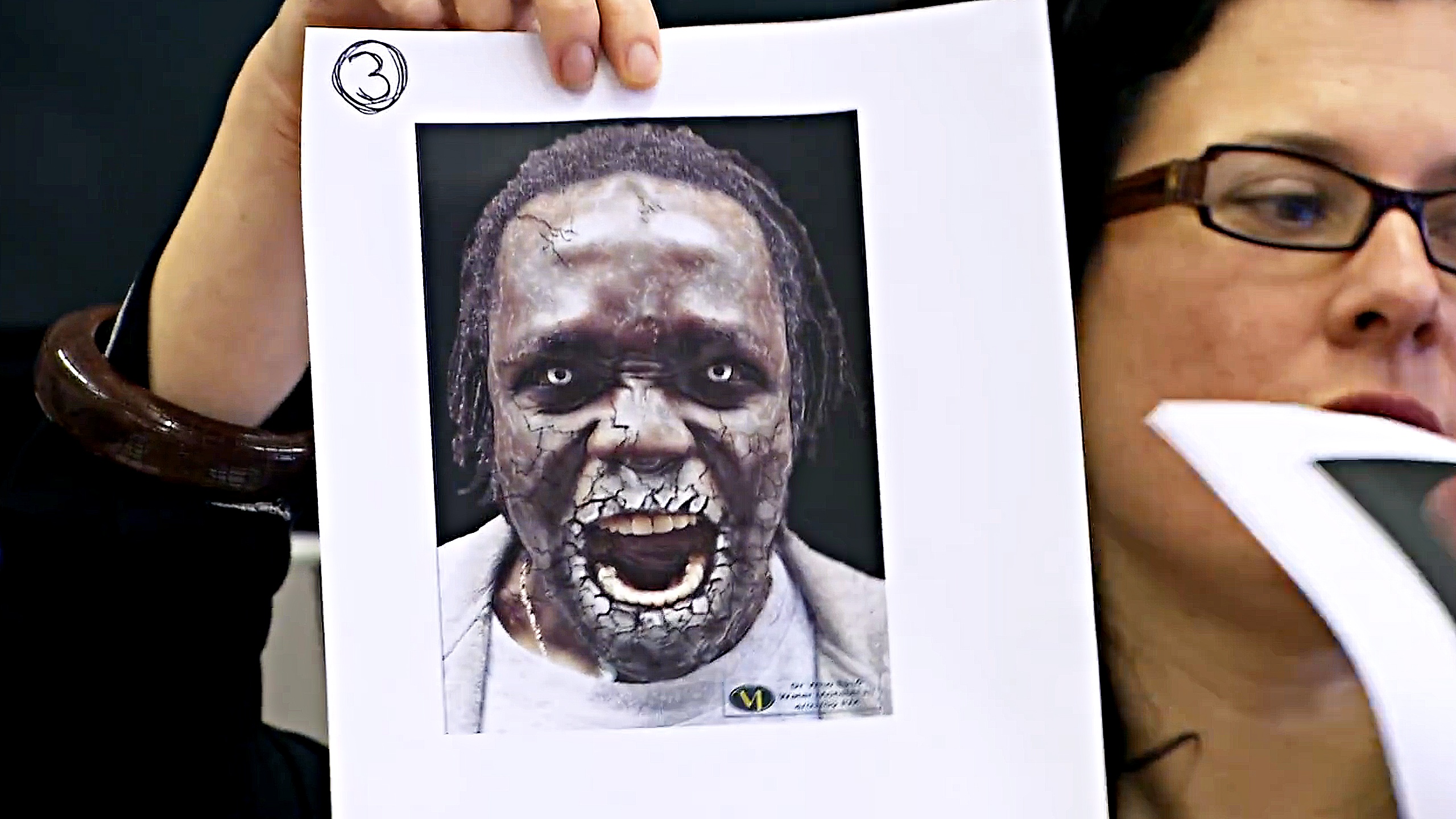
Even then, there were concerns about going too far, to the point where the look of the zombies was changed midway through filming.
The Waters of Mars co-writer Phil Ford has since recalled, “It was the only time I believe that Russell saw dailies and went onto the studio floor to change something because it was too scary”.
Specifically, it was felt that the contact lenses used to make Andy and Tarak’s eyes white made them too frightening. It was then decided that for Maggie Cain's transformation, actress Sharon Duncan-Brewster would not wear them.
The Waters of Mars is already one of the darkest episodes of the revival, and these original designs would've cemented that reputation even further.
1. Davros’ Dark Backstory (Journey’s End)

When the Master returned in 2007 he came with a brand-new backstory, conveyed in a tantalising flashback. And a similar thing very nearly happened when Davros returned the following year.
Series 4 finale Journey’s End originally featured a flashback to the Kaled-Thal war, depicting Davros before his life-changing accident.
Described in this iteration as a gaunt man in a medic’s coat, Davros would've been shown experimenting on wounded soldiers, with one “thrashing in agony” as he’s injected with a syringe.
We’d then have witnessed the explosion that changed his life forever, as described in the script:
"Davros, his head now bald, red, peeling; holding both hands over his face, so he can’t be seen. He’s screaming."
This scene was cut early on due to budget constraints, but even if it hadn't been, there's no telling whether a bloody wartime flashback featuring wounded soldiers and Davros' skin peeling off would've made it past the edit!
DELETED SCENES. Jjst couldn't afford them. they got as fa as the readthrough, but... we had to cut. Sob. #SubwaveNetwork pic.twitter.com/38w8qImeWB
— Russell T Davies (@russelldavies63) April 19, 2020
That said, with Julian Bleach now playing a pre-accident version of the character on TV, RTD could feasibly bring this scene to life in his new era.
The entire concept of Dot and Bubble was one he envisioned in 2010, so he's not opposed to revisiting old ideas!