10 Deadliest Accidents In Star Trek
ZERO DAYS SINCE LAST TRANSPORTER MALFUNCTION

In Star Trek, anyone stepping onto a transporter pad or boarding a shuttle is intimately aware of the deadly consequences should things go wrong. No amount of Heisenberg compensators or magnetic interlocks can prevent the unpredictable or frustrate the fallible. Save for certain cases, 'human error' post-First Contact is equally anthropocentric. On the contrary, accidents in Trek are literally, almost comfortingly, universal.
The opposite of accident is intentional act or (in some cases) culpable negligence. You can't blame the Mars Attack on wet floors. By definition, an accident is not a natural disaster. That rules out, for example, the volcanic eruptions that led to the near extinction of the Scalosians by the year 2268. No gravitational wavefronts, solar flares, or natural sources of radiation either.
Particularly for legal purposes, 'accidental death' tends NOT to include death by disease, other illness, or old age. (You'd have a hard time finding insurance in Star Trek's future anyway.) That does mean death by virus aboard the USS Exeter in The Omega Glory, and death by rapid aging in The Deadly Years (and Unnatural Selection), won't be included here. As for the giant space amoeba in The Immunity Syndrome, we'll let the Vulcan lawyers figure that out.
'Deadliest' is also DEADLIEST, so rest in peace (ish), Commander Sonak. In memoriam A.G. Robinson, and our apologies to all the others left off this list. Accidents do happen, after all. Go big or blow up on your way back to starbase!
10. Dyson Sphere Disaster
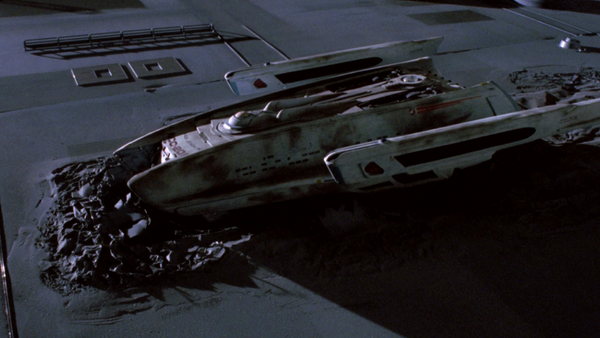
In 2294, the USS Jenolan, a Sydney-class passenger transport ship, went missing on its way to the Norpin colony on Norpin V. It took 75 years to find out what had happened. Given the traumatic nature of events, we can forgive Scotty a few Aldebaran whiskies, too.
The Jenolan had, in fact, crashed into a Dyson Sphere — a truly gigantic structure built around a star to harness its energy. This particular Dyson Sphere was 200 million kilometres in diameter, with an interior surface area of over 250 million M-class planets. It had been abandoned by its creators.
The direct cause of the crash wasn't the Sphere's rather large gravitational field, but an incompatibility between the resonance frequency of its tractor beams and Starfleet power systems. When the Sphere tried to lock on to the Jenolan, it overloaded the ship's aft power coils. Badly damaged, the Jenolan could no longer resist gravity's pull. Only Scotty and Ensign Matt Franklin survived the collision. Only Scotty made it out of transporter suspension.
Though no such numbers are mentioned on screen, the novelisation of Relics gives the Jenolan's crew complement at 36, plus its captain, James Armstrong. The number of passengers, in addition to Captain Montgomery Scott (retired), isn't specified, though it is implied there were quite a few. The novel does state how the passengers died — from asphyxiation due to a hull breach caused by the crash.
9. Molecular Mishap(s)
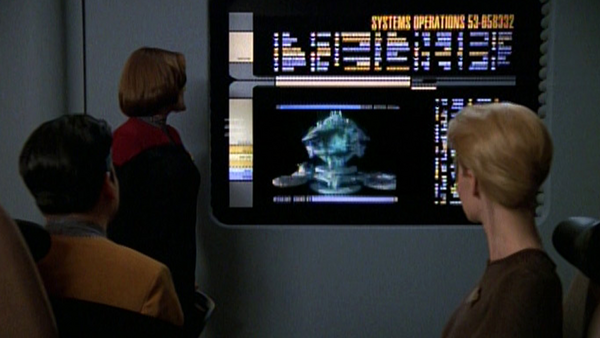
Curiosity is the universal constant, which at least comes with fair warning. History abounds with those who have made the ultimate self-sacrifice in the interest of science and invention. Risking the proverbial cat is a far cry from endangering an entire quadrant. To paraphrase Captain Janeway, when science steps over into mass destruction, it's time to know when to quit. Omega was several of those times.
The Federation first faced the devastating power of the Omega molecule in the second half of the 23rd century. In fact, a single molecule of Omega caused an explosion that killed its creator Ketteract and 126 other scientists at a classified research outpost in the Lantaru sector. The accident also ruptured subspace across several light years. A "handful" of Omega molecules could do the same across thousands.
In the Delta Quadrant, one pre-warp civilisation's experiments with Omega as a power source led to death and devastation across 300,000 square kilometres of their M-class moon. "Half the quadrant" was still in danger from the molecules that remained. "The final frontier has some boundaries that shouldn't be crossed," to quote Janeway once more.
The Borg were also more than simply curious about Omega. They sought to "assimilate it at all costs". Omega was perfection, though that particular quality would be forever wanting in the 600,000 drones "sacrificed" in the Collective's one (known and failed) attempt to synthesise the molecule. Forget fair warning, it only took one trillionth of a nanosecond for Omega to destabilise. That's not nearly time enough to blink.
8. Firewall Troubleshoot

In 2256, deadly met disgusting in an accident on the USS Glenn. Context was for those who went to wander the dark corridors of this Crossfield-class. "Helical trauma," i.e., twisted to death, is one of the worst ways to go. By the vagaries of the crew complement of sister ship the USS Discovery, 135 or so all went the same way.
Parallel to the Discovery, the Glenn was also running spore drive experiments under the supervision of astromycologist Straal, research partner to Paul Stamets. Straal's "breakthrough" was the capture, and use as a navigator, of a giant tardigrade (or, rather, a tardigrade-like creature). One 90-light-year jump to the Beta Quadrant with the soon-to-be-named 'Ripper' went well enough. The trip back, not so much.
Upon exiting the mycelial plane, the Glenn hit an "undetectable Hawking radiation firewall," causing all biological life (except the tardigrade) to 'spin out'. When the away team led by Commanders Stamets and Landry arrived aboard, the crew were indeed just a gruesomely contorted pile of their former selves.
This was an accident, yes (Hawking radiation might also suggest the ship struck a black hole), but in the heat of war with the Klingons, and with Mirror Lorca breathing down the Prime universe's neck, it was an accident waiting to happen.
7. Oberth And Death

At over a century (and counting), the Oberth-class science vessel ranks amongst the longest serving Federation starship classes, alongside the likes of the Miranda class and the Excelsior class. In all that time, and with limited capacity to defend itself, the Oberth has fallen afoul of more deadly misfortune than most.
Partly an accident, if you want to place the blame on the gunner like Commander Kruge, the USS Grissom (Oberth-class) was destroyed by the Klingons in 2285. Skip ahead to 2366, the USS Bonestell met its end at the Battle of Wolf 359. Definitely not an accident! The USS Cochrane, once transport for Admiral Satie and for Wesley Crusher, suffered losses in the Dominion War. At some point in her Starfleet career, Beckett Mariner also crashed an Oberth.
The most infamous of the class has to be the USS Pegasus. A mixture of malfeasance, accidental explosion, and much-needed mutiny against Captain Pressman saw the deaths of everyone aboard but nine in 2358. The precise number of lives lost that day was given by Commander Riker in These Are the Voyages… — "seventy-one" (the standard crew complement of the Oberth class is eighty). Some of those officers ended their existence inside solid rock.
The 'curse of the Oberth' also struck the SS Tsiolkovsky in 2363. Whilst studying the collapse of a red supergiant, its crew succumbed to a form of polywater intoxication, largely similar to the Psi 2000 infection that had spread to the crew of Kirk's Enterprise.
Suffering from the sensation of extreme heat (in more ways than one), part of the Tsiolkovsky's 80-strong crew died by lowering the environmental controls to freezing point. The rest were "sucked out" (*correction, "blown out") into space when they released the emergency hatch on the bridge. No amount of modesty blankets or carefully placed hands could save them.
6. Immortality Is Not A Gas

Well, you know what they say: it's all hurt until someone gets fun and games. On the way to one of the deadliest accidents in Federation history, the crew of the Enterprise-D was rudely interrupted by the "Q entity". As per tradition, he just wanted to play for a bit with Commander Riker and co. on a faraway planetoid, and to grant Riker the power of the Continuum.
Back then, Picard was a little more diplomatic about the "bullsh*t," but still determined to get to Quadra Sigma III. Parking Q in his own 'penalty box' for a minute, Quadra Sigma III was a mining colony with 504 inhabitants. In 2364, methane-like gas leaked from an underground source on the planet, causing an explosion that laid waste to operations on the surface.
When the Enterprise finally did arrive, delayed or not by the galaxy's most inaccurate historical reenactment society, there were only eight survivors. Riker, now a Q, or near as damn it, was prevented by a promise from restoring any of the 496 to life. He quickly reneged on said promise when he made Wesley a grown-up and provided Klingon sexy time for Worf (amongst other offers to the crew). Priorities, Will! Priorities!
5. Dekyon Field Casualty List

Often in Star Trek, the only mistake is not making it more than once. The only accident is not having to file a report. Time travel, or temporal mechanics more widely, is a handy thing when it comes to avoiding the most disastrous of misfortunes. Though it didn't stick, one of many do-overs for the Enterprise-D is still burned into our retinas — those very deadly explosions in the Typhon Expanse.
The opener to Cause and Effect was as cool as it was flaming red hot. At less than 50 seconds, thinking time for the audience was also left to the opening credits (before one could simply hit skip). The Enterprise was back in fine functioning form just after, ready to blow up again. Death re-set (and re-set) is still death, and there were about a thousand people around to die ad infinitum on board.
Had the temporal causality loop not been broken in less cataclysmic fashion, the cause of the effect would have remained one of the worst (accidental) ship-to-ship collisions in Starfleet history — USS Bozeman meets warp nacelle. Thankfully, Star Trek: The Next Generation was brought to you today by the letter 'R' and the number 3. Death is countless echoes in the dekyon field, and one ship lost to time.
4. Borg Survival Course
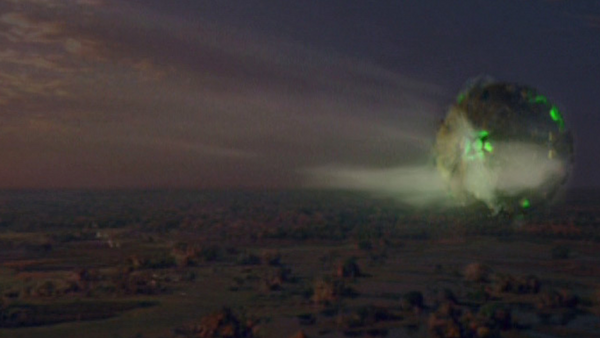
Here's a sentence you won't hear often — let's give the Borg the benefit of the doubt! We don't know what caused the crash of the Borg Sphere on Planet 1865-Alpha in the Delta Quadrant, shown at the start of Survival Instinct. The Collective was hardly averse to sacrificing the odd vessel when it suited, but by all accounts, this was not a deliberate act. It was definitely deadly.
In Unimatrix Zero, Part II, the Borg Queen herself noted that "sphere 878" had a complement of "eleven thousand drones". Taking that figure as standard, the morbid calculation is a simple subtraction. The only survivors of the crash in Survival Instinct were Two of Nine (Lansor), Three of Nine (Marika Wilkarah), Four of Nine (P'Chan), Seven of Nine, and a mortally wounded drone, designation unknown. Eleven thousand minus four.
Of those four, three probably wished they were dead. No accident this time, but the desperate, last-ditch effort of a frightened Seven of Nine down on the planet in 2368. Through new interlink nodes created by Seven's nanoprobes, Wilkarah, Lansor, and P'Chan were trapped in a "neural triad" — a collective within the Collective. Breaking that bond once they were out left them with only a few months to live. Eleven thousand minus one.
3. Full Moon! Half Moon! Total Collapse!

"Klingons never do anything small, do you?" as Commander Riker said to Lieutenant Commander Worf. A gorch is one thing, a moon is another, though the principle remains the same. Praxis wasn't just any accident, it was a Klingon accident. When it erupted, the whole galaxy felt its force.
There might be argument to say that this wasn't an accident at all. Over-mining and lax safety procedures aren't the fault of happenstance. There was seemingly no malice in it, however, so we'll stick with our original ruling — a Klingon cock-up on an industrial scale.
There might also be argument to say this wasn't very deadly. The death toll for Praxis was never given on screen. One line from the fifth draft of the script for Star Trek VI: The Undiscovered Country, cut from the film, noted that the moon was "barren of indigenous life forms".
The only source that does provide a definitive figure for the population of Praxis — at half a million — is for an alternate universe in 'The Chimes at Midnight' short story, part of the Star Trek Universes Echoes and Refractions anthology. Either way, and automation aside, it would be more than odd if absolutely no one was around for the mining operations.
Moreover, if the shockwave from the explosion could play merry hell with the Excelsior on the other side of the Neutral Zone, how on Qo'noS was there still a Qo'noS right next door? As strange as it sounds, the Klingons got mighty lucky with "deadly pollution of their ozone," instead of immediate planetary obliteration.
2. Problem Polarics
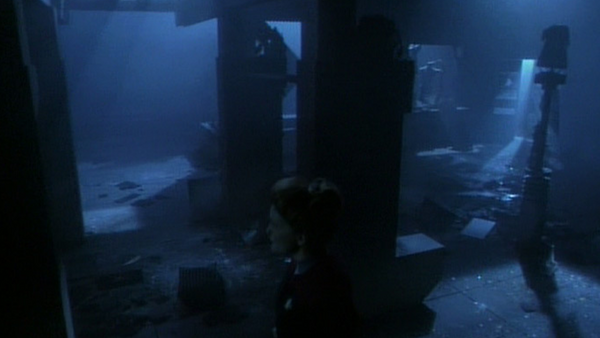
'Polaric ions' are the Omega molecule on a budget. Both could be used as a power source, both as a potential weapon. Omega destroyed subspace, and a polaric ion explosion could cause a chain reaction there. When the polaric "time bomb" went off on what is commonly known as 'Makull's homeworld' in the Delta Quadrant, all organic life was wiped out in a matter of seconds. Voyager was rocked at the edge of the shockwave.
The explosion had a secondary effect. It left behind floating subspace fractures on the planet — doors through time. Captain Janeway and Lieutenant Paris were sent back to the day before the accident. As it happened, it was the crew's own efforts to mount a rescue which caused the explosion in the first place. Janeway's intervention to prevent the rescue then prevented that timeline from ever existing.
The millions, possibly billions, of inhabitants of Makull's planet got their Time and Again. The same can't be said for others. In the 23rd century, an 'incident' involving a polaric energy device almost completely destroyed a Romulan research colony on Chaltok IV. That led to the 'Polaric Test Ban Treaty,' signed in 2268.
Chaltok IV was also where Laris wound up forever waiting for Jean-Luc in Star Trek Picard's third season. Being forgotten is the deadliest thing of all.
1. A Kelpien's Catastrophe

For a galaxy-wide mega explosion, 'the Burn' was one hell of a damp squib. In the late 3060s, every active warp core that used dilithium to control the matter-antimatter reaction suddenly and simultaneously suffered a breach. Millions upon millions were killed, an untold number of ships destroyed. The cause of the worst cataclysm in Starfleet and Federation history? A lone Kelpien screaming through subspace. We'd swear someone was making this up.
One giant let-down in early 2021 was at least confirmation that the Burn wasn't wanton vandalism of biblical proportions. Bad for the galaxy, and for the audience, is good for the list. Su'Kal, said Kelpien, was also only a child at the time, reacting in distress to the death of his mother, Doctor Issa.
One accident had led to another. Whilst pregnant with Su'Kal, Issa and ship, the Khi'eth, had crashed on "planet made of dilithium," Theta Zeta. In utero, Su'Kal somehow developed a connection with the dilithium present and with subspace. You know, 'radiation' and stuff… Just run with it! Issa herself died of radiation poisoning, and Su'Kal's laments then "travelled at the resonant frequency of dilithium's subspace components". Cue the cosmos on fire!
In the aftermath of the Burn, Starfleet and the Federation were reduced to mere shadows of their former selves. Even Earth seceded into isolation. The population of Trill symbionts was "decimated," and who knows how many across the galaxy were killed by the rise to power of the Emerald Chain. It took over a century for the recovery process to begin with a little assist from a band of time travellers. After all, nothing in Star Trek is truly an accident, and deadliest is the discovery of the hero ship.