Doctor Who: Every Doctor's DEFINITIVE Episode
What is every Doctor's magnus opus?

Picking a best episode for each Doctor is easy. But picking the episode that best defines them as a character is much harder.
A quintessential Doctor Who story isn’t necessarily the one fans like most, or the one with the highest IMDb rating. It’s the episode that captures who that Doctor is at their core, exploring their quirks and flaws, putting them against a memorable foe in a memorable setting, with a tight central concept. These episodes should have an ageless, classic energy – the kinds of stories you’d pop in front of someone and say ‘this is Doctor Who’.
A couple of ground rules: I’ll be including only the numbered Doctors, so no War or Fugitive Doctor (though I’m sure we can all agree that The Day of the Doctor is quintessential). I’ve also included Eight, as he’s a good chap who often gets left in limbo, and he does, in fact, have several stories to choose from.
I’m also including televised stories only – no expanded media!
15. The Aztecs (The First Doctor)

The Aztecs is an extraordinary bit of television, from its sumptuous costume design to its exploration of cultural intervention. It also just happens to contain William Hartnell's very best performance as the First Doctor.
From his moral outrage at Barbara's plan to interfere in history to his bemusement at becoming engaged, Hartnell nails every single ebb and flow of the First Doctor's arc throughout.
The relationship between the Doctor and Barbara is the beating heart of Doctor Who in its early years, and Hartnell and Jacqueline Hill are terrific here. The way that the Doctor tenderly suggests to Barbara that she's made a subtle difference by saving just one life is a touching moment that reveals to the audience that she's even changed the Doctor's mind when it comes to tampering with time.
It's not for nothing that over 40 years later, The Fires of Pompeii repeated many of the same beats with David Tennant and Catherine Tate!
14. The Evil Of The Daleks (The Second Doctor)

You can see Patrick Troughton working out what does and doesn't work throughout his first season as the Doctor. His experiments with hats, disguises, and performance styles eventually allow him to perfect the Second Doctor that we know and love.
The Evil of the Daleks is all the better for this, given that David Whitaker's script demands a Doctor who is every bit as multi-faceted as Patrick Troughton was.
This serial allows Troughton to demonstrate multiple layers of the character across all seven episodes, from reluctant hero, to manipulative schemer, to scientific genius, and back again. It's a truly marvellous and well-rounded Doctor performance.
Troughton balances the Doctor's scientific curiosity with a childlike glee and defines future portryals of the character as he does so. The Evil of the Daleks is also an absolute corker of a story, taking us from 1960s London to Skaro, via Victorian Kent! It's the perfect distilation of what Doctor Who – and the Doctor – is.
13. Inferno (The Third Doctor)

If there's a classic Doctor Who story that best sums up any incarnation of the character, it's Inferno. The Third Doctor tries desperately to save the parallel Earth from destruction, even though it's run by a nightmarish fascist regime. Decades later, Ncuti Gatwa's Fifteenth Doctor would do something very similar on the planet Finetime!
However it's the perfect Third Doctor story because it defines that era purely by showing us what it isn't. The Doctor may feel constrained by being stranded on Earth and his role within UNIT, but by interacting with the fascistic Brigade Leader, he understands that our Brigadier is definitely more of a friend than an enemy.
It's also the Pertwee-era story that best taps into his skills as both a comedian and an actor. The Doctor's wry contempt for the Republican Security Force is delivered by a man who knows exactly how to deliver a punchline or a witty retort.
And it's just a corker of a story to boot!
12. City Of Death (The Fourth Doctor)

Watching City of Death, it's tempting to believe that Tom Baker knew an ITV strike would make this the most-watched Doctor Who story of all time – peaking with 16.1 million for part four.
Baker is absolutely electric here, perhaps powered by his burgeoning romance with Lalla Ward, but primarily a script by Douglas Adams and Graham Williams that practically fizzes with energy.
City of Death has an incredible plot (using time travel to mass-produce Mona Lisas) that could easily have become a blockbuster movie. It's indicative of the ambition and high-concept ideas that are emblematic of the Tom Baker era in general.
This story also epitomises everything that Tom Baker wanted to bring to Doctor Who – wit, humour, energy – and does so without sacrificing its supporting cast or the gravity of the drama.
As a certain purple supervillain might say, it's perfectly balanced, just like a fine wine. And indeed, just like a fine wine, City of Death has aged beautifully, and still stands out as the most iconic and delightful Fourth Doctor story.
11. The Caves Of Androzani (The Fifth Doctor)

Not unlike the harassed junior doctors or family patriarchs he'd play in later life, Peter Davison's Fifth Doctor was often a slightly out-of-his-depth victim of circumstance. The Caves of Androzani is therefore the most fitting story of his era, because it places him in the grimmest, most impossible situation imaginable.
This is no longer the Doctor who stood by and let the Silurians and humans kill each other in Warriors of the Deep – this is a man who will go to hell and back to save a single life. Peter Davison is absolutely brilliant as a Doctor who quickly realises that his idealistic worldview is out of step with the grim realities of Androzani's corporate and military complexes.
It's often forgotten that Davison is a superb actor, who was sometimes wasted in the role of a thinly characterised Doctor. Thankfully, writer Robert Holmes finally gives him a chance to showcase the nuances of the character in a send-off that darkly defines his whole era.
Your first thought might be cricket whites and celery, but underneath all the quirks The Caves of Androzani is a true reflection of who the Fifth Doctor always was.
10. Vengeance On Varos (The Sixth Doctor)

The success of The Caves of Androzani dictated the tone of the following season, giving rise to some grimmer, more violent Doctor Who stories. One of those was Vengeance on Varos, but unlike some other examples at least it was attempting to make a comment about violence on screen.
Varos is Colin Baker's finest hour as the Sixth Doctor, as he goes toe-to-tail with slimy capitalist Sil in his attempts to bring down the planet's corrupt regime. It's an episode that's not without its controversy – the acid bath, the fact that it revels in the very violence it's supposed to condemn – but it does give Colin Baker his best material.
The Sixth Doctor's moral outrage is always something to behold, and there's a lot to go round in a story that features corrupt officials, evil corporations, bizarre genetic experiments, hangings, and dehydrations.
You don't get that on Gogglebox, do you?
9. The Curse Of Fenric (The Seventh Doctor)

The Curse of Fenric is a hugely atmospheric story that takes in World War 2, biological weapons, impossible chess problems, and evil from the dawn of time. It's also the culmination of various threads that had been left dangling by script editor Andrew Cartmel and his writers from Dragonfire onward.
Overseeing it all is Sylvester McCoy's Seventh Doctor, who is at his most mercurial, striking the perfect balance between clown and chess master. He entertains a baby with birdsong while plotting a final showdown with an ancient evil, and it all flows naturally. This is a Doctor that came more into his own as his era progressed, and he was at his peak here.
And then, at the very heart of it, is the Doctor and Ace's relationship being put to the ultimate test. It's heartbreaking to watch, all the more because of Sylvester McCoy and Sophie Aldred's very real friendship. This is the story where the dark truth of the Doctor's manipulations was revealed so it was a huge, definitive point for their relationship and era as a whole.
Both performers put in their finest performances in a multi-layered script, making The Curse of Fenric the gold standard of Seventh Doctor stories.
8. The Night Of The Doctor (The Eighth Doctor)

Yes, we only had two choices here and the other choice was the admittedly slightly iffy TV Movie, but The Night of the Doctor is still quintessential Eight.
The Eight that appears in this minisode isn’t movie Eight – it’s the Eight that has lived through many offscreen audio adventures (which, in a lovely touch, the script canonises). This is the version fans fell in love with during the wilderness years, and in a brutally short runtime, McGann showcases warmth, wit, and his trademark romanticism, but with a jaded exhaustion resulting from the Time War.
The episode understands Eight perfectly. He's compassionate to the end, refusing to carry weapons, desperate to save one life even when the war has made that instinct feel naive. His regeneration isn’t bombastic, it’s bleak – a broken ‘good’ man having to compromise his own morals for the greater good.
It’s all very emo, and all very Eight. It's also what fans point to when we all repeatedly say how good an Eighth Doctor spinoff series would be!
7. The Empty Child/The Doctor Dances (The Ninth Doctor)

Not only is this two-parter utterly iconic, but for Nine’s character, it’s an important beat in his arc – this is the point where the Doctor finally starts to forgive himself for the Time War.
Up until this point, Nine is angry, sharp-edged, and visibly traumatised. He’s the PTSD Doctor, carrying the weight of a double genocide on his back. He is a man who has lost everyone, but in this story, in spite of the hopeless situation he faces, Nine is able to save everyone.
In another episode this might feel like cheating and could very easily undercut the stakes. In Nine's case, however, he needs this win so badly that this moment, instead of being a cop-out, is one of pure euphoria.
"Everybody lives!" is the emotional apex of Nine’s arc, and it’s not just any old victory. For the first time since the war, the Doctor saves the day without any compromise or trade-off, and the episode makes sure that this ‘flawless victory’ is well-earned. The bleak horror tones of the rest of the script cleverly frame this ending as a twist, because at no point does it look like it's heading in that direction (this Moffat bloke is pretty good, they should get him to write some more).
Then comes the gas mask child, the creature responsible for many childhood nightmares across the country. This two-partner also introduces Captain Jack Harkness, and nobody needs to explain why that makes it an instant classic!
6. Human Nature/The Family Of Blood (The Tenth Doctor)
David Tennant's Doctor always felt the most human, and so he was the perfect incarnation to realise Paul Cornell's acclaimed novel on TV.
Tennant puts in his best performance in the show, not as the Doctor, but as John Smith, allowing him to showcase his range as a gentle, vulnerable man who finds out that not only is he not real, but that he is doomed to face his own death.
Watching John fall in love with a life he can never have is devastating telly and Tennant sells it completely. John might share some of Ten's traits, but he is not the Doctor. Tennant's performance is brilliant, celebrating everything the Tenth Doctor is by showing everything he isn't – slightly cruel, slightly cowardly.
So yes, we can have a quintessential story that barely features the Doctor himself. In spite of the Doctor's absence, this is a thorough study of his character. We explore his callousness, his mythology, and his inability to truly account for human emotion, try as he might to mimic it. The story presents Ten as a force of nature, and that's before he even pops up.
When the Doctor does return, the shift is chilling. The punishments he devises for the Family are cruel, spiteful, and wildly darker than the behaviour we see week on week. Ten’s righteous fury tips into something genuinely frightening in this story, and it sets the scene beautifully for the arc that would eventually conclude in Tennant's run of specials.
5. The Time Of The Doctor (The Eleventh Doctor)

Is The Time of the Doctor Eleven's best story? No. But it's so gloriously Eleven that it simply had to be the one.
Eleven spent his era pretending to be young with his bow ties, childlike energy and skidding round corners, but what really made this an interesting portrayal is when his immense age slipped through the cracks. Smith, in spite of being the youngest Doctor ever, sold the ancient being angle of the character in a way none of his predecessors had. The Time of the Doctor finally lets him be what he always was underneath – super duper old! You truly believe, watching this story, that this twenty-something man is dying of old age.
This story is also the culmination of every arc Matt Smith’s Doctor ever had, in the most crash-bang-wallop way possible. We go to the fields of Trenzalore, we answer the oldest question, we finally wrap up all the loose ends with The Silence, and to top it all off, we finally break the regeneration limit after 50 years.
On his way out Smith replays his greatest hits, playing out every facet and trope of his character, dropping every catchphrase, facing every single iconic villain, and then he gracefully steps back in the most poetic regeneration scene in the show's history.
The fairytale era ends with a distinctly fairytale story, in a sleepy, mythological town, at Christmas, with the Doctor playing the gallant and quirky protector. You could not dream up a more perfect bookend. This is the ending this Doctor deserved.
4. Heaven Sent (The Twelfth Doctor)

...aaaaaaaand absolutely no-one was shocked.
45 minutes of Peter Capaldi running around a castle and talking to himself is somehow Doctor Who at its absolute peak, stripping both the essence of the show and the character of the Doctor down to their cores. Peter Capaldi gives the performance of his career, carrying an entire episode that channels grief, rage, humour, intellect and despair without ever losing momentum.
The Doctor is trapped inside, "a killer puzzle box designed to scare him to death" – possibly the most Doctor-suited scenario we've ever seen. We get to see him as a problem-solver in a way that's rarely seen in the show, a storyteller, and a grief-stricken and very human man grappling with the death of his favourite person in existence. Without any companions to show off to, or a villain to posture against, we get to see the Doctor as he is when he's truly alone, and this allows Capaldi to channel an exceedingly rare streak of vulnerability.
It feels like every version of the character exists is this story. The genius, the action hero, the chessmaster, the stubborn old man, the one who hides his grief and the one who wears it on his sleeve – everyone's invited. Beat that for definitive.
Moody, spooky, and tinged with melancholy, Heaven Sent is the sort of Doctor Who episode that Peter Capaldi's casting enabled. His skills as an actor elevated the show, and Heaven Sent absolutely nails it.
Much like The Caves of Androzani, you wouldn't want Doctor Who to be like this every week, but you're amazed that the show has something like Heaven Sent in its wheelhouse.
3. Spyfall (The Thirteenth Doctor)

Jodie Whittaker’s first series struggled with identity. But coming into Series 12, Spyfall grabs you and doesn't let go. This is where her era found its footing, and the tone, style, and ambition finally started to align.
The globe-trotting espionage thriller genre makes for a cinematic opener that really slaps you awake. We're presented with a story that balances spectacle with mystery and still leaves room for character drama, humour, and some well above-average action set-pieces. For the first time, the show felt high-budget without feeling empty. Most importantly of all, this story was fun, and that's what Thirteen's era should have been from the beginning, rather than the grim and moody Series 11, which felt like a bit of a hangover from the darker tones of the previous Doctors.
Whittaker is given some real plot to chew on, and she gets to be commanding, playful and elusive. Spyfall also (re)introduces the Master, the defining antagonist of Thirteen’s run. Sacha Dhawan’s Master is great fun, crackling with vindictive malice, especially in Part 1's hair-raising cliffhanger. Dhawan really brings out the best in Thirteen's character, providing her with a foil that draws out her harder edge.
All told, Spyfall feels like the blueprint for what this era wanted to be. Bold, modern, cinematic, and stylish Doctor Who with a global scope and emotional stakes. It never quite reached these heights consistently, but Spyfall at least gave us a taste.
2. Wild Blue Yonder (The Fourteenth Doctor)
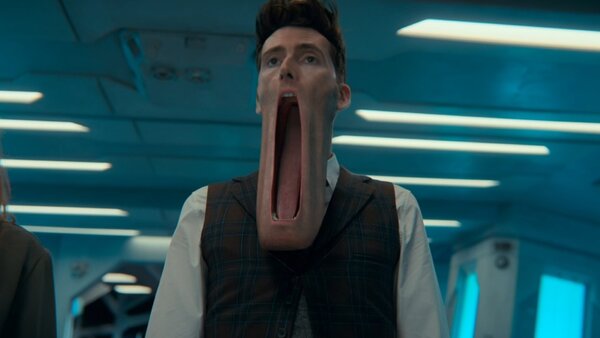
Fourteen’s era is strange by design. We've got three episodes to pick from, and there's really only one correct choice. The Star Beast is a nostalgia fest, and The Giggle is an episode that belongs more to Fifteen and the Toymaker than Fourteen.
But even within a theoretical larger pool of episodes, it still feels like Wild Blue Yonder would qualify as quintessential Fourteen. This episode is the only story of the three that's actually about Fourteen (not Ten, and not Fifteen), and actually does something unique with this Doctor.
Stripped of spectacle, nostalgia and plot clutter, the episode becomes a character study of a man who has, after an exceedingly long life, finally reached his breaking point. For real this time. It presents a Doctor that is distinct from Ten in terms of personality, with the lived experience of Eleven through Thirteen visible in the way he conducts himself.
Moreover, Doctor Who really shines when it's devoid of clutter. Hello Heaven Sent, Midnight, Boom, and many others. Wild Blue Yonder follows suit. Two actors, four characters, one spooky spaceship and a high-concept threat. The Not-Things are perfect for this story – they require no explanation, no answer, and they're simply there to frighten, taunt, and probe our protagonists into giving us that juicy trauma dump.
Tennant and Tate remind us why they were so electric as a partnership in the noughties, masterfully playing both these menacing, uncanny creatures as well as the older, more mature versions of their characters. This is nostalgia done right. Don't put these two in front of viewers and expect them to clap – show us why we missed them, and tell us how they've grown.
If Fourteen exists for any reason, it's this episode. Without it, the 60th anniversary specials would be severely lacking in any sort of substance.
1. The Story & The Engine (The Fifteenth Doctor)

This episode only works because of Ncuti Gatwa. No other Doctor can exist in this story. That alone makes it definitive Fifteen. But don't worry, we've got more justification than that.
The Story & the Engine embraces culture with an authenticity that isn't always present in Doctor Who. The setting isn't just a backdrop, as it would be in other stories – Inua Ellams' script draws from it directly and organically. It presents Lagos through the Doctor's eyes, and what this place means to him, rooting us in the story, and presenting an oft-unseen glimpse behind the curtain.
The episode distils Fifteen’s character beautifully. He's not just a playful, sassy dude – he's contemplative, principled, and understanding. The audience feels closer and more connected to Fifteen as a character in this episode than any other in his run, and it's because, on this rare occasion, it's the Doctor, not the companion, who serves as the audience surrogate.
The Story & The Engine is about the power of stories, and specifically, the power of those who are telling them, and no story sums up the power of the Doctor better than the six words spoken by the man himself: "I'm born. I die. I'm born".
A never-ending story of renewal, change, and hope, that's not just at the core of the character, but at the core of the show itself.