10 Doctor Who Characters You Didn't Realise Probably Died Horrible Deaths
Excuse me, WHAT happened to the Fourteenth Doctor?!

There have been a lot of horrible character deaths in Doctor Who. It didn't get that 'hide behind the sofa' reputation for nothing, after all.
Side characters are repeatedly dispatched in all manner of brutal and terrifying ways, ranging from strangulation, to disintegration, to ray-guns that cause "massive internal displacement." Yeesh.
These deaths are all memorable in their own ways because we get to see them in some capacity. But what fans might not realise is that there is also a sizeable contingent of characters who suffer various ignominious or painful deaths offscreen.
Whether it's companions being abandoned in completely unwinnable situations, side characters dying in ways that only reveal their true horror after you really stop and think about them, or entire civilisations being exterminated between episodes, death has a habit of catching up to everyone, and sometimes, you might not have realised just how horrible those deaths might have been.
10. The Corsair

The Corsair dying offscreen is one of the driving incidents in The Doctor’s Wife, but most people probably don't appreciate just how grim this Time Lord’s death is implied to be.
At some point before The Doctor’s Wife begins, the Corsair is lured into a bubble universe by House, where they are killed and their body is used as spare parts to repair Auntie and Uncle.
Now, an issue with this otherwise straightforward plan is that the Corsair is a Time Lord, and so their body regenerates when it’s damaged. And with expanded media indicating that it was only the Ninth Corsair that was killed by House, it's not even like they were on their final life.
So what exactly do you have to do to a Time Lord to kill them and remove certain body parts without triggering the explosive regeneration process at any point?
It’s worth remembering that the Tenth Doctor had his hand chopped off in The Christmas Invasion while he was still alive and it grew back pretty much straight away, but only because he was still within the first few hours of his regeneration, which wouldn't have been an option for the Corsair.
In other words the poor bloke must've been absolutely butchered, and it makes you wonder just how many tiny pieces he was carved into.
9. Slitheen Skinsuits

The Slitheen are generally thought of as funny farting aliens, and to be fair, that’s not an entirely inaccurate description.
Regardless of your thoughts on their depiction in Aliens of London and World War Three, after Boom Town the rest of their TV appearances were in the more child-friendly Sarah Jane Adventures on CBBC.
But underneath the flatulence and silly-looking faces, there's a darker element of the Slitheen that usually goes overlooked – every single skinsuit they wear was originally a person, and that means all of these people died horrible, brutal deaths, and potentially had their insides removed and skin peeled away while they were still conscious.
As far as Doctor Who deaths go, having all your stuffing pulled out so your skin can be used as a disguise is one of the more conceptually horrible. And the cherry on top is that these people’s families don’t even know! Not only are you murdered, but your loved ones get to keep interacting with the very thing that killed you, blissfully unaware that your remains have been reduced to a high-tech Halloween costume.
And they say this show is for kids.
8. Nardole

Steven Moffat has a habit of giving characters cruel fates before pulling the rug out at the last minute and having a bit of an "everybody lives" moment.
Amy and Rory got to live out the rest of their lives in 20th century New York, Clara is gallivanting around the universe with Ashildr in a stolen TARDIS until she returns to the moment of her death, Bill gets to travel the universe with her semi-omnipotent water-alien girlfriend, and River Song’s data ghost gets uploaded to the Library’s data core.
And then there’s Nardole.
While the poor guy spends most of Series 10 being the Twelfth Doctor’s verbal punching bag and personal butler, his send-off doesn’t actually seem that bad at first, being left in charge of the surviving humans on the Mondasian colony ship. But the thing is, how long can Nardole really hope to last?
The Cybermen have already evolved from janky Tenth Planet-style Cybermen to modern metal ones in the span of a single episode, so they're basically unstoppable. And even if they do outrun the Cybermen, they’re going to run out of spaceship eventually.
The best Nardole can really hope for is spending the rest of his life running away with no hope of escape until he gets deleted. And the worst case is pretty much what happened to Bill, but without any magical space girlfriend to save him in the end.
It’s not the worst fate suffered by a Doctor Who character, but compared to Amy, Rory, Clara, Bill, and River, poor old Nardole got a pretty raw deal.
7. The Thals

After Gallifrey, Doctor Who’s most well-known alien planet is Skaro, home of the Daleks. But something that doesn’t come up very often nowadays is that Skaro is actually the home planet of another alien race too: the Thals.
Introduced alongside the Daleks in Doctor Who’s second-ever story, the Thals were a peaceful species with a violent past, with their generations-long war with the Kaleds leading directly to the creation of the Daleks. After their run-in with the First Doctor, the Thals eventually developed spaceflight, and made it their personal mission to help rid the galaxy of the Dalek menace.
But for some reason, the Thals haven’t been seen on television since 1975. And from this conspicuous absence, it isn't much of a stretch to assume that the Daleks finally succeeded in well and truly exterminating their oldest foes. Either that, or the Thals crashed into some random moon somewhere and died.
The odds certainly aren't good of them having survived the Time War either, especially considering how many different races the war affected, and that even the mighty Daleks were all-but wiped out.
6. John Smith

In Human Nature, the Doctor uses a Chameleon Arch to disguise himself as a human, allowing him to live undetected as mild-mannered English school teacher John Smith.
It’s easy to watch the story and simply think of Smith as the Doctor suffering from a temporary amnesia that gets fixed at the end, but that’s not how other characters talk about it at all.
For all intents and purposes John Smith is a completely independent person from the Doctor, and that person has to die to allow the Doctor to return. An innocent man has to commit suicide for the benefit of someone he’s never met, and, from his point of view, may not even exist.
As viewers we know that the Doctor must come back so it's easy to overlook how traumatizing it must've been for John to pull the trigger, and the fact that it happens offscreen makes the weight of his sacrifice even easier to brush aside.
So while not necessarily as physically horrible as other deaths, John Smith’s end might be the most existentially horrifying. Imagine discovering that your entire life is a lie and that your body actually belongs to someone else – someone who is considered so much more important than you that you are left with no option but to kill yourself so that this other person can return.
Once again, THIS IS A FAMILY SHOW.
5. The Last Humans

Of all the horrible fates suffered by characters in Doctor Who, the Toclafane is up there with the worst of the worst.
These floating metal murder-balls contain the remains of the last humans, who travelled to a so-called "Utopia" in the hope of salvation from the natural end of the universe. Instead, they were reduced to clinically-insane disembodied heads trapped inside miniature death machines.
But while this is pretty horrific in its own right, they’re not technically dead. Some might argue that they’ve suffered a fate worse than death, but that’s besides the point – Creet and the rest of the humans are technically still alive in their Toclafane forms.
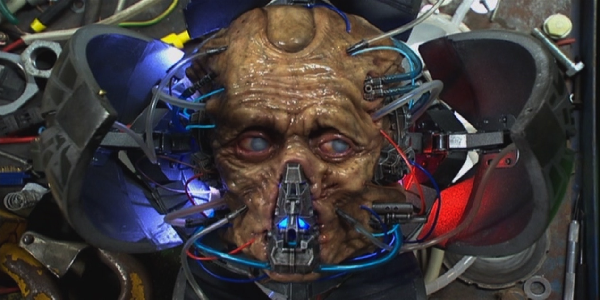
Their actual final end is less graphic, but no less terrifying. When the Paradox Machine is destroyed in Last of the Time Lords, time reverts back to the moment just before the Toclafane arrived on 21st century Earth, sending all of them back to the barren planet "Utopia", at the end of the universe.
All of this means that the canonical end of humanity in Doctor Who is for us to be stuffed inside flying metal balls and forced to slowly experience the heat death of the universe. And not only that, but we get to have the briefest moment of hope before being sent hurtling back to the end of time.
What's that Doctor? "Everybody lives"? Yeah, not quite.
4. Oswin Oswald

Oswin Oswald was a character whose sole purpose was to die, but everyone has forgotten just how terrifying that death actually was.
Whether or not being converted into a Dalek is the same as dying is up for debate, but what isn't up for debate is that Oswin suffered one of the worst fates in the history of the show.
We don't see a lot of what happened to Oswin other than a few quick flashes onscreen, and because she's all happy and charming for 99% of the episode, you might catch yourself thinking that what happened to her wasn't all that bad. But as the Eleventh Doctor explains, she invented a fake reality for herself, full of soufflés and classical music, simply because the truth was too horrible to confront.
Those brief snippets of Oswin being bolted into some kind of Jigsaw trap while the Daleks torture and experiment on her are absolutely brutal. To achieve a full human-to-Dalek conversion would require a lot of chopping and carving, and this is just a guess here, but it's highly unlikely they gave her any local anaesthetic.
At least the Cybermen get to retain their humanoid forms, but to get turned into a Dalek, your body is essentially just meat being warped beyond all recognition. Picture that the next time you tuck into a soufflé.
3. The Fourteenth Doctor

At the end of The Giggle, the concept of bi-generation was introduced to Time Lord biology. Mortally wounded by the Toymaker, the Fourteenth Doctor came down with a severe case of the glowy face... but instead of changing his form, he split in half and created the Fifteenth Doctor.
When we last saw him, Fourteen was on Earth with the Noble family to enjoy some much-needed R&R, which left open so many exciting storytelling opportunities. Will he return in future episodes? Will he have his own line of novels and audio dramas? Or even a full TV spinoff, perhaps?
It turns out that the answer to all of those questions is a big fat no... because he's dead.
That's according to the word of God (also known as Russell T Davies), who has revealed that David Tennant's latest incarnation won't be returning to our screens anytime soon. He said:
"He’s absolutely not coming back. I think he died. I’m going to start saying that. He went to Venice, 2063, when the city sank, and he went into a whirlpool, which is really sad."
Granted, a freak comedy death in 2063 does still leave a good 40-year window for the Fourteenth Doctor to enjoy the quiet life, and granted, RTD is having a bit of a laugh here. And we also know that Doctor Who showrunners are rotten little liars!
But still, it does seem that Fourteen's return is very much off the table at the moment, and saying that he died is a simple way for the producers to put to bed the constant questions about whether or not he'll come back.
2. The General

In the early 2010s, Doctor Who introduced a new recurring Time Lord character for the first time in decades.
The General was in charge of Gallifrey’s defences during the last days of the Time War, and struck up an uneasy alliance with the Doctor(s) before returning to help the Doctor depose Lord President Rassilon.
Across their appearances the General managed to develop an entertaining dynamic with the Doctor, with the two being polar opposites while still having a lot of respect for each other. It’s a relationship that had potential for the General to become a recurring character like Madame Vastra or Kate Stewart – so it’s a shame they’re almost certainly dead.
Considering how utterly destroyed Gallifrey is in The Timeless Children, and that the General was, the last time we saw them, still in a position of power, it's safe to assume that they were one of the many victims of the Master’s bloodthirsty rampage. And given the Spy Master’s affinity for inventively painful ways of killing, we can’t imagine the General didn't suffer on their way out.
The same goes for the rest of the Time Lords too, many of whom also suffered a rather undignified afterlife due to being converted into CyberMasters. The Spy Master was crazy even by Master standards, and after discovering the secret of the Timeless Child – which sends him into a pure rage – you can bet that he wanted to make the Time Lords pay in the most painful way possible.
1. Madame de Pompadour

The original girl who waited is one of the most memorable side characters in the Tenth Doctor’s era, and her tragic death at the end of The Girl in the Fireplace has helped it become one of the most highly-regarded episodes of modern Who.
In that final scene, the Doctor returns to Versailles to invite Madame de Pompadour to join him in the TARDIS, only to discover that she has died of an illness while waiting for him.
Her letter paints a tragic but somewhat romantic picture of Reinette slowly succumbing to some vaguely defined illness, but assuming that the Whoniverse follows the character's real-world history, the truth is far worse.
Madame de Pompadour actually died of tuberculosis. Also known simply as "consumption", TB is a horrible disease that tends to attack the lungs, and is one of the most lethal and painful in history.
While Reinette’s letter makes it clear that she is sick, it's still a somewhat optimistic image and the episode never goes into great detail. As a result, those unfamiliar with the character's real history probably didn't think twice about the awful manner in which she actually went out.