10 Doctor Who Mysteries You Didn't Know Were Answered
You've heard of Chekhov's gun, now meet Steven Moffat's duck pond...

Doctor Who is the question that must never be answered, but that's no excuse for leaving so many unanswered questions all over the place for the past 60 years. However, the answers to some of these mysteries have been provided – you just need to know where to look.
In the modern media landscape, it seems like every screenwriter is interrogated in the press, forced to explain any glaring "plot holes" or bits of ambiguity. We've seen Russell T Davies do this at San Diego Comic-Con recently, trying to diplomatically answer an ill-tempered question about the Shalka Doctor.
Often, various mysteries remain unanswered due to production reasons – lines of dialogue being cut for time, filming locations being unavailable, things like that. It's frustrating, but it's an unfortunate reality of making a TV show as demanding as Doctor Who.
Thankfully then, our Doctor Who showrunners, actors, and writers of spinoff media are always on hand to explain what the answers to some of these tantalising mysteries are, while other answers are easily missed within the show itself!
10. Who Was The Woman In Abu Dhabi?

There are a couple of lines in The Star Beast that feel like they might be setting up something for the future, such is the curse of online discourse. For example, was Donna's assertion that you should never trust a man with a goatee a hint that the Master was around, or was it just some solid life advice?
Also, Donna's extended riff on the grown woman from Abu Dhabi who is "obsessed with gonks" never went anywhere in The Star Beast, or the remainder of the 60th anniversary specials.
It's been theorised that she might've been one of Sutekh's Susan Triad minions, but this was never explicitly stated. So who was this mysterious woman? And why was she obsessed with gonks?!
Well, Gary Russell's novelisation of The Star Beast reveals the woman's identity as Leila Krishnam. It's revealed that Leila's father is very impressed by Rose's work, and that her gonks make Leila the envy of all her friends.
So quite why Rose has to slum it doing admin work for UNIT on weekends rather than establishing thriving business links with Abu Dhabi to sell her toys is anyone's guess.
9. Who Was GUS?

Representing a shady organization that wanted to capture the Foretold, the mysterious computer GUS had been trying to ensnare the Doctor since his eleventh incarnation.
So it seemed incredibly odd that by the end of Series 8's Mummy on the Orient Express, the Twelfth Doctor never tried to learn more about GUS and what he actually was.
None of Jamie Mathieson's subsequent scripts brought back GUS either, leaving it as one of the biggest loose ends of the modern era. But that doesn't mean no answers exist!
In a blog on his website, Mathieson detailed his original plans to incorporate GUS into Series 10's Oxygen, which were abandoned when it was felt that it lacked impact as an ending.
In the original version, the sign that Bill sees read "Ganymede Systems – putting the YOU in User". That would've given us "Ganymede User Systems" – or GUS for short.
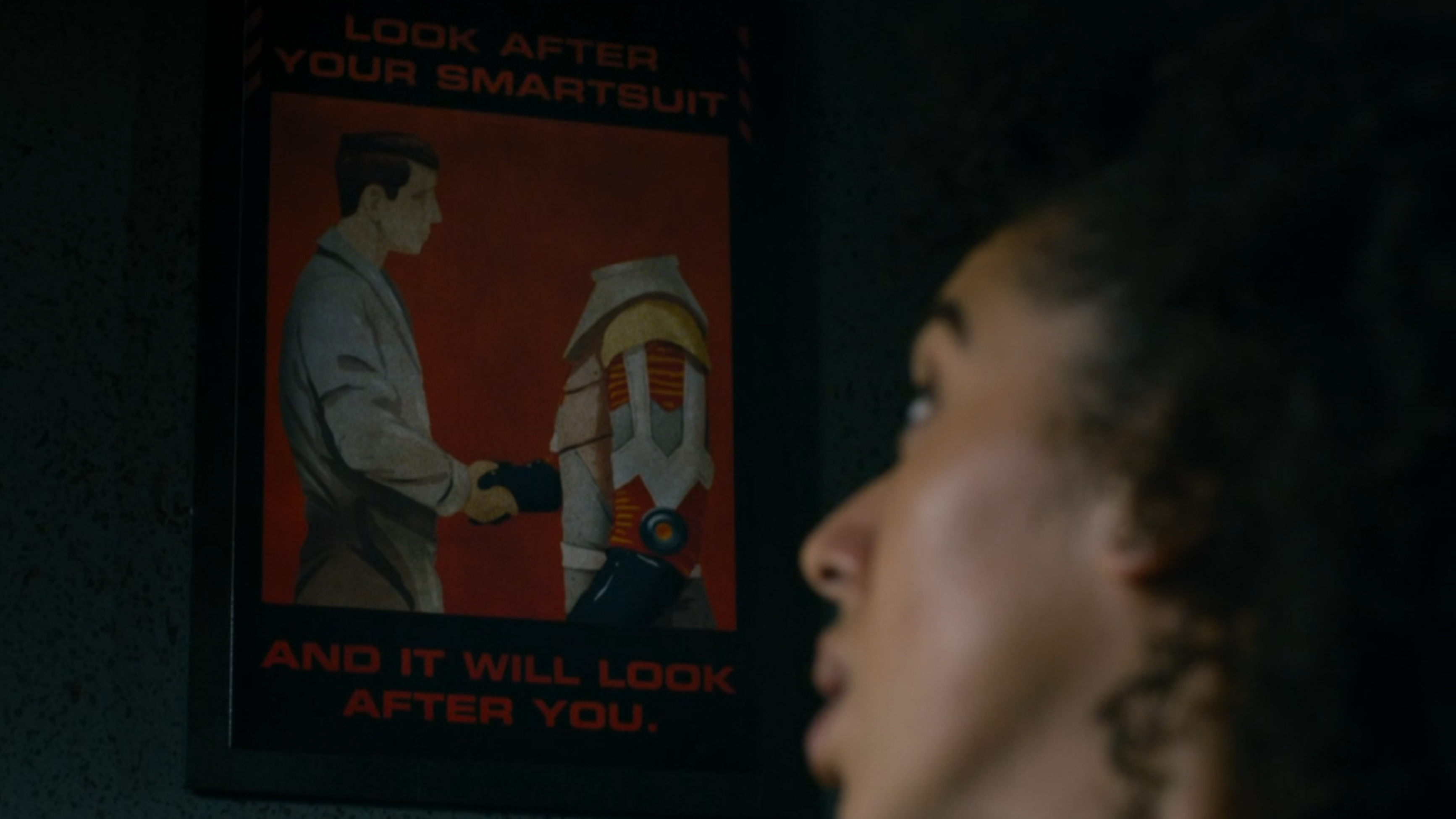
Then, at the episode's climax, the Doctor contacted Ganymede's Head Office and defeated a nefarious executive called Kline, who would've had the exact same voice as GUS.
It's a little convoluted and it's no surprise it was dropped, but it works perfectly well as head canon!
8. When Did Ace Leave The Seventh Doctor?

Because Doctor Who went off the air in 1989 and never returned until 1996, Ace's departure was never depicted onscreen.
The original intention was reportedly to leave Ace on Gallifrey, where she would train to be a Time Lord. However, there are other tellings of the day the Doctor and Ace parted company in the expanded universe.
The 2020 novel At Childhood's End recounts the Seventh Doctor and Ace's last day together, in parallel with her first meeting with the Thirteenth Doctor. While the canonicity of that novel is now thrown out of whack by The Power of the Doctor, you can still sort of make it fit if you squint hard enough.
However, it's Tales of the TARDIS that gives us the most definitive date for the Doctor and Ace parting company in televised Doctor Who. Discussing their last day together in the Memory TARDIS, the Doctor states that "the Rani was up to her old tricks."
Given that the only time Seven and Ace faced the Rani together was in the 1993 charity special Dimensions in Time, we can definitively call that Ace's final story.
And if you've ever seen Dimensions in Time, you can completely understand why Ace would want to get shot of the Doctor soon after.
7. Why Was There A Twist At The End?

There were a lot of people who watched Ncuti Gatwa's first Doctor Who season that wondered why the show kept breaking the fourth wall.
But for some, even weirder was the moment everyone suddenly broke into song at the end of The Devil's Chord, for seemingly no reason whatsoever.
Unlike other moments in RTD2 though (cough Ruby's Mum cough), the big song and dance number felt like a natural conclusion to what went before, considering that music was at the heart of the episode, and was shown to possess great power.
The actual, scripted reason for There's Always A Twist At The End was revealed by Russell T Davies in the pages of SFX magazine, who explained that the Doctor was originally going to say:
"Time’s gonna go crazy now, music is flooding back in, and everything’s gonna be strange for 10 minutes."
It's odd that such an incredibly quick moment was cut, as is RTD's justification that offering an explanation was "boring".
Hopefully he doesn't take the same approach with Mrs Flood...
6. How Can The Doctor Remember Heaven Sent?

In Heaven Sent, the Doctor spends 4.5 billion years inside the confession dial. Each time he dies, he powers up a machine that beams in a brand-new Doctor. So surely, the final Doctor that breaks through the wall cannot possibly remember every moment of those 4.5 billion years.
So why does he say that he can "remember it all" at the end of each loop? Massive Time Lord brain or not, that's a lot of memories to keep in one head.
Steven Moffat discussed this in Doctor Who Magazine #495, in answer to a fan's question. Moffat's belief is that the Doctor essentially creates those memories for himself. When he understands that he must break through the wall and when he notices all those skulls in the water, he realises that he's been doing this for a very long time, and the weight of all those centuries becomes his memory.
He doesn't necessarily remember every single detail, but each version of the Doctor realises that they've been there for thousands, millions, billions of years each time they get to the diamond wall.
As an extra flourish, Moffat also suggests that the Doctor remembers because the confession dial won't let him forget, saying that:
"In a world designed to suck your bad dreams from your mind and feed them back to you, isn't it possible that his worst day - the one he's living right now, again and again - is hanging in the air around him?"
Oh Moffat, you clever sod.
5. Who Was On The Laptop?

After The Power of the Doctor went out, there was much speculation about an empty chair at the companion support group. Was it a tribute to the much-missed Elisabeth Sladen? Had Anneke Wills been unable to attend filming?
A cursory glance at the script for the episode reveals the truth, because everyone who appears onscreen is named in Chris Chibnall's stage directions for the scene. The script also reveals that a laptop is supposed to be set up on the empty chair, which would've been connected to other companions Zooming in.
The companions that Chibnall wanted to appear on Zoom were Martha or Ryan or Jackie Tyler. The laptop isn't even visible in the final scene, but his choice of characters is interesting.

For one thing, it's strange that Ryan didn't appear on the laptop. Tosin Cole wouldn't have even needed to film new material, as they could've reused his vlog clips from The Woman Who Fell To Earth. And as for Martha, we seem doomed never to get an update on Doctor Jones.
And quite how Jackie Tyler was Zooming in from Pete's World is a whole other Doctor Who mystery to be solved! Maybe she's just more powerful than we thought.
4. Who Put That Sofa There?

Sylvester McCoy is an actor who has never knowingly turned down the opportunity for a comedy pratfall. Case in point, Survival Part Three – the final episode of Classic Doctor Who – in which the Doctor hops on a motorbike for a life or death game of chicken with Midge.
Midge is burned and mangled in the collision while the Seventh Doctor... ends up head-first in some sofa cushions? It's the sort of all-too convenient resolution that makes Doctor Who fans either roll their eyes with disgust, or hoot with laughter.
But seriously, how on Earth did the Seventh Doctor dismount an exploding motorbike and end up with his head between the sofa cushions without a single scratch?
Step forward Paul Cornell, whose 30th anniversary comic Emperor of the Daleks explained that the Seventh Doctor had a bit of help. At the end of the story, the Sixth Doctor asks if his future self "appreciated the mattress in Perivale?"
Now, yes, it wasn't a mattress, it was a sofa. Which means Paul Cornell either forgot this, or, more excitingly, the Seventh Doctor leapt from an exploding motorbike, bounced off a mattress, and landed headfirst on an old sofa.
If they'd aired that in 1989, Doctor Who's future would've been assured all the way through the 1990s!
3. How Did Captain Jack Become The Face Of Boe?

Though some fans still don't believe it, Captain Jack Harkness is indeed the Face of Boe.
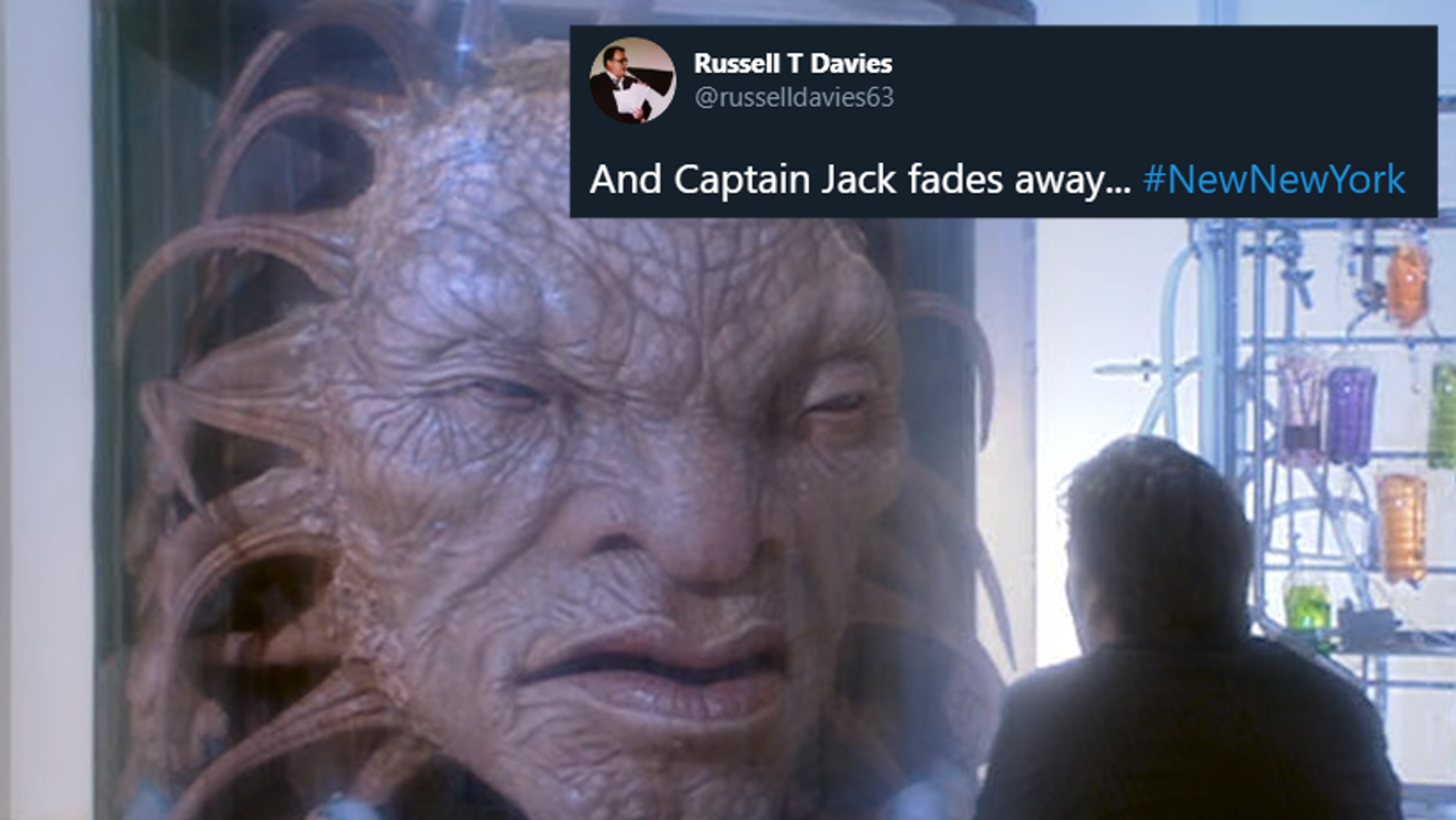
Aside from being more or less explicitly confirmed in the Series 3 finale, Russell T Davies also reiterated his intent during a lockdown tweetalong of New Earth, referring to the Face of Boe as Captain Jack during the scene where the giant pickled head fades away.
During another lockdown watchalong – this time for the Series 3 episode Gridlock – RTD was at it again, offering an explanation for how the handsome Time Agent ultimately ended up looking like the Face of Boe.
The answer? Time.
As RTD put it, after five billion years of growth, "extraordinary changes" must happen. Jack may have been immortal but he never stopped growing or ageing, and after living for such a comically long time it's understandable that something weird might have happened to him.
So… why does Captain Jack looks like that after 5 billion years? The question is, why not? Have you seen how your ears keep growing, your nose? After FIVE BILLION YEARS, extraordinary changes must happen. And here they are! #NewNewYork
— Russell T Davies (@russelldavies63) May 30, 2020
There's also the theory that Jack was decapitated by the Headless Monks at some point, and it's his head that grew into the Face of Boe.
Jack was set to appear in A Good Man Goes To War at one point, so there's no reason both of these explanations can't be true!
2. Is The Duck Pond Important?

Part way through The Eleventh Hour, the Doctor and Amy are walking through Leadworth's village square, and he points out that the duck pond doesn't have any ducks in it. Amy replies that there's never been any ducks in the pond, but they call it that anyway.
Rather than being one of Steven Moffat's many throwaway gags, the duck pond exchange is framed as something important to be paid off later, which it never was. But that wasn't the original plan.
Moffat has answered the question of what was going on with the duck pond at least twice – once in his Doctor Who Magazine column, and again in a recent interview with Inverse.
His original intent was to reveal that the ducks had been victims of the crack in time, and like Rory and Amy's parents, had been erased from time. The ending of The Big Bang would've seen the TARDIS dematerialise from Leadworth village square, to reveal the ducks back in the pond.
Unfortunately, unpredictable weather meant that they were unable to shoot the scene. As a result, it was relocated to the more controllable environment of Amy's back garden, losing the duck pond resolution altogether. How ri-duck-ulous.
1. Why Does The Doctor HATE Pears?

"Never ever eat pears" was one of the pearls of wisdom the Twelfth Doctor imparted to his future incarnation before regenerating.
But why did he feel this was so important to pass on? Why doesn't the Doctor like pears? Is it the fact that you can spend so long waiting for them to ripen that you miss the one day that they're actually edible?
Well, the Doctor's dislike of pears spans multiple incarnations and mediums. In a throwaway line in Hell Bent, the Twelfth Doctor explains why he doesn't like them when he describes them as "too squishy", resulting in your chin always being wet.
This was a nod to Paul Cornell's novel Human Nature, in which the Seventh Doctor insisted that he not be allowed to eat pears while he was living as a human.
This detail was retained when Cornell adapted Human Nature for TV in 2007, where the Tenth Doctor told Martha via recorded message that he absolutely loathes pears.
Annoyingly, this dialogue was cut from the finished version, meaning that the scene where John Smith casually eats a pear while checking on the fob watch lost its comic impact.
Also... pears aren't that bad mate, come on.