10 Doctor Who Real Life Alternate Timelines

What if Doctor Who had turned left instead of right? Would Earth survive?

Lifelong Doctor Who fans can consider ourselves blessed. Unlike those pesky Trekkies or annoying X-Philes, we've been fans of a show that, apart from a few brief hiatuses (and one fairly long one) has been on our screens for half a century now. With that long and expansive a history, there are many other directions the show could have taken. It may seem odd to be considering alternate realities and possibility spaces lurking within the trousers of time, but it's something the show has certainly dealt with before. In the episode Turn Left, the Doctor's companion Donna Noble is offered the chance to see what her life would be like if she had made a different decision. Our speculations won't have the same effects on the universe that Donna's decision did, of course, but that's not to say their not worth thinking about at all. It's not secret that Doctor Who has narrowly escaped damnation over the years, often by a hair's breadth. What if that had actually happened? This article is purely speculative, designed to generate discussion and debate. It also addresses the show from a real-world production point of view, though there may be a plot-related What If here and there. Let us know what moments in Doctor Who history you've similarly wondered about for future lists.

10. What If Peter Davison Had Stayed After Caves Of Androzani?
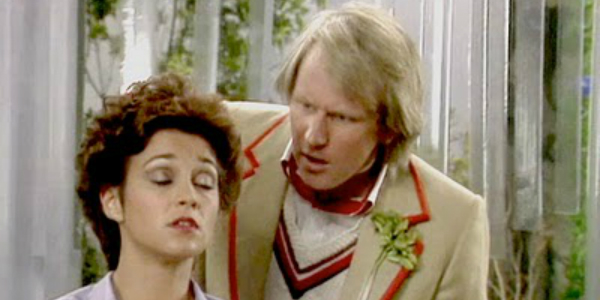
Peter Davison left Doctor Who in 1984 after only three years in the role, for a variety of reasons. One: Patrick Troughton advised him to stay three years to avoid being typecast, advice he passed along to Sylvester McCoy (who eventually had no choice in the matter) and David Tennant (who did). And, in his words, the scripts were 'crap'. But then The Caves Of Androzani came along, and Davison felt a brief pang about leaving just as the scripts developed. So, what if Davison had reversed his decision and decided to stay for another year, or even two? Davison might have been disappointed - he wouldn't have enjoyed The Twin Dilemma nearly so much. It's also hard to imagine that the Season 22 scripts would've remained quite so violent with the Davison Doctor in the lead, either. Let's imagine, though, that the same scripts were on the table for the Fifth Doctor as for the Sixth. A proper meeting between the Fifth Doctor and Lytton would be interesting, though the outcome wouldn't be too different. Vengeance would be a very different story with Doctor Five, though, as would The Two Doctors. Having written a violent script with the Fifth Doctor in before, would Robert Holmes have really toned down the latter story that much? It's honestly hard to imagine those stories with Davison because the tone of those stories is so bleak and so dark - so very much a Colin Baker tone. Was the drop in ratings for the 22nd season less to do with the longer run-time and more to do with the increased violence, leading to the 18-month hiatus and the subsequent Trial of a Time Lord season? We're not blaming Colin Baker, mind you - tone comes down to script editor and producer, not the lead. But would any of these events have occurred if Davison had stayed on?

9. What If The BBC Had Never Erased Any Of The Episodes?

In the '60s and '70s, the BBC erased videotapes of Doctor Who after they were broadcast, or copied to film for overseas sale and then destroyed. These days, everything can be and is stored for posterity. But what if the BBC had retained all episodes of Doctor Who? Entire sub-branches of Doctor Who fandom would never have existed. Who cares about rare telesnaps by John Cura or off-air recordings by fans such as Graham Strong or David Holman if you can pop in a DVD to see any episode you wanted? The series' success would have continued along the same lines as it has either way, only with a great deal more material for the BBC to release for syndication, then on video, and then to DVD and digital formats. The quality of those earlier episodes wouldn't be nearly as good, though. Those episodes look as good as they do because of the VidFIRE technique developed by Peter Finklestone to address the quality drop caused by telerecording a videotaped programme using a film camera. We'd like to think that Finklestone would have developed the process anyway, and as those of us who still have the un-VidFIREd Tomb of the Cybermen can attest, it's better with VidFIRE than without it. Then there are the reconstruction artists that got their careers started trying to marry telesnaps with existing audio to create watchable (and not so watchable) versions of those lost stories, and the recolourised versions of the Pertwee episodes that were telerecorded in black and white... What would happen to them? Still, we're sure many of us would love to have a grainy copy of the fourth episode of The Tenth Planet, or an even grainier copy of Power of the Daleks, than a reconstruction, or none at all.

8. What If The 1996 TV Movie Had Gone To Series?

To some people, the idea that the 1996 TV movie could have gone to series is frightening enough. But even more frightening, if it had gone to series, perhaps we'd have had no 2005 series at all. The main reason why the backdoor pilot didn't get picked up was it aired opposite the Roseanne finale, and as disappointing and dumb as that finale was, it still pulled in all the viewers that Tuesday night. Let's imagine the Roseanne finale had aired another time, and somehow a TV movie based on a British television series which most Americans felt was the province of PBS geeks and nerds was the ratings hit that Fox needed it to be to commit to making a series. For one thing, British fans still have trouble with what they see as 'Americanisms' in the movie, and there would be far more in a series. For another, while the '90s was a fertile period for TV science fiction, not all of it was good science fiction. For every X-Files and Sliders that Fox produced, there were also shows like The Visitor, which no one remembers. While we'd like to think that Doctor Who is so brilliant that it can't be screwed up that badly, we have only to look at Dimensions In Time to know that it can. Also, by the 1997-98 television season, Fox was already producing The X-Files and Millennium (remember that?) and had started The Visitor. If they'd done Doctor Who instead of The Visitor, it would've aired on Friday nights at 8, where it might have suffered the humiliation of being beaten in the ratings by such fare as Sabrina The Teenage Witch and Boy Meets World. Let's say Fox put Doctor Who on opposite some other genre show to fight it out. Wednesday nights were out - Star Trek: Voyager aired that night, but Fox still had Party of Five on. If Fox had given up their Tuesday Night Movie slot - which is where the movie premiered - they could have aired Doctor Who opposite another series which had just begun the spring before: Buffy The Vampire Slayer. Um. Let's put ourselves in the shoes of those viewers. Which show would you rather watch on a Tuesday night: an Americanised knock-off of a British show, or Buffy? There's one other thing to consider: the half-human thing. Sure, the Doctor jokes about it later in the movie, but the Master notes it first. We've all been able to ignore this pretty easily - but if we'd gotten a TV series, not a chance. And finally, it's doubtful it would have lasted long - and that might have prevented the BBC from ever doing a series to begin with, even in 2005. Besides, who would want to see the Daleks again if they sounded like that? Speaking of Daleks...

7. What If Terry Nation's Dalek Series Had Been Picked Up In America?

Evil of the Daleks was touted as the final end for the Daleks - in Doctor Who, anyway. Terry Nation wanted to shop his lucrative property around, and he planned to sell a Daleks-only series in America. Nothing happened, of course, and Nation soon realized that the only way he could make money with Daleks, apart from licensing, was with Doctor Who. But what if there had been a Dalek series produced in America sometime after 1967? Science fiction on American television in 1968 consisted only of Star Trek (by then doomed on Friday nights at 10pm) and the newly-premiered Land of the Giants. This lack of competition would've been good news for any network doing the show. In the previous season, it would have been up against a much stronger Star Trek, Lost in Space, Voyage to the Bottom of the Sea... A Dalek series would definitely have been in colour, though, and it would have looked good, especially with ABC or CBS producing it. Whatever else can be said about Giants and Lost in Space, they (sometimes) looked good. An American series would likely have used those gorgeous colour Daleks from the movies, and shooting on film means we'd likely have Blu-ray versions of the series on disc by now. But what would the plot be? Similar to Mission to the Unknown, probably. Marc Cory would be brought back from the dead to fight the Daleks at every turn - but where would the series go? And speaking of Americanisation, we've already seen how the Daleks sound in an American production, and that was the decision of a British director. Both The Prisoner and The Avengers were successful in America, but they were imports. It would make no sense for an American-produced series to retain the accents. Think about that: Daleks...with American accents. Even those of us brought up in America would shudder at that. Also, American sci fi series back then were short - the longest lasting no more than three seasons - and it's not clear how well Daleks would have done in the ratings. No one in America knew about them. The first movie was not released in the U.S. until July 1966, while the second movie wasn't released theatrically in the States at all. A Dalek series would have made much more sense if the BBC had produced it, even with the same production standards as Who. Terry Nation would then be in something of a pickle, though, since bringing them back to Doctor Who would no longer be so easy due to rights problems. Imagine the problems involved releasing the 1996 TV movie in America on DVD, only amplified. Would we really want a Dalek-less Doctor Who - even if we got a neat-looking Blu-ray set out of it?

6. What If Hartnell Had Been Forced Out During The Celestial Toymaker?

By 1966, producer Innes Lloyd was so fed up with William Hartnell that he wanted Hartnell gone. In The Celestial Toymaker, the Doctor is made invisible, and Lloyd wanted a different actor playing the Doctor when he reappeared. Since Hartnell was on vacation during the making of those episodes, it was considered an easy (albeit cowardly) way to force him out. BBC€™s head of serials Gerald Savoy quashed this before it could happen. But what if the fourth episode (which still exists) had featured the Doctor returning with a different face? We wouldn't still talking about Doctor Who, for one thing - the series might not have made it past the 1960s. One reason for the show's longevity is regeneration. Regeneration has always allowed for a renewal not only of the lead actor but of the entire series. Even during the '80s, when the producer remained the same, there are three distinct eras of Doctor Who, and the change in actor generally lead to a (temporary) ratings bump that kept the show going. Worst case scenario: the actor chosen as the Second Doctor wants to move on after three years to avoid being typecast (as, indeed, he did). Would new producers have come with the idea of regeneration anyway? Or would they have figured that they couldn't possibly spring another far-fetched face change on the audience again? If they don't, Doctor Who does not carry on past 1970; it never gets syndicated abroad; and it has a small fan following (similar to Doomwatch) rather than a worldwide one. Worst of all, all of the episodes are missing because no truly devoted fans are trying to keep them from being destroyed. Good thing Lloyd didn't get his way.

5. What If Tom Baker Had Returned For The Five Doctors?

In 1983, producer John Nathan-Turner tried many times to get Tom Baker to participate in the anniversary that year. Baker eventually passed on the part, Terrance Dicks redrafted his script, and clips of Baker from the unfinished story Shada were used. But what would have happened if Baker had agreed to return? This one is less speculative: on the 20th anniversary DVD, Dicks revealed that, if Baker had returned, the Fourth Doctor would be the one to steal the transmat device from the Master in the Death Zone. He would then go to Gallifrey, get involved with Borusa, and betray his fellow Doctors. This is based on Dicks' belief that, if any Doctor were to go over to the Dark Side, it would be the Fourth. This does make you wonder whether fans would've accepted the Fourth Doctor going rogue. We've seen this once before, in The Invasion Of Time - but there, he was pretending to betray Gallifrey in order to save it. In Dicks' original version of the story, he would actually have joined Borusa's side. So how would the Doctors get out of this predicament? With the Fifth Doctor on their side, would they have banded together to contact the Fourth Doctor's mind to show him the error of his ways? Or would he somehow be dealt with by Rassilon in the same way that the Master is? There are loads of possibilities here, some of them downright uncomfortable, and it's not clear that the fans at the time would've much cared for a Doctor not only acting evil but being evil. Dicks admits it was better for the story that the Fifth Doctor be the center of attention. If Baker had participated, though, he might've been more willing to participate in the Big Finish audios from the start. It's doubtful that his participation in Dimensions in Time would've been affected, though - pity, that.

4. What If Rose Tyler: Earth Defence Had Actually Been Made?

After Billie Piper left in 2006, showrunner Russell T. Davies began working on a 90-minute special called Rose Tyler: Earth Defense. It have have focused on Rose working with the alternate Torchwood and would have featured the alternate Jack Harkness, Gwen Cooper, and Adam Mitchell. It also would have featured the Slitheen and dinosaurs. The BBC commissioned the special, and Billie Piper agreed to participate. But at the last moment, Davies decided it would cheapen Rose's final scenes in Doomsday and it was unfair for fans to see Rose without the Doctor getting to do so. But what would have happened if we'd gotten that special? She'd probably still return for Season Four. In fact, Rose having these adventures with the alternate Torchwood would probably lead her to take the actions she does to preserve Donna Noble's timeline. And while Davies may have felt at the time that it would be unfair for us to see Rose, we're now unable to see either Rose or the Human Doctor. Maybe it's time to dust off the script for this special, write the Human Doctor in, and make it into The Doctor And Rose: Earth Defense? Would we have gotten so tired of Rose as a result of this special that we would not welcome her return in Season Four, though? Spin-off exhaustion could have been a real possibility. At that point, we already had Torchwood, The Sarah Jane Adventures, Doctor Who Confidential, and (shudder) Totally Doctor Who. Would a Rose Tyler special have been a bridge too far? Depends on how much you like the character, probably, or on whether you believe there's such a thing as too much Doctor Who (by the way, we don't). And on a related note...

3. What If Rose And The Human Doctor Had Been Given A TARDIS?

Towards the end of Journey's End, Rose Tyler is returned to the parallel universe with what we've been calling the Human Doctor. In a scene that was filmed but not aired, the two are given a piece of TARDIS coral with which they can grow their own TARDIS. The lines were removed from the final edit because they complicated the scene too much, but Russell T. Davies has been quoted as saying that fans can assume that the part of the scene actually happened. In this case, it's not so What If as What Might've Happened? From a production point of view, including these lines might have given Stephen Moffatt a different way of including the Tenth Doctor and Rose Tyler in the 50th anniversary story, seeing as the Human Doctor and Rose could somehow have used their newly grown TARDIS to jump universes. But from a storytelling point of view, it creates several disturbing possibilities. For one thing, we have to assume that he survives for any period of time, seeing as Journey's End never tells us why or whether the Human Doctor is any more likely to survive a metacrisis than Donna Noble is. Let's assume he does, and that he and Rose now have a TARDIS. Given the Doctor's wanderlust, it's unlikely they'll stay on Earth for long after the TARDIS is ready to go. Is there a Doctor already in that universe, since there's already a Torchwood? Is there a Gallifrey? And scarier still - are there Daleks? If there are, then Rose and the Human Doctor might be better off staying home, as there are plenty of people out there who might want to kill the Doctor - including another Doctor. Even if the other universe does not contain all of these potential threats, it's still a dangerous place - and this Doctor cannot regenerate. The Doctor's companions have been, on the whole, lucky - very few of them have died out there. The same can't be said about the Doctor himself, who is, to paraphrase his own words about Rose, 'jeopardy-friendly'. How long would it be before the Human Doctor goes and gets himself killed, for good, leaving Rose stranded on some alien planet, if she herself survives? Better they remain Earth Defenders than to go out there where somebody could get seriously hurt - but it's not much safer here, is it?

2. What If K-9 And Company Had Gone To Series?

With the passing of Elisabeth Sladen a few years ago, we lost one of the most beloved companions ever. We also lost The Sarah Jane Adventures, which some people are less upset about. We did get some terrific cameos by two Doctors and another former companion, but for the most part, the show was what it was meant to be: a kids' programme, in a way that Doctor Who itself never really was. Things might have been very different if the first attempt to give Sarah Jane her own show, K-9 and Company back in 1981, had gone to series. While the special got decent ratings, the new BBC controller Alan Hart wasn't keen on it, and so it never went into regular production. What if it had? Hopefully the writing would have gotten better. Nearly everyone disliked Terrence Dudley's script, including Lis Sladen, and the finished product feels more like a murder mystery than science fiction. Sarah Jane would eventually investigate alien threats on Earth, much as she would do in SJA, though her only young sidekick would have been her aunt's ward Brendan, who is a good deal easier to take than Luke and the rest of SJA's Scooby Gang. And much like the latter series, a K-9 and Company series would have allowed the appearance of many of Doctor Who's regular villains - possibly even more of them, in fact - and the setting might have resulted in stories closer to the Jon Pertwee era of the show, with Sarah taking more of the lead. Also, though Sladen was active during the production of SJA, she was still much more in her prime in the '80s (the occasional tumble down a gentle incline notwithstanding). On the other hand, the jogging and the karate kick we could do without. It's sheer speculation to try to guess how long such a series might have lasted, though it's doubtful it could have run for long. Sarah and K-9's appearances in The Five Doctors might have given the show a ratings bump, though, and we might have seen Davison or even Colin Baker make a cameo appearance before the series ended. And would it not have been wonderful to see the Tom Baker Doctor working alongside Sarah Jane one more time? We'd likely still get the K-9-free audio dramas regardless. As for the Sarah Jane Adventures... While there's no reason School Reunion could not still have happened, a second spin-off would have been unlikely. It's up to you to decide whether that would have been a win or not.

1. What If Doctor Who Had Never Been Made?

Question Mark To quote the Master, 'a Universe without the Doctor scarcely bears thinking about.' The obvious answer to this one is that you wouldn't be reading this article, nor would we be writing it. And don't be nasty and say that would be a plus, either. But seriously: what has the impact of Doctor Who been on our culture? Some would argue that franchises like Star Trek and Star Wars have had more of an effect, but we would not be one of them. The absence of Doctor Who means all of the leads in science fiction programmes and movies would fall into the Captain Kirk-Han Solo-Buck Rogers model: handsome, rugged, virile, highly sexualised, and unquestionably heterosexual. The TV Movie and the 2005 series making the Doctor into a character capable of romantic interest doesn't negate the 25-plus years when he wasn't, and that has had an impact on young fans who would later become fans and even writers. Another impact is on our language. The terms TARDIS, Dalek, Cybermen, and even police box are no longer single descriptors limited to explaining a concept specific to a single TV show. They instead each invoke a set of connotations that transcend their denotative meanings in the dictionary. (That's something to consider, too: the word 'Dalek' now appears in the OED.) We'd not only lose the word, we'd lose the concept. Sure, we'd still have 'Nazi' to fall back on, but the word 'Dalek' describes a concept with its own brand of evil and horror, an even more universal one. The Nazis were evil, but they were still human beings (despite all evidence to the contrary). The Daleks never were. Such an alien evil is hard to imagine outside of the works of H.P. Lovecraft or Ambrose Bierce. What about all the writers, actors, producers, filmmakers, artists, and other professionals who entered their field or took a different direction because of their interest in Doctor Who? Would we still have a show like Sherlock, or David Tennant's acting career, or the works of Alan Moore, without Doctor Who - or if we did, would they be just as brilliant? Isn't it a wonderful thing that we live in a world where we don't know the answer to that question? We'd like to hear your answers to some of these questions, and we'd especially like to hear some of the What Ifs you've asked yourself over the years about Doctor Who, so feel free to discuss all of this in the comments section below!

Contributor
Contributor

Tony Whitt has previously written TV, DVD, and comic reviews for CINESCAPE, NOW PLAYING, and iF MAGAZINE. His weekly COMICSCAPE columns from the early 2000s can still be found archived on Mania.com. He has also written a book of gay-themed short stories titled CRESCENT CITY CONNECTIONS, available on Amazon.com in both paperback and Kindle format. Whitt currently lives and works in Chicago, Illinois.