10 Doctor Who Villains Who Should NEVER Return
From the mighty to the not-so mighty, which of Doctor Who's villains should never return.

Doctor Who remains one of the longest-running series on television and currently holds the title of longest running science fiction series in history. It has been running since the 23rd November 1963 and has given audiences some of the best and – let’s face it - worst villains of all time. From the genocidal Daleks to the spine-chilling Weeping Angels, the Doctor has come up against it all, and with a hero as captivating and brilliant as the Doctor, the villains need to meet the same standard, but sometimes this is not always the case.
This list will not only look at the worst Doctor Who villains that should never return, but also the villains that while perfect and brilliant in their own right, have either been over-used or have left such an impression already, that bringing them back would almost be detrimental to their memory.
10. The Abzorbaloff

The Abzorbaloff was a wild card in Doctor Who's pantheon of monsters and villains. Only appearing Love and Monsters, the monster was actually designed by a young fan as part of a competition run by Blue Peter. Viewers were invited to create their own Doctor Who monsters and send them in, with the winners' design being used in the actual show.
Played by Peter Kay, the Abzorbaloff's key characteristic was that it literally "absorbed" it's victims into its body, but the victims themselves were fully conscious and aware- but incapable of escaping. Scary, right? It could have been. Peter Kay was arguably a more menacing character in human form, but the big reveal of his true nature was more laughable than frightening.
It didn't help that the episode's tone was a bit all over the place and inconsistent, with the narrative following Elton Pope played by Marc Warren, who had joined a club made up of people who had all had previous encounters with the Doctor.
Doctor Who has had some quirky monsters before, but seeing Peter Kay run around in a big, green fat suit is not something that needs to make a return.
9. The Slitheen

First seen in Aliens in London during the revival series of Doctor Who, the Slitheen were a family of galactic criminals who sought to take over the Earth so that they could sell it to the highest bidder. Their wide-eyed, bloated appearance, and sharp claws could be interpreted as a design triumph, and the fact that they wore human skins as suits was a suitably nightmarish concept for a classic Doctor Who villain, had it not been for the fact that you could see the obvious zip across the forehead.
There were however some moments that showed potential. Particularly in the episode Boom Town, that focused on one of the survivors. The fantastic dialogue and great acting were solid pros, but the legacy of the Slitheen soon resorted to flabby paunches and childish farting that while may have kept the children entertained, were not the traits that we would associate with a classic Doctor Who villain who we can't wait to see again.
Following their appearance in Series 1, the Slitheen then went on to appear in the spin-off show The Sarah Jane Adventures, but with an even smaller budget. The Slitheen were not done any favours. They then went on to make cameo appearances in later Doctor Who seasons, being present in The Pandorica Opens and part of the fleet surrounding Trenzalore in The Time of the Doctor, but after many attempts at trying to promote them as monsters, many Whovians would agree that the Slitheen shouldn’t be revisited any time soon.
8. Tzim-Sha

Tzim-Sha was a Stenza warrior first introduced in The Woman That Fell To Earth, the debut episode of the Thirteenth Doctor played by Jodie Whitaker. The Stenza warrior sought to become the next leader of his race and to become so, was tasked with travelling to Earth to claim a human trophy, without the use of weapons or assistance. Naturally, he cheated from the offset and used a swarm of gathering coils to track down his target – a human named Karl Wright, living in Sheffield.
His face covered for the first half of the episode, Tzim-Sha worked his way across Sheffield and claimed a couple of human kills across the way, taking a trophy from each victim; that trophy being a tooth. Under his helmet, it was revealed that Tzim-Sha in fact had his face adorned with the teeth of his previous human trophies, a perfectly chilling concept that was arguably one of the episode’s greatest strengths, in a rather safe opening episode for the Thirteenth Doctor.
However, while the Doctor is known for quipping with their enemies, the moment the nickname 'Tim Shaw' came into the frame, that was it for this would-be villain.
He may have been the first villain that the Thirteenth Doctor encountered and defeated, but he was later brought back in a surprise return in the season finale, which felt like the writers were attempting to create a new, recurring villain that could lead the new era of Doctor Who in the same way that the Master and Davros had closed seasons before him. Sadly, they were mistaken. Sha never had the same gravitas as his predecessors.
He had the look, but not enough substance, and despite surviving their last encounter, should probably be left trapped in that trophy case.
7. The Family

The Family of Blood were a group of malevolent aliens who had chased the Doctor (played by David Tennant at the time) and his companion Martha through time and space, seeking the Time Lord's life force in a quest for immortality. In order to escape them, the Doctor was forced to turn himself into a human using a Chameleon Arch in the TARDIS, disguising his Time Lord biology and changing him into the school teacher John Smith, who worked at a boy's school in rural England 1913.
Though we never see their true form, the Family track the Doctor to his last location and possess the local villagers. It's all in the performances by the actors that bring these terrifying creatures to life, as while on the outside they appear human, it's their facial expressions and mannerisms that make them such a disturbing presence- and that's before they animate an army of scarecrows and possess a little girl who has an IT-style balloon.
Their terrorism of the Doctor and attacking both the village and the school makes for some great acting and terrific script-writing, as the Doctor does not know that he is in fact a Time Lord due to the Chameleon Arch, adding a real sense of peril and danger to the story.
By the end, the Doctor imprisons each of the Family, granting them immortality, but not in the manner that they wished for. It's a terrific two-part from Russell T Davies and to bring these villains back after such a perfect outing would risk ruining the impact that they brought in the beginning.
6. The Great Intelligence

The Great Intelligence was a mysterious being that supposedly pre-dated the universe, and actually first appeared back in 1967 alongside the Second Doctor, Patrick Troughton. The Second Doctor described it as “a sort of formless, shapeless thing floating about in space like a cloud of mist, only with a mind and a will.” The Doctor has always had a way with words.
The Great Intelligence then went on to be a recurring villain, of sorts, across Series 7, first appearing in the Christmas special 'The Snowmen', that saw Ian McKellen performing the voice of a threatening snow globe, and then again very briefly at the end of The Bells of Saint John, this time using the face of Richard E Grant.
It wasn’t until the end of the series, The Name of the Doctor, where the Great Intelligence was properly given the spotlight. In the episode, the Great Intelligence captures the Doctor’s allies and lures him to the site of his grave, Trenzalore, to force him to open his own tomb with the intention of stepping into the Doctor’s time-stream to alter the events of the past, and ultimately destroy the Time Lord.
The Great Intelligence’s intentions are never really clear and his associates, dubbed “the Whisper Men”, are arguably more interesting and much scarier. Not even the talents of veteran actors Ian McKellen and Richard E Grant could make this villain truly captivating. It is such a wasted opportunity, as the Great Intelligence could have been a good substitute for the Master, being an entity of seemingly timeless knowledge, but that was not to be the case.
The current whereabouts or fate of the Great Intelligence have been left open and ambiguous, but unless they can find a good reason to bring him back, better off just leaving him wherever he ended up.
5. The Weeping Angels

The Weeping Angels were first introduced in Series 3's 'Blink', a one-off episode penned by Steven Moffat who would later go on to be showrunner for the series. The episode was unusual in the sense that the Tenth Doctor did not appear as the central character, instead following the narrative of Sally Sparrow, played by Carey Mulligan.
The Weeping Angels were conceptually genius. The idea that seemingly ordinary everyday statues were actually monsters who could only move when unseen was a beautifully realised idea that worked well for a show that at the time worked on a limited budget.
But this was when Steven Moffat wasn't running the show. After Russell T Davies stepped away and Moffat took the helm, the Weeping Angels were brought back. But with each new appearance, and the more detail that was added to their lore, their impact started to wear off.
It's a classic case of "Less is more". The Weeping Angels are a great Doctor Who villain, but not one that needs to revisited in the future.2
4. The Silence
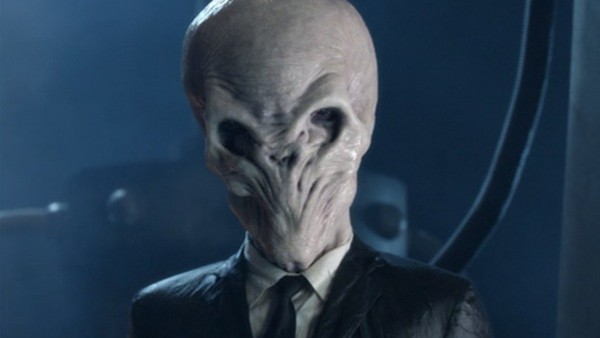
The Silence were first introduced in The Impossible Astronaut, the season opener for Matt Smith's second outing as the Doctor. Tasters of their presence within the season arch had been dropped in from the beginning, with the infamous line "Silence Will Fall" being a recurring theme that never came to fruition until the second season.
Inspired by Edward Munch's 1893 expressionist painting The Scream, the Silence were humanoid aliens dressed like Men in Black agents, that had the unique ability to make someone forget them entirely the moment they looked away. Using this ability, the Silence had infiltrated human society throughout history, and through pervasive influence had steered humanity in the direction that best suited them - that was until the Doctor stopped them of course.
Both menacing in appearance and practice, the Silence became the primary seasonal villain with the single goal of ending the Doctor. Their true origins were later revealed in Matt Smith's final episode, The Time of the Doctor where it was detailed that The Silence were originally genetically-designed priests; members of the Papal Mainframe who using their ability, were able to take confessions from people who would immediately forget about them.
By the end of Matt Smith's run as the Doctor, the story of the Silence had come full circle with no more story to tell. If the Silence were to be brought back as villains, their true origins would impact on any nefarious plans that they had in store for him. Maybe they could bring one back for the Doctor's confession. You know, for the next time they die.
3. The Cybermen

Cybernetically augmented humanoids, stripped of all emotion and hell-bent on converting (or upgrading) all of humanity as part of the next stage of their evolution. The Cybermen have been a classic Who-villain since their first appearance back in 1966's The Tenth Planet. Since the 2005 reboot, the Cybermen have been back multiple times in different guises and have always given the Doctor a run for their money.
Under Russell T Davies, the Cybermen were brought back in 2006 in the two-part story 'Rise of the Cybermen/The Age of Steel', and they didn't half make an impression. Set in a dystopian backdrop of a parallel universe, the Cybermen start rounding up humans and taking them to conversion centres, where their victims are seemingly sliced up and stuffed into robotic shells that are impervious to human weaponry, and can’t be negotiated with.
But as time has gone on, the writers and showrunners have tried to find new and interesting ways of developing the Cybermen further with questionable results. The turning point was in Series 7's Nightmare in Silver, where the Cybermen were given a new makeover and ‘additional’ abilities, including some kind of technology that slowed down time, thereby allowing them to move at great speed, which started to undermine the unstoppable, bulletproof tank-like nature of these villains.
They then came back with a new look in Series 8’s Dark Water and Death in Heaven, a new look in World Enough and Time and The Doctor Falls (Series 10) and then again in Ascension of the Cybermen and The Timeless Children (Series 12).
With the Cybermen normally being such a strong villain to fall back on (should the writers run out of ideas), it feels like they have been reinvented (or tried to be reinvented) one too many times, and with the exception of the Lone Cyberman, none of them have really stuck the landing-with the Cyber-Time Lords in the most recent season finale (The Timeless Children) being the final straw. It is hard to think of a new way that will bring the Cybermen back to their full glory, which is why they should be left alone for the foreseeable future.
2. Davros

Without a doubt, Davros is one of the greatest Doctor Who villains that has ever graced the show. Creator of the Dalek race, Davros was originally created for the 1975 serial Genesis of the Daleks, and since his first appearance, has featured across the Whovian canon and played by four actors. His return in 2008 to face off against David Tennant's Doctor was superbly brought to life by Julian Bleach, with equal portions of maniacal laughter and cold, calculating dialogue. The only reason that Davros features in this list at all is that his portrayal and story told across Series 9's opening two-parter was arguably the perfect send off for this iconic villain.
Told across The Magician's Apprentice and The Witch's Familiar in 2015, the Twelfth Doctor (played by Peter Capaldi) is lured back to Skaro by a dying Davros, who in the opening scene is revealed to have been a little boy who the Doctor abandoned on a battlefield after learning who he would grow up to be. This supposedly set off the chain of events that would lead to the Davros becoming the villain we all know him to be, and the eventual creation of the Dalek race. Both Bleach and Capaldi have some very endearing dialogue that demonstrates the shared respect that they have for one another, despite being mortal enemies, and while it soon becomes apparent that Davros still has a nefarious scheme on his mind, the two-parter ends with the Doctor returning to that same battlefield and saving a young Davros.
The boy asks which side he fights for, and the Doctor replies it does not matter as long there is mercy.
There is nothing to suggest that by saving young Davros that anything changed in the timeline (wibbly wobbly timey wimey stuff), particularly as we have seen the Daleks return to battle Jodie Whitaker's Thirteenth Doctor, but by the end of the two-parter, it felt like a farewell to the old villain in the sense that there were no more stories to tell. Of course, there are always more stories to tell, but it would wiser to let Davros rest after such a long and successful run.
1. The Master

The Doctor has had many enemies over the years, but the Master towers above them all. The renegade Time Lord and lover of chaos has served as both the Doctor’s friend and enemy across their many portrayals, and has been played by an impressive twelve actors since their first appearance in the 1971 episode, Terror of the Autons. They are the Moriarty to The Doctor's Sherlock Holmes, but similar to Moriarty in BBC’s Sherlock, they need to know when to let go, because like Davros, the Master (more specifically the Missy incarnation) has already had the perfect send-off.
The Series 10 two-part finale titled World Enough and Time and The Doctor Falls sees the return of not only the Mondasian Cybermen, but also the 'surprise' return of John Simm’s incarnation of The Master, who's last known appearance was in Series 4’s The End of Time. It was a welcome return, and one that was doubly surprising as Michelle Gomez’s Missy was also there. Two Masters in the same place could only spell more trouble.
But the series had already had an arc that was leading to some sort of redemption for Missy. Capaldi and Gomez had wonderful chemistry in their episodes, arguably the most playful and emotional of the pairings that we have seen before them, and this cultivated in an ending that saw Missy stab her previous incarnation, who in return shot her in the back. Missy was left on the doomed planet with no signs of regeneration, while Simm’s incarnation escapes.
It was then a great surprise that three years later, in the Series 12 episode, Spyfall, The Master was once again back, this time played by Sacha Dhawan to face Jodie Whittaker’s Doctor. However, The Master's inclusion on this list is not a bashing on Dhawan’s performance. Quite the opposite in fact.
We do not know if his incarnation pre-dates or comes after Gomez, but after seeing her redemption at the end of Series 10, his return as a villain felt somewhat undermined. We are of course talking about a show that deals with time travel, and the notion that a previous version of the Master could turn up is not implausible. But in the same way that Chris Chibnall had Gallifrey destroyed, right after Moffat brought it back, Chibnall has brought back the Master right after Moffat gave her a fitting ending.
Like the Cybermen, it feels like the character is becoming over-used, and like Davros, already had a fitting end, and it’s time that the showrunners look to other notorious villains from the Doctor’s past, or create new ones altogether.
Watch Next
Doctor Who Quiz: Which Villains Do You Know?
