10 Iconic Alien Planets In Classic Doctor Who
The most memorable, exciting and terrifying holiday destinations in the galaxy.

The Doctor has been travelling in the TARDIS on our screens for nearly sixty years, but some of the weird and wonderful worlds they have explored in that time may be completely alien to you.
Originating in the classic 1963-1989 TV Series, some of these colourful alien planets deserve further exploration, and we think these intergalactic hotspots are some of the coolest, most influential, most dangerous, and most memorable in the Whoniverse.
From deadly, war-torn jungles to radioactive wastelands, quarry-like mining colonies to sinister circuses, Doctor Who's unique production design has captured the imagination of audiences everywhere, leaving us with these timeless marvels of sci-fi ingenuity.
Read on and take a journey with us through time and space to visit Ten Iconic Alien Planets that the TARDIS materialised on in the classic series, and discover the menaces the Doctor faced there...
10. Mechanus

During the events of 1965's The Chase, the First Doctor and his companions found themselves on the run from both the Daleks and the deadly occupants of this colony planet gone wrong - the robotic Mechonoids.
Originally a dense jungle planet, Mechanus was to be populated by Earth colonists. Their service droids, the Mechonoids, had been sent ahead by humanity to construct a city, but, instead, they revolted and claimed the planet and the rare metal deposits under it for themselves.
Mechanus' robotic uprising caused significant and potentially lethal repercussions to the Doctor and friends, who were soon imprisoned whilst on the run from the Daleks - not too far behind. Before long, the jungle and the raised city, with its gangways, space-age metal and intricate architecture, were destroyed in an epic battle between the Mechonoids and the invading Daleks
We'd love to see in NuWho if the Mechonoids are still battling the Daleks, and what happened to their impressive planet.
Intergalactic Travel Advice: avoid unless you like a barbecue and automated service.
9. Segonax

Arriving on Segonax, the Seventh Doctor and Ace visited 'The Greatest Show in the Galaxy', also known as the Psychic Circus - an intergalactic travelling show.
With their Big Top pitched in a beautiful, sandy desert under the rings of another planet in the deep blue sky, the Psychic Circus had picked a stunning backdrop for their tourist trap.
However, the colours and the lights were just a front as this was a literal tourist trap. The Circus was under the control of sinister clowns, malfunctioning robots, and the ancient Gods of Ragnarok who were forcing audience members to perform for them in a deadly show.
The Seventh Doctor destroyed the Big Top and scattered the Circus, leaving this arid world back in the hands of the native Segonaxians.
Intergalactic Travel Advice: avoid if you don't have a party trick.
8. Terra Alpha
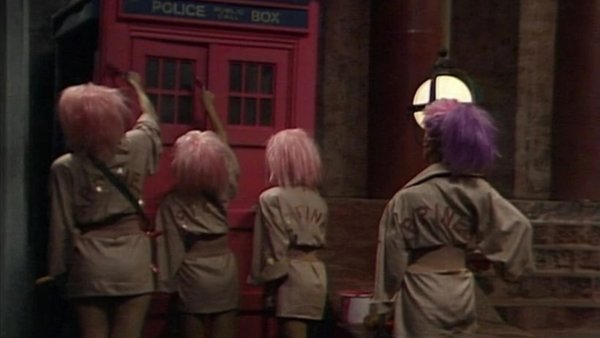
1988's The Happiness Patrol saw the Seventh Doctor and Ace arrive on a charming human colony planet where if you're unhappy, you die.
A dystopian nightmare painted pink - this gaudy, totalitarian 24th Century colony had Earth-styled streets, factories, muzak, tourist zones and entertainment plazas. However, it was all a facade, disguising the sinister underbelly of this Orwellian prison.
Even the original natives, branded as 'The Pipe People', had been cast underground to the sewer pipes because they weren't aesthetically pleasing enough for Helen A - Terra Alpha's iron-fisted ruler, who was modelled after Margaret Thatcher.
This off-brand Britain is eerie to watch, and eerier to step foot in - especially with trained snipers at the windows above the streets. The Doctor, however, managed to thwart Helen A's plans following a go-cart chase on the pristine streets and a battle in the laboratory of the Kandyman - a bizarre and deeply sinister prison warden who looks like Bertie Bassett.
Intergalactic Travel Advice: don't forget to smile.
7. Vortis

Vortis, most commonly referred to as 'The Web Planet', originated in a 1965 serial where the First Doctor and his companions arrived in the middle of a feud between the planet's original occupants the Menoptera - a race of butterfly-like people - and the Animus, with their ant-like Zarbi.
Both species were fighting for survival on the desolate plains of the planet, desperate for a cave, vegetation, or a crater they could call home.
This instantly recognisable planet comes from some of the Doctor's earliest adventures travelling in time and space, and even in black and white, its strange foliage, craggy outcrops and deadly acid pools stand out. It also makes Vortis entirely uninhabitable by humans.
With its grey atmosphere, low oxygen, and quaint residents, this ingenious example of an alien planet is iconic, quirky, and as beautiful as it is deadly. It would feel at home in NuWho, with the Doctor and her friends exploring its curious and updated landscapes.
Intergalactic Travel Advice: mosquito nets may be required.
6. Peladon

First appearing in 1972's The Curse of Peladon and later in 1974's The Monster of Peladon, this dark, stormy, and mountainous world was the stage for the Third Doctor's meetings with the Peledonians, the Galactic Federation, and the Martian Ice Warriors.
The Peledonians - an ancient, noble race of scholars and miners with unusual hair, lived within a fortified Citadel built into the side of the vast Mount Megeshra. Here, the Doctor navigated his way through treason, treachery, and labyrinth-like caverns dense enough to conceal the terrifying monster, Aggedor, as well as a grand religious temple, and a fighting arena.
Beyond the walls, even the TARDIS was at risk - knocked from the granite cliffside by the powerful storms upon its first arrival.
Intergalactic Travel Advice: bring a raincoat and welly boots.
5. Metebelis III

Having heard about Metebelis III's beauty, the Third Doctor had attempted several times to travel to the planet to see its green forests, deserts, mountain ranges, and its ghostly blue tinge from its orbiting moon.
However, it was upon contact with a race of Giant Spiders who populated the planet and some deadly, radioactive material which triggered his regeneration in 1974's Planet of the Spiders.
As well as the spiders, 1973's The Green Death revealed that Metebelis III was home to strange bird-like creatures, giant snakes, and unknown primitives. Also native to the blue planet were Metebelis crystals, possessing latent psychic abilities and capable of breaking mind control. These popped up again in NuWho episode Hide, but were originally retrieved by the Third Doctor on one of his quests to the planet.
An important part of Doctor Who mythos and the Third Doctor's tenure, Metebelis III should make a return in NuWho, with this amazing biosphere and its residents receiving a thorough investigation.
Intergalactic Travel Advice: big day for a fan of spiders.
4. Androzani Minor

The main location of 1984's The Caves of Androzani, this notable planet's oceans dried up billions of years ago, leaving in its place a humid, desert world caked in boiling mud and ridden with caverns and tunnels. On the steep, dusty surface, hot springs and geysers would erupt, causing dangerous mud-spewing explosions and landslides.
By the 30th Century, the inhospitable plains were being colonised by humans mining the caves for the rare but poisonous spectrox. It was in these tunnels that the Fifth Doctor and Peri encountered terrorist Sharaz Jek and a horde of adversaries including a Magma Beast and murderous androids.
After defeating Jek and succumbing to spectrox poisoning, the Doctor carried Peri back across the mud plains as they exploded behind them. Unable to cure himself, the Doctor regenerated in the TARDIS on the arid Androzani.
Another location memorable for being the setting of a Doctor's last adventure, Androzani has also been referenced in NuWho by the Great Intelligence when he turned the Doctor's victories into defeats.
Intergalactic Travel Advice: a bit muddy.
3. Telos

Hosting the creepy 'Tomb of the Cybermen' - a suspended animation chamber stocked with a legion of the sleeping metal warriors - Telos plays an important part in the Cybermen's history.
First appearing in 1967, the Second Doctor helped freeze the Cybermen back in their tombs on this icy, desolate world archaeologists had unearthed on an expedition. 1985's Attack of the Cybermen showed an earlier version of Telos - thawed out and yet another dry, quarry-like world. Here, it was populated by invading Cybermen and the sparkly natives, the Telosion Cryons.
Despite not being the Cybermen's original homeworld of Mondas, Telos acts as their home throughout the majority of the Classic Who series - their base of operations, their resting place, and their occupied world.
Besides from its distinct place in the Whoniverse, Telos also serves as the setting for one of Doctor Who's creepiest and most iconic moments - when the Cybermen awake from their refrigeration...
Intergalactic Travel Advice: wrap up, and watch out for Cybermats.
2. Gallifrey

The infamous homeworld of the Doctor and his people, the Time Lords, was first depicted in 1969's The War Games but more famously explored in The Deadly Assassin and subsequent stories during the Fourth and Fifth Doctor's tenure.
In the constellation of Kasterborous, Gallifrey was located two-hundred and fifty million light-years away' from Earth, and much of what we see takes place inside an enclosed Time Lord Citadel. Inside the Citadel - grand, sweeping council chambers, the vast panopticon, and the mysterious Matrix where the Doctor was forced to battle Time Lord visions at the mercy of the Master.
As the series progressed, we were treated to more of the Doctor's regal homeworld, with its decadent architecture, walkways, and a rich history including the invention of the black hole, time travel, and TARDISes. The Invasion of Time revealed that beyond the Citadel, dusty wastelands referred to as 'Outer Gallifrey' lay populated by tribal Gallifreyans who were not Time Lords.
Another iconic addition to the planet arose in 1983's The Five Doctors, where four incarnations of the Doctor, companions, and enemies, were drawn into an ancient, defunct arena known as the Death Zone, complete with a Dark Tower and perilous moors.
The location has been fleshed out in NuWho, but the Classic Series established its place in Doctor Who history as the iconic home of the Doctor's people.
Intergalactic Travel Advice: steal a TARDIS and run away.
1. Skaro

Skaro - the homeworld of the most iconic Doctor Who villains, the Daleks, was the first alien planet we saw the Doctor travel to back in 1963's The Dead Planet. Therefore, we think it is the most iconic in the show's history.
The futuristic Dalek City we saw in 1963's serial could be found on the outskirts of a radioactive jungle and shone like an unassuming, world of the future from 60s sci-fi. Inside its pristine metal walls and behind its sliding doors were corridors generating static electricity for the Daleks to travel along - and ultimately cause their downfall.
The Daleks weren't alone on Skaro though, as they were at war with rival faction the Thals. This war had raged on for centuries, and in 1975's Genesis of the Daleks, we see its origin - and the origin of the Daleks.
The Skaro we see at the beginning of the Daleks is more akin to World War II Nazi-Germany, with trenches, bunkers, and a grimy, war-torn surface. In secret laboratories and underground war rooms, evil Kaled scientist Davros created his new weapon to survive the battle with the Thals and the radioactive landscape - the Mark III Travel Machine, also known as the Dalek.
Although appearing briefly in NuWho, nothing can compare to the original classic sci-fi haven of the Dalek City from the 1963 serial or its warlike counterpart seen centuries earlier in Genesis of the Daleks.
Intergalactic Travel Advice: remember your Giger counter.
Watch Next
Doctor Who Quiz: Which Villains Do You Know?
