10 Most Satisfying Twists In Star Trek
Star Trek has managed to stick the landing more than once.

Twists in the narrative are an often vital part of storytelling. Too often, audiences complain, and many times rightly so, that the way a story plays out is far too predictable. Introducing an unexpected twist can elevate the tale beyond its base level. However, this can be a tricky trait to introduce.
Some filmmakers are famous for their twist endings. M. Night Shyamalan may be the best known of the modern filmmakers for this, yet that is not to say that his films are often received well. A twist for twist's sake is rarely something positive as a story unfolds.
Recent developments in Star Trek have caused an outpouring of dissatisfaction for twists that have been introduced to the narrative. Right or wrong, the main argument seems to be that twists have either been underwhelming or simply nonsensical. Whether these cries have merit or not, it invites an analysis of the franchise as a whole.
Star Trek has never been afraid to throw a curveball or twist into the story when it is the right thing for the plot. From the days of Kirk right up until the modern age of Burnham and Mariner, here are some of the best twists in Star Trek's history.
10. David, I Am Your Father

James T. Kirk had always been known as a bit of a ladies man. Though there were times in Star Trek that he certainly came across as immature in his approach to women, he rarely seemed like the type of man who would actively abandon one who he knew needed him. Therefore, the introduction of his relationship with Carol Marcus was handled beautifully.
Star Trek II: The Wrath of Khan introduces her first as a highly competant scientific leader, before ever introducing their shared history. McCoy seems to understand that there is something more, as he watches her breakdown of the Genesis project with Kirk and Spock. However, something that only Kirk knows is how deep that connection goes.
When the crew of the Enterprise finally find the personnel from Regula 1, they are attacked at knife point by David, a young man who is clearly distraught. Though Kirk manages to overpower him and demands to know where Dr. Marcus is, the young man beligerantly replies that he is Dr. Marcus.
The penny drops, for both Kirk and the audience, that this Dr. Marcus - David Marcus - is the son of Starfleet's most famous Admiral. Many other stories have introduced a previously unknown family member late in the game, yet few manage it in such a natural manner as this twist. David Marcus, while his appearances in Star Trek were brief, would go on to become a major driving factor in Kirk's approach to his duties going forward.
9. Commander Sela

Denise Crosby left Star Trek: The Next Generation toward the end of its first season, presumably forever. However, the situation had been badly handled and she and the show rekindled a relationship as it went into the third season. She was brought back for the stellar episode Yesterday's Enterprise, reprising the role of Tasha Yar. This episode set things to right, giving the character a far better send off than they had previously received.
Again, this could have been the end of the story for Tasha Yar and Denise Crosby. However, Crosby then approached the writers with another idea. As Yar had been sent into the past, she could in theory return again - in a different form.
The character of Sela was a shock that floored many audience members. She was introduced in pure shadow form in The Mind's Eye, before revealing herself in the closing moments of Redemption, Part 1.
Not only was she a fearsome opponant for the Enterprise, but having Denise Crosby play her own daughter, a daughter fiercely loyal to the Romulan Empire, was a fantastic way of bringing her back to the franchise, while still remaining firmly within the established story parametres.
As far as we know, Sela remains alive in the Star Trek universe and, in Star Trek: Picard and its focus on Romulan storylines, it is more than possible that she could return once more.
8. Shall We Die Together?

The Star Trek: The Next Generation episode The Defector focuses on Admiral Jarok's race to prevent a full-scale war between the Federation and the Romulan Empire. Unfortunately, his patriotism was used against him by the Romulan Senate, leaving the Enterprise in a very sticky situation, having entered the Neutral Zone at his urging.
To enter the zone is to invite conflict with either power, so when two Romulan Warbirds de-cloak directly in front of the Starfleet ship, it frankly doesn't look good for their chances. However, Commander Tomalok did not reckon with Captain Picard.
Throughout the episode, Picard had quietly spoken with Worf, just enough to suggest to the audience that they knew something that no one else did. This secret becomes apparent when Picard faces off against Tomalok. While the Romulan gloats that the Enterprise will be brought, broken, to the Romulan capital city, Picard calmly tells him that both he and his crew are ready to die in the service of the Federation. Tomalok scoffs, thinking he's called his bluff.
Then, at Picard's order, Worf signals for the three cloaked Klingon Birds of Prey to make themselves known to the Romulans. Though it is a tense standoff, Tomalok accepts his defeat and slinks away, leaving a relieved Picard and a cheering audience behind.
7. Mariner Really Does Care

In Star Trek: Lower Decks, Brad Boimler is the consumate professional, except for the fact that he is not yet very good at his job. As an Ensign, he is still very much learning his trade. So, when he is assigned to escort a Klingon dignatory to an embassy, he takes on the assignment with pride. However, he is less than thrilled to discover that Beckett Mariner will be joining him.
The mission is one disaster after another, beginning with them losing K'orin and the shuttle, thanks to several bottles of blood wine, and culminating in Boimler almost having eggs laid in his throat. He becomes increasingly upset that in almost every situation, Mariner seems to be the better of the two at spotting trouble.
That is, until they run into a Ferengi - one ripped straight out of The Next Generation's first season. This Ferengi is as stereotypical a mugger and villain as is possible to find, which Boimler cottons to immediately. Mariner brushes off his worries, about to walk straight into a trap. Boimler stops her, pulls his phaser and reveals the Ferengi to be no good. Boimler finally feels a bit of confidence that he can actually spot trouble sometimes, helping him feel a little better.
Despite her protests to the contrary, Mariner later speaks to the same Ferengi over her PADD. His name is Quimp, and he owed her a favour, so pretended to mug them to give Boimler a shot in the arm. It is a nice little moment, showing that there is a true friendship blossoming between Mariner and Boimler.
6. Computer, End Program

The estate of Sir Arthur Conan Doyle was not massively impressed when Star Trek produced Elementary, Dear Data. That is to say, while they wrote to the show and expressed their enjoyment of the episode itself, they had to remind the producers that Sherlock Holmes was not in the public domain, and was not free for use. Whoops.
Though it took another four years or so to wrangle out the details, Professor James Moriarty, as played by Daniel Day, returned once again in The Next Generation's sixth season episode, Ship In A Bottle. This time, the sentient hologram was accidentally activated by Reginald Barclay - the once admitted holo-addict.
What follows is an episode akin to a game of cat-and-mouse, where Moriarty once again holds the ship hostage as he seeks for his own happy ending. Picard, Barclay and Data do what they can to appease him, but it is clear that the genius program has the upper hand. He is able to leave the holodeck by willing it to happen, something that should have been impossible! It is only when is given a shuttle and guaranteed safe passage, with his companion the Countess Regina Bartholomew, that he releases control of the Enterprise again.
At which point it is all revealed to have been a clever simulation, created by the Enterprise crew as a ruse. It is a wonderful twist ending, though the most satisfying moment of the episode comes from the final check, where Barclay looks up and tentatively says 'Computer, End Program', with nothing happening. A beautifully cathartic ending.
5. The Name's Riker, Thomas Riker

When Commander Riker arrives on Deep Space Nine and promptly steals the USS Defient, with Major Kira on board, it left a few members of the audience scratching their heads. This surely seemed an odd character arc for the Enterprise's Number One! Yet when he stripped off those stuck on sideburns, eyebrows raised even further.
This was not William T. Riker. This was Thomas Riker, the transporter clone created in The Next Generation's sixth season episode, Second Chances.
This entire story was a payoff for that episode. And it was absolutely brilliant. Thomas was introduced as an officer who had been created accidentally, yet still retained all of the memories of his counterpart. Therefore, he had every right to believe that Starfleet had abandoned him. His discovery that he had not been abandoned, they merely never knew of his existence, was hardly the salve it might have been.
He wanted to be the hero of his own story again and what better way than by joining the Maquis? He was able to gain entry to the Defiant with his charm and familiar face, but he lacked the knowledge to truly follow through on his plans - something that Major Kira spotted almost immediately.
Both the twist in the reveal of his identity and his eventual surrender were excellent moments in the episode. It is possible that he is still out there somewhere, who knows!
4. Voyager 6
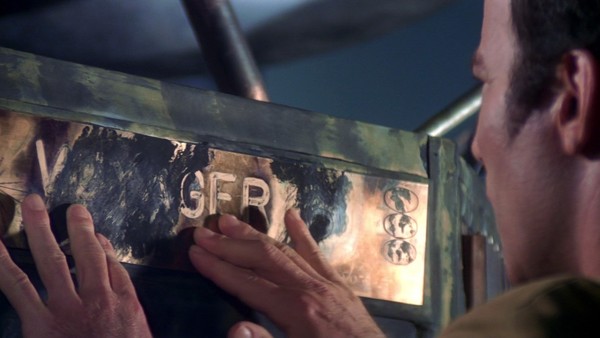
Star Trek: The Motion Picture will forever remain one of our favourite entries into the Trek canon, even if it isn't the most exciting film in the bunch. It is, arguably, the most science-fiction heavy Star Trek movie of them all, with its themes of exploration, extra-terrestrial intelligence and the search for something greater than what we see before us.
The reveal of V'Ger's origin - that of being one of the Voyager space probes launched from Earth - is a perfect twist on the cyclical story. The Motion Picture doesn't rely on effects-heavy space battles to achieve its end, but rather on the calculations of Spock, the childlike innocence of V'Ger (in the form of Lt. Ilia) and the very human insistence on experience of Decker.
While The Motion Picture may be best remembered for the absolutely gorgeous visuals that it offers to the audience, the importance of the twist should not be forgotten. Humanity's curiosity almost becomes its own doom, with its reach far exceeding its grasp. However, the movie also offers the resolution that we are ultimately capable of anything, as long as we are open to change.
We may be on a lonely hill here, but we are firmly camped in and ready for the long haul!
3. You're A God, Ben
The spiritualism that exists in Star Trek: Deep Space Nine is one of the key factors to its success, though it is not to everyone's tastes. Gene Roddenberry had envisaged a future without religion, so having Captain Sisko be so heavily involved in it may have been antithetical to what he had wanted for Star Trek. However, by the seventh season of the show, Sisko's close relationship with the Prophets is explained.
He was chosen by them to be their Emissary. To that end, they arranged his birth. One of them took control of Sarah Sisko and arranged for her to meet Joseph, staying long enough to ensure Ben's birth.
Sometimes, this kind of reveal can be risky. It is in a way similar to introducing a new member of the family very far down the line. However, the writers' took special care to ensure that the reveal was backed up through the entire series, so much so that when Sarah Sisko was introduced, she felt like the natural next step in Ben's story.
His final fate (so far) to arrive in the Celestial Temple again feels like the right place for his story to pause. It is hopefully not the entire end, as Sisko has two children and a wife out there, but with the timeless nature of the Prophets, who is to say when or where he could turn up?
2. The Shields Do Work

In Star Trek: The Next Generation's episode Suspicians, Dr. Crusher quits Starfleet, owing to the death of two scientists as part of metaphasic shield testing. The episode opens with her relating the story of what happened to Guinan (and the audience) in the form of a flashback. As the experiments continued, the Ferengi Dr. Ragar had developed this shielding which would allow a ship to enter the corona of a star. However, he was murdered.
The experiment presses on regardless, with Dr. Jo Brill taking a shuttle equipped with the shields into the star. The shields fail him and Dr. Crusher is forced to watch him die on the viewscreen.
And that's that. She tells Guinan she's resigned and is awaiting an inquiry. Guinan, true to character, is having none of it and encourages Beverly to test if something really did go wrong. So, bucked by this, Crusher takes the shuttle back and discovers that there is nothing wrong with the shields at all. In fact, a very much alive Dr. Jo Brill attempts to murder her inside the shuttle, but she is able to fight him off.
She returns to the ship, vindicated and exonerated, feeling triumph at her win.
1. I'm Not Really Here

What does Fear fear? In Star Trek: Voyager's second season episode The Thaw, the ship encounters stasis pods, in which there are people bound by a shared hallucination. The hallucination manifests a terrifying version of the circus, complete with a demonic Clown leading the troupe. Harry Kim and B'Elanna Torres are trapped inside, leading the crew of Voyager in a struggle to save them.
In the end, the only thing that the Clown will accept is a trade and so Captain Janeway volunteers herself to take their place. At first, he is delighted, ready to torment her for years to come. But then something is wrong.
In one of the best twists in all of Star Trek: Voyager, Janeway turns the tables on him: she was never really there. She is a holographic representation of herself and therefore free to leave at any time. Without souls to feed on, the Clown begins to fade away into nothing. He finally admits his own fear, which Janeway acknowledges, watching him dissolve.
It is both chilling and thrilling at the same moment, truly displaying the master tactician and unflinching captain that Janeway really was.
Watch Next
The ULTIMATE Star Trek 'Who Said It' Quiz
